
Chef Juliette
John Dory (St. Pierre)
John Dory has the delicacy of sole and the firmness of turbot. A light flouring, a quick butter sauté, and nut-brown beurre noisette show exactly why looks never mattered.
A cooking platform built around craft, culture, and the stories behind what we eat.
Created by Chef Juliette
Based on No. 1533, Poulet Sauté Archiduc, from Le Guide Culinaire (1907) by Auguste Escoffier
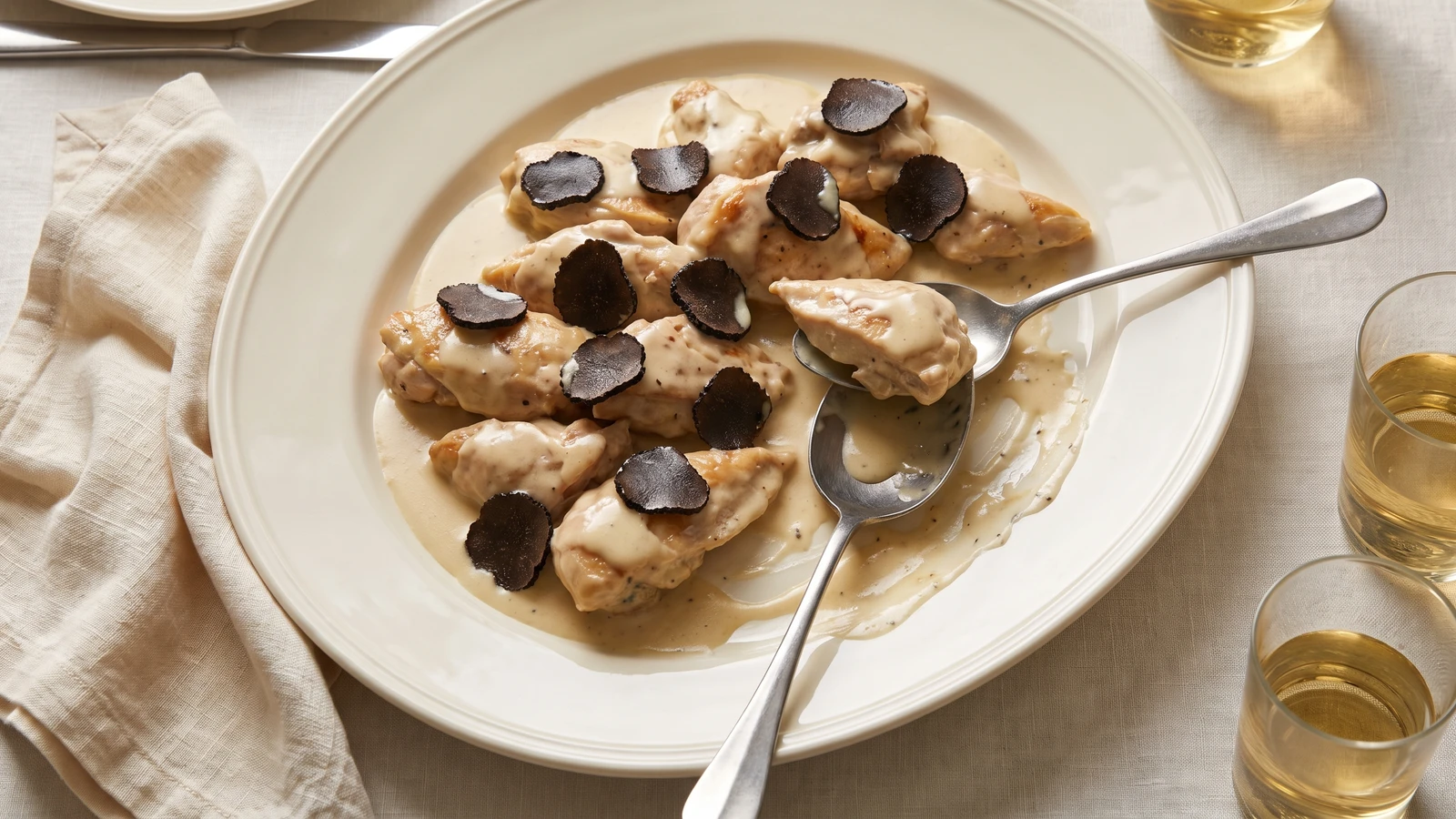
A lesson in restraint: chicken gently stiffened in butter without browning, then cloaked in an ivory onion, brandy, cream, and velouté sauce sharpened with lemon, Madeira, and black truffle.
Poulet Sauté Archiduc (pale-sautéed chicken with brandy, cream, Madeira, and truffle) teaches restraint over reflex. The one true thing is this: colour is the enemy. You are not building a brown fond. You are using faire raidir, stiffening the chicken gently in butter until its surface firms and turns opaque, while the pan stays pale enough to protect an ivory sauce.
The entry was written for a kitchen with a saucier on staff, chicken velouté and stock never far from the fire, a tammy for rubbing sauces smooth, and a hot cupboard to hold the bird. At home, you need prepared velouté, a fine-mesh strainer, and a very low oven. No salamander belongs here, because this is neither a browned nor a gratinéed finish. The fowl and sauce are scaled to four servings while the book's proportions remain intact: equal measures of cream and velouté, the full butter finish, lemon, Madeira, and ten slices of truffle. One cook, one stove, one evening.
The brigade's separate sauce station and long hot holding are scaffolding, so they go. Cooking the onion in butter without colour, reducing the brandy, passing the sauce, and mounting it with butter off the heat are the dish, so they stay. Watch the pan during the first ten minutes. The sauce can be rescued, but colour on the chicken cannot. Keep the pan pale. Everything depends on it.
Poulet Sauté Archiduc belongs to the cosmopolitan French grand-kitchen repertoire centered on the formal dining rooms of Paris, where aristocratic titles often named a particular garnish or sauce treatment rather than a regional birthplace. Archiduc does not make this an Austrian country dish; here the name denotes a pale French sauté enriched with onion, brandy, cream, velouté, Madeira, butter, lemon, and black truffle. The preparation traveled readily to bourgeois tables because its distinction lies in disciplined sauce work and a few truffle slices, not in monumental service.
Quantity
1 chicken (about 3½ lb / 1.6 kg)
cut into 8 serving pieces
Quantity
1½ teaspoons (7.5 ml / 9 g)
divided
Quantity
¼ teaspoon (1.25 ml / 0.5 g)
divided
Quantity
8 tablespoons (120 ml / 113 g)
divided, with 1 tablespoon reserved in case the pan must be reset
Quantity
¾ cup (180 ml / 115 g)
finely sliced
Quantity
3 tablespoons (45 ml / 43 g)
Quantity
⅓ cup plus 1 tablespoon (95 ml / 95 g)
Quantity
⅓ cup plus 1 tablespoon (95 ml / 100 g)
Quantity
¼ lemon, about 1 tablespoon (15 ml / 15 g)
juiced
Quantity
1 tablespoon (15 ml / 15 g)
Quantity
10 thin slices (about 15 g)
drained if preserved
Quantity
1 tablespoon (15 ml / 15 g)
| Ingredient | Quantity |
|---|---|
| whole chickencut into 8 serving pieces | 1 chicken (about 3½ lb / 1.6 kg) |
| fine saltdivided | 1½ teaspoons (7.5 ml / 9 g) |
| ground white pepperdivided | ¼ teaspoon (1.25 ml / 0.5 g) |
| unsalted butterdivided, with 1 tablespoon reserved in case the pan must be reset | 8 tablespoons (120 ml / 113 g) |
| yellow onionfinely sliced | ¾ cup (180 ml / 115 g) |
| brandy, preferably Cognac | 3 tablespoons (45 ml / 43 g) |
| heavy cream | ⅓ cup plus 1 tablespoon (95 ml / 95 g) |
| prepared chicken velouté | ⅓ cup plus 1 tablespoon (95 ml / 100 g) |
| medium lemonjuiced | ¼ lemon, about 1 tablespoon (15 ml / 15 g) |
| medium-dry Madeira | 1 tablespoon (15 ml / 15 g) |
| black truffledrained if preserved | 10 thin slices (about 15 g) |
| chilled heavy cream for rescuing the sauce (optional) | 1 tablespoon (15 ml / 15 g) |
Pat the chicken completely dry, then season it with 1 teaspoon of the salt and half the white pepper. Let it stand for 20 minutes while you measure everything else. Heat the oven to 200°F (95°C) and place an oval serving platter inside to warm. Have the cream and prepared chicken velouté ready beside the stove, because the sauce moves quickly once the chicken leaves the pan.
Melt 2 tablespoons (30 ml / 28 g) of the butter in a wide, heavy sauté pan over low heat. Add the onion and a pinch of the remaining salt, cover, and cook for 10 to 12 minutes, stirring often, until thoroughly soft and translucent but still ivory. This is suer, sweating without browning. If an onion edge turns gold, remove that piece; if the pan floor colours, transfer the onions to a bowl and wipe the pan clean before proceeding. A brown glaze here will travel straight into the sauce.
Lift the onions into a bowl. Melt another 2 tablespoons (30 ml / 28 g) of butter in the same clean pan over medium-low heat. Add the chicken in a single layer, working in two batches if necessary, and faire raidir, stiffen it without browning, for 6 to 8 minutes. Turn the pieces every minute or two; the surfaces should become firm, pale, and opaque, with no golden crust. If the butter browns, remove the chicken immediately, wipe out the pan, and restart with the reserved tablespoon of butter. Ça se rattrape: the chicken may keep a small blond mark, but the sauce will remain ivory.
Return all the chicken and the softened onions to the pan. Cover and cook over the lowest heat that maintains a quiet sizzle, turning the pieces once, until cooked through, about 15 to 20 minutes. Remove the breast pieces when they reach 160°F (71°C), then hold them on the warm platter until carryover heat takes them to 165°F (74°C). Let the legs continue until at least 175°F (79°C), when the meat beside the joint feels tender. Keep the pan pale throughout; if the onions threaten to catch, add 1 tablespoon of water and lower the heat.
Arrange the cooked chicken on the warmed platter, cover loosely with parchment or foil, and return it to the low oven for no longer than 15 minutes. Leave the onions and pale cooking juices in the sauté pan. This short hold replaces the grand kitchen's hot cupboard; a long hold would dry the breast before the sauce reached it.
Pour the brandy over the onions and bring it to a lively simmer over medium heat. Do not flambé it. Scrape up only the pale juices and reduce until scarcely a tablespoon remains and the sharp alcoholic smell has softened, about 2 to 3 minutes. Reduction, not flame, concentrates the brandy without disturbing the sauce's colour.
Stir in the heavy cream and prepared chicken velouté, keeping their equal measures intact. Simmer gently for 3 minutes, stirring until the onions and liquids become one creamy mixture. Set a fine-mesh strainer over a clean saucepan and press the sauce through firmly with a ladle or flexible spatula, rubbing the onions until only dry fibres remain. The strainer is the honest home equivalent of the tammy, and this passing is worth keeping because it gives Archiduc its smooth, formal finish.
Tip any pale juices collected on the chicken platter into the strained sauce. Bring it to a gentle simmer and reduce until it has a stiff nappant consistency, coating a spoon generously and leaving a clean track when you draw a finger through it. Remove the saucepan from the heat. Montez au beurre, whisk in 3 tablespoons (45 ml / 43 g) of cold butter one tablespoon at a time, then whisk in the lemon juice and Madeira. Do not boil after the butter goes in. If yellow beads appear at the edge, put the optional chilled cream in a clean warm bowl and whisk in the broken sauce one spoonful at a time. Ça se rattrape.
Taste the sauce and correct it with the remaining salt and white pepper. It should taste first of chicken and cream, then brandy and Madeira, with lemon sharpening the finish rather than announcing itself. Pour the sauce generously over the chicken, letting it pool around the pieces, and arrange exactly 10 thin truffle slices across the top. Serve at once. À table!
1 serving (about 270g)
Culinary guides, cultural storytelling, and the editorial depth that makes cooking meaningful.
Discover Culinary ExplorerChef Juliette
John Dory has the delicacy of sole and the firmness of turbot. A light flouring, a quick butter sauté, and nut-brown beurre noisette show exactly why looks never mattered.

Chef Juliette
Fresh haddock proves its delicacy in the meunière pan: a fine flour crust, moist pearly flakes, and beurre noisette sharpened with lemon and parsley, ready from one skillet in half an hour.

Chef Juliette
Éperlans à l’Anglaise turns small fish into a lesson in disciplined coating: boned smelts under a close, crisp crumb, pan-fried in clarified butter and finished with bright, half-melted maître d’hôtel butter.

Chef Juliette
Tiny smelts, shallot, mushrooms, white wine, gratin sauce, and fine bread raspings meet a fierce oven, where the fish must turn tender in the same breath the buttered crust bronzes.