
Chef Juliette
John Dory (St. Pierre)
John Dory has the delicacy of sole and the firmness of turbot. A light flouring, a quick butter sauté, and nut-brown beurre noisette show exactly why looks never mattered.
A cooking platform built around craft, culture, and the stories behind what we eat.
Created by Chef Juliette
Based on No. 1531, Chapon fin aux Perles du Périgord, from Le Guide Culinaire (1907) by Auguste Escoffier
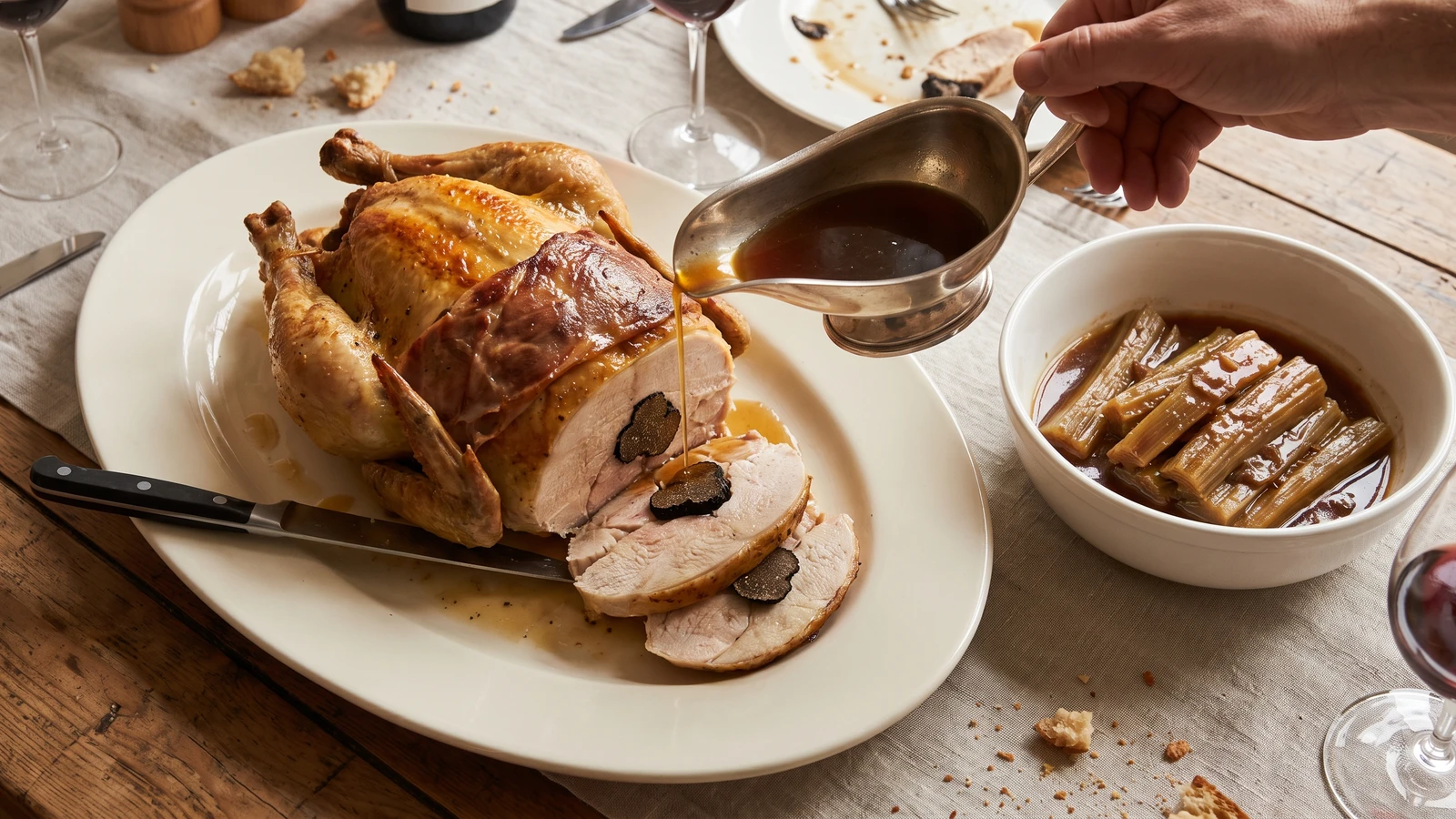
A black-truffle capon held inside a tight veal mantle, braised with Cognac until succulent and served with gleaming cooking liquor and cardoons ready to catch every spoonful.
Chapon fin aux Perles du Périgord (fine capon with Périgord black truffles) teaches one severe, useful principle: perfume must be contained before it can become flavor. The truffles go into the cavity, then paper-thin noix de veau closes around the capon as an edible mantle. Wrap it tightly. If the seams gape, the most precious aroma in the pot will season the kitchen instead of the bird.
The original entry assumed a large festive capon, a butcher able to shave veal to a veil, a stockpot never off the fire, and a saucier free to reduce the braising liquor while another pair of hands dealt with the cardoons. A salamander has no work in this dish, so your home equivalent is simpler: a small capon, veal sliced by your butcher, good unsalted stock reduced in the same cocotte, and cooked cardoons warmed in the finished jus. I cut the brigade quantity to four and keep the sequence intact. One cook, one stove, one evening.
The scaffolding can go: no separate braising pan, no second sauce station, no silver timbale, and no live stockpot. The dish stays: true black truffle inside the bird, a complete veal envelope, Fine Champagne Cognac, gentle braising, and the liquor served separately with cardoons au jus. Before you touch the pan, arrange and tie that veil until there is no open seam. Everything afterward can be corrected. The wrapping decides whether the Chapon fin keeps its soul.
The perles in this grand-kitchen name are the black truffles of Périgord in southwest France, gathered around oak roots and prized because their perfume penetrates fat and poultry as they cook. The construction belongs to the national classical table rather than to a Périgourdin farmhouse: a festive capon receives the region's truffles, a veal mantle holds their aroma, and Cognac supplies the braise. Cardoons beside the bird do not make it Lyonnais; they were a valued winter vegetable across formal French tables, often served simply au jus.
Quantity
1 bird, 4¾ to 5¼ lb (2.15 to 2.4 kg)
giblets removed
Quantity
1 cup small whole (240 ml / 150 g)
brushed clean
Quantity
1¼ lb (570 g), 14 to 16 paper-thin slices
reserve 2 slices for patching
Quantity
1 tablespoon (15 ml / 18 g)
divided
Quantity
1 teaspoon (5 ml / 2 g)
divided
Quantity
8 tablespoons (120 ml / 113 g)
divided
Quantity
⅔ cup (160 ml / 150 g)
Quantity
2½ cups (600 ml / 600 g)
divided
Quantity
4 cups (950 ml / 700 g)
cut into 3-inch (7.5 cm) lengths
| Ingredient | Quantity |
|---|---|
| small capongiblets removed | 1 bird, 4¾ to 5¼ lb (2.15 to 2.4 kg) |
| fresh Périgord black truffles (Tuber melanosporum)brushed clean | 1 cup small whole (240 ml / 150 g) |
| noix de veau, veal cushion or top roundreserve 2 slices for patching | 1¼ lb (570 g), 14 to 16 paper-thin slices |
| fine sea saltdivided | 1 tablespoon (15 ml / 18 g) |
| finely ground white pepperdivided | 1 teaspoon (5 ml / 2 g) |
| unsalted butterdivided | 8 tablespoons (120 ml / 113 g) |
| Fine Champagne Cognac or good VSOP Cognac | ⅔ cup (160 ml / 150 g) |
| unsalted rich brown chicken or veal stockdivided | 2½ cups (600 ml / 600 g) |
| drained cooked cardoon stalks or heartscut into 3-inch (7.5 cm) lengths | 4 cups (950 ml / 700 g) |
Set an oven rack in the lower middle and heat the oven to 325°F (165°C). Dry the capon thoroughly, including the cavity. Season inside and out with about two-thirds of the salt and half the white pepper. Leave the small truffles whole and halve only those larger than a walnut, then place them loosely inside the cavity so air can circulate around them. Close the opening with two wooden skewers and lace them together with butcher's twine. Tuck the wings under and tie the legs close to the body.
Lay all but two veal slices on the work surface in overlapping rows, making a sheet large enough to surround the capon. Set the bird breast-side down in the center, draw the slices around it, then cover the back, breast, thighs, and leg joints with a second overlapping layer wherever needed. Tie loops of twine around the bird at 1½-inch (4 cm) intervals, then run one long tie from neck to tail. No poultry skin should show. If a slice tears, cover the opening with one of the reserved pieces and tie across it. The veal envelope is not decoration. It is the dish.
Melt 3 tablespoons (45 ml / 43 g) butter in a snug oval cocotte over medium heat. Lower in the wrapped capon and brown it patiently on every accessible side, turning with two broad spatulas so the veal stays in place, about 12 to 15 minutes. You want an even butter-gold mantle and a brown fond on the pot floor, not scorched butter. Take the pot off the heat before adding the Cognac. Return it to the burner and simmer for 3 minutes, scraping up the fond, until the raw alcoholic sharpness softens. There is no need to ignite it.
Pour in 2 cups (475 ml / 475 g) stock; it should reach roughly one-third of the way up the capon. Add enough of the remaining stock to reach that level if your cocotte is broad. Lay a round of baking parchment directly over the bird, cover with the lid, and place in the oven. Braise for 1 hour 40 minutes to 2 hours, opening the pot only once after 75 minutes to baste. The liquid should barely tremble. If it boils hard, lower the oven to 300°F (150°C). The capon is ready when the thickest part of the thigh reaches 165°F (74°C) without touching bone. If the mantle splits, lay a reserved veal slice across the opening and pin it with a wooden skewer before replacing the parchment. Ça se rattrape.
Lift the capon onto a warm platter with two broad spatulas and rest it for 25 minutes. Strain the braising liquor into a heatproof jug, wipe out the cocotte, and return the liquor to it. Skim away the surface fat, then simmer until reduced to about 1½ cups (350 ml) and nappant, meaning it lightly coats the back of a spoon. Taste before adding salt because reduction concentrates everything. Reserve ½ cup (120 ml) for the cardoons. Off the heat, montez au beurre, whisk the remaining 2 tablespoons (30 ml / 28 g) cold butter into the sauce a piece at a time. If greasy beads appear, whisk 1 teaspoon cold water in a clean bowl and add the sauce back gradually. Ça se rattrape. Keep the liquor warm without boiling.
While the capon rests, melt the remaining 3 tablespoons (45 ml / 42 g) butter in a wide skillet over medium-low heat. Add the cardoons, the remaining salt and pepper, and warm them gently for 5 minutes without browning. Pour in the reserved ½ cup (120 ml) braising liquor and simmer for 6 to 8 minutes, turning carefully, until the cardoons are hot and the jus clings in a glossy film. Transfer them with their gravy to a warmed deep timbale or serving bowl. The source asks for a timbale of cardoons, not a molded pudding; a deep bowl serves its purpose honestly at home.
Remove every tie and skewer without disturbing the veal mantle. Carve through the mantle into the breast, then separate the legs and slice the thigh meat. Catch any truffles that roll from the cavity and arrange them beside the carved capon. Keep the platter nearly dry, as the original service intends: send the reduced braising liquor to the table in a warmed sauceboat and the cardoons in their separate bowl, allowing each guest to spoon both beside the meat. À table!
1 serving (about 720g)
Culinary guides, cultural storytelling, and the editorial depth that makes cooking meaningful.
Discover Culinary ExplorerChef Juliette
John Dory has the delicacy of sole and the firmness of turbot. A light flouring, a quick butter sauté, and nut-brown beurre noisette show exactly why looks never mattered.

Chef Juliette
Fresh haddock proves its delicacy in the meunière pan: a fine flour crust, moist pearly flakes, and beurre noisette sharpened with lemon and parsley, ready from one skillet in half an hour.

Chef Juliette
Éperlans à l’Anglaise turns small fish into a lesson in disciplined coating: boned smelts under a close, crisp crumb, pan-fried in clarified butter and finished with bright, half-melted maître d’hôtel butter.

Chef Juliette
Tiny smelts, shallot, mushrooms, white wine, gratin sauce, and fine bread raspings meet a fierce oven, where the fish must turn tender in the same breath the buttered crust bronzes.