
Chef Juliette
Pullets and Capons for Relevés
Three roads through the Paris poultry canon, poach, poêler, or braise, with one rule beneath them all: protect the breast with bacon while the legs cook, then turn the liquor into sauce.
A cooking platform built around craft, culture, and the stories behind what we eat.
Created by Chef Juliette
Based on No. 1525, Poularde Trianon, from Le Guide Culinaire (1907) by Auguste Escoffier
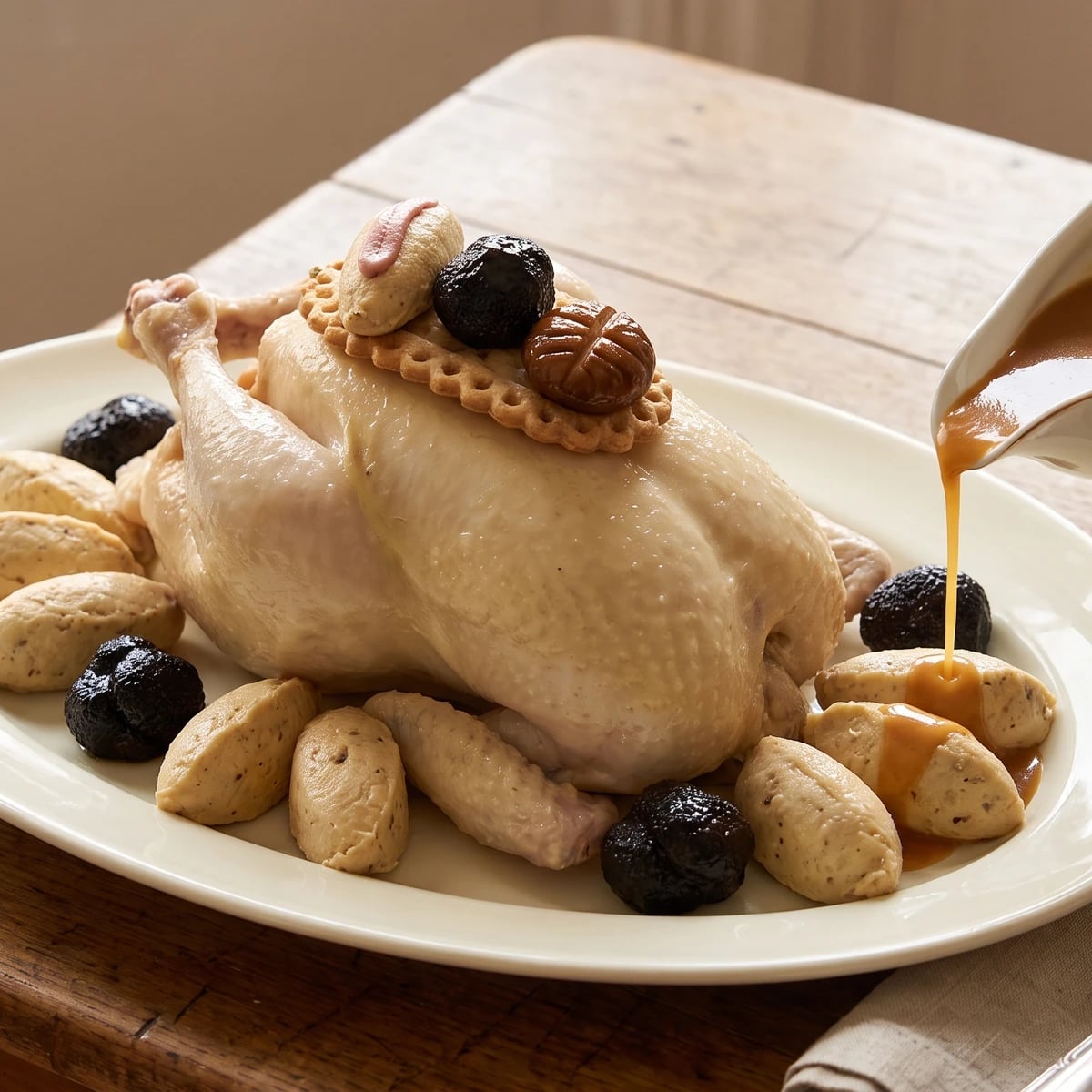
Poularde Trianon brings a gently poached pullet to the table ringed with tender chicken quenelles hiding foie gras, whole black truffles between them, and sauce suprême served generously alongside.
Poularde Trianon (poached pullet with foie gras-filled quenelles and truffles) teaches the architecture of a grand garnish: every element is manageable alone, but temperature, timing, and arrangement must arrive together. The one true thing to know before touching a pan is this: the foie gras purée goes inside the raw quenelles before they are poached. Never inject it afterward. The filling is their hidden center, not a repair.
The book's kitchen assumed a saucier on staff, chicken stock never off the fire, another pair of hands shaping quenelles, and a silver hatelet (ornamental skewer) waiting in the service drawer. A salamander belonged to that same brigade world, but Poularde Trianon never needed one because its finish is ivory, not gratinéed. At home, a snug stockpot, a food processor, one fine sieve, and a short food-safe garnish skewer do the work. I have scaled the presentation to twelve table quenelles, one decorated hatelet quenelle, and four small whole truffles around a poularde for four. Repeated pounding and multiple passes through a tamis were brigade scaffolding. The filled quenelles, whole truffles, gentle poach, and sauce suprême (chicken velouté finished with cream) are the dish, and they stay.
Cold decides the quenelles. Keep the farce mousseline (cream-enriched chicken forcemeat) chilled from processor to poaching pan, seal the foie gras completely inside, and test one small spoonful before shaping the rest. If the mixture loosens or splits, ça se rattrape, and the method tells you exactly where to stop and chill it.
Poularde Trianon belongs to the formal Parisian grand-kitchen register, and its title invokes the Trianon palaces at Versailles through a garnish rich in foie gras, truffle, and ornamental presentation. It traveled from banquet service into hotel and prosperous household cooking through the classical repertory, where a poached bird arrived whole and its sauce was passed separately to preserve the pale finish. The hatelet supplied ceremony, not flavor; the dish's identity rests in the filled quenelles, whole truffles, poularde, and sauce suprême.
Quantity
1, 3½ to 4 pounds (1.6 to 1.8 kg)
giblets removed
Quantity
3 quarts (2.8 L / 2.8 kg)
Quantity
1 medium, about 4 ounces (115 g)
cut into large pieces
Quantity
1 small, about 4 ounces (115 g)
thoroughly washed and cut into large pieces
Quantity
1 rib, about 2 ounces (55 g)
cut into large pieces
Quantity
1 small, about 4 ounces (115 g)
peeled and halved
Quantity
2
Quantity
1
Quantity
1½ tablespoons (22.5 ml / 27 g)
divided
Quantity
½ teaspoon (2.5 ml / 1 g)
divided
Quantity
about 2 cups diced (475 ml / 340 g)
kept very cold
Quantity
1
Quantity
¾ cup (180 ml / 180 g)
kept very cold
Quantity
⅛ teaspoon (0.6 ml / 0.3 g)
Quantity
about ½ cup (120 ml / 85 g)
Quantity
1 tablespoon (15 ml / 15 g)
Quantity
5, about 3½ ounces (100 g) total
4 small and 1 medium; drained if preserved
Quantity
1 large, about 1 ounce (30 g)
stem removed
Quantity
1 very thin slice, about ¾ ounce (20 g)
cut into small diamonds
Quantity
6 tablespoons (90 ml / 85 g)
divided
Quantity
3 tablespoons (45 ml / 24 g)
Quantity
1 cup (240 ml / 240 g)
| Ingredient | Quantity |
|---|---|
| poularde or plump young pulletgiblets removed | 1, 3½ to 4 pounds (1.6 to 1.8 kg) |
| unsalted chicken stock | 3 quarts (2.8 L / 2.8 kg) |
| carrotcut into large pieces | 1 medium, about 4 ounces (115 g) |
| leekthoroughly washed and cut into large pieces | 1 small, about 4 ounces (115 g) |
| celerycut into large pieces | 1 rib, about 2 ounces (55 g) |
| onionpeeled and halved | 1 small, about 4 ounces (115 g) |
| whole cloves | 2 |
| bouquet garni of parsley stems, thyme, and bay | 1 |
| fine sea saltdivided | 1½ tablespoons (22.5 ml / 27 g) |
| ground white pepperdivided | ½ teaspoon (2.5 ml / 1 g) |
| skinless, boneless chicken breastkept very cold | about 2 cups diced (475 ml / 340 g) |
| large egg white | 1 |
| heavy cream for the quenelleskept very cold | ¾ cup (180 ml / 180 g) |
| freshly grated nutmeg | ⅛ teaspoon (0.6 ml / 0.3 g) |
| cooked foie gras terrine or bloc de foie gras | about ½ cup (120 ml / 85 g) |
| heavy cream for the foie gras purée | 1 tablespoon (15 ml / 15 g) |
| whole black truffles4 small and 1 medium; drained if preserved | 5, about 3½ ounces (100 g) total |
| white button mushroomstem removed | 1 large, about 1 ounce (30 g) |
| cooked salted tonguecut into small diamonds | 1 very thin slice, about ¾ ounce (20 g) |
| unsalted butterdivided | 6 tablespoons (90 ml / 85 g) |
| all-purpose flour | 3 tablespoons (45 ml / 24 g) |
| heavy cream for the sauce suprême | 1 cup (240 ml / 240 g) |
Pat the poularde dry. Season its cavity and exterior with 2 teaspoons of the salt and a light dusting of white pepper, tuck the wings underneath, and truss the legs close to the body. Stud the onion halves with the cloves. Put the stock, carrot, leek, celery, onion, bouquet garni, and another teaspoon of salt in a snug stockpot, then bring the liquid to 185°F (85°C). Lower in the poularde breast-side up; the stock should just cover it. If it does not, use a narrower pot rather than diluting the stock with a great quantity of water.
Keep the stock between 175°F and 185°F (79°C and 85°C), with only a faint movement at the surface. Cover the pot slightly ajar and poach for 60 to 75 minutes, turning the poularde once if its breast is not fully submerged. It is ready when the thickest part of the breast reaches 165°F (74°C) and the inner thigh reaches at least 175°F (79°C). A boil toughens the flesh and can tear the pale skin. If the skin begins to split, lower the heat at once and leave the bird still; ça se rattrape. Present the torn side downward and brush it with the buttery truffle glaze before serving. Lift the cooked poularde onto a warm tray, cover loosely, and rest it while you finish the garnishes. Strain the stock and keep it hot.
While the poularde poaches, work the foie gras and its tablespoon of cream through a fine sieve until completely smooth. Transfer the purée to a small piping bag fitted with a ¼-inch round tip and chill it until firm enough to hold a line. If it becomes too stiff to pipe, let the bag stand for five minutes at room temperature; adding unnecessary cream would make the filling run into the poaching liquor.
Chill the food processor bowl and blade for ten minutes and set a clean bowl over ice. Pulse the cold chicken with 1 teaspoon salt, ¼ teaspoon white pepper, and the nutmeg until it becomes a sticky, cohesive paste. Reserve 1 teaspoon of egg white and 2 tablespoons of the cold cream, then process in the remaining egg white. With the motor running, pour in the remaining cream in a thin stream and stop as soon as the mousseline looks smooth and glossy. Press it once through a fine sieve into the iced bowl. Poach a teaspoonful in hot stock and taste it. If it is firm and springy, fold in a little reserved cream; if it frays or feels loose, fold in the reserved egg white and chill for twenty minutes. If the mixture looks greasy or curdled, it became warm. Stop, spread the bowl over ice for ten minutes, then pulse briefly with one spoonful of reserved cream. Ça se rattrape.
Line a chilled tray with parchment. Divide the mousseline into 13 portions of about 1½ ounces (42 g) each. With two soup spoons dipped in ice water, spread half of one portion inside a spoon and make a shallow channel along its length. Pipe about 1½ teaspoons of foie gras purée into that channel, cover it completely with the remaining mousseline, and pass the mixture between the spoons to form a smooth oval quenelle. The seal must be complete, with no foie gras showing. Pipe the purée in now, before poaching, never afterward. Make 12 plain quenelles for the platter. On the thirteenth, press a small diamond of salted tongue flush into the upper surface for the hatelet. Chill all 13 for fifteen minutes.
Melt 3 tablespoons of butter in a saucepan, stir in the flour, and cook this blond roux for two minutes without letting it color. Gradually whisk in 2 cups (480 ml) of the hot strained poaching stock, adding each splash only after the last has become smooth. Simmer gently for twelve minutes, skimming if necessary. Reserve 2 tablespoons of the sauce cream, add the rest, and simmer until the sauce coats the back of a spoon in an even ivory veil, about eight to ten minutes. Strain it into a clean saucepan. Off the heat, whisk in 2 tablespoons of cold butter and the reserved cream, then correct the seasoning with the remaining salt and white pepper. If the sauce is too thick, loosen it with hot stock; if thin, reduce it before adding the finishing butter. If butter beads appear, take the pan off the heat and whisk in a tablespoon of cold stock. Ça se rattrape. Hold the sauce warm without boiling.
Bring 2 inches (5 cm) of strained stock to 175°F (79°C) in a wide sauté pan. Lower in the plain quenelles in two batches and poach for 9 to 12 minutes, turning them once, until they feel springy and the chicken mantle reaches 165°F (74°C). Poach the tongue-decorated quenelle separately with its decoration facing upward, spooning hot stock over the top instead of turning it. Never boil them. If the first quenelle leaks foie gras, chill the remaining pieces, patch the opening with a smear of cold mousseline, and poach again at gentler heat. Hold the finished quenelles in clean stock around 160°F (71°C) for no more than fifteen minutes.
Groove the mushroom cap by rotating it against the tip of a small knife and cutting shallow curved channels from center to rim. Cooking well is not carving fancy, so keep the cuts simple and do not pierce the cap. Put ½ cup (120 ml) of strained stock and the remaining tablespoon of butter in a small pan. Simmer the mushroom cap gently until tender, about five minutes. Add the medium truffle for the final three minutes and the four small truffles for the final minute, merely warming fresh truffles for thirty seconds. Lift everything out, reduce the liquid to a glossy glaze, then roll the mushroom and truffles through it.
Thread the tongue-decorated quenelle, the medium glazed truffle, and the grooved mushroom cap onto a short food-safe metal skewer, handling the quenelle gently so it does not split. This is the hatelet. If the quenelle cracks, set the three elements together at the neck end of the platter and place the skewer behind them; the ornament still reads correctly and the food remains intact. Insert the assembled hatelet shallowly into the upper breast only after the poularde is on its platter, and remove it before carving.
Remove the twine and set the poularde in the center of a warmed oval platter. Brush its surface lightly with the remaining truffle glaze. Arrange the 12 plain quenelles in four generous heaps of three around the bird, then place one small whole glazed truffle in each gap between the heaps. Crown the poularde with the hatelet. Pour the sauce suprême into a warmed sauceboat and bring it to the table at the same moment, passing it generously without hiding the ring of quenelles and truffles. À table!
1 serving (about 510g)
Culinary guides, cultural storytelling, and the editorial depth that makes cooking meaningful.
Discover Culinary Explorer
Chef Juliette
Three roads through the Paris poultry canon, poach, poêler, or braise, with one rule beneath them all: protect the breast with bacon while the legs cook, then turn the liquor into sauce.

Chef Juliette
The service method that protects a grand poultry dish: carve the suprêmes in the kitchen, keep them in their liquor, rebuild the bird with pilaf, and send every guest a hot, complete plate.

Chef Juliette
The marshal’s poularde teaches gentle poaching: a rice-stuffed bird held at a bare tremble, then cloaked in sauce Albuféra and surrounded by truffle tartlets, tiny quenelles, mushrooms, and salted tongue.

Chef Juliette
Poularde Alexandra turns one poached bird into a small ceremony: truffle and tongue in the sliced suprêmes, feather-light mousseline beneath a bronzed Mornay coat, and buttered asparagus tartlets all around.