
Chef Juliette
John Dory (St. Pierre)
John Dory has the delicacy of sole and the firmness of turbot. A light flouring, a quick butter sauté, and nut-brown beurre noisette show exactly why looks never mattered.
A cooking platform built around craft, culture, and the stories behind what we eat.
Created by Chef Juliette
Based on No. 1521, Poularde Sylvana, from Le Guide Culinaire (1907) by Auguste Escoffier
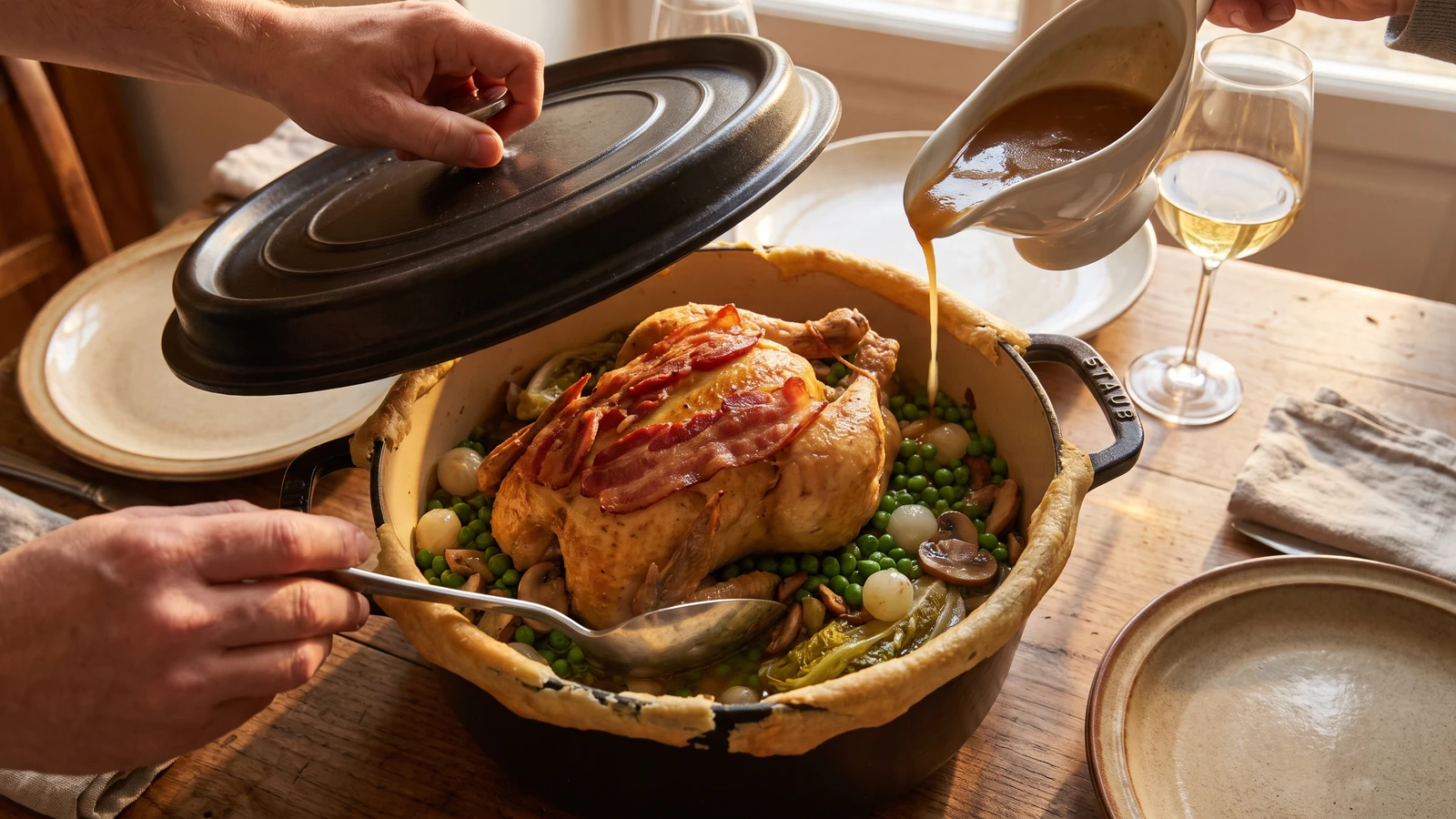
Poularde Sylvana traps a mushroom-stuffed bird, buttered peas, lettuce, and new onions beneath a pastry-sealed lid, so every drop of juice stays in the cocotte and returns to the table.
Poularde Sylvana (a mushroom-stuffed pullet baked with peas and lettuce in a pastry-sealed cocotte) teaches cuisson à l'étouffée (cooking in a tightly closed pot): once the lid is sealed, every drop the bird and vegetables release must stay inside and season the whole. The seal is not decoration. It is the dish's engine, so make it continuous before the pot goes near the oven.
The original kitchen assumed a saucier on staff, chicken stock never off the fire, and enough hands to brown the bird while another pan half-cooked the garnish. Its salamander has no work here; the colour comes in the first roasting, and the pastry seal finishes the cooking. At home, a small roasting chicken stands in honestly for the hard-to-find poularde, concentrated stock and the roasting fond become the gravy, and the same skillet handles mushrooms and peas. Those extra brigade pans are scaffolding. The pastry lining, mushroom stuffing, and egg-white seal stay, because they are the architecture.
Done well, the lid opens onto butter-glossed peas, tender lettuce, sweet onions, and a burnished bird carrying mushroom perfume in its cavity. One cook, one stove, one evening. The step that decides Poularde Sylvana is the lutage (sealing the pot with dough): inspect the entire seam and patch even a pinhole before baking.
Poularde Sylvana belongs to the codified Parisian grand-kitchen repertoire, where named poultry dishes were defined by their garnish and method rather than by a provincial claim. Its mushrooms suggest woodland, while peas, new onions, lettuce, chervil, and mint give the cocotte the green register of a formal spring table, a combination drawn from cuisine bourgeoise and carried into grand service. Although pastry surrounds the vessel, this is not a pie: the paste is a lutage, built first to keep the pot hermetically closed and served proudly in place.
Quantity
1, weighing 3½ to 4 lb (1.6 to 1.8 kg)
Quantity
about 6 cups (1.4 L / 454 g)
trimmed and quartered
Quantity
4 tablespoons (60 ml / 57 g)
Quantity
3⅓ cups (800 ml / 400 g)
2 tablespoons reserved for rolling
Quantity
14 tablespoons (210 ml / 200 g)
cubed, with 1 teaspoon reserved for the cocotte
Quantity
6 to 8 tablespoons (90 to 120 ml / 90 to 120 g)
Quantity
3 teaspoons (15 ml / 18 g)
divided
Quantity
2 cups (475 ml / 290 g)
keep frozen peas frozen until needed
Quantity
10, about 5 oz (140 g)
peeled with the root ends intact
Quantity
1, about 5 oz (140 g)
cut julienne-fashion
Quantity
6
Quantity
4
Quantity
1 small
Quantity
1 teaspoon (5 ml / 4 g)
Quantity
4 tablespoons (60 ml / 57 g)
Quantity
2 tablespoons (30 ml / 30 g)
Quantity
1
lightly beaten
Quantity
1 thin sheet, about 4 oz (115 g), or 4 slices
Quantity
1½ cups (360 ml / 360 g)
Quantity
1 tablespoon (15 ml / 14 g)
| Ingredient | Quantity |
|---|---|
| pullet or small roasting chicken | 1, weighing 3½ to 4 lb (1.6 to 1.8 kg) |
| small button mushroomstrimmed and quartered | about 6 cups (1.4 L / 454 g) |
| unsalted butter for the mushrooms | 4 tablespoons (60 ml / 57 g) |
| all-purpose flour2 tablespoons reserved for rolling | 3⅓ cups (800 ml / 400 g) |
| cold unsalted butter for the pastrycubed, with 1 teaspoon reserved for the cocotte | 14 tablespoons (210 ml / 200 g) |
| ice water | 6 to 8 tablespoons (90 to 120 ml / 90 to 120 g) |
| fine sea saltdivided | 3 teaspoons (15 ml / 18 g) |
| shelled fresh peas, or frozen peaskeep frozen peas frozen until needed | 2 cups (475 ml / 290 g) |
| small new onionspeeled with the root ends intact | 10, about 5 oz (140 g) |
| small butter lettucecut julienne-fashion | 1, about 5 oz (140 g) |
| parsley stalks | 6 |
| chervil sprigs | 4 |
| mint sprig | 1 small |
| granulated sugar | 1 teaspoon (5 ml / 4 g) |
| unsalted butter for the pea garnish | 4 tablespoons (60 ml / 57 g) |
| water | 2 tablespoons (30 ml / 30 g) |
| large egg whitelightly beaten | 1 |
| unsmoked fatback or thinly sliced unsmoked bacon | 1 thin sheet, about 4 oz (115 g), or 4 slices |
| rich unsalted chicken stock | 1½ cups (360 ml / 360 g) |
| cold unsalted butter for the gravy | 1 tablespoon (15 ml / 14 g) |
Reserve 2 tablespoons of the flour and 1 teaspoon of the pastry butter. Mix the remaining flour with 1 teaspoon of the salt, then rub in the cold butter until the mixture resembles coarse crumbs with a few flat flakes still visible. Add the ice water a spoonful at a time, stopping as soon as the dough holds together when pressed. Flatten into a disc, wrap, and chill for 30 minutes. This plain pâte brisée (shortcrust pastry) replaces the source's unspecified paste: it rolls thinly, seals firmly, and can face the table without looking like builder's putty.
Pat the mushrooms dry. Melt their 4 tablespoons of butter in a wide skillet over medium heat and cook until the bubbling quiets, the milk solids turn hazelnut-brown, and the butter smells toasted. This is beurre noisette (hazelnut-browned butter). Add the mushrooms, raise the heat to medium-high, and toss until their liquid has cooked away and their edges are golden, 8 to 10 minutes. Season with ½ teaspoon of the salt and spread them on a plate to cool. If liquid pools in the skillet, give the mushrooms more room and stronger heat; don't drain them, because their flavour would go down the sink with the liquid.
Pat the chicken thoroughly dry and season its cavity and skin with ¾ teaspoon of the salt. Spoon the cooled mushrooms loosely into the cavity, leaving enough room for the heat to circulate, then tie the legs together and tuck the wing tips underneath. If the final spoonful won't fit without packing, reserve it for the cocotte rather than forcing it inside.
Heat the oven to 425°F (220°C). Set the chicken breast-side up in a shallow roasting pan and spoon over any beurre noisette remaining from the mushroom skillet. Roast for 25 to 30 minutes, until the skin is deeply golden but the meat is only partly cooked. This first roasting supplies the colour the sealed cocotte cannot. If the skin remains pale, give it another 5 minutes in the hot oven; a broiler scorches the high points before the rest can bronze. Preserve every brown mark and juice in the roasting pan for the gravy, then lower the oven to 375°F (190°C).
Tie the parsley stalks, chervil, and mint into a compact herb bundle. Cut the lettuce julienne-fashion, into fine matchstick-like shreds. Put the new onions, lettuce, herb bundle, sugar, ½ teaspoon of the salt, pea-garnish butter, and water into the mushroom skillet. If using fresh peas, add them now. Cover and cook over medium-low heat for 8 to 10 minutes, tossing the pan twice, until the onions begin to yield and the peas remain firm. If using frozen peas, fold them in only for the final minute because they were blanched before freezing. If the pan catches before the onions soften, add 1 tablespoon of water, lower the heat, and continue. Discard the herb bundle.
Rub the inside of a 5-quart (4.7 L) cocotte with the reserved teaspoon of butter. On the reserved flour, roll the chilled pastry about 1⁄16 inch (2 mm) thick and large enough to line the base and sides with roughly 2 inches (5 cm) hanging beyond the rim. Ease it into the cocotte without stretching it; patch any tear with a scrap and egg white. Set the half-browned chicken breast-side up inside, surround it with the pea garnish and any spare mushrooms, then lay the fatback or overlapping bacon over the breast. Fit the lid. Brush the pastry overhang and lid edge with egg white, draw the pastry over the joint, and press it firmly against the lid to form an unbroken lutage. Keep the remaining egg white and pastry scraps nearby.
Set the sealed cocotte on a rimmed baking sheet and bake at 375°F (190°C) for 45 minutes, allowing 5 extra minutes for a bird near 4 lb (1.8 kg). Don't lift the lid. The closed pot traps the chicken juices, mushroom perfume, butter, and vegetable liquor, which is the one principle the dish asks you to defend. If the pastry seam splits while baking, work quickly: brush the crack with egg white, press on a scrap of dough, and return the cocotte to the oven. Ça se rattrape.
As soon as the cocotte goes into the oven, set the roasting pan over medium heat and pour in the chicken stock. Scrape up every piece of fond, then boil steadily until reduced to about ¾ cup (180 ml), 12 to 15 minutes. Strain into a small saucepan and keep it ready over the gentlest heat. Just before serving, remove it from the heat and whisk in the cold finishing butter with the remaining ¼ teaspoon salt. If the butter beads on the surface, whisk in 1 teaspoon of cold water off the heat until the gravy returns to a gloss. Pour it into a warm sauceboat.
Rest the cocotte, still sealed, for 15 minutes, then carry it to the table. Cut through the pastry band and lift the lid where everyone can see the butter-glossed garnish beneath. Before carving, check the deepest part of the thigh with an instant-read thermometer; it must register at least 165°F (74°C). If it falls short, move the chicken to the roasting pan and finish it at 375°F (190°C), leaving the covered vegetables in the cocotte. The ceremony pauses, supper survives. Carve the chicken, spoon peas, onions, lettuce, mushrooms, and cocotte juices around it, and pass the chicken gravy separately. À table!
1 serving (about 685g)
Culinary guides, cultural storytelling, and the editorial depth that makes cooking meaningful.
Discover Culinary ExplorerChef Juliette
John Dory has the delicacy of sole and the firmness of turbot. A light flouring, a quick butter sauté, and nut-brown beurre noisette show exactly why looks never mattered.

Chef Juliette
Fresh haddock proves its delicacy in the meunière pan: a fine flour crust, moist pearly flakes, and beurre noisette sharpened with lemon and parsley, ready from one skillet in half an hour.

Chef Juliette
Éperlans à l’Anglaise turns small fish into a lesson in disciplined coating: boned smelts under a close, crisp crumb, pan-fried in clarified butter and finished with bright, half-melted maître d’hôtel butter.

Chef Juliette
Tiny smelts, shallot, mushrooms, white wine, gratin sauce, and fine bread raspings meet a fierce oven, where the fish must turn tender in the same breath the buttered crust bronzes.