
Chef Juliette
Pullets and Capons for Relevés
Three roads through the Paris poultry canon, poach, poêler, or braise, with one rule beneath them all: protect the breast with bacon while the legs cook, then turn the liquor into sauce.
A cooking platform built around craft, culture, and the stories behind what we eat.
Created by Chef Juliette
Based on No. 1517, Poularde Sicilienne, from Le Guide Culinaire (1907) by Auguste Escoffier
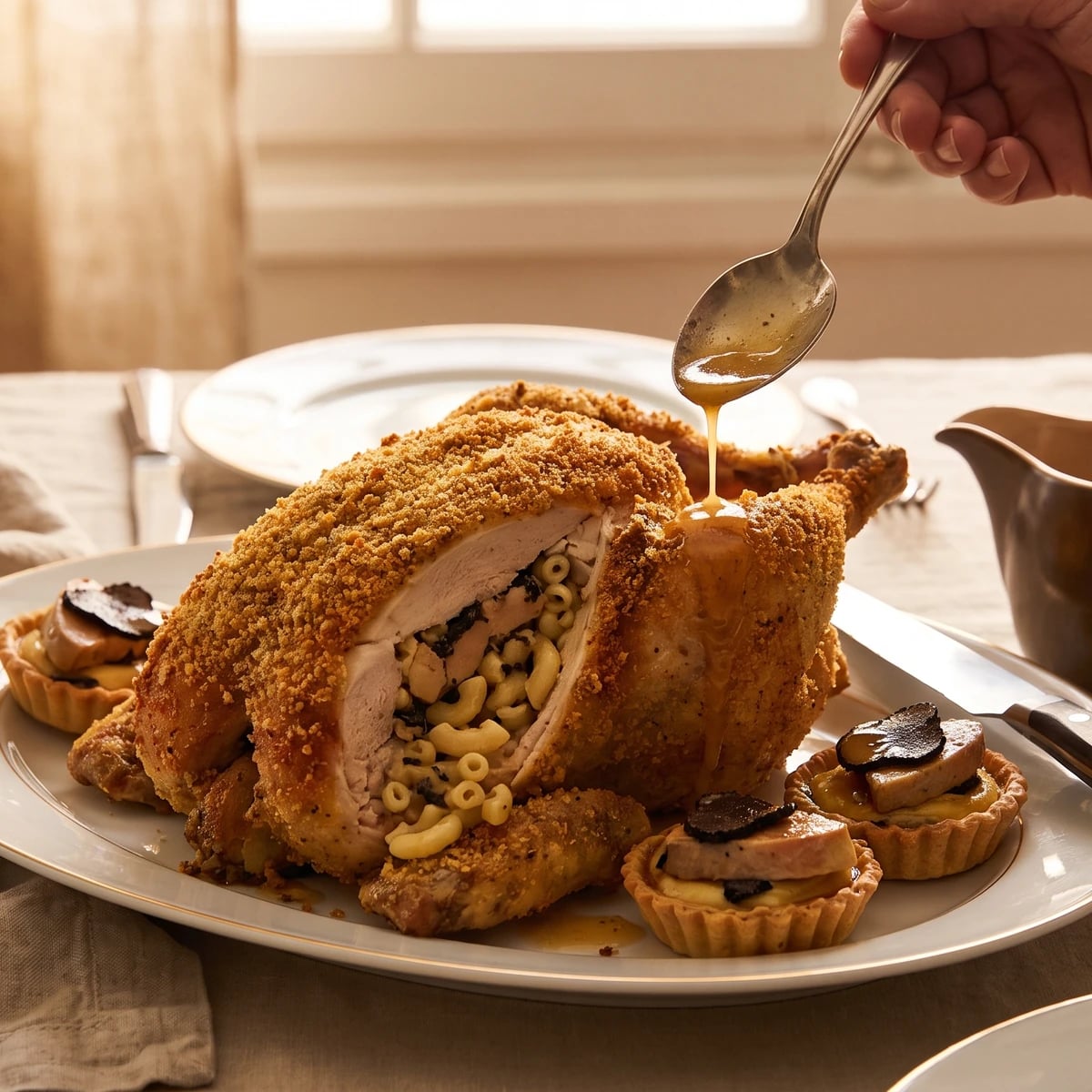
Poularde Sicilienne turns gentle poaching into a grand reconstruction: macaroni, truffle, foie gras, and offal under melting caul, with buttered chicken glaze and four crowned tartlets for the table.
Poularde Sicilienne (Sicilian-style stuffed young hen) teaches reconstruction, one of the cleverest grammars in the classical kitchen. The bird is gently poached, its suprêmes (breast fillets) are lifted for the tartlets, the breastbone is removed, and the hollow is refilled with macaroni, truffle, foie gras, and small offal. The one true thing to know before touching the pan is this: the second cooking exists to melt and colour the caul, not to cook the chicken. Boil the first poach and no luxurious garnish can return the moisture you lost.
The original assumed a saucier keeping beef liquor and chicken glaze ready, a stockpot never off the fire, a pastry cook turning out tartlet crusts, and a salamander, the fierce overhead broiler, waiting to colour the wrapping. At home, a plump small roasting chicken replaces the harder-to-find poularde, good unsalted stocks reduce in two ordinary pans, all-butter puff pastry handles the tartlets, and your broiler supplies the final minute if needed. The decorative low cushion is brigade scaffolding and goes; the beef-bound macaroni, caul, truffle, foie gras, tartlets, and buttered glaze are the dish and stay. One cook, one stove, one evening.
Cocks’ combs and chicken kidneys are scarce in ordinary markets. If your butcher can supply them already cleaned and cooked, use them; otherwise confit gizzards and sautéed hearts stand in gram for gram, not invisibly, but honestly, keeping the springy and mineral contrast the garnish needs. Work gently when you raise the suprêmes. The decisive step is the caul wrap: it must restore the bird’s natural shape snugly before the browning begins.
Poularde Sicilienne belongs to the Parisian grand-kitchen repertoire, not to the household cooking of Sicily. Its Italian naming comes through macaroni and the strong beef braising liquor à la Napolitaine, while the truffle, foie gras, caul wrapping, tartlet service, and buttered chicken glaze speak the language of French grand-kitchen practice. It passes naturally to the home table by shedding display supports and surplus hands, not by surrendering the reconstruction that defines it.
Quantity
1, about 4 lb (1.8 kg)
giblets removed
Quantity
10 cups (2.4 L / 2.4 kg)
Quantity
1½ cups (360 ml / 360 g)
Quantity
½ cup (120 ml / 60 g)
Quantity
¼ cup (60 ml / 65 g)
chilled and cut into ½-inch dice
Quantity
4 slices, 1 oz (28 g) each
thoroughly chilled
Quantity
1 small, about 1 oz (30 g)
two-thirds diced and the remainder cut into 4 thin slices
Quantity
½ cup (120 ml / 75 g)
diced
Quantity
1 sheet, about 8 oz (225 g)
thawed but cold
Quantity
2 tablespoons (30 ml / 16 g)
for rolling
Quantity
1 large sheet, about 12 oz (340 g)
soaked in cold water and patted dry
Quantity
½ cup (120 ml / 50 g)
Quantity
10 tablespoons (150 ml / 142 g)
divided
Quantity
2 tablespoons (30 ml / 36 g)
divided
Quantity
½ teaspoon (2.5 ml / 1 g)
divided
| Ingredient | Quantity |
|---|---|
| poularde or small roasting chickengiblets removed | 1, about 4 lb (1.8 kg) |
| good unsalted chicken stock | 10 cups (2.4 L / 2.4 kg) |
| gelatin-rich unsalted beef stock | 1½ cups (360 ml / 360 g) |
| small dried macaroni | ½ cup (120 ml / 60 g) |
| cooked foie graschilled and cut into ½-inch dice | ¼ cup (60 ml / 65 g) |
| raw foie grasthoroughly chilled | 4 slices, 1 oz (28 g) each |
| fresh black truffletwo-thirds diced and the remainder cut into 4 thin slices | 1 small, about 1 oz (30 g) |
| cooked cocks’ combs and chicken kidneys, or confit chicken gizzards and sautéed chicken heartsdiced | ½ cup (120 ml / 75 g) |
| all-butter puff pastrythawed but cold | 1 sheet, about 8 oz (225 g) |
| all-purpose flourfor rolling | 2 tablespoons (30 ml / 16 g) |
| pork caul fatsoaked in cold water and patted dry | 1 large sheet, about 12 oz (340 g) |
| fine dry breadcrumbs | ½ cup (120 ml / 50 g) |
| unsalted butterdivided | 10 tablespoons (150 ml / 142 g) |
| fine sea saltdivided | 2 tablespoons (30 ml / 36 g) |
| ground white pepperdivided | ½ teaspoon (2.5 ml / 1 g) |
Heat the oven to 400°F (200°C). Use 1 tablespoon of the butter to grease four 3¼-inch (8 cm) tartlet tins. Roll the cold puff pastry lightly on the floured surface and cut four rounds large enough to line the tins with a small overhang. Press them into the corners, prick the bases, and chill for 10 minutes. Line with parchment and baking weights, bake for 12 minutes, then remove the weights and bake for another 6 to 8 minutes, until the pastry is crisp and butter-gold. If a side slumps, press it gently back into shape while warm. Cool the shells in their tins, then lift them out.
Set the chicken breast-side up in a narrow stockpot and pour in the cold chicken stock, which should cover the bird or come very close. Add 2 teaspoons of the salt. Warm it slowly until the liquid reaches a bare tremble, about 180°F (82°C), skimming any foam that rises. Hold it between 175°F and 185°F (80°C and 85°C) for 45 to 60 minutes, turning the bird once if its breast is not submerged, until the breast reaches 160°F (71°C) and the inner thigh reaches 170°F (77°C). Never let it boil. If bubbling gathers across the surface, pull the pot from the burner until it calms, then continue over lower heat. Lift the bird onto a rack and let it rest for 20 minutes. Strain the poaching liquor, measure out 5 cups for the glaze, reserve another cup for adjustments, and save the rest for another pot.
Pour the beef stock into a small wide saucepan and boil steadily until it reduces to about ⅓ cup (80 ml), 15 to 20 minutes. This is the home equivalent of the strong braising liquor from beef à la Napolitaine that the original kitchen had waiting. It should be deep brown, gelatinous, and strong enough to coat the macaroni without making soup. If it becomes salty before it gains body, add a spoonful of the reserved unsalted chicken liquor and reduce more gently. Keep it warm.
When the chicken is cool enough to handle, set it breast-side up. Run a small sharp knife down one side of the breastbone, then sweep the blade close against the ribs to lift the first suprême whole; repeat on the other side, leaving both wing bones attached to the carcass as the source directs. Cover the suprêmes so they do not dry. With poultry shears, carefully cut the ribs where they meet the breastbone and lift away the breastbone and keel cartilage, preserving the back, legs, wings, and as much outer skin as possible. You should now have a broad cavity where the breast meat stood. Small tears are harmless because the caul will hold the reconstruction together.
Bring a saucepan of water to the boil and season it with most of the remaining salt. Cook the macaroni until just tender but still firm at its centre, then drain it very thoroughly. Return it to the warm pan with the reduced beef liquor and toss over low heat until the pasta is coated and no loose liquid remains. Take the pan off the heat before folding in the diced cooked foie gras, diced truffle, cocks’ combs and kidneys or their home equivalent, and ¼ teaspoon of the white pepper. If the mixture runs, remove the delicate garnish and reduce the macaroni for another minute; if it tightens into a lump, loosen it with a spoonful of reserved chicken liquor. Ça se rattrape. Taste and correct the seasoning.
Raise the oven again to 400°F (200°C). Spread the caul flat on the board and trim away any especially thick knots. Fill the chicken’s breast cavity with the warm macaroni mixture without crushing it, drawing any loose skin over the filling. Set the reconstructed bird breast-side up on the caul and shape the filling into the rounded line of a whole breast. Wrap the caul snugly around the chicken with the seam underneath. If the membrane tears, overlap a wet patch of caul across the opening; once rendered, the join disappears. Melt 3 tablespoons of butter, brush it over the entire wrapping, and press on the breadcrumbs. Set the chicken seam-side down on a rack in a shallow roasting pan.
Bake for 25 to 35 minutes, until the caul has rendered nearly translucent, the breadcrumbs are a deep bronze, and the centre of the filling reaches 165°F (74°C). This oven time is for the wrapping and the filling, not for recooking the bird, so stop as soon as those signs are present. If the crumbs darken before the filling is hot, cover the top loosely with foil. If the filling is ready but the surface remains pale, place it under the broiler, the home salamander, for 30 to 60 seconds. Watch without blinking; the last colour arrives quickly. Rest the bird for 10 minutes.
While the chicken browns, boil the measured 5 cups of chicken poaching liquor in a wide saucepan, skimming away excess fat, until it reduces to about 1¼ cups (300 ml) and coats the back of a spoon with a glossy film. Taste before seasoning with the remaining white pepper and only as much salt as it needs. Take the pan completely off the heat and monter au beurre, whisk in 4 tablespoons of cold butter a piece at a time, to make the buttered chicken glaze. Do not boil it afterward. If the glaze splits, stop. Ça se rattrape: whisk a tablespoon of cold reserved liquor in a clean warm pan, then add the broken glaze gradually until it comes back together.
Cut each reserved suprême diagonally into two broad slices, giving four pieces in all. Place one in each tartlet shell, brush lightly with chicken glaze, and warm them in the oven for 4 to 5 minutes while the reconstructed bird rests. Melt the remaining 2 tablespoons of butter in a skillet until it foams, then add the cold raw foie gras slices and toss them gently in the butter for 30 to 45 seconds per side, just until coloured outside and supple within. If the butter begins to smoke, pull the pan from the heat at once; scorched fat melts the foie before it colours. Set one foie gras slice over each suprême and crown each with a truffle slice.
Transfer the reconstructed chicken to a warmed low oval platter. The old decorative cushion served display, not flavour, and the home table needs no such architecture. Spoon just enough buttered chicken glaze over the caul to make it gleam without soaking its whole crust, then arrange the four tartlets closely around the bird. Send the remaining glaze separately in a warm sauceboat. At the table, divide each leg into thigh and drumstick portions, cut through the caul to expose the macaroni filling, and give each guest dark meat, a spoonful of filling, and one crowned tartlet. À table!
1 serving (about 560g)
Culinary guides, cultural storytelling, and the editorial depth that makes cooking meaningful.
Discover Culinary Explorer
Chef Juliette
Three roads through the Paris poultry canon, poach, poêler, or braise, with one rule beneath them all: protect the breast with bacon while the legs cook, then turn the liquor into sauce.

Chef Juliette
The service method that protects a grand poultry dish: carve the suprêmes in the kitchen, keep them in their liquor, rebuild the bird with pilaf, and send every guest a hot, complete plate.

Chef Juliette
The marshal’s poularde teaches gentle poaching: a rice-stuffed bird held at a bare tremble, then cloaked in sauce Albuféra and surrounded by truffle tartlets, tiny quenelles, mushrooms, and salted tongue.

Chef Juliette
Poularde Alexandra turns one poached bird into a small ceremony: truffle and tongue in the sliced suprêmes, feather-light mousseline beneath a bronzed Mornay coat, and buttered asparagus tartlets all around.