
Chef Juliette
John Dory (St. Pierre)
John Dory has the delicacy of sole and the firmness of turbot. A light flouring, a quick butter sauté, and nut-brown beurre noisette show exactly why looks never mattered.
A cooking platform built around craft, culture, and the stories behind what we eat.
Created by Chef Juliette
Based on No. 1516, Poularde Santa-Lucia, from Le Guide Culinaire (1907) by Auguste Escoffier
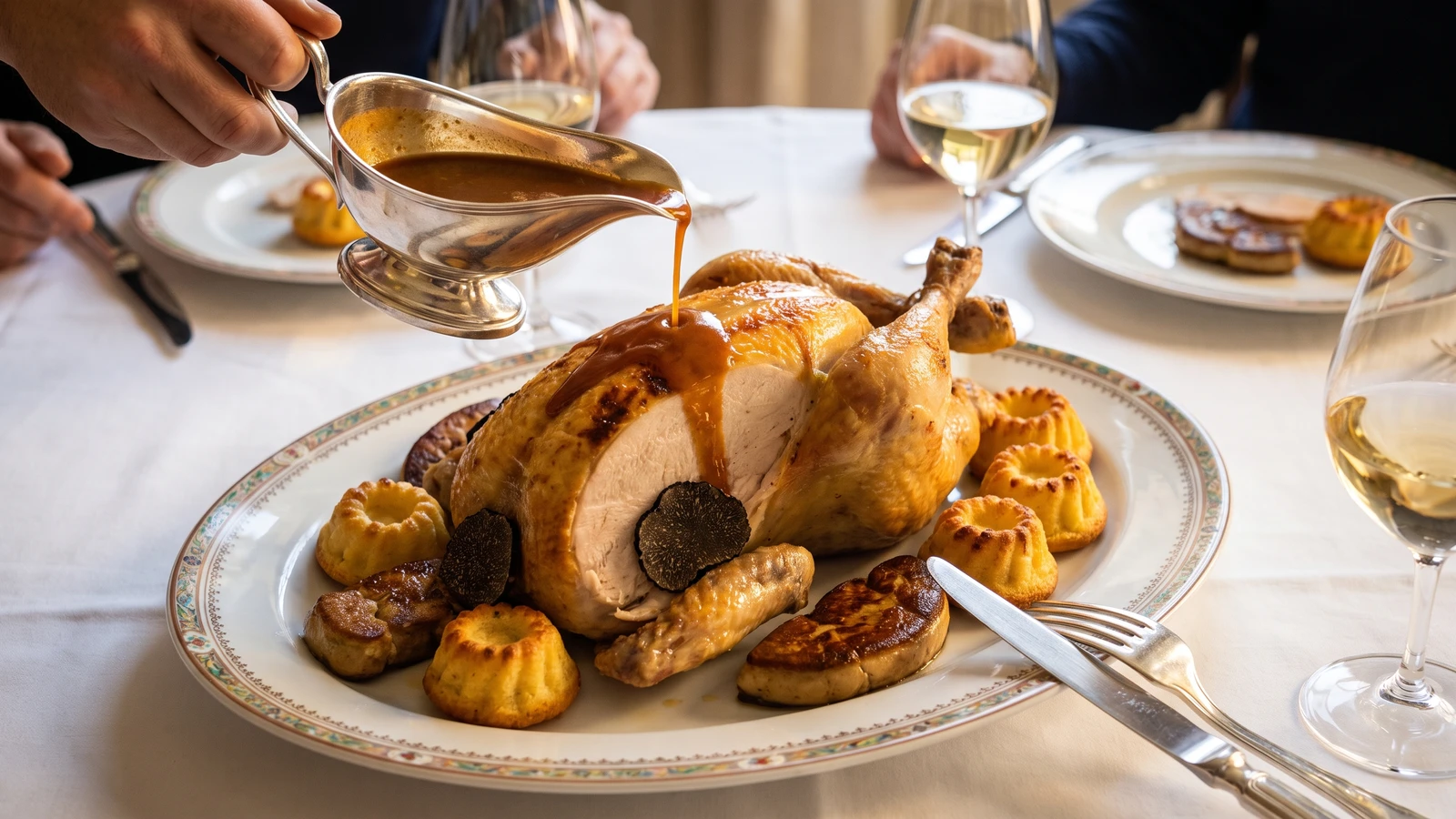
Poularde scented from within by Madeira-steeped truffles, braised under a shallow measure of Marsala, then ringed with golden semolina tartlets and buttery foie gras. The short moistening is what turns liquor into sauce.
Poularde Santa-Lucia (truffle-stuffed pullet braised in Marsala) teaches one severe, useful rule: luxury still needs restraint. The braising liquor must come only partway up the bird. Drown it and you get broth; give it just enough Marsala and stock, then reduce honestly, and the liquor becomes a glossy sauce carrying poultry fond, truffle, and wine.
The old entry assumed that Poularde Sainte Alliance (No. 1515) had already supplied the cold Madeira-steeped truffles, that stock was never off the fire, that a saucier would reduce the liquor, and that a salamander and several hands would finish the garnishes at service. Your equivalents are a close-fitting cocotte, good unsalted chicken stock, the oven broiler, and one saucepan. The decorative low cushion and relay carving are service scaffolding, so they go. The truffle stuffing, short Marsala moistening, gnocchi à la romaine tartlets, and collops of foie gras tossed in butter are the dish, so every one stays. One cook, one stove, one evening.
Measure the liquid before it enters the cocotte, and reduce the Marsala before adding the stock. That short moistening is the step that decides Santa-Lucia; everything afterward is careful timing and a warm platter.
Poularde Santa-Lucia belongs to the cosmopolitan grand-hotel table rather than to a single French province, a table where named poulardes were composed from a roast or braise, a concentrated liquor, and separately finished garnishes. It borrows its Madeira-steeped truffle treatment from Poularde Sainte Alliance (No. 1515), then exchanges that preparation's elaborate bird-service procession for Marsala, gnocchi à la romaine, and foie gras. The Italianate name and ingredients do not make it an Italian regional dish: the method remains firmly within the French classical system of fond, short braising, reduction, and arranged garnish.
Quantity
1 (4½ to 5 lb / 2 to 2.3 kg)
giblets removed
Quantity
1 home-scale batch from Poularde Sainte Alliance (No. 1515)
thoroughly chilled
Quantity
2½ teaspoons (12 ml / 15 g)
divided
Quantity
1 teaspoon (5 ml / 2 g)
divided
Quantity
10 tablespoons (150 ml / 142 g)
divided
Quantity
1½ cups (360 ml / 360 g)
Quantity
1 cup (240 ml / 240 g)
Quantity
1¼ cups (300 ml / 305 g)
Quantity
½ cup (120 ml / 85 g)
Quantity
¼ cup (60 ml / 25 g)
finely grated
Quantity
1
Quantity
⅛ teaspoon (0.6 ml / 0.25 g)
Quantity
4 collops, about 1¼ oz each (5 oz / 140 g total)
well chilled
| Ingredient | Quantity |
|---|---|
| fine poularde or plump roasting pulletgiblets removed | 1 (4½ to 5 lb / 2 to 2.3 kg) |
| Madeira-steeped truffle componentthoroughly chilled | 1 home-scale batch from Poularde Sainte Alliance (No. 1515) |
| fine sea saltdivided | 2½ teaspoons (12 ml / 15 g) |
| freshly ground black pepperdivided | 1 teaspoon (5 ml / 2 g) |
| unsalted butterdivided | 10 tablespoons (150 ml / 142 g) |
| dry Marsala | 1½ cups (360 ml / 360 g) |
| unsalted chicken stock | 1 cup (240 ml / 240 g) |
| whole milk | 1¼ cups (300 ml / 305 g) |
| fine semolina | ½ cup (120 ml / 85 g) |
| Parmesanfinely grated | ¼ cup (60 ml / 25 g) |
| large egg yolk | 1 |
| freshly grated nutmeg | ⅛ teaspoon (0.6 ml / 0.25 g) |
| raw duck foie graswell chilled | 4 collops, about 1¼ oz each (5 oz / 140 g total) |
Heat the oven to 325°F (165°C). Set the cold truffle component from Poularde Sainte Alliance (No. 1515) in a sieve over a bowl, keeping every drop of its Madeira liquor. Dry the poularde thoroughly, inside and out, then season it with 1¾ teaspoons of the salt and ¾ teaspoon of the pepper. Put the truffles into the cavity, truss the bird compactly, and cook it at once. A stuffed raw bird waits for nobody.
Butter four shallow 3-inch (7.5 cm) tartlet molds with 1 tablespoon of the butter. Bring the milk to a gentle simmer with another tablespoon of butter, ½ teaspoon of salt, and the nutmeg. Rain in the semolina while whisking, then stir over low heat for 4 to 5 minutes, until the paste pulls cleanly from the pan. If it lumps, take it off the heat and beat vigorously with the whisk; ça se rattrape. Mix in the yolk and Parmesan, divide the paste among the molds, and smooth it about ½ inch (1.25 cm) thick. Chill until firm.
Melt 2 tablespoons of butter in a close-fitting heavy cocotte over medium heat, reserving another tablespoon in case the pot needs refreshing. Brown the poularde patiently on both legs, its back, and finally the breast, about 10 to 12 minutes altogether. You want a deep hazelnut colour and a brown fond across the pot floor. If the butter blackens before the skin colours, lift out the bird, wipe away the burnt solids, and begin again with the reserved butter. Burnt butter cannot build a good sauce, but the bird is not lost.
Transfer the browned bird briefly to a tray. Pour the Marsala and reserved Madeira liquor into the cocotte, scrape up every part of the fond, and boil until reduced by half. Add the chicken stock and return the poularde breast-side up; the liquid should rise no more than one-third of the way up the bird. Cover and braise in the oven, basting every 20 minutes, until the thickest part of the breast and the centre of the cavity reach 165°F (74°C) and the thigh is tender, about 60 to 75 minutes. Never add liquid merely to surround the bird. The short moistening is the sauce.
Lift the poularde onto a warm tray, tipping any cavity juices back into the cocotte without losing the truffles. Tent it loosely and rest for 20 minutes; a tight wrapping softens the burnished skin. Raise the oven to 425°F (220°C), and set a serving platter somewhere warm.
Turn the chilled gnocchi tartlets onto a lined baking sheet and brush them with 2 tablespoons of melted butter. Bake for 12 to 15 minutes, until firm and golden underneath, then pass them under the broiler for 1 to 2 minutes to bronze the ridges. This is the honest home equivalent of the salamander. If a tartlet begins to spread, slip it back into its mold and finish it there; ça se rattrape.
Strain the braising liquor into a saucepan, pressing nothing through, and skim away the excess fat. Boil until it reduces to about 1¼ cups (300 ml) and naps the back of a spoon in a glossy layer. Take it off the heat and monter au beurre, finish by whisking in 2 tablespoons of cold butter, one piece at a time. If the sauce is thin, reduce it further before adding the butter; if it tightens too much, loosen it with unsalted stock. If it splits, whisk in a teaspoon of cold water away from the heat. Ça se rattrape.
Keep the foie gras cold until the final moment. Season the collops with the remaining salt and pepper. Heat the final tablespoon of butter in a skillet until it foams, add the foie gras, and toss it in the butter, turning once, until bronzed outside and just firm at the centre, about 30 to 45 seconds per side. Lift the collops out immediately. If they begin to slump, the pan is too hot; take it off the burner and move the foie gras to a cool plate before it renders away.
Set the whole poularde on the warm oval platter, which replaces the original decorative cushion without pretending dinner needs architecture. Arrange the four gnocchi tartlets and four foie gras collops alternately around it. Spoon a little Marsala sauce over the bird and send the rest in a warm sauceboat. At the table, retrieve and divide the truffles as you carve, giving each diner poultry, truffle, one tartlet, one collop of foie gras, and enough sauce to join them. À table!
1 serving (about 525g)
Culinary guides, cultural storytelling, and the editorial depth that makes cooking meaningful.
Discover Culinary ExplorerChef Juliette
John Dory has the delicacy of sole and the firmness of turbot. A light flouring, a quick butter sauté, and nut-brown beurre noisette show exactly why looks never mattered.

Chef Juliette
Fresh haddock proves its delicacy in the meunière pan: a fine flour crust, moist pearly flakes, and beurre noisette sharpened with lemon and parsley, ready from one skillet in half an hour.

Chef Juliette
Éperlans à l’Anglaise turns small fish into a lesson in disciplined coating: boned smelts under a close, crisp crumb, pan-fried in clarified butter and finished with bright, half-melted maître d’hôtel butter.

Chef Juliette
Tiny smelts, shallot, mushrooms, white wine, gratin sauce, and fine bread raspings meet a fierce oven, where the fish must turn tender in the same breath the buttered crust bronzes.