Culinary Explorer

A cooking platform built around craft, culture, and the stories behind what we eat.
Discover Culinary Explorer
Poularde au Riz

Poularde au Riz

Created by Chef Juliette

Based on No. 1513, Poularde au Riz, from Le Guide Culinaire (1907) by Auguste Escoffier

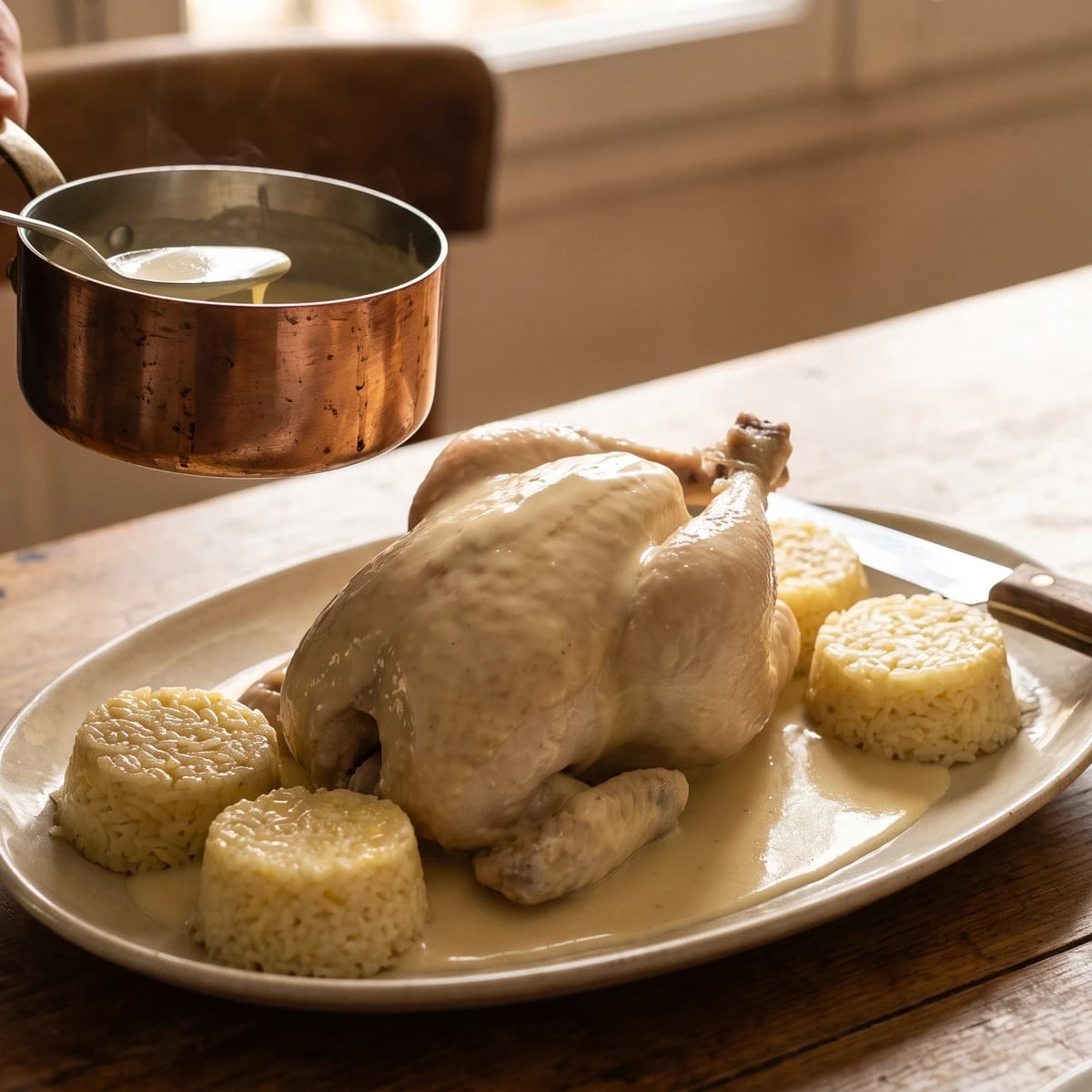
Poularde au Riz turns one clear poaching liquor into three expressions: tender chicken, buttered rice timbales, and glossy Sauce Allemande deepened with chicken essence. Protect the liquor and the dish is already half made.

Main Dishes
French
Comfort Food
Dinner Party
Weeknight
25 min
Active Time
1 hr 45 min cook2 hr 10 min total
Yield4 servings

Poularde au Riz (poached chicken with rice) teaches economy in the classical sense: one fragrant poaching liquor cooks the rice, forms the body of Sauce Allemande (velouté enriched with yolk and cream), and reduces into the chicken essence that gives the sauce its authority. The liquor is the flavour. Protect it, and the entire dish speaks with one voice.

The original assumed a stockpot never off the fire, a saucier reducing essence, another pair of hands buttering rows of timbale moulds, and a bird large enough for a full service. At home, a snug stockpot, one saucepan, four small ramekins, and a plump chicken do the work. The brigade's separate stock and extra hands are scaffolding, so they can go; the bare poach, concentrated essence, Sauce Allemande, and moulded rice are the dish, so they stay. That is the honest scale for one cook, one stove, one evening.

When it is right, the poularde arrives beneath an ivory sauce with a quiet gloss, surrounded by neat, buttered rice timbales that taste deeply of chicken rather than water. Before touching a pan, know the step that decides everything: the poaching liquor must barely tremble, never boil.

Poularde au Riz belongs to the Parisian classical and cuisine bourgeoise table, where poached poultry was presented whole beneath a finished sauce and surrounded by precisely moulded garnishes. Bresse is celebrated for the poularde itself, but this preparation is not a Bressan regional specialty; its grammar belongs to the national sauce canon carried from grand kitchens into prosperous home dining rooms. Sauce Allemande's name is a frequent distraction: it is a French velouté finished with yolk and cream, and here reduced poultry liquor makes the difference between a merely pale sauce and one that tastes unmistakably of chicken.

The technique, the tradition, and the story behind every dish.

Discover Culinary Explorer

Ingredients

whole poularde or plump young chicken

Quantity

1 whole, 3¾ to 4 lb (1.7 to 1.8 kg)

cold water

Quantity

10 cups (2.4 L / 2.4 kg), plus more only if needed to cover

yellow onion

Quantity

1 medium (about 1 cup / 150 g)

peeled and quartered

leek, white and pale green parts only

Quantity

1 medium (about 1½ cups / 150 g)

split and thoroughly rinsed

celery stalk

Quantity

1 large (about ½ cup / 60 g)

cut into three pieces

bouquet garni of parsley stems, thyme, and bay leaf

Quantity

1

whole black peppercorns

Quantity

1 teaspoon (5 ml / 3 g)

fine sea salt

Quantity

2 teaspoons (10 ml / 12 g), plus more as needed

long-grain white rice

Quantity

1¼ cups (300 ml / 250 g)

unsalted butter

Quantity

5 tablespoons (75 ml / 70 g)

divided

all-purpose flour

Quantity

¼ cup (60 ml / 30 g)

heavy cream

Quantity

½ cup (120 ml / 120 g)

divided

large egg yolks

Quantity

2

fresh lemon juice

Quantity

1 tablespoon (15 ml / 15 g)

ground white pepper

Quantity

¼ teaspoon (1.25 ml / 0.5 g)

Equipment Needed

  • Snug 6 to 8-quart stockpot
  • Fine-mesh sieve
  • 2-quart heavy saucepan
  • Instant-read thermometer
  • Four 6-ounce ramekins or small timbale moulds
  • Warm oval serving platter

Instructions

  1. 1

    Prepare the poularde

    Remove the packet from the cavity, but do not wash the bird. Tie the legs loosely together and tuck the wing tips underneath, which keeps the poularde compact enough to cook evenly and present whole. Set it breast-side up in a snug 6 to 8-quart stockpot. Add the onion, leek, celery, bouquet garni, peppercorns, and salt, then pour in enough cold water to cover the bird by about 1 inch (2.5 cm). A snug pot matters because unnecessary water makes a weak liquor.

  2. 2

    Poach at a tremble

    Bring the liquid up slowly over medium heat, skimming away the grey foam before it disperses. As soon as small bubbles gather around the edge, lower the heat and partially cover the pot. Hold the liquor between 180 and 185°F (82 and 85°C), with only an occasional bubble breaking the surface, for 50 to 65 minutes. The thickest part of the breast must reach 165°F (74°C), and the inner thigh should reach at least 170°F (77°C). If the pot boils, pull it halfway off the heat and add ½ cup (120 ml / 120 g) cold water to stop the violence. Ça se rattrape: resume at the gentlest tremble and strain the liquor carefully later.

    A hard boil tightens the meat and churns fat and proteins into the liquor. Gentle poaching gives both tender poultry and a clean foundation for the sauce.
  3. 3

    Strain the liquor

    Lift the poularde carefully, tipping it over the pot so the cavity drains. Set it breast-side up on a rack over a warmed platter and cover loosely with foil. Strain the liquor through a fine sieve without pressing the vegetables, let it stand for 5 minutes, then skim off most of the surface fat. Measure 1½ cups (360 ml / 360 g) for the chicken essence, 2 cups (480 ml / 480 g) for the sauce, and 1¾ cups (420 ml / 420 g) for the rice. Keep any remaining liquor hot for loosening the sauce. Taste before adding more salt, because the essence will concentrate everything.

  4. 4

    Reduce the essence

    Pour the 1½ cups (360 ml / 360 g) of reserved liquor into a wide saucepan and boil steadily until reduced to ½ cup (120 ml / 120 g), about 10 to 15 minutes. It should taste intensely of chicken without becoming harsh or aggressively salty. If it reduces too far, loosen it with a spoonful of reserved liquor. Transfer the chicken essence to a small bowl and keep it nearby.

  5. 5

    Cook and mould rice

    Butter four 6-ounce (180 ml) ramekins with 1 tablespoon (15 ml / 14 g) of the butter. Melt another tablespoon (15 ml / 14 g) in a lidded saucepan, add the rice, and cook for 2 minutes, stirring until every grain is coated and looks pearly. This is nacrer, coating the rice in fat before its liquid arrives. Add the 1¾ cups (420 ml / 420 g) hot poaching liquor, bring it to a simmer, cover tightly, and cook over very low heat for 15 to 17 minutes. Rest off the heat for 5 minutes, then fluff and taste. If the rice is wet, uncover it over low heat for a minute; if it is firm and dry, add 2 tablespoons (30 ml / 30 g) hot liquor, cover, and wait 3 minutes. Pack the rice gently into the buttered ramekins and cover to keep warm.

  6. 6

    Build Sauce Allemande

    Melt 2 tablespoons (30 ml / 28 g) butter in the saucepan used for the essence. Stir in the flour and cook this pale roux for 2 minutes without letting it brown. Gradually whisk in the 2 cups (480 ml / 480 g) hot poaching liquor, adding the first portion slowly so the roux stays smooth. Simmer gently for 8 to 10 minutes, whisking often, until the velouté reaches nappe, coating the back of a spoon in an even film. If lumps form, whisk firmly off the heat; if they persist, strain the sauce and carry on. Whisk the egg yolks with 7 tablespoons (105 ml / 105 g) of the cream. Slowly whisk in a ladleful of hot velouté, then return the mixture to the saucepan. Cook over the lowest heat, stirring constantly, until the sauce thickens slightly, but never let it boil. Whisk in the chicken essence, lemon juice, white pepper, and the final tablespoon (15 ml / 14 g) of butter. Taste before adjusting the salt. If the liaison shows its first graininess, remove the pan from the heat, whisk in the reserved tablespoon (15 ml / 15 g) cold cream, and strain into a clean bowl. Ça se rattrape. If the finished Sauce Allemande is too thick to pour, loosen it with hot poaching liquor one spoonful at a time.

    Once the yolks enter, boiling is forbidden. Gentle heat gives the Sauce Allemande its satin body; high heat turns the liaison into scrambled egg.
  7. 7

    Dish and coat

    Remove the trussing string and transfer the poularde to a warm oval platter. Spoon enough Sauce Allemande over the bird to cloak it generously while leaving its shape visible, then pour the rest into a warm sauce boat. Run a thin knife around each ramekin and invert the rice timbales around the poularde. Lift each mould straight upward so the rice keeps its shape. Carry the platter to the table whole and carve there, giving every serving chicken, rice, and another spoonful of sauce. À table!

Chef Tips

  • A true poularde is a plump, tender young hen with enough fat to remain succulent during poaching. If your butcher doesn't carry one, choose a broad-breasted 3¾ to 4-pound chicken. Technique first, always; a modest bird poached carefully will beat a splendid one sent through a rolling boil.
  • Use the smallest pot that holds the chicken comfortably. A wide stockpot demands too much water, and no amount of ceremony can give diluted liquor the body this sauce needs.
  • No timbale moulds are required. Four straight-sided 6-ounce ramekins or small heatproof teacups give the rice its proper shape without filling a cupboard with single-purpose equipment.
  • Sauce Allemande waits poorly over direct heat. Hold it for no more than 20 minutes in a bowl set over barely warm water, stirring occasionally; if it tightens, loosen it with a spoonful of hot poaching liquor.
  • Pour a dry Chardonnay with enough body for the cream and egg liaison, such as a white Burgundy. The wine should refresh the sauce, not compete with the quiet flavour of the poached bird.

Advance Preparation

  • The poularde may be poached up to one day ahead. Cool the bird and strained liquor separately, refrigerate both promptly, then rewarm the chicken very gently in the liquor until its centre reaches 165°F (74°C).
  • The chicken essence can be reduced one day ahead and chilled in a covered container. Cook the rice and finish the Sauce Allemande near serving time, since moulded rice dries during reheating and the yolk liaison dislikes a second cooking.
  • The vegetables, bouquet garni, and buttered ramekins can be prepared earlier the same day, leaving the evening's work to poaching, reduction, and assembly.

Frequently Asked Questions

Nutrition Information

1 serving (about 500g)

Calories
955 calories
Total Fat
53 g
Saturated Fat
24 g
Trans Fat
1 g
Unsaturated Fat
25 g
Cholesterol
340 mg
Sodium
900 mg
Total Carbohydrates
59 g
Dietary Fiber
1 g
Sugars
2 g
Protein
57 g

Note: Chef personas and recipes are created with AI assistance. Cook with care: follow safe food-handling practices, check doneness with a thermometer when needed, and adapt for allergies and your kitchen.

Where cooking meets culture.

Culinary guides, cultural storytelling, and the editorial depth that makes cooking meaningful.

Discover Culinary Explorer

More from Poultry (Volaille)

Browse the full collection