
Chef Juliette
John Dory (St. Pierre)
John Dory has the delicacy of sole and the firmness of turbot. A light flouring, a quick butter sauté, and nut-brown beurre noisette show exactly why looks never mattered.
A cooking platform built around craft, culture, and the stories behind what we eat.
Created by Chef Juliette
Based on No. 1511, Poularde Reine Margot, from Le Guide Culinaire (1907) by Auguste Escoffier
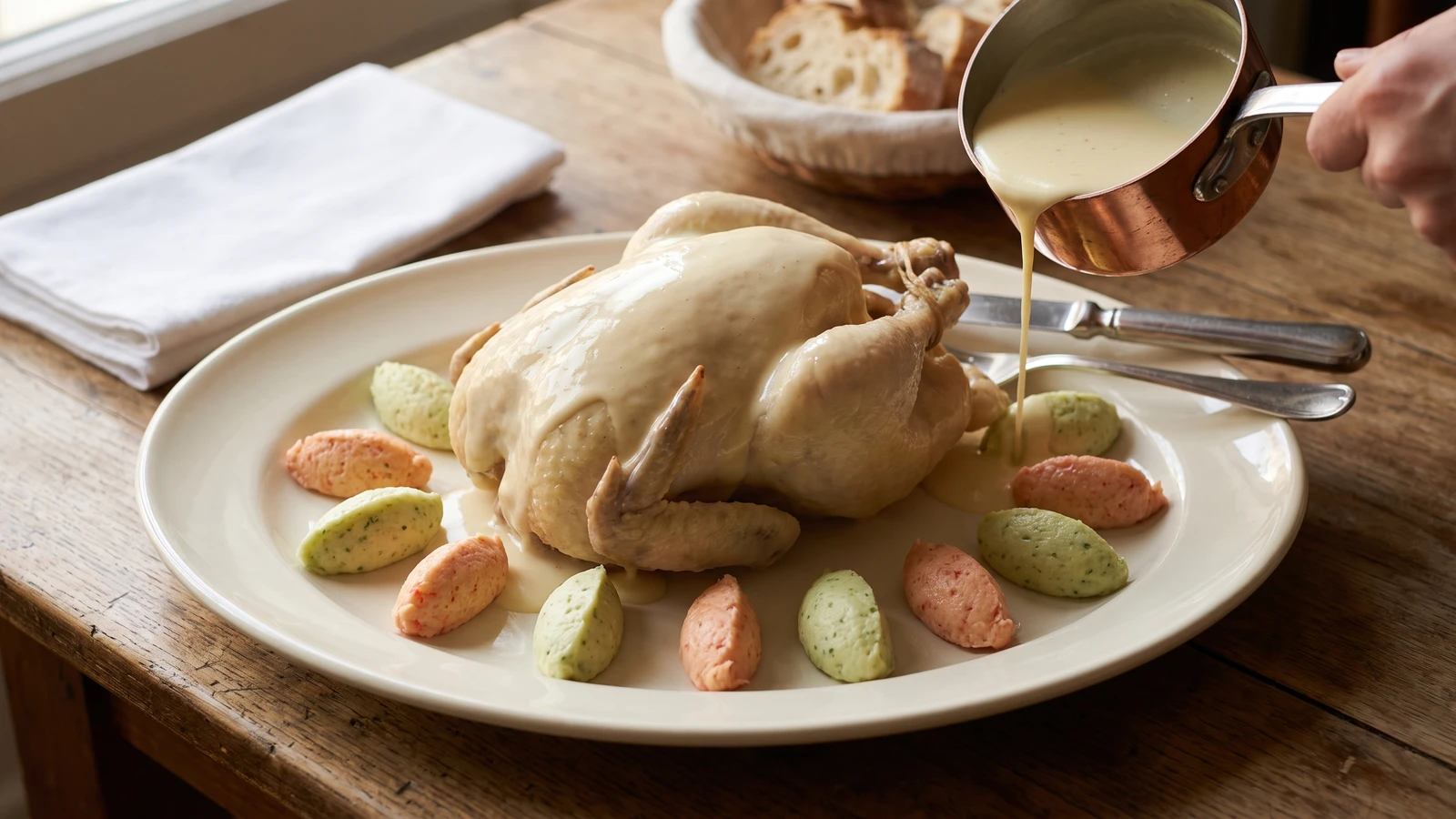
A poached poularde with almond mousseline at its heart, ivory sauce suprême over the breast, and alternating green pistachio and coral crayfish quenelles: grand French grammar brought within reach of one stove.
Poularde Reine Margot (poached chicken with almond mousseline and two-color quenelles) teaches the most exacting rule of a mousseline: temperature is an ingredient. Keep the chicken, cream, bowl, and blade cold, and the forcemeat becomes light and close-grained; let it warm and the emulsion loosens before the bird reaches the pot. That is the one true thing to know before touching a pan.
The original entry assumed a saucier tending sauce suprême from a stockpot never cold, separate hands shaping green pistachio and coral crayfish quenelles, and a poaching rondeau broad enough for service. This version keeps its exact stuffing ratio, two-thirds pound of mousseline to two ounces of almond purée, but uses one food processor batch, one snug stockpot, strained poaching liquor, and a warm oven for the brief hold. A salamander has no work here because this finish is coated, not browned. Separate brigade batches are scaffolding and can go; the cold emulsion, gentle poach, almond finish, and alternating colors are the dish and stay.
The finished poularde is pale and magnificent beneath an ivory gloss, with tender almond stuffing inside and a ring of green and coral quenelles declaring that this is dinner with an occasion attached. One cook, one stove, one evening. Before you begin, clear space in the refrigerator and set a bowl of ice beside the processor. Keeping the mousseline cold is the step that decides everything.
Poularde Reine Margot belongs to the named poultry dishes of Parisian grand cuisine, where a whole poached poularde became a canvas for a composed sauce and formal garnish. The title invokes Marguerite de Valois, remembered as Reine Margot, but the dish is a culinary dedication, not proof of a recipe preserved from her household. Its alternating green pistachio and coral crayfish quenelles show the classical habit of making color through flavored preparations, while almond binds stuffing and sauce into one idea.
Quantity
1, weighing 4 to 4½ pounds (1.8 to 2 kg)
giblets removed
Quantity
about 2 cups (475 ml / 300 g)
diced and thoroughly chilled
Quantity
1
thoroughly chilled
Quantity
¾ cup (180 ml / 180 g)
thoroughly chilled
Quantity
2 teaspoons (10 ml / 12 g)
divided
Quantity
½ teaspoon (2.5 ml / 1 g)
divided
Quantity
⅛ teaspoon (0.6 ml / 0.25 g)
Quantity
¼ cup (60 ml / 57 g)
Quantity
2 teaspoons (10 ml / 10 g)
Quantity
1 teaspoon (5 ml / 5 g)
softened
Quantity
½ cup (120 ml / 45 g)
rinsed, dried, and crushed
Quantity
2 tablespoons (30 ml / 28 g)
Quantity
8 cups (1.9 L / 1.9 kg)
Quantity
up to 4 cups (950 ml / 950 g)
as needed to cover the poularde
Quantity
4 tablespoons (60 ml / 57 g)
divided
Quantity
3 tablespoons (45 ml / 24 g)
Quantity
1 cup (240 ml / 240 g)
Quantity
½ cup (120 ml / 120 g)
| Ingredient | Quantity |
|---|---|
| poularde or small roasting chickengiblets removed | 1, weighing 4 to 4½ pounds (1.8 to 2 kg) |
| skinless chicken breastdiced and thoroughly chilled | about 2 cups (475 ml / 300 g) |
| large egg whitethoroughly chilled | 1 |
| heavy cream for the mousselinethoroughly chilled | ¾ cup (180 ml / 180 g) |
| fine sea saltdivided | 2 teaspoons (10 ml / 12 g) |
| ground white pepperdivided | ½ teaspoon (2.5 ml / 1 g) |
| freshly grated nutmeg | ⅛ teaspoon (0.6 ml / 0.25 g) |
| smooth unsweetened blanched almond purée | ¼ cup (60 ml / 57 g) |
| unsweetened pistachio paste | 2 teaspoons (10 ml / 10 g) |
| unsalted butter for the pistachio buttersoftened | 1 teaspoon (5 ml / 5 g) |
| cooked crayfish shellsrinsed, dried, and crushed | ½ cup (120 ml / 45 g) |
| unsalted butter for the crayfish butter | 2 tablespoons (30 ml / 28 g) |
| rich unsalted white chicken stock | 8 cups (1.9 L / 1.9 kg) |
| cold wateras needed to cover the poularde | up to 4 cups (950 ml / 950 g) |
| unsalted butter for the sauce suprêmedivided | 4 tablespoons (60 ml / 57 g) |
| all-purpose flour | 3 tablespoons (45 ml / 24 g) |
| heavy cream for the sauce suprême | 1 cup (240 ml / 240 g) |
| plain unsweetened almond milk | ½ cup (120 ml / 120 g) |
Stir the pistachio paste with the softened teaspoon of butter until you have a smooth beurre de pistache, then chill it until firm but still pliable. For the beurre d’écrevisse, crayfish-shell butter, melt the remaining two tablespoons of butter over low heat, add the crushed shells, and cook gently for 10 minutes, pressing them against the pan without letting the butter brown. Strain through a fine sieve and press firmly to extract the coral-colored butter. Measure 1 tablespoon (15 ml / 14 g), cool it until softly set, and freeze any remainder for another sauce.
Chill the processor bowl and blade for 15 minutes. Process the diced chicken with 1¼ teaspoons (6.25 ml / 7.5 g) of the salt, ¼ teaspoon (1.25 ml / 0.5 g) of the white pepper, and the nutmeg until the meat becomes smooth and tacky. Add the egg white and process briefly. With the machine pulsing, add the cold cream in four additions, stopping as soon as each disappears. Press the mousseline through a fine sieve into a bowl set over ice. Poach a teaspoonful in barely trembling stock and taste it for seasoning. If the paste turns glossy, greasy, or loose in the processor, stop immediately. Ça se rattrape: chill it over ice for 10 minutes, then work in 1 tablespoon (15 ml / 15 g) of very cold cream taken from the sauce allowance.
Weigh out exactly 10⅔ ounces (302 g) of chicken mousseline and fold in the ¼ cup (60 ml / 57 g) of almond purée. This preserves the source ratio, and the ratio matters more than making the number look tidy. Spoon the almond mousseline into the poularde without compressing it, close the cavity with skewers, and truss the legs securely. Divide the remaining plain mousseline equally between two chilled bowls, cover both directly on the surface, and keep them over ice.
Set the stuffed poularde breast-side up in a snug stockpot, using a square of muslin as a lifting sling if you have one. Add the chicken stock and enough cold water to cover the bird by about 1 inch (2.5 cm). Bring the liquid slowly to 180 to 185°F (82 to 85°C), then hold it there for 75 to 90 minutes. The surface should quiver, never boil. If bubbles begin breaking hard around the bird, pull the pot from the heat, add a small splash of cold water, and lower the burner before returning it. Ça se rattrape. A hard boil tears the skin, toughens the mousseline, and clouds the stock.
While the poularde poaches, fold the chilled beurre de pistache into one bowl of mousseline and 1 tablespoon (15 ml / 14 g) of softly set beurre d’écrevisse into the other. Mix only until the colors are even, keeping both bowls nested over ice. The brigade made separate mousseline batches for these garnishes; dividing one neutral batch gives the same two preparations without asking one cook to repeat the entire emulsion.
Insert an instant-read thermometer through the cavity opening into the center of the almond stuffing without touching bone. It must reach 165°F (74°C), and the thickest part of the thigh should reach at least 170°F (77°C). Lift the poularde carefully, let the cavity drain, and place it on a rack over a shallow pan. Cover loosely and hold it in a 170°F (75°C) oven for no longer than 35 minutes. Skim the poaching liquor, strain it, and measure 2 cups (475 ml / 475 g) into a saucepan for the sauce.
Return the remaining poaching liquor to 175 to 180°F (79 to 82°C). Using two teaspoons dipped in hot water, shape six small ovals from each colored mousseline and lower them into the liquid in batches. Poach for 6 to 8 minutes, turning once, until lightly springy and cooked to 165°F (74°C) at the center. Lift them onto a warm plate and cover. If the first quenelle frays at the edges, the liquid is too hot or the paste has warmed. Lower the heat and chill the mixtures for 10 minutes before continuing; the next one will hold.
Bring the reserved 2 cups (475 ml / 475 g) of poaching liquor to a full boil for 3 minutes, then keep it hot. Melt 3 tablespoons (45 ml / 42 g) of the sauce butter in a clean saucepan, stir in the flour, and cook this roux gently for 2 minutes without coloring it. Whisk in the hot liquor a little at a time, making each addition smooth before the next. Simmer for 10 minutes, add the heavy cream, and reduce gently until the sauce naps the back of a spoon. Add the almond milk and simmer just long enough to restore that light coating consistency. Strain, season with the remaining salt and white pepper as needed, then whisk in the final tablespoon of cold butter off the heat. If the sauce is too thick, loosen it with poaching liquor; if thin, simmer it longer. If it looks oily, whisk in a tablespoon of cold almond milk. Ça se rattrape.
Remove the skewers and twine, set the poularde breast-side up on a warm oval platter, and spoon enough sauce suprême over it to coat the surface in an even ivory gloss. Arrange the pistachio and crayfish quenelles alternately around the bird, green then coral, and carry the remaining sauce separately in a warm sauceboat. Carve at the table so every plate receives poultry, almond stuffing, one quenelle of each color, and a generous spoonful of sauce. À table!
1 serving (about 500g)
Culinary guides, cultural storytelling, and the editorial depth that makes cooking meaningful.
Discover Culinary ExplorerChef Juliette
John Dory has the delicacy of sole and the firmness of turbot. A light flouring, a quick butter sauté, and nut-brown beurre noisette show exactly why looks never mattered.

Chef Juliette
Fresh haddock proves its delicacy in the meunière pan: a fine flour crust, moist pearly flakes, and beurre noisette sharpened with lemon and parsley, ready from one skillet in half an hour.

Chef Juliette
Éperlans à l’Anglaise turns small fish into a lesson in disciplined coating: boned smelts under a close, crisp crumb, pan-fried in clarified butter and finished with bright, half-melted maître d’hôtel butter.

Chef Juliette
Tiny smelts, shallot, mushrooms, white wine, gratin sauce, and fine bread raspings meet a fierce oven, where the fish must turn tender in the same breath the buttered crust bronzes.