
Chef Juliette
John Dory (St. Pierre)
John Dory has the delicacy of sole and the firmness of turbot. A light flouring, a quick butter sauté, and nut-brown beurre noisette show exactly why looks never mattered.
A cooking platform built around craft, culture, and the stories behind what we eat.
Created by Chef Juliette
Based on No. 1500, Poularde à la Parisienne, from Le Guide Culinaire (1907) by Auguste Escoffier
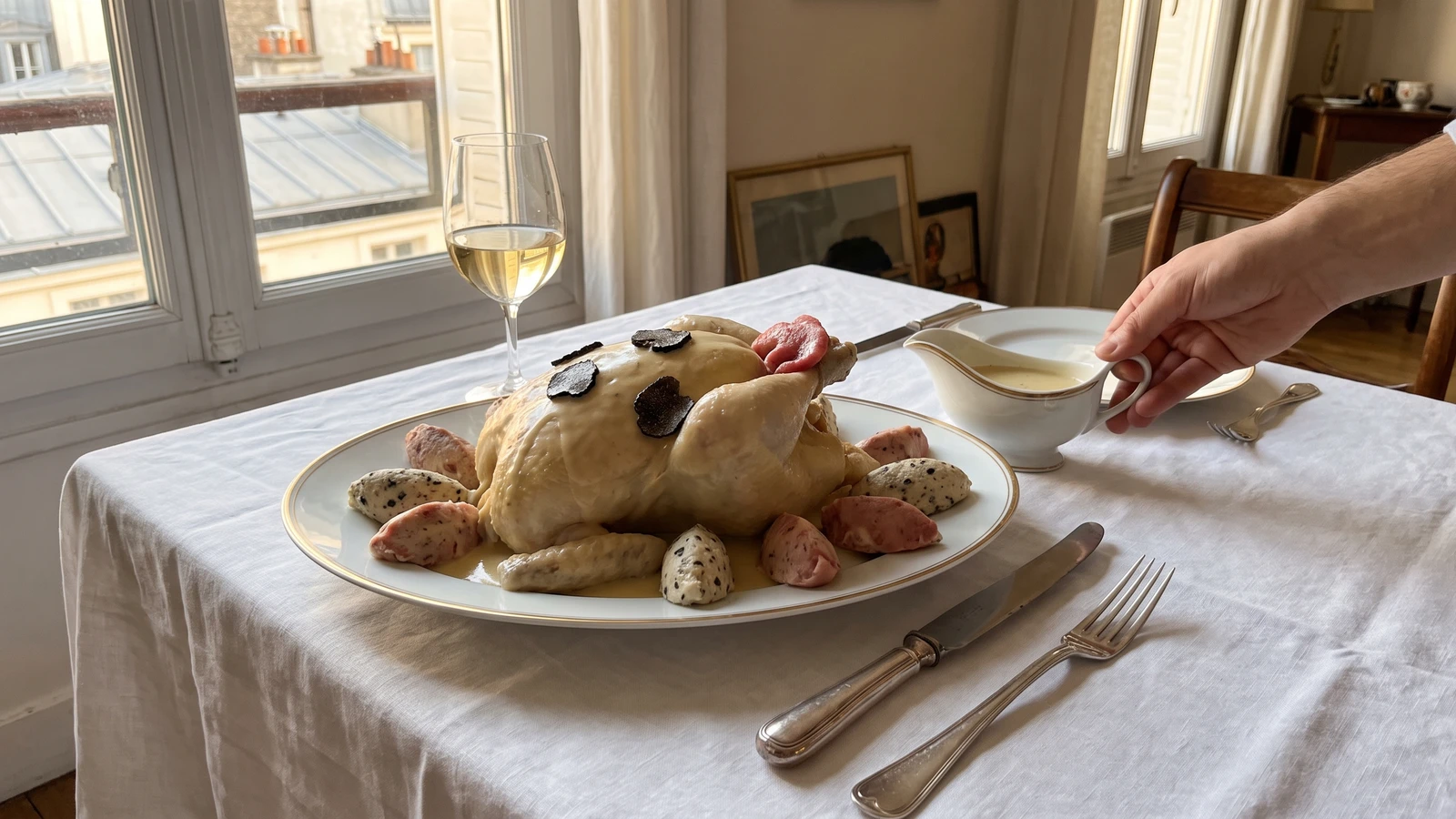
Poularde gently poached, cloaked in yolk-finished Sauce Allemande, and dressed with black truffle, cured tongue, and alternating chicken quenelles: Parisian grand cooking brought intact to a generous home table.
Poularde à la Parisienne (Parisian poached pullet with truffle, tongue, quenelles, and yolk-finished velouté) teaches one discipline above all: gentle heat. The bird and quenelles must poach at a bare tremble, and the Sauce Allemande can be warmed but never boiled once the yolks have finished it. That is the one true thing to know before touching a pan.
The original expected a saucier on staff, a stock never off the fire, prepared chicken forcemeat, a separate pale glaze, and several hands to shape, poach, sauce, and decorate at once. Your home equivalent is a small poularde in a snug stockpot, twelve spoon-moulded quenelles from one batch of chilled forcemeat, prepared Sauce Allemande warmed at the last moment, and a cup of the same poaching liquor reduced for the pale border. The extra pots and extra hands are brigade scaffolding, so they go. The gentle poach, the two flavoured halves of forcemeat, the truffle and tongue, the Allemande, and the thread of glaze are the dish, so every one stays. One cook, one stove, one evening.
When it is right, the bird sits pale and succulent beneath ivory sauce, black truffle and rosy tongue stepping across the breast, with tender quenelles alternating around it like a generous edible border. Shape every garnish before the bird finishes, then guard the Allemande while the platter comes together. That final warming decides the dish: low heat, constant attention, never a boil.
Poularde à la Parisienne belongs to the formal Paris table, where a poached fattened pullet could carry the work of several kitchen stations in one composed dish. Its Sauce Allemande, black truffle, salted tongue cut as cocks' combs, two alternating chicken quenelles, and pale glaze mark a city cuisine built from precise preparations rather than a single regional larder. Parisienne here names the arrangement and method, not an ingredient grown around Paris, a useful correction to the idea that every French place-name signals a rustic local stew.
Quantity
1 (3½ to 4 lb / 1.6 to 1.8 kg)
Quantity
10 cups (2.4 L / 2.4 kg)
Quantity
Up to 2 cups (480 ml / 480 g)
only if needed to cover the bird
Quantity
1 (5 oz / 140 g)
peeled and cut into large pieces
Quantity
1 (5 oz / 140 g)
washed and cut into large pieces
Quantity
1 (6 oz / 170 g)
peeled and quartered
Quantity
1
Quantity
1 tablespoon (15 ml / 18 g)
Quantity
½ teaspoon (2.5 ml / 1 g)
Quantity
2 cups (480 ml / 450 g)
thoroughly chilled
Quantity
2 small (about ¼ cup / 55 g)
half thinly sliced and half finely chopped
Quantity
¾ cup loosely packed (180 ml / 115 g)
half cut into cocks' combs and half finely chopped
Quantity
2½ cups (600 ml / 600 g)
Quantity
2 tablespoons (30 ml / 30 g)
only if needed to rescue the sauce
| Ingredient | Quantity |
|---|---|
| small poularde or plump young chicken | 1 (3½ to 4 lb / 1.6 to 1.8 kg) |
| unsalted, gelatin-rich chicken stock | 10 cups (2.4 L / 2.4 kg) |
| cold water (optional)only if needed to cover the bird | Up to 2 cups (480 ml / 480 g) |
| medium carrotpeeled and cut into large pieces | 1 (5 oz / 140 g) |
| medium leek, white and pale green partswashed and cut into large pieces | 1 (5 oz / 140 g) |
| medium onionpeeled and quartered | 1 (6 oz / 170 g) |
| bouquet garni of parsley stems, thyme, and bay leaf | 1 |
| fine salt | 1 tablespoon (15 ml / 18 g) |
| ground white pepper | ½ teaspoon (2.5 ml / 1 g) |
| prepared fine chicken forcemeatthoroughly chilled | 2 cups (480 ml / 450 g) |
| whole black truffles, fresh or well-preservedhalf thinly sliced and half finely chopped | 2 small (about ¼ cup / 55 g) |
| cooked salted ox tongue or unsmoked cured beef tonguehalf cut into cocks' combs and half finely chopped | ¾ cup loosely packed (180 ml / 115 g) |
| prepared Sauce Allemande | 2½ cups (600 ml / 600 g) |
| cold heavy cream (optional)only if needed to rescue the sauce | 2 tablespoons (30 ml / 30 g) |
Reserve the truffle slices and cocks' combs of tongue for decorating the bird. To make the tongue shapes, cut thin pieces about 1½ inches long and notch one edge three or four times with the tip of a knife. Divide the cold chicken forcemeat exactly in half. Fold the chopped truffle into one half and the chopped tongue into the other, keeping the two mixtures distinct.
Dip two dessertspoons in cold water. Scoop a rounded spoonful of truffle forcemeat with one, then pass it between the spoons until it forms a smooth oval with tapered ends. Make six, then repeat with the tongue forcemeat. Set all twelve quenelles on a chilled plate, keeping the varieties in separate rows, and return them to the cold. The first may look solemnly lopsided. By the third, your hands will understand.
Set the poularde breast-side up in a snug 6 to 8-quart stockpot. Add the stock, carrot, leek, onion, bouquet garni, salt, and white pepper. The liquid should cover the bird; add only enough cold water to finish the job, and place a small heatproof plate over it if it floats. Bring the liquid from cold to 176 to 185°F (80 to 85°C) over medium heat within about thirty minutes, then lower the heat and hold it at a bare tremble. Poach until both the thickest breast and the inner thigh reach 165°F (74°C), usually another thirty-five to fifty minutes. Never let it boil. If it does, pull the pot off the heat, add a ladleful of cold stock, and resume over lower heat before the flesh tightens.
Lift the poularde carefully, letting the hot liquid drain from its cavity, and set it breast-side up on a rack over a tray. Cover it loosely and rest it while the garnishes cook. Strain the poaching liquor, discard the aromatics, and skim away surface fat. Measure 1 cup (240 ml / 240 g) into a small saucepan for the glaze, then return enough liquor to the stockpot to poach the quenelles.
Bring the strained liquor back to 176 to 185°F (80 to 85°C). Lower in the quenelles without crowding them, working in two batches if necessary, and poach for eight to twelve minutes, turning once, until they feel lightly springy and reach 165°F (74°C) at the centre. Lift them with a slotted spoon and drain on a clean cloth. A boil makes their surfaces ragged and their centres rubbery; if the liquid grows lively, slide the pot off the burner until it calms.
Boil the measured cup of poaching liquor in the small saucepan until it reduces to ¼ cup (60 ml / about 65 g), skimming as needed. It should remain pale gold and become lightly syrupy, enough to fall from a spoon in a narrow glossy thread. If it turns sticky before reaching that texture, loosen it with a spoonful of strained poaching liquor. This reduction replaces the separate pot of pale glaze a brigade kept ready all day.
Put the prepared Sauce Allemande in a heavy saucepan over the lowest heat. Stir continuously until it is hot, fluid, and able to nap the back of a spoon, about 140 to 149°F (60 to 65°C). If it is too thick, loosen it a tablespoon at a time with strained poaching liquor. Never let it simmer. If the yolks begin to form fine grains, remove the pan from the heat immediately and whisk in 1 tablespoon (15 ml / 15 g) cold cream, adding the second only if needed, then pass the sauce through a fine sieve. Ça se rattrape when you catch it early.
Set the whole poularde on a thoroughly warmed oval platter and coat it generously with Sauce Allemande, letting the ivory sauce settle naturally around the base. Arrange the truffle slices and tongue cocks' combs alternately across the breast. Surround the bird with the quenelles, alternating truffle and tongue from one end of the platter to the other. Spoon the reduced pale glaze in one fine, unbroken thread around the outer edge. Bring the remaining Allemande in a warm sauceboat, present the bird whole, then carve it into four portions at the table. À table!
1 serving (about 510g)
Culinary guides, cultural storytelling, and the editorial depth that makes cooking meaningful.
Discover Culinary ExplorerChef Juliette
John Dory has the delicacy of sole and the firmness of turbot. A light flouring, a quick butter sauté, and nut-brown beurre noisette show exactly why looks never mattered.

Chef Juliette
Fresh haddock proves its delicacy in the meunière pan: a fine flour crust, moist pearly flakes, and beurre noisette sharpened with lemon and parsley, ready from one skillet in half an hour.

Chef Juliette
Éperlans à l’Anglaise turns small fish into a lesson in disciplined coating: boned smelts under a close, crisp crumb, pan-fried in clarified butter and finished with bright, half-melted maître d’hôtel butter.

Chef Juliette
Tiny smelts, shallot, mushrooms, white wine, gratin sauce, and fine bread raspings meet a fierce oven, where the fish must turn tender in the same breath the buttered crust bronzes.