Culinary Explorer

A cooking platform built around craft, culture, and the stories behind what we eat.
Discover Culinary Explorer
Poularde à la Montbazon

Poularde à la Montbazon

Created by Chef Juliette

Based on No. 1494, Poularde à la Montbazon, from Le Guide Culinaire (1907) by Auguste Escoffier

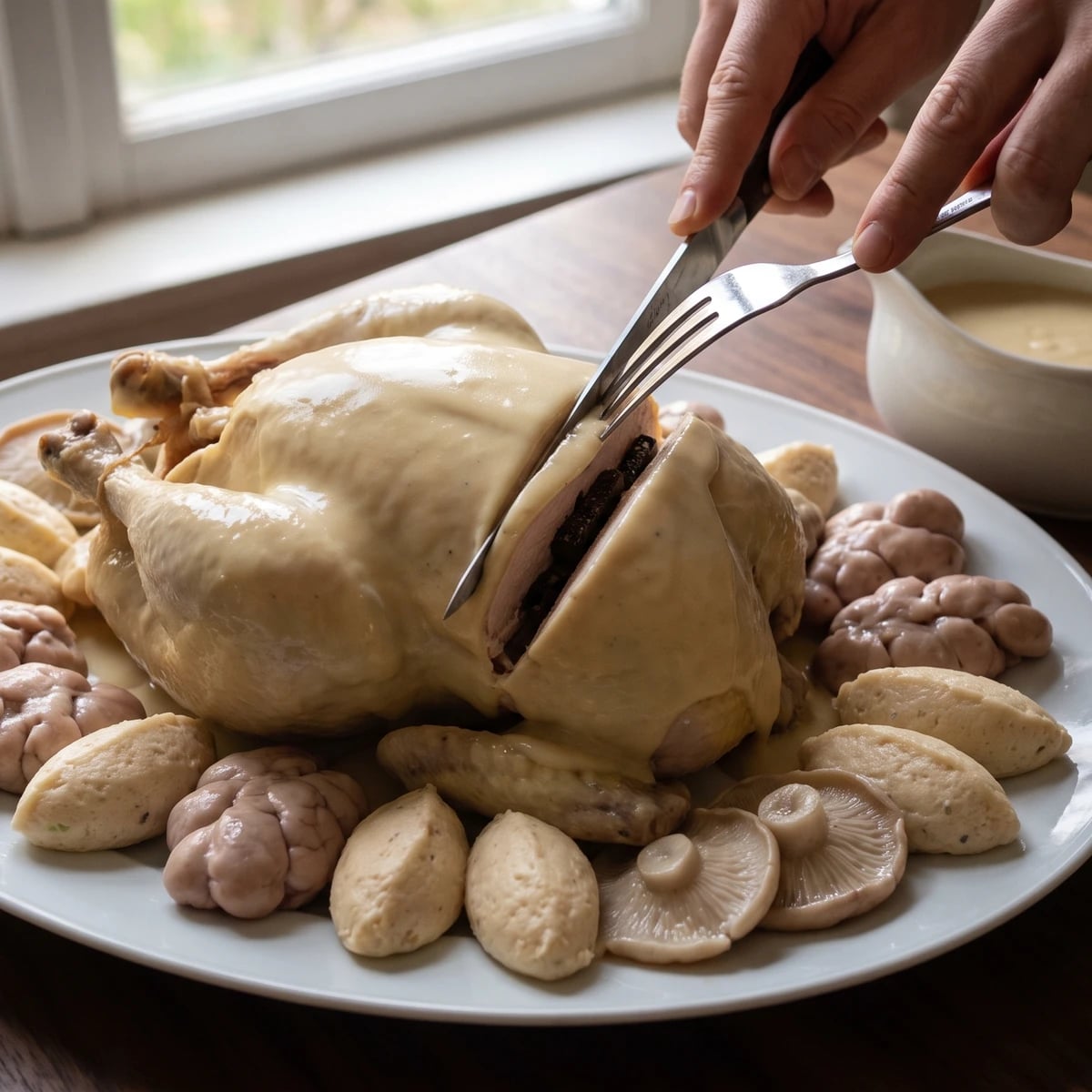
A truffle-studded poularde under ivory Sauce Suprême, encircled by poached lamb sweetbreads, chicken Mousselines, and grooved mushrooms: grand cuisine made coherent for one calm cook at home.

Main Dishes
French
Dinner Party
Special Occasion
2 hr
Active Time
2 hr 15 min cook4 hr 15 min total
Yield4 servings

Poularde à la Montbazon teaches coordination. Its one true rule arrives before the bird meets the pot: blanch the lamb sweetbreads first, because their loose proteins will cloud the poaching liquor and dull the ivory Sauce Suprême, the cream-enriched chicken velouté that binds the dish. Around it sit tender sweetbreads, grooved mushroom caps, and Mousselines, the small spoon-moulded portions of chicken forcemeat named in the book's glossary.

The original entry assumed a saucier, a stockpot never off the fire, a larding needle, and spare hands shaping garnish while the poularde poached. At home, a narrow skewer studs the truffle, a food processor and fine sieve make smooth Mousselines, one saucepan serves each garnish in turn, and a warmed oval platter replaces the hot cupboard. The salamander has no work here, because nothing is gratinéed and the sauce must remain ivory. I have scaled the bird and its alternating garnish to four servings; the brigade's holding pans and ornamental abundance are scaffolding and can go, while the truffle studding, preliminary blanch, gentle poach, mousseline, and Sauce Suprême are the dish and must stay.

Done well, the sauce gleams rather than pastes, each breast slice reveals black truffle, and the alternating garnish makes the platter generous without making it fussy. One cook, one stove, one evening. Begin with the sweetbreads: blanch them cleanly before anything else, and the rest of the service stays clear.

Although its name points to Montbazon in Touraine, Poularde à la Montbazon belongs to the named repertory of Parisian grand cuisine rather than to Touraine farmhouse cooking. Its title draws on the ducal name attached to the town, while its composition follows grand-kitchen grammar: truffled poached poultry, Sauce Suprême, and a formal alternating garnish of sweetbreads, Mousselines, and grooved mushroom caps. The geography is honorific rather than culinary; generations of cooks carried the dish through manuals and formal dining rooms as a composed service piece, not a regional Touraine specialty.

The technique, the tradition, and the story behind every dish.

Discover Culinary Explorer

Ingredients

whole poularde or plump young chicken

Quantity

1, about 4 lb (1.8 kg)

neck and giblets removed

fresh black truffle or whole preserved black truffles

Quantity

1 large or 2 small, about 1½ oz (40 g)

cut into 16 slim batons

unsalted or low-sodium chicken stock

Quantity

12 cups (2.8 L / 2.8 kg)

divided

lamb sweetbread lobes

Quantity

4 small lobes, about 12 oz (340 g)

small white button mushrooms

Quantity

8, about 6 oz (170 g)

stems removed and caps grooved

boneless, skinless chicken breast for the Mousselines

Quantity

8 oz (225 g)

cut into 1-inch (2.5 cm) cubes and thoroughly chilled

large egg white

Quantity

1

thoroughly chilled

heavy cream for the Mousselines

Quantity

¾ cup (180 ml / 180 g)

thoroughly chilled

fine sea salt

Quantity

1 tablespoon (15 ml / 18 g), plus more as needed

divided

ground white pepper

Quantity

½ teaspoon (2.5 ml / 1 g)

divided

all-purpose flour

Quantity

½ cup (120 ml / 60 g)

unsalted butter

Quantity

8 tablespoons (120 ml / 113 g)

divided

heavy cream for Sauce Suprême

Quantity

1½ cups (360 ml / 360 g)

Equipment Needed

  • 7-quart (6.5-liter) stockpot that holds the poularde snugly
  • Food processor
  • Fine-mesh sieve
  • Wide shallow pan for poaching the Mousselines
  • Instant-read thermometer
  • Thin metal skewer and narrow chopstick
  • Two dessert spoons
  • Two small trays and a 2 lb (900 g) weight
  • Large oval serving platter and sauce boat

Instructions

  1. 1

    Blanch the sweetbreads

    Cover the lamb sweetbreads with plenty of cold water and soak them for 1½ hours, changing the water twice. Transfer them to a saucepan, cover with fresh cold water, salt it lightly, and bring slowly to a bare simmer. Blanch for 4 minutes, then drain into ice water. Pull away the outer membrane and any coarse tubes without tearing the lobes, place them between two small trays, and weight the top with about 2 lb (900 g) for 30 minutes. Cut the pressed sweetbreads into 8 neat pieces. The discarded water may turn grey and cloudy; that is the blanch doing its work. If a trimmed lobe still leaks milky residue, blanch it again for 2 minutes in fresh water before pressing.

    Do not skip the blanch because the sweetbreads look clean. The proteins you cannot see are precisely what would escape into the final poaching liquor and muddy the Sauce Suprême.
  2. 2

    Stud and truss

    Pat the poularde dry. Use a thin metal skewer to make 16 shallow channels at an angle through the fleshiest parts of the breasts and thighs, then push a truffle baton into each channel with the narrow end of a chopstick. Tuck any truffle fragments beneath the breast skin. Season the cavity and exterior with about 2 teaspoons of the salt, fold the wing tips underneath, and truss the legs against the body. The skewer and chopstick replace the larding needle cleanly; no special instrument is needed.

  3. 3

    Poach at a tremble

    Set the poularde breast-up in a snug stockpot and add enough cold chicken stock to cover it, reserving at least 1 cup for adjustments. Bring the liquid up slowly over medium heat, skimming the surface as needed. Once it reaches 180 to 185°F (82 to 85°C), lower the heat and partially cover the pot. Poach at the faintest tremble for 55 to 70 minutes, until both the thickest breast and the innermost thigh register 165°F (74°C). Never let the stock boil. If it does, lower the heat immediately and add some reserved cold stock; the flesh will relax, and fine straining will save the broth.

  4. 4

    Make the Mousselines

    While the poularde poaches, process the very cold chicken breast with 1 teaspoon salt and ¼ teaspoon white pepper until the meat becomes smooth and tacky. Add the cold egg white and process only until absorbed. Force the mixture through a fine-mesh sieve into a bowl set over ice, then work in the ¾ cup cold cream in three additions. Keep the mixture cold throughout. Poach a teaspoonful in barely simmering water and taste it. If the test spreads or feathers at the edges, set the bowl over ice for 10 minutes and test again; warmth, not a missing binder, is usually the culprit. If the forcemeat looks grainy, chill it thoroughly and process it for a few seconds until it comes back together.

  5. 5

    Poach the Mousselines

    Bring a wide pan of salted water to 180°F (82°C). With two wet dessert spoons, shape the chicken forcemeat into 8 smooth oval Mousselines, each made from about 2 generous tablespoons. Lower them into the water as they are shaped and poach without boiling for 7 to 9 minutes, turning once, until springy and cooked to 165°F (74°C) at the centre. Lift them out with a slotted spoon and hold them covered on a warm plate.

  6. 6

    Poach the garnish

    When the poularde is cooked, lift it carefully from the stock, drain the cavity, and cover it loosely while it rests. Strain the poaching stock through a fine-mesh sieve. Put 2 cups (475 ml / 475 g) of the strained stock into a clean saucepan and bring it to a bare tremble. Poach the grooved mushroom caps for 4 to 5 minutes, then lift them out. Add the pressed sweetbread pieces and poach for 8 to 10 minutes, until tender and 160°F (71°C) at the centre. Keep the mushrooms, sweetbreads, and Mousselines covered with a few spoonfuls of warm strained stock while the sauce is finished.

  7. 7

    Build Sauce Suprême

    Melt 4 tablespoons (60 ml / 56 g) of the butter in a saucepan over medium-low heat. Stir in the flour and cook this roux for 3 minutes without allowing it to colour. Gradually whisk in 4 cups (950 ml / 950 g) of the warm strained poultry stock, adding each portion only after the last is smooth. Simmer gently for 15 minutes, skimming if needed, then add all but 1 tablespoon of the sauce cream. Reduce for 12 to 18 minutes, until the Sauce Suprême coats the back of a spoon in an even ivory layer. Strain it, remove it from the heat, and whisk in the remaining 4 tablespoons (60 ml / 56 g) cold butter a little at a time. Season with salt and the remaining white pepper. If the sauce is lumpy, simmer while whisking and strain it; if it is too thick, loosen it with stock. If it separates after the butter goes in, put the reserved tablespoon of cold cream in a clean pan and whisk in the broken sauce gradually. Ça se rattrape.

  8. 8

    Dish and coat

    Warm a large oval platter with hot water, then dry it thoroughly. Remove the trussing string, set the whole poularde in the centre, and coat it evenly with about 1¼ cups (300 ml / 300 g) of Sauce Suprême. Drain the garnishes well and arrange them around the bird in the book's alternating order: one lamb sweetbread piece, one Mousseline, one grooved mushroom cap, then repeat. Pour the remaining Sauce Suprême into a warmed sauce boat and serve it separately as the entry directs. Present the bird whole, then carve it at the table so each serving receives truffle-studded poultry and all three garnishes. À table!

Chef Tips

  • A poularde is a plump, specially fattened young hen. If your butcher cannot obtain one, choose a broad-breasted young chicken close to 4 lb (1.8 kg); careful poaching matters more than the label. A much larger capon changes the timing and overwhelms this four-person garnish.
  • Order lamb sweetbreads specifically. Calf sweetbreads are larger and firmer, and although fine in their own preparations, they change the proportions the source gives this delicate poultry dish.
  • Fresh black truffle has the finest perfume, but whole preserved black truffles are the classical pantry's honest answer outside the season. Drain them well and use the truffle itself. Scented oil cannot stud a bird and does not replace it.
  • The Sauce Suprême must be pale, smooth, and rich enough to cling without becoming paste. Cook the roux without colour, reduce before adding the finishing butter, and keep it below a boil afterward. We don't apologize for butter.
  • Serve a dry, full-bodied white with enough structure for truffle and sweetbreads. A white Burgundy is splendid, while a dry Vouvray gives a quiet nod to Touraine without pretending the dish is a regional one.

Advance Preparation

  • The sweetbreads may be soaked, blanched, trimmed, and pressed up to 24 hours ahead. Cover and refrigerate them, then cut and complete their poaching shortly before service.
  • The chicken mousseline forcemeat may be made up to 4 hours ahead and held tightly covered over ice in the refrigerator. The shaped Mousselines may be poached up to 2 hours ahead and rewarmed gently in strained stock.
  • The poularde may be truffle-studded and trussed up to 4 hours ahead. Keep it covered and refrigerated, then take it out 20 minutes before beginning the cold-stock poach.
  • The white roux for Sauce Suprême may be cooked a day ahead and refrigerated. Build the velouté with fresh poaching stock, then add the cream and finishing butter close to service.

Frequently Asked Questions

Nutrition Information

1 serving (about 720g)

Calories
1550 calories
Total Fat
122 g
Saturated Fat
61 g
Trans Fat
3 g
Unsaturated Fat
53 g
Cholesterol
670 mg
Sodium
2450 mg
Total Carbohydrates
19 g
Dietary Fiber
1 g
Sugars
5 g
Protein
94 g

Note: Chef personas and recipes are created with AI assistance. Cook with care: follow safe food-handling practices, check doneness with a thermometer when needed, and adapt for allergies and your kitchen.

Where cooking meets culture.

Culinary guides, cultural storytelling, and the editorial depth that makes cooking meaningful.

Discover Culinary Explorer

More from Poultry (Volaille)

Browse the full collection