Culinary Explorer

A cooking platform built around craft, culture, and the stories behind what we eat.
Discover Culinary Explorer
Poularde à la Lucullus

Poularde à la Lucullus

Created by Chef Juliette

Based on No. 1489, Poularde à la Lucullus, from Le Guide Culinaire (1907) by Auguste Escoffier

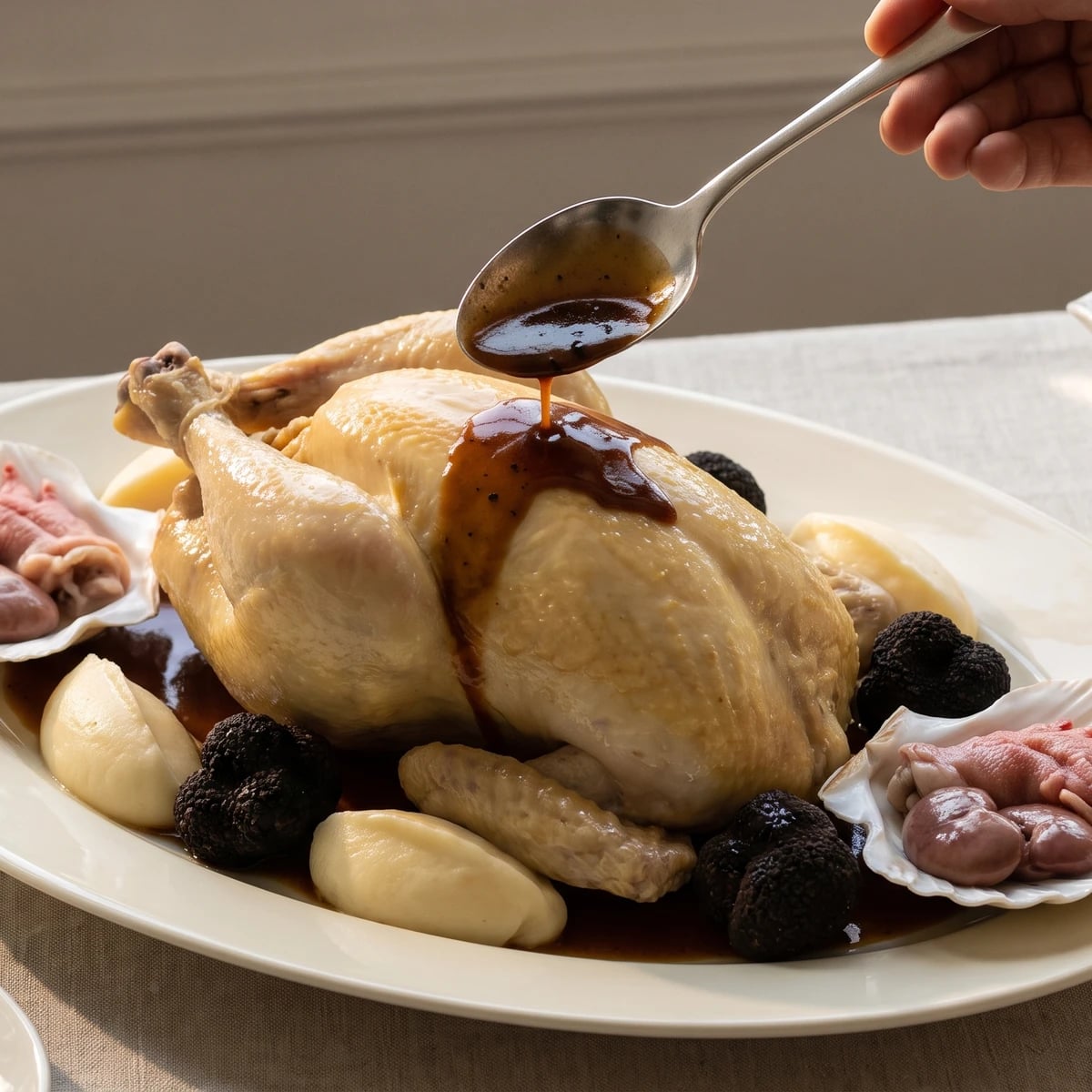
Poularde à la Lucullus teaches orchestration: tender braised bird, Champagne-scented black truffles, trembling Mousselines, and a truffled demi-glace brought together hot, glossy, and generous on one oval platter.

Main Dishes
French
Dinner Party
Special Occasion
Celebration
1 hr
Active Time
2 hr 30 min cook3 hr 30 min total
Yield4 servings

Poularde à la Lucullus (braised pullet with Champagne truffles and Mousselines) teaches orchestration. The bird must remain succulent, the truffles whole and fragrant, the quenelles delicate, and the sauce deep enough to bind everything without burying it. One true thing governs every part: gentle heat. Boil the Mousselines and they turn to cotton wool; hurry the demi-glace and its gloss becomes grease.

The original assumed a saucier on staff, a stock never off the fire, several hands shaping quenelles, silver shells, and an edible cushion built only to raise the bird. Your kitchen gets an unsalted finished demi-glace, a food processor and fine sieve, one cocotte, and two small porcelain shell dishes. The silver and the cushion were brigade scaffolding, so they can go. The braise, Champagne-cooked truffles, Mousselines, poultry offal, truffle essence, and reduced sauce are the dish itself, so every one stays.

This is lavish cooking, but it isn't impossible cooking. Arrange the work around the covered braise and the platter comes together for one cook, one stove, one evening. Keep the Mousseline mixture truly cold, then poach each round at the barest tremble. That is the step that decides the dish.

Poularde à la Lucullus belongs to the Parisian grand-kitchen and formal banquet table, not to one provincial larder. In classical menu language, à la Lucullus announces abundance through black truffles and a concentrated sauce, invoking a name long used as shorthand for lavish appetite; this formula balances that richness with pale Mousselines and the traditional poultry-offal garnish. It passed into bourgeois celebration cooking because all its ceremony is assembled around a familiar braised bird, while the silver shells and edible pedestal remained matters of service rather than flavor.

The technique, the tradition, and the story behind every dish.

Discover Culinary Explorer

Ingredients

poularde

Quantity

1, weighing 4½ to 5 pounds (2 to 2.25 kg)

giblets removed

fine sea salt

Quantity

3 teaspoons (15 ml / 18 g)

divided

ground white pepper

Quantity

1 teaspoon (5 ml / 2 g)

divided

unsalted butter

Quantity

6 tablespoons (90 ml / 85 g)

divided

yellow onion

Quantity

1 medium, about 1 cup (240 ml / 150 g)

cut into ½-inch dice

carrot

Quantity

1 large, about ¾ cup (180 ml / 100 g)

cut into ½-inch dice

celery

Quantity

1 stalk, about ½ cup (120 ml / 60 g)

cut into ½-inch dice

bouquet garni

Quantity

1

made with 2 parsley stems, 2 thyme sprigs, and 1 bay leaf

rich unsalted chicken stock

Quantity

7½ cups (1.8 liters / 1.8 kg)

divided

unsalted demi-glace (half-glaze sauce)

Quantity

2 cups (480 ml / 480 g)

brut Champagne

Quantity

1½ cups (360 ml / 360 g)

small whole black truffles

Quantity

8, about 4 ounces (115 g)

fresh or preserved, drained

natural truffle packing juice (optional)

Quantity

2 tablespoons (30 ml / 30 g)

boneless, skinless chicken breast for the Mousselines

Quantity

12 ounces (340 g)

diced

large egg whites for the Mousselines

Quantity

2

heavy cream for the Mousselines

Quantity

1 cup (240 ml / 240 g)

freshly grated nutmeg for the Mousselines

Quantity

1/16 teaspoon (0.3 ml / 0.1 g)

cleaned cocks' combs

Quantity

4

cleaned cocks' kidneys (rooster testicles)

Quantity

8

fresh lemon juice

Quantity

2 tablespoons (30 ml / 30 g)

Equipment Needed

  • 6-to-7-quart heavy cocotte with lid
  • Food processor
  • Fine-mesh drum sieve or sturdy fine sieve
  • Wide 10-to-12-inch straight-sided sauté pan
  • Small heavy saucepan with parchment lids
  • Instant-read thermometer
  • 20-to-22-inch oval serving platter
  • Two small porcelain shell dishes or shallow ramekins
  • Warm sauceboat

Instructions

  1. 1

    Chill Mousseline components

    Put the diced chicken breast, food-processor bowl and blade, egg whites, and cream in the freezer for 15 minutes. They must become very cold without freezing. Reserve 2 tablespoons of the cream separately. Mousseline forcemeat is an emulsion, and cold keeps its fat and moisture bound together instead of letting them separate.

    Set the processor bowl inside a larger bowl of ice while you work if the kitchen is warm. Temperature matters more than speed here.
  2. 2

    Make the Mousselines

    Process the cold chicken with 1 teaspoon of the salt, ¼ teaspoon of the white pepper, and the nutmeg until it becomes smooth, sticky, and pale. Add the egg whites one at a time, processing only until each disappears, then pour in all but the reserved cream in a thin stream. Press the forcemeat through a fine sieve and fold in the final cream. Poach a teaspoonful in barely trembling stock and taste it; adjust the seasoning, then shape 8 large rounds with two wet spoons or a ⅓-cup scoop and chill them on a buttered tray. If the forcemeat turns oily or grainy, stop before adding more cream. Chill it for 10 minutes, whisk a spoonful with a little of the reserved cold cream until smooth, then fold that back through the rest. Ça se rattrape.

    The food processor replaces the mortar work of the brigade, but the fine sieve stays. It removes sinew and gives Mousselines their satin texture.
  3. 3

    Start the braise

    Heat the oven to 325°F (165°C). Dry the poularde, truss it compactly, and season it inside and out with 1½ teaspoons of the salt and ½ teaspoon of the white pepper. Melt 2 tablespoons of the butter in a snug heavy cocotte and turn the bird through it until the skin is evenly pale gold, not deeply roasted. Lift it out, add the onion, carrot, and celery, and cook for 7 to 8 minutes without darkening them. Return the poularde breast-side up, add 2½ cups of the chicken stock and the bouquet garni, and cover the bird with parchment rubbed with 1 tablespoon of butter. Cover the cocotte and braise until the liquid barely trembles and the breast reaches 162°F (72°C) while the thigh reaches about 175°F (79°C), usually 65 to 80 minutes.

  4. 4

    Whiten the offal

    While the poularde braises, curve each cleaned cocks' comb gently into a crescent and secure it with a short wooden pick. Put the combs in a small saucepan with 1½ cups of the chicken stock, the lemon juice, ¼ teaspoon of salt, and a small parchment lid. Poach at the barest tremble for 35 to 45 minutes, adding the cocks' kidneys for the final 8 minutes, until the combs are tender and the kidneys are firm, white, and cooked through. A boil toughens the kidneys and darkens the combs; if the liquid starts rolling, move the pan off the heat at once and resume more gently. Hold everything in its cooking liquor.

  5. 5

    Poach at a tremble

    Heat 3 cups of the chicken stock in a wide straight-sided pan to 165 to 175°F (74 to 79°C). Lower in the Mousselines without crowding, working in two batches if necessary, and poach for 8 to 10 minutes, turning once, until they feel lightly resilient and reach 165°F (74°C) at the center. The liquid must quiver but never boil. If it does boil, lift the pan off the heat and add up to ½ cup of the reserved cold stock; the first roughened quenelle cannot become silk again, but the rest can be saved. Ça se rattrape. Hold the cooked Mousselines in the warm poaching stock.

  6. 6

    Cook truffles in Champagne

    Put the whole truffles and Champagne in the smallest saucepan that holds them comfortably. Cover with a parchment lid and cook at a bare simmer for 8 minutes if fresh or 5 minutes if preserved. Lift out the truffles and keep them covered. Reduce the Champagne cooking liquor gently to ¼ cup, then add the natural packing juice if using preserved truffles. This concentrated liquor is the essence de truffe, the truffle essence that will finish the sauce. If it reduces too far, loosen it with a spoonful of reserved stock.

  7. 7

    Rest and strain

    Transfer the cooked poularde to a warm tray, cover it loosely, and rest it for at least 15 minutes so the breast completes its cooking without drying. Strain the braising liquor into a saucepan without pressing the vegetables, then skim away the surface fat. Reduce the liquor briskly to 1 cup. If the cocotte yielded less, make up the measure with reserved chicken stock; the sauce needs the bird's liquor, but it does not need muddy, crushed vegetables.

  8. 8

    Build the truffled sauce

    Whisk the demi-glace into the reduced braising liquor and simmer until the sauce coats the back of a spoon and leaves a clean line when you draw a finger through it. Add the essence de truffe and taste before adding the remaining salt or white pepper, because every reduction concentrates seasoning. Take the pan off the heat and whisk in 2 tablespoons of cold butter, a little at a time, until the sauce gleams. If the butter separates into greasy beads, begin with 1 tablespoon of cold stock in a clean saucepan and whisk the broken sauce into it spoonful by spoonful. Ça se rattrape.

  9. 9

    Warm every garnish

    Warm the Mousselines gently in their poaching stock and the truffles in a spoonful of the finished sauce. Remove the wooden picks from the cocks' combs, then warm the combs and kidneys in a little of their cooking liquor with the final tablespoon of butter. Warm the oval platter, two small porcelain shell dishes, and sauceboat. Nothing should wait once the sauce is mounted with butter.

  10. 10

    Dish à la Lucullus

    Pour about ¾ cup of the truffled demi-glace across the bottom of the warm oval platter and set the whole poularde directly in its center. The old edible cushion added height, not flavor, so it is omitted. Ring the bird with the 8 whole truffles alternating with the 8 large round Mousselines. Set one porcelain shell dish at each end of the platter and fill each with 2 curled cocks' combs and 4 cocks' kidneys. Send the remaining sauce separately in the warm sauceboat, exactly as the source intends. À table!

Chef Tips

  • A poularde is a plump young hen raised for tenderness, not a capon. Order one from a good poultry butcher. If it cannot be found, use the fullest 4½-to-5-pound chicken available and expect slightly leaner meat; technique first, always.
  • Use fresh black truffles when the season gives them honestly, and whole preserved black truffles at other times. The classical pantry solved this problem long ago. Truffle oil cannot replace the whole truffles or their natural juice.
  • Buy a real, unsalted demi-glace from a butcher or a reliable frozen source. The stockpot that never went cold was brigade scaffolding; using a properly made finished demi-glace is its honest home equivalent. Bouillon paste is too salty to survive this reduction.
  • Order cleaned cocks' combs and cocks' kidneys from an inspected specialty poultry supplier. They are part of this particular Lucullus garnish, not a reflex flourish. If they prove entirely unobtainable, omit the two shell dishes and add two more Mousselines, knowing plainly that this is the one departure from the source.
  • Cook with a dry brut Champagne. Serve another bottle of the same style at the table, where its acidity cuts through the demi-glace and cream without arguing with the truffles.

Advance Preparation

  • The Mousselines can be poached one day ahead. Cool them promptly in their strained poaching liquor, refrigerate them covered, and warm them at a bare tremble before assembling the platter.
  • The cocks' combs and kidneys can be cleaned and poached one day ahead, then chilled in their cooking liquor. Warm them gently with butter just before service.
  • The demi-glace may be bought or prepared well ahead and frozen in measured portions. Thaw it completely before beginning so the final sauce comes together during the poularde's rest.
  • The vegetables can be cut, the poularde trussed, and the cold Mousseline components measured up to six hours ahead. Keep the poultry and cream thoroughly chilled.

Frequently Asked Questions

Nutrition Information

1 serving (about 750g)

Calories
1535 calories
Total Fat
106 g
Saturated Fat
44 g
Trans Fat
1 g
Unsaturated Fat
61 g
Cholesterol
590 mg
Sodium
2320 mg
Total Carbohydrates
24 g
Dietary Fiber
2 g
Sugars
9 g
Protein
121 g

Note: Chef personas and recipes are created with AI assistance. Cook with care: follow safe food-handling practices, check doneness with a thermometer when needed, and adapt for allergies and your kitchen.

Where cooking meets culture.

Culinary guides, cultural storytelling, and the editorial depth that makes cooking meaningful.

Discover Culinary Explorer

More from Poultry (Volaille)

Browse the full collection