
Chef Juliette
John Dory (St. Pierre)
John Dory has the delicacy of sole and the firmness of turbot. A light flouring, a quick butter sauté, and nut-brown beurre noisette show exactly why looks never mattered.
A cooking platform built around craft, culture, and the stories behind what we eat.
Created by Chef Juliette
Based on No. 1487, Poularde Louise d’Orléans, from Le Guide Culinaire (1907) by Auguste Escoffier
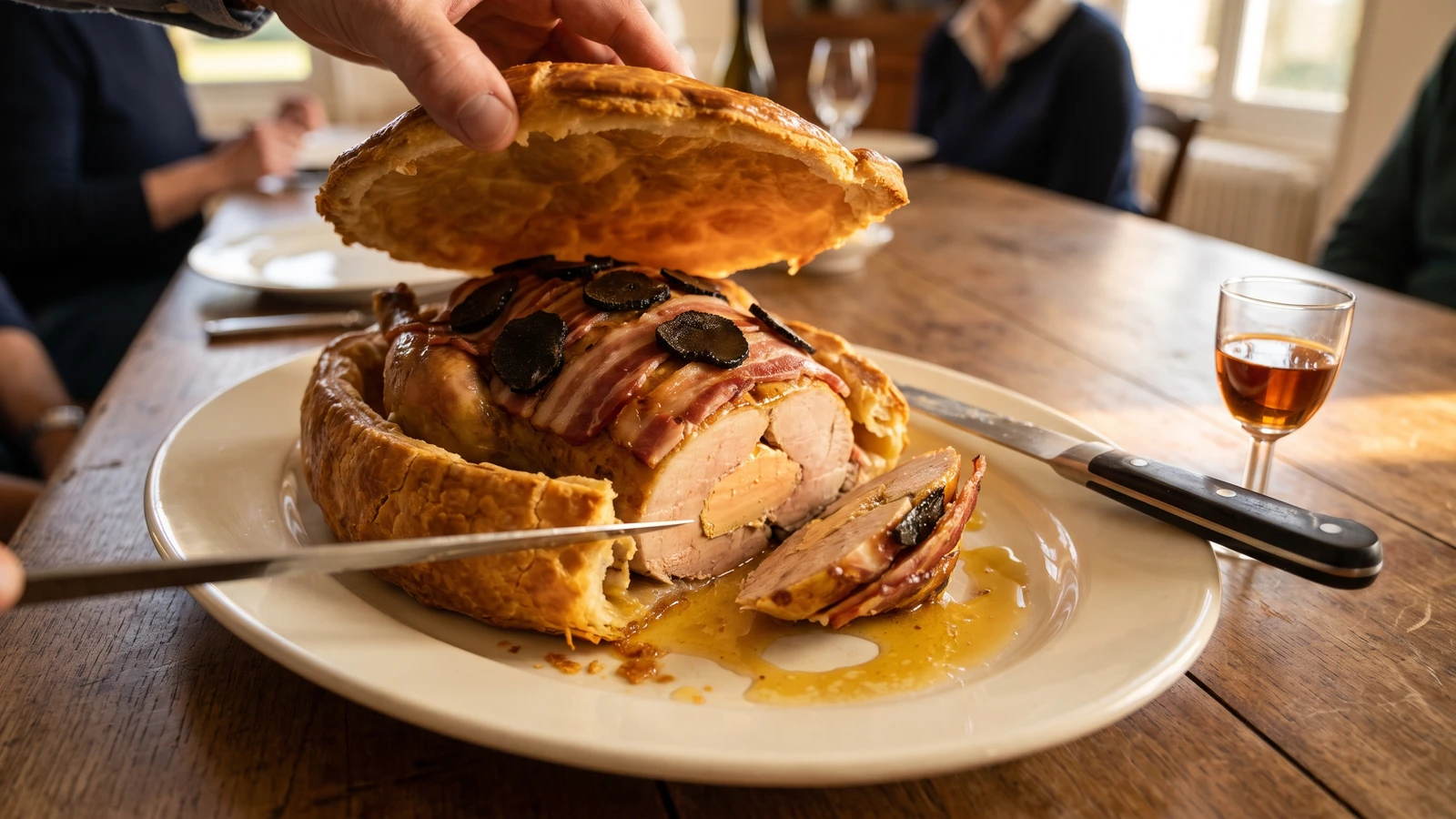
A truffle-studded whole foie gras fills a butter-browned poularde, then black truffle, bacon, and a vented pastry case hold every rich perfume through the long, gentle bake.
Poularde Louise d’Orléans (pullet with truffled foie gras sealed in pastry) teaches the discipline of enclosed cooking: hold every drop of fat and perfume close, but give pressure one deliberate escape. Before you touch a pan, know the one true thing: the slit in the crown is functional, not decorative. Let it seal and the case can split; keep it open and the poularde bastes inside its shelter of truffle, bacon, and foie gras.
The grand kitchen assumed a saucier with succulent veal stock never off the fire, enough hands to cool the foie while the bird was readied, and a pastry bench built for wrapping whole poultry. It did not need a salamander for this preparation, and neither do you. A narrow saucepan makes three cups of stock deep enough to poach, a rimmed home tray carries a four-serving poularde, and a probe thermometer verifies the dense center. The stockpot scale and extra hands are brigade scaffolding, so they go; the truffle-studded foie, the twenty-minute butter colouring, the truffle and bacon cloak, the plain sealed paste, and the full one-and-three-quarter-hour bake are the dish, so they stay. One cook, one stove, one evening.
Hot, the foie gras softens into the poultry juices and the black truffle perfumes every cut. Cold, those juices set around the foie and give richly marbled slices. The paste will be firm because it is a cooking case, not a tender pie crust. Seal every seam tightly, then keep that top slit open from oven door to table; that is the step that decides the whole magnificent thing.
Poularde Louise d’Orléans belongs to Parisian cuisine de cérémonie, not to a rustic Orléanais poultry tradition; its aristocratic title is a dedication in the grand-kitchen manner, not a map of ingredients. Its construction moves the stuffed roast toward pâté en croûte, using truffle, foie gras, bacon, and paste to hold richness around the bird through a long bake. The plain crust is chiefly a sealed cooking case, not a delicate pie shell, which explains both the essential vent and the instruction to carry it whole to the table, hot or cold.
Quantity
1 bird, 4 to 4½ lb (1.8 to 2 kg)
giblets removed and bird dried inside and out
Quantity
1 small whole foie gras, 14 oz (400 g)
deveined if necessary and kept cold
Quantity
6 oz (170 g)
divide into 1¼ oz (35 g) short batons and 4¾ oz (135 g) slices ⅛ inch (3 mm) thick
Quantity
3 cups (720 ml / 720 g)
Quantity
½ cup (120 ml / 120 g)
Quantity
4 tablespoons (60 ml / 56 g)
melted
Quantity
18 to 20 slices, 12 oz (340 g)
Quantity
8 cups (1.92 L / 960 g)
divided between the dough and dusting
Quantity
2 cups (480 ml / 480 g)
divided between the dough and sealing
Quantity
1 tablespoon (15 ml / 18 g)
Quantity
2 teaspoons (10 ml / 12 g)
Quantity
1 teaspoon (5 ml / 2 g)
| Ingredient | Quantity |
|---|---|
| poularde or plump roasting chickengiblets removed and bird dried inside and out | 1 bird, 4 to 4½ lb (1.8 to 2 kg) |
| whole fresh foie grasdeveined if necessary and kept cold | 1 small whole foie gras, 14 oz (400 g) |
| whole black truffles, fresh or preserveddivide into 1¼ oz (35 g) short batons and 4¾ oz (135 g) slices ⅛ inch (3 mm) thick | 6 oz (170 g) |
| rich unsalted veal stock | 3 cups (720 ml / 720 g) |
| dry old Madeira | ½ cup (120 ml / 120 g) |
| unsalted buttermelted | 4 tablespoons (60 ml / 56 g) |
| thinly sliced unsmoked streaky bacon | 18 to 20 slices, 12 oz (340 g) |
| all-purpose flourdivided between the dough and dusting | 8 cups (1.92 L / 960 g) |
| cool waterdivided between the dough and sealing | 2 cups (480 ml / 480 g) |
| fine sea salt for the dough | 1 tablespoon (15 ml / 18 g) |
| fine sea salt for the poularde | 2 teaspoons (10 ml / 12 g) |
| freshly ground black pepper | 1 teaspoon (5 ml / 2 g) |
Cut the 1¼ oz (35 g) portion of truffle into short, slim batons. Pierce narrow channels through the cold foie gras with a skewer or the tip of a small knife, then tuck a truffle baton into each channel without tearing the lobes apart. Heat the veal stock and Madeira in a narrow 2-quart (2-liter) saucepan to 180 to 185°F (82 to 85°C), where the surface barely moves. Lower in the foie gras and poach for exactly 15 minutes, turning it carefully every 5 minutes if the liquid does not cover it. Never boil it, or the fat renders before the bird can receive it. If a lobe loosens, stop handling it, press it gently back against its natural seam, and chill it in that shape. Ça se rattrape. Lift the foie onto a shallow tray, cool for 20 minutes, then refrigerate for 45 to 60 minutes, until firm enough to insert whole.
While the foie gras chills, mix 7¾ cups (1.86 L / 930 g) of the flour with the dough salt. Add 1⅞ cups (450 ml / 450 g) of the water and work the mixture into a stiff, smooth paste, kneading for 6 to 8 minutes. This is a cooking enclosure, so strength matters more than delicacy. If it breaks into dry crumbs, wet your hands and continue kneading; add water only a teaspoon at a time. If it clings heavily, dust with a little of the reserved flour. Cover tightly and rest for at least 30 minutes so it rolls without springing back.
Heat the oven to 425°F (220°C). Season the poularde inside and out with the bird salt and pepper. Insert the chilled foie gras lengthwise into the cavity, fitting the smaller lobe beside the larger at its natural seam if necessary; do not chop it into stuffing, because the whole foie gras is part of the construction. Close the cavity with small skewers and kitchen twine, then truss the legs close to the body. Set the bird breast up on a rack in a roasting tray, brush generously with melted butter, and roast for 20 minutes, basting twice, until the skin stiffens and takes a deep butter-gold colour. If the butter darkens too quickly, move the tray down one rack. Remove the bird and let it stand for 15 minutes, only long enough to handle, while lowering the oven to 325°F (165°C). Proceed directly to the wrapping; do not refrigerate partially roasted stuffed poultry.
Reserve an orange-sized piece of dough for repairs, then divide the remainder into a slightly larger lower sheet and a smaller top sheet. Roll the lower piece about ⅛ inch (3 mm) thick on the lightly floured counter and transfer it to a parchment-lined rimmed baking tray. Arrange 5 or 6 bacon slices in the footprint of the bird, cover them with overlapping truffle slices, and set the coloured poularde on top. Tile every exposed part of the bird with the remaining thick truffle slices, including the legs and sides, then cover the truffles completely with overlapping bacon. Keep the order exact: poultry, truffle, bacon, dough. The truffle perfumes the flesh, the bacon protects it, and the paste contains them both.
Roll the second piece of dough ⅛ inch (3 mm) thick and large enough to drape over the whole bird with a broad margin at the base. Brush the edge of the lower sheet with some of the reserved water, lower the top sheet over the bird, and press out the large air pockets without disturbing the bacon. Trim the edges, fold the lower edge over the upper, and pinch firmly into one continuous seal. Inspect the legs and tail carefully, where leaks begin. Patch any thin place with dampened reserved dough. Cut a proper 1-inch (2.5 cm) slit through the crown and prop it open with a loose little collar of baking parchment. A pinprick is not enough; the slit must release steam without opening the seams.
Bake the sealed poularde at 325°F (165°C) for the full 1 hour 45 minutes. Check the slit twice during baking and reopen it with the tip of a knife if dough begins to close over it. If the case splits elsewhere, press a damp patch of reserved dough over the break and restore the top vent at once. Ça se rattrape. At the end of the baking time, pass a clean probe thermometer through the vent into the center of the foie gras, then check the innermost thigh without touching bone. Both must reach 165°F (74°C). If either is cooler, continue baking in 10-minute intervals; if the crust is already dark enough, cover it loosely with foil while leaving the vent exposed.
For hot service, transfer the whole case to an oval platter and rest it for 25 to 30 minutes. Carry it to the table as it stands, then enlarge the vent into an oval lid with a serrated knife and lift the lid away. The paste is firm by design and need not be eaten. Remove the trussing, carve the poularde, and cut through the foie gras so each serving receives poultry, truffle, bacon, and a generous piece of the center. Spoon over the butter-rich juices held inside the case. Never apologize at your own table. À table!
For cold service instead, rest the unopened case for 20 minutes, then place it uncovered on a wire rack in the coldest part of the refrigerator within 1 hour of leaving the oven. Keep the vent open and check the center through it with a probe: it should cool to 70°F (21°C) within 2 hours and to 40°F (4°C) within 6 hours total. If it cools too slowly, open the case, transfer the poularde and foie gras to a shallow chilled tray, and refrigerate them separately; the intact presentation is lost, but the food is protected. Once fully cold, cover the case and keep it refrigerated for up to 2 days. If the case remained intact, serve it as it stands and open it at the table before slicing.
1 serving (about 880g)
Culinary guides, cultural storytelling, and the editorial depth that makes cooking meaningful.
Discover Culinary ExplorerChef Juliette
John Dory has the delicacy of sole and the firmness of turbot. A light flouring, a quick butter sauté, and nut-brown beurre noisette show exactly why looks never mattered.

Chef Juliette
Fresh haddock proves its delicacy in the meunière pan: a fine flour crust, moist pearly flakes, and beurre noisette sharpened with lemon and parsley, ready from one skillet in half an hour.

Chef Juliette
Éperlans à l’Anglaise turns small fish into a lesson in disciplined coating: boned smelts under a close, crisp crumb, pan-fried in clarified butter and finished with bright, half-melted maître d’hôtel butter.

Chef Juliette
Tiny smelts, shallot, mushrooms, white wine, gratin sauce, and fine bread raspings meet a fierce oven, where the fish must turn tender in the same breath the buttered crust bronzes.