
Chef Juliette
John Dory (St. Pierre)
John Dory has the delicacy of sole and the firmness of turbot. A light flouring, a quick butter sauté, and nut-brown beurre noisette show exactly why looks never mattered.
A cooking platform built around craft, culture, and the stories behind what we eat.
Created by Chef Juliette
Based on No. 1485, Poularde à l’Ivoire, from Le Guide Culinaire (1907) by Auguste Escoffier
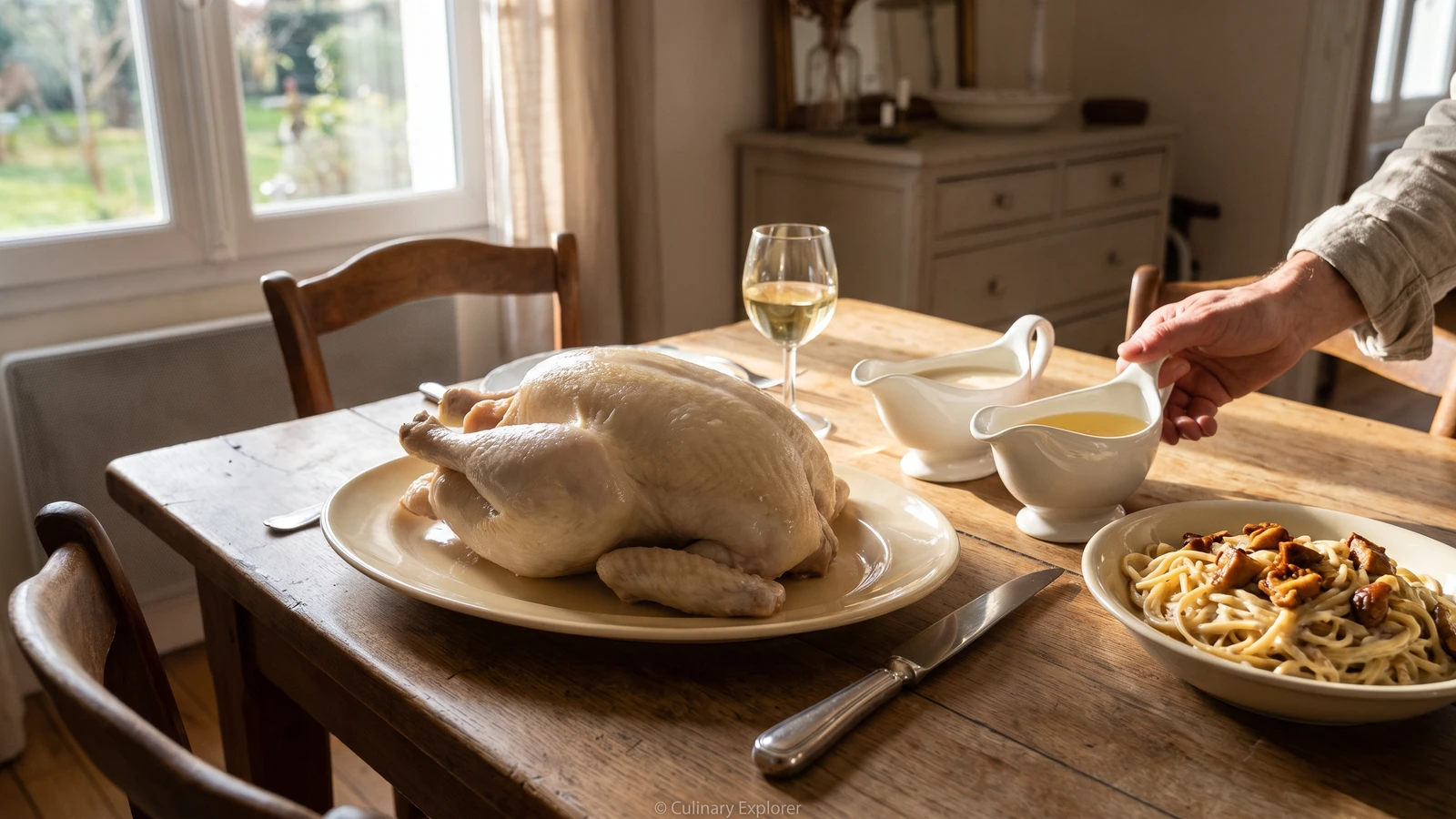
A tender poularde presented without camouflage, with glossy sauce ivoire, clear poaching liquor, and cream-bound cèpe noodles alongside: a quiet lesson in temperature, restraint, and pale sauce work.
Poularde à l’Ivoire (ivory-poached pullet) teaches the discipline of whiteness. The one true thing is this: the cooking liquor must never break into a boil while the bird is in it. Pale, succulent flesh, clear broth, and a satin sauce all depend upon that restraint. This isn't timid cooking. It is control made visible.
The original entry assumed a saucier beside the range, a stockpot never off the fire, and enough hands to finish the garnish while the poularde was being dished. A salamander, so useful for color elsewhere, has no work here; one browned patch loses the argument. Your equivalents are a narrow stockpot, the bird's own cooking liquor reduced into a fresh foundation, and a small saucepan that makes exactly enough sauce for four.
What changes is scale and staffing, not the order or presentation. The permanent fond and simultaneous brigade service are scaffolding; the bubbleless poach, pale sauce, plain bird, and separate sauceboats are the dish and must stay. One cook, one stove, one evening. Guard the heat above all, because a liquor held below a bubble gives you everything this poularde promises.
Poularde à l’Ivoire belongs to the Parisian classical repertoire of named poultry preparations, while its prized raw material often came from poultry country such as Bresse in the Ain. The ivory title is not ornamental: generations of cooks used the uncolored skin, clear liquor, and pale sauce as proof that the bird had been poached below a simmer and handled without browning. Its plain central platter, with sauce, broth, and garnish sent separately, carried grand-kitchen service into the bourgeois dining room and let each diner dress the tender meat at the table.
Quantity
1, weighing 4½ to 5 pounds (2 to 2.3 kg)
giblets removed
Quantity
1 (about 120 g)
halved
Quantity
12 cups (2.8 L / 2.8 kg)
plus more only if needed to cover
Quantity
1 tablespoon plus 1 teaspoon (20 ml / 24 g)
Quantity
1 medium (about 1½ cups / 360 ml / 120 g)
split and rinsed
Quantity
2 (about 1 cup / 240 ml / 100 g)
cut into large pieces
Quantity
1 medium (about 1 cup / 240 ml / 150 g)
peeled and halved
Quantity
2
Quantity
1
made with 4 parsley stems, 1 thyme sprig, and 1 small bay leaf
Quantity
1 teaspoon (5 ml / 2.5 g)
Quantity
3 cups (720 ml / 720 g)
Quantity
2 tablespoons plus 1 teaspoon (35 ml / 30 g)
Quantity
¼ cup (60 ml / 30 g)
Quantity
¾ cup (180 ml / 180 g)
Quantity
2 tablespoons (30 ml / 28 g)
cubed
Quantity
2 cups (480 ml / 480 g)
Quantity
Up to 1 teaspoon (5 ml / 6 g)
Quantity
¼ teaspoon (1.25 ml / 0.6 g)
divided
Quantity
About 5 cups (1.2 L / 225 g)
Quantity
About 3 cups (720 ml / 225 g)
sliced ¼ inch (6 mm) thick
Quantity
2 tablespoons (30 ml / 28 g)
Quantity
½ cup (120 ml / 120 g)
Quantity
2 teaspoons (10 ml / 12 g)
| Ingredient | Quantity |
|---|---|
| poularde or plump air-chilled young chickengiblets removed | 1, weighing 4½ to 5 pounds (2 to 2.3 kg) |
| medium lemonhalved | 1 (about 120 g) |
| cold waterplus more only if needed to cover | 12 cups (2.8 L / 2.8 kg) |
| fine sea salt for the poaching liquor | 1 tablespoon plus 1 teaspoon (20 ml / 24 g) |
| leek, white and pale green parts onlysplit and rinsed | 1 medium (about 1½ cups / 360 ml / 120 g) |
| celery ribscut into large pieces | 2 (about 1 cup / 240 ml / 100 g) |
| yellow onionpeeled and halved | 1 medium (about 1 cup / 240 ml / 150 g) |
| whole cloves | 2 |
| bouquet garnimade with 4 parsley stems, 1 thyme sprig, and 1 small bay leaf | 1 |
| white peppercorns | 1 teaspoon (5 ml / 2.5 g) |
| strained pullet cooking liquor for the sauce ivoire | 3 cups (720 ml / 720 g) |
| unsalted butter for the roux | 2 tablespoons plus 1 teaspoon (35 ml / 30 g) |
| all-purpose flour | ¼ cup (60 ml / 30 g) |
| heavy cream for the sauce ivoire | ¾ cup (180 ml / 180 g) |
| cold unsalted butter for finishing the saucecubed | 2 tablespoons (30 ml / 28 g) |
| additional strained pullet cooking liquor for serving | 2 cups (480 ml / 480 g) |
| fine sea salt for final seasoning | Up to 1 teaspoon (5 ml / 6 g) |
| ground white pepperdivided | ¼ teaspoon (1.25 ml / 0.6 g) |
| dried fine egg noodles | About 5 cups (1.2 L / 225 g) |
| fresh or frozen cèpes (porcini mushrooms)sliced ¼ inch (6 mm) thick | About 3 cups (720 ml / 225 g) |
| unsalted butter for the cèpes | 2 tablespoons (30 ml / 28 g) |
| heavy cream for the noodles | ½ cup (120 ml / 120 g) |
| fine sea salt for the noodle water | 2 teaspoons (10 ml / 12 g) |
Pat the poularde dry and remove any feathers or loose fat from the cavity. Rub both cut lemon halves over the entire skin, paying particular attention to the breast above the fillets; the lemon discourages discoloration and gives the skin its clean ivory cast. Truss the legs loosely so the bird cooks evenly without being squeezed out of shape. Put the leek, celery, onion studded with the cloves, bouquet garni, peppercorns, and poaching salt in a narrow stockpot. Set the poularde breast-side up over the vegetables, add the cold water, and add only enough extra water to cover the bird by 1 inch (2.5 cm).
Set the pot over medium-low heat and bring the liquor slowly to 175 to 180°F (79 to 82°C), skimming away the grey foam as it rises. Lay a parchment round on the surface and, if the bird floats, hold it down with a small heatproof plate. Keep the pot partly covered and maintain that temperature without allowing a bubble to break the surface. Poach for 55 to 75 minutes after the liquor reaches temperature, until the thickest part of the breast registers 165°F (74°C) and the inner thigh reaches at least 170°F (77°C), without touching bone. If the liquor begins to boil, pull the pot off the heat at once and add ½ cup (120 ml) cold water down the side; one brief surge can be arrested, but continued boiling tightens the flesh and clouds the broth.
Lift the poularde carefully, tipping it over the pot to drain the cavity. Set it breast-side up on a tray, moisten a sheet of parchment with hot cooking liquor, lay it directly over the bird, and cover loosely with foil while it rests. Strain the cooking liquor through a fine sieve without pressing the vegetables, then skim off the yellow surface fat. Measure 3 cups (720 ml) for the sauce ivoire and 2 cups (480 ml) for the second sauceboat; keep another cup nearby for loosening the sauce if needed. Warm the serving portion gently and correct its seasoning with a little of the reserved salt. It should taste clear and distinctly of poultry, not like salted water.
Only now, with the bird safely out, may the liquor boil. Reduce the 3 cups (720 ml) reserved for the sauce to 2 cups (480 ml), then pour it into a jug. Melt the roux butter in the same wiped saucepan, stir in the flour, and cook gently for 2 minutes without letting it color; the raw flour smell must leave while the mixture remains chalk-pale. Whisk in the hot reduced liquor in three additions, smoothing each one before adding the next, then simmer gently for 8 minutes. Add the cream, reserving 1 tablespoon for rescue, and cook until the sauce reaches nappe, a coating consistency that leaves a clean line when you draw a finger across the back of a spoon. Take it off the heat and monter au beurre (mount with butter) by whisking in the cold cubes one at a time. Season with white pepper and salt. If it becomes lumpy, pass it through the fine sieve; if the butter separates, whisk in the reserved cold cream away from the heat. Ça se rattrape. Pour the glossy ivory sauce into a warm sauceboat.
While the sauce cooks, prepare the garnish. If using frozen cèpes, put them in a wide skillet without fat and cook until their released water has evaporated; fresh cèpes may begin directly with the butter. Add the butter and sauté until the mushrooms are tender and their edges take a proper hazelnut color, then season with half the white pepper. Cook the noodles in generously boiling water with the measured salt until just tender, reserving ½ cup (120 ml) noodle water before draining. Return the noodles to their pot, fold in the cream and cèpes over low heat, and toss until lightly bound. If the cream tightens before service, loosen it with a spoonful of noodle water. The garnish should be supple, not cemented together.
Warm an oval platter, dry it thoroughly, and remove the trussing string from the poularde. Set the bird on the platter breast-side up and leave it plain: no sauce poured over it, no parsley, and no attempt to disguise the ivory skin. Bring it to the table with the sauce ivoire in one warm sauceboat, the clear cooking liquor in another, and the cream-bound cèpe noodles in a separate bowl. Carve the breast across the grain, give each diner a little dark meat, and let everyone choose sauce, broth, or both. À table!
1 serving (about 750g)
Culinary guides, cultural storytelling, and the editorial depth that makes cooking meaningful.
Discover Culinary ExplorerChef Juliette
John Dory has the delicacy of sole and the firmness of turbot. A light flouring, a quick butter sauté, and nut-brown beurre noisette show exactly why looks never mattered.

Chef Juliette
Fresh haddock proves its delicacy in the meunière pan: a fine flour crust, moist pearly flakes, and beurre noisette sharpened with lemon and parsley, ready from one skillet in half an hour.

Chef Juliette
Éperlans à l’Anglaise turns small fish into a lesson in disciplined coating: boned smelts under a close, crisp crumb, pan-fried in clarified butter and finished with bright, half-melted maître d’hôtel butter.

Chef Juliette
Tiny smelts, shallot, mushrooms, white wine, gratin sauce, and fine bread raspings meet a fierce oven, where the fish must turn tender in the same breath the buttered crust bronzes.