
Chef Juliette
John Dory (St. Pierre)
John Dory has the delicacy of sole and the firmness of turbot. A light flouring, a quick butter sauté, and nut-brown beurre noisette show exactly why looks never mattered.
A cooking platform built around craft, culture, and the stories behind what we eat.
Created by Chef Juliette
Based on No. 1478, Poularde Grand Hôtel, from Le Guide Culinaire (1907) by Auguste Escoffier
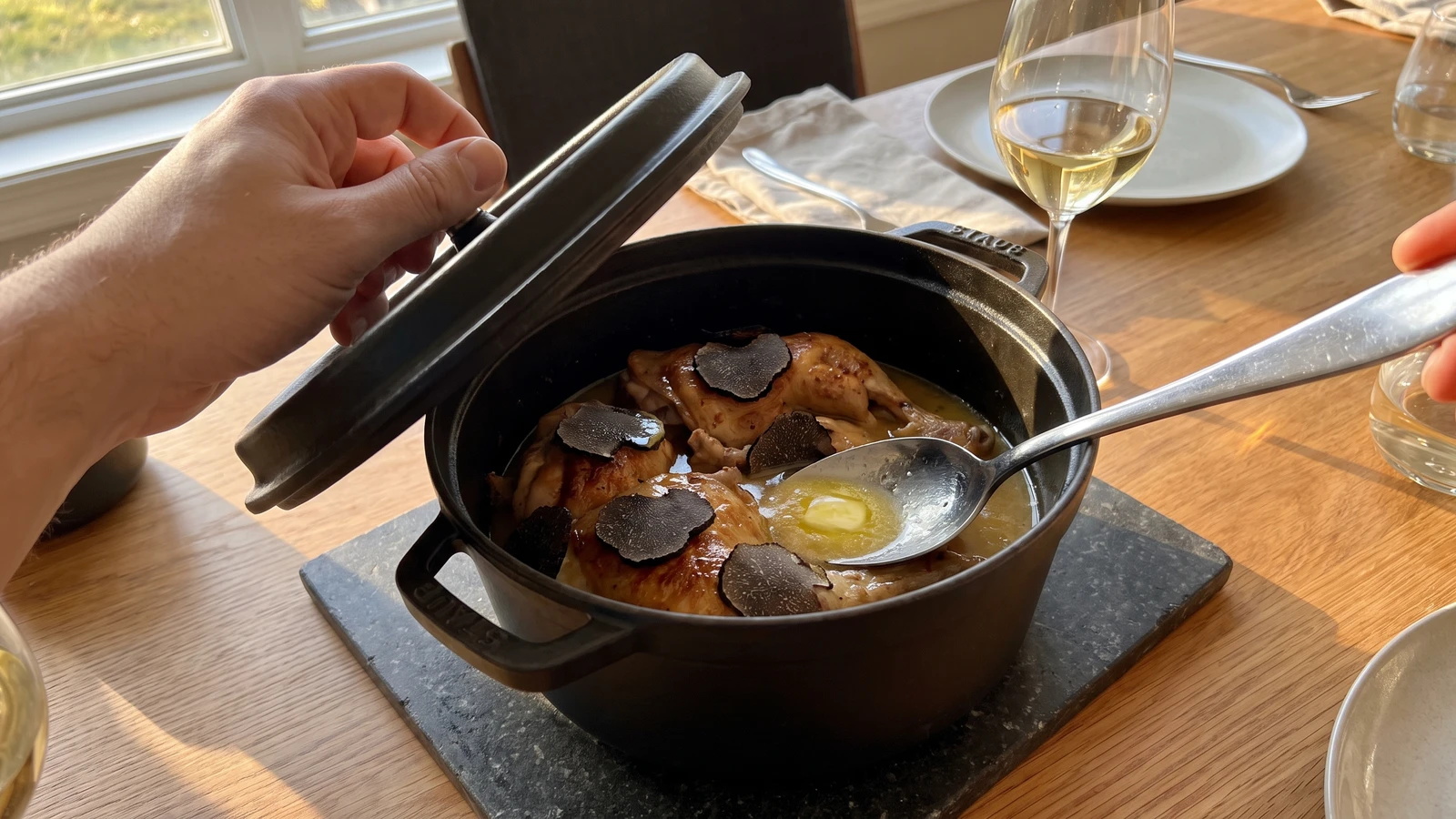
Poularde Grand Hôtel puts butter-browned chicken and thick raw truffle in a sealed cocotte, where eight fierce minutes turn white wine, stock, and the bird's juices into fragrant gloss.
Poularde Grand Hôtel (the impatient cook's truffled pullet) teaches one true thing before you touch a pan: truffle perfume is captured, not added. The chicken must be nearly cooked in butter first. The thick raw truffle enters only when bird, wine, stock, and cocotte can be closed together so nothing precious escapes.
The Grand Hôtel kitchen assumed a saucier at hand, a stock never off the fire, and a very hot cocotte ready beside the range. A salamander might have stood nearby, but this entry never calls on it; there is no broiled finish to invent. At home, a covered sauté pan, a preheated metal cocotte, and good gelatin-rich stock do the same work. The staff and ready stock were scaffolding, so they go. The separate hot cocotte and brief, tight seal are the dish, so they stay. One 3½-pound poularde serves four, and the book's full five ounces of truffle remain because reducing that proportion would change the dish rather than merely its size. One cook, one stove, one evening.
Done properly, the chicken arrives butter-gold, the raw truffle slices softened but still thick, and the white wine liquor glossy with poultry juices. The one step to guard is the seal: fit it tightly, then don't lift the lid before eight minutes.
Poularde Grand Hôtel belongs to the grand-hotel table of Monte Carlo, where the Grand Hôtel devised it for diners who could not wait for a traditionally truffled pullet to be prepared. Rather than insert truffles into a whole bird and give their perfume time to penetrate, the kitchen jointed the poularde and enclosed thick raw slices with it in a hot cocotte, turning delay into concentrated contact. Its name points to a hotel, but its lasting lesson is the cocotte itself: the dish travels from range to table without being replated.
Quantity
1 bird, 3½ to 4 pounds (1.6 to 1.8 kg)
jointed into 8 pieces as for a Sauté
Quantity
4 tablespoons (60 ml / 57 g)
divided
Quantity
1½ teaspoons (7.5 ml / 9 g)
divided
Quantity
½ teaspoon (2.5 ml / 1 g)
divided
Quantity
5 ounces (about 1 cup sliced / 140 g)
brushed clean and sliced ⅛ inch (3 mm) thick
Quantity
3 tablespoons (45 ml / 45 g)
Quantity
⅓ cup (80 ml / 80 g)
| Ingredient | Quantity |
|---|---|
| poularde or plump young chickenjointed into 8 pieces as for a Sauté | 1 bird, 3½ to 4 pounds (1.6 to 1.8 kg) |
| unsalted butterdivided | 4 tablespoons (60 ml / 57 g) |
| fine sea saltdivided | 1½ teaspoons (7.5 ml / 9 g) |
| freshly ground black pepperdivided | ½ teaspoon (2.5 ml / 1 g) |
| fresh raw winter black trufflesbrushed clean and sliced ⅛ inch (3 mm) thick | 5 ounces (about 1 cup sliced / 140 g) |
| dry white wine | 3 tablespoons (45 ml / 45 g) |
| gelatin-rich chicken stock | ⅓ cup (80 ml / 80 g) |
Set a rack in the middle of the oven and heat it to 475°F (245°C). Put an empty 4-quart seasoned cast-iron or heavy stainless-steel cocotte and its lid in the oven for 15 minutes, using only a vessel its maker permits you to preheat empty. Cut a sheet of heavy foil large enough to cover the rim. Pat the chicken completely dry, then season it with 1¼ teaspoons of the salt and ⅜ teaspoon of the pepper.
Melt 3 tablespoons of the butter in a large covered sauté pan over medium heat. Sauté here means cooking the jointed bird quickly in butter before its final enclosed cooking, not braising it in liquid. Brown the legs and thighs skin-side down for 4 minutes, then add the breast pieces and wings and continue until every skin side is butter-gold, about 4 minutes more. Work in batches if the pieces cannot sit flat. Turn them, return everything to the pan, add the remaining butter, cover, lower the heat to medium-low, and cook for 8 to 10 minutes. The breast should reach about 145 to 150°F (63 to 66°C) and the thigh about 155°F (68°C), nearly cooked but with room for the final eight minutes. If the butter blackens or smells sharp, lift out the chicken, discard the scorched butter, wipe away only the black flecks, and continue with the reserved butter while preserving any clean bronze fond. Ça se rattrape.
While the chicken cooks under cover, brush the truffles clean without peeling them. Slice them a full ⅛ inch (3 mm) thick, not into transparent wafers, then toss them gently with the remaining ¼ teaspoon salt and ⅛ teaspoon pepper. Their thickness is deliberate: the slices must cook and remain substantial rather than disappear into the liquor.
Remove the hot cocotte and lid from the oven and set them securely on heatproof trivets. Transfer the chicken to the cocotte in a snug layer, skin-side up, then distribute the seasoned truffle slices over and between the pieces. Put the sauté pan over medium-high heat, pour in the white wine, and swill the pan while scraping up every clean brown trace of fond. After 30 seconds, add the chicken stock and bring it to one full boil. Do not reduce it to a glaze, because this modest liquor must cook the truffles inside the sealed pot. Pour it around the chicken and truffles.
Lay the prepared foil across the cocotte rim, clamp on the lid, and crimp the foil around it. If the lid fits loosely, use a second sheet of foil as a gasket; a poor seal is the likely failure here, and the foil is its honest rescue. Return the cocotte to the 475°F (245°C) oven for 8 minutes, allowing 10 only if the truffles were cut thicker than ⅛ inch or the chicken cooled during transfer. Do not peek. At 8 minutes, check that the thickest chicken piece has reached at least 165°F (74°C). If it has not, reseal the cocotte and give it the remaining 2 minutes.
Carry the closed cocotte directly to the table and open it there. The truffle slices should retain their shape while softening at the edges, and the butter, wine, chicken juices, and stock should form a light, gleaming liquor beneath the bird. Spoon that liquor and plenty of truffle over every portion. Serve immediately. À table!
1 serving (about 250g)
Culinary guides, cultural storytelling, and the editorial depth that makes cooking meaningful.
Discover Culinary ExplorerChef Juliette
John Dory has the delicacy of sole and the firmness of turbot. A light flouring, a quick butter sauté, and nut-brown beurre noisette show exactly why looks never mattered.

Chef Juliette
Fresh haddock proves its delicacy in the meunière pan: a fine flour crust, moist pearly flakes, and beurre noisette sharpened with lemon and parsley, ready from one skillet in half an hour.

Chef Juliette
Éperlans à l’Anglaise turns small fish into a lesson in disciplined coating: boned smelts under a close, crisp crumb, pan-fried in clarified butter and finished with bright, half-melted maître d’hôtel butter.

Chef Juliette
Tiny smelts, shallot, mushrooms, white wine, gratin sauce, and fine bread raspings meet a fierce oven, where the fish must turn tender in the same breath the buttered crust bronzes.