
Chef Juliette
John Dory (St. Pierre)
John Dory has the delicacy of sole and the firmness of turbot. A light flouring, a quick butter sauté, and nut-brown beurre noisette show exactly why looks never mattered.
A cooking platform built around craft, culture, and the stories behind what we eat.
Created by Chef Juliette
Based on No. 1477, Poularde à la Grammont, from Le Guide Culinaire (1907) by Auguste Escoffier
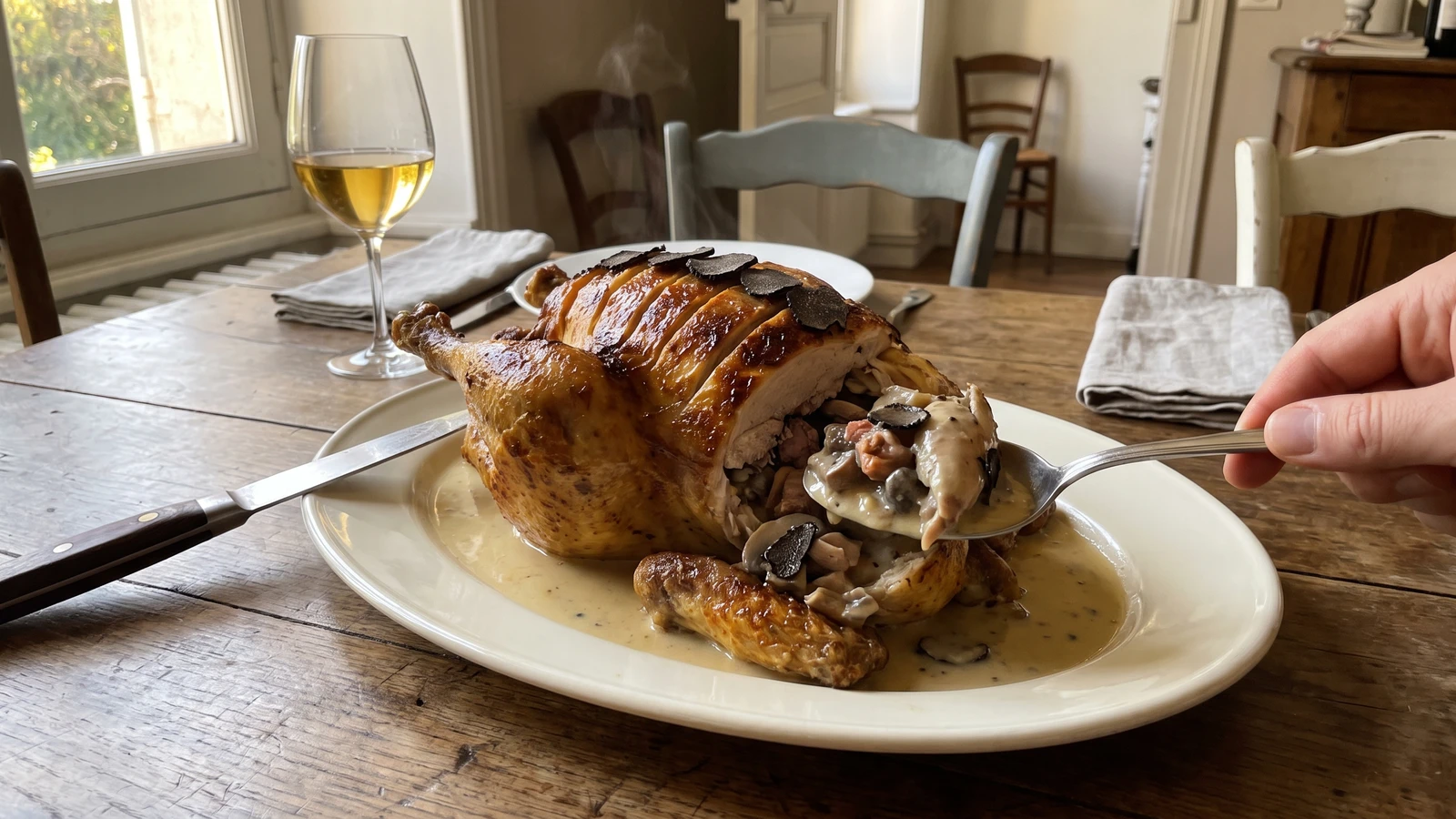
Poached poularde, carved and rebuilt with quail, mushrooms, cocks' combs, and truffle, then cloaked in Allemande and bronzed fast: classical construction made workable for one careful cook.
Poularde à la Grammont (poached pullet, refilled and glazed) teaches controlled reconstruction. The bird is cooked gently, taken apart while still warm, filled with a truffled garnish, rebuilt so it looks whole, then glazed hard and fast. The one truth to know before touching a pan is this: the broiler colors the dish, it does not reheat it, so every sauce and garnish must be ready, warm, and within reach before the suprêmes come off the carcass.
The original assumed a saucier on staff, a stock never off the fire, a salamander, larks from the game dealer, and enough hands to carve while two sauces stayed perfect. At home, good unsalted chicken stock becomes the fond, the broiler becomes the salamander, farmed quail replaces unavailable larks, and reserved juice from a preserved black truffle supplies the truffle essence while the truffle itself gives the slices. Prepared cocks' combs and kidneys stay because their yielding, delicate offal texture is part of the Grammont garnish. This is the formula scaled for four: one cook, one stove, one evening.
The brigade's decorative mushroom grooving and its forest of little pans are scaffolding; smooth caps and two saucepans do the same honest work. What must stay is the poaching, the half-cooling, the garnish bound with truffled Béchamel, the sliced suprêmes returned with truffle between them, and the stiff Allemande under Parmesan and real butter. Have the broiler fierce and the Allemande warm before you remove the breast bones. That timing decides the dish.
Poularde à la Grammont belongs to the Parisian classical repertoire of named poulardes, where a poached bird was boned, rebuilt around a composed garnish, sauced, and glazed for formal service. Its combination of lark fillets, cocks' combs and kidneys, mushrooms, truffle, Béchamel, Allemande, and Parmesan records the grand kitchen's habit of unifying several prized textures beneath one glaze, rather than a regional poultry method. The exact dedicatee behind the name remains uncertain; what survives securely is the formula, carried from brigade carving and the salamander to a careful home table.
Quantity
1 (4 to 4½ pounds / 1.8 to 2 kilograms)
giblets removed
Quantity
10 cups (2.4 liters / 2.4 kilograms)
plus hot water if needed to cover
Quantity
1 (5 ounces / 150 grams)
quartered
Quantity
1 (3½ ounces / 100 grams)
cut into chunks
Quantity
1 (4 ounces / 115 grams)
white and pale green parts washed and sliced
Quantity
1
2 parsley stems, 2 thyme sprigs, and 1 bay leaf
Quantity
1 teaspoon (5 milliliters / 6 grams), plus more for seasoning
Quantity
½ teaspoon (2.5 milliliters / 1 gram)
lightly crushed
Quantity
2 tablespoons (30 milliliters / 28 grams)
Quantity
¼ cup (60 milliliters / 30 grams)
Quantity
1 cup (240 milliliters / 245 grams)
warmed
Quantity
1 jar (about 1 ounce / 30 grams), with at least 1 tablespoon (15 milliliters / 15 grams) juice
truffle juice reserved
Quantity
12 (6 ounces / 170 grams)
stems removed and caps grooved if desired
Quantity
4 combs plus 4 kidneys (5 ounces / 140 grams total)
drained if preserved
Quantity
2 tablespoons (30 milliliters / 28 grams)
Quantity
8 (8 ounces / 225 grams)
replacing larks' fillets and patted dry
Quantity
2 tablespoons (30 milliliters / 28 grams)
Quantity
3 tablespoons (45 milliliters / 42 grams)
Quantity
⅓ cup (80 milliliters / 40 grams)
Quantity
2 cups (480 milliliters / 480 grams)
strained
Quantity
2
Quantity
⅓ cup (80 milliliters / 80 grams)
Quantity
1 teaspoon (5 milliliters / 5 grams)
Quantity
¼ teaspoon (1.25 milliliters / 0.5 gram), plus more to taste
Quantity
½ cup (120 milliliters / 45 grams)
Quantity
2 tablespoons (30 milliliters / 28 grams)
melted
| Ingredient | Quantity |
|---|---|
| poularde or plump young chickengiblets removed | 1 (4 to 4½ pounds / 1.8 to 2 kilograms) |
| unsalted chicken stockplus hot water if needed to cover | 10 cups (2.4 liters / 2.4 kilograms) |
| medium yellow onionquartered | 1 (5 ounces / 150 grams) |
| medium carrotcut into chunks | 1 (3½ ounces / 100 grams) |
| small leekwhite and pale green parts washed and sliced | 1 (4 ounces / 115 grams) |
| bouquet garni2 parsley stems, 2 thyme sprigs, and 1 bay leaf | 1 |
| fine sea salt | 1 teaspoon (5 milliliters / 6 grams), plus more for seasoning |
| white peppercornslightly crushed | ½ teaspoon (2.5 milliliters / 1 gram) |
| unsalted butter for the Béchamel | 2 tablespoons (30 milliliters / 28 grams) |
| plain flour for the Béchamel | ¼ cup (60 milliliters / 30 grams) |
| whole milkwarmed | 1 cup (240 milliliters / 245 grams) |
| preserved whole black truffletruffle juice reserved | 1 jar (about 1 ounce / 30 grams), with at least 1 tablespoon (15 milliliters / 15 grams) juice |
| small button-mushroom capsstems removed and caps grooved if desired | 12 (6 ounces / 170 grams) |
| prepared cocks' combs and kidneysdrained if preserved | 4 combs plus 4 kidneys (5 ounces / 140 grams total) |
| unsalted butter for the mushrooms and offal | 2 tablespoons (30 milliliters / 28 grams) |
| farmed quail breast filletsreplacing larks' fillets and patted dry | 8 (8 ounces / 225 grams) |
| unsalted butter for the quail | 2 tablespoons (30 milliliters / 28 grams) |
| unsalted butter for the Allemande | 3 tablespoons (45 milliliters / 42 grams) |
| plain flour for the Allemande | ⅓ cup (80 milliliters / 40 grams) |
| hot poultry poaching liquorstrained | 2 cups (480 milliliters / 480 grams) |
| large egg yolks | 2 |
| heavy cream | ⅓ cup (80 milliliters / 80 grams) |
| fresh lemon juice | 1 teaspoon (5 milliliters / 5 grams) |
| ground white pepper | ¼ teaspoon (1.25 milliliters / 0.5 gram), plus more to taste |
| finely grated Parmesan | ½ cup (120 milliliters / 45 grams) |
| unsalted butter for glazingmelted | 2 tablespoons (30 milliliters / 28 grams) |
Choose a narrow pot that holds the poularde without leaving it adrift, and have a broiler-safe oval platter ready. Tie the legs loosely and tuck the wing tips beneath the bird so it keeps a generous shape. Put the stock, onion, carrot, leek, bouquet garni, measured salt, and crushed peppercorns in the pot, then bring them to a bare simmer for 10 minutes. The liquid should taste lightly seasoned, never salty, because part of it will be reduced into the Allemande.
Lower the poularde breast-side down into the seasoned stock. Add enough hot water to cover it, bring the liquid back to 180 to 185°F (82 to 85°C), then partially cover and poach for 25 minutes. Turn the bird breast-side up and continue for 25 to 35 minutes, until the thickest part of the breast reaches 165°F (74°C) and the thigh reaches at least 170°F (77°C). The surface should barely tremble, with only an occasional lazy bubble. If it breaks into a boil, lift the pot from the heat and add a little cold water. Ça se rattrape. Return it to gentler heat rather than letting the breast tighten.
While the poularde poaches, melt the Béchamel butter in a saucepan, add the flour, and stir over low heat for 2 minutes without letting the roux color. Whisk in the warm milk by degrees, then cook for 5 to 7 minutes, stirring, until the Béchamel is stiff enough to hold a mound. Season lightly and stir in the reserved truffle juice. If it lumps, pass it through a fine sieve; if it becomes too stiff to fold, loosen it with a spoonful of warm milk. Melt the mushroom butter in a sauté pan. Cook the mushroom caps for 4 to 5 minutes until glossy and tender, then add the prepared cocks' combs and kidneys and warm them through gently. Fold them into the truffled Béchamel, cover closely, and hold the mixture warm over a pan of barely hot water. Do not add the quail yet. Its last-second sauté is part of the dish.
Lift the cooked poularde carefully from the stock, let the cavity drain, and place the bird breast-side up on the broiler-safe platter. Tent it loosely and let it half-cool for 15 to 20 minutes, only until your hands can work without a quarrel. Strain 2 cups of the poaching liquor. Melt the Allemande butter in a clean saucepan, stir in its flour, and cook the pale roux for 2 minutes. Whisk in the hot poaching liquor gradually, then simmer for 10 to 12 minutes until the velouté is reduced, smooth, and thick enough to coat the back of a spoon heavily. Whisk the yolks with the cream, temper them with a ladleful of hot velouté, then return the mixture to the saucepan over very low heat. Stir until the Allemande falls from the spoon in a broad ribbon. Add the lemon juice and ground white pepper. Never let it boil after the yolks enter. If it begins to grain, take it off the heat, put a tablespoon of cold cream in a clean bowl, and whisk in the troubled sauce little by little before straining it. Ça se rattrape.
Heat the broiler to high and set a rack about 5 inches (13 centimeters) below it. Remove the trussing string. With a narrow sharp knife, cut down each side of the breastbone and follow the ribs to lift off the two suprêmes, the breast fillets, in whole pieces. Cover them so they stay moist. Use kitchen shears to remove the exposed keel and front rib bones, leaving the back, legs, and wings intact so the carcass remains a serving shell. If the breast opening tears, draw the sides together with a short wooden skewer. The sauces will cover the repair, and you will remove the skewer while serving. Never apologize at your own table.
Season the dry quail fillets lightly with salt and white pepper. Melt their butter in a wide sauté pan over medium-high heat and wait until the foam subsides. Add the fillets in one uncrowded layer and sauté for 60 to 90 seconds on each side, just until firm, opaque, and cooked through to 165°F (74°C). Fold them immediately into the warm mushroom, comb, kidney, and Béchamel mixture. These little fillets go in at the last second because earlier cooking turns them dry and anonymous.
Spoon the hot garnish into the boned breast cavity, filling it generously but without crushing the quail or mushroom caps. Slice each suprême crosswise into pieces about ½ inch (1.25 centimeters) thick. Return the slices to their original positions over the filling, overlapping them slightly and placing a thin slice of preserved truffle between every two pieces. Pour any juices from the resting breasts over the filling. The poularde should recover its rounded outline; if it sits a little proudly, good. Cooking well is not cooking fancy.
Warm the Allemande gently if needed, without boiling, then coat the entire upper surface of the rebuilt poularde in a layer about ¼ inch (6 millimeters) thick. Cover it evenly with the grated Parmesan and trickle the melted butter over the cheese. Set the platter beneath the fierce broiler for 2 to 4 minutes, rotating once, until the sauce bubbles at the rim and the top becomes a deep hazelnut gold. Do not step away. If one patch darkens too quickly, shield that spot with a scrap of foil while the rest colors. The salamander worked quickly, and so does your broiler.
Carry the glazed poularde directly to the table. Cut down through the arranged suprêmes and spoon some of the central garnish beside each serving, making certain everyone receives quail, mushroom, comb, kidney, truffle, and sauce. There is no resting here; the contrast between the bronzed glaze and yielding filling is at its best immediately. À table!
1 serving (about 600g)
Culinary guides, cultural storytelling, and the editorial depth that makes cooking meaningful.
Discover Culinary ExplorerChef Juliette
John Dory has the delicacy of sole and the firmness of turbot. A light flouring, a quick butter sauté, and nut-brown beurre noisette show exactly why looks never mattered.

Chef Juliette
Fresh haddock proves its delicacy in the meunière pan: a fine flour crust, moist pearly flakes, and beurre noisette sharpened with lemon and parsley, ready from one skillet in half an hour.

Chef Juliette
Éperlans à l’Anglaise turns small fish into a lesson in disciplined coating: boned smelts under a close, crisp crumb, pan-fried in clarified butter and finished with bright, half-melted maître d’hôtel butter.

Chef Juliette
Tiny smelts, shallot, mushrooms, white wine, gratin sauce, and fine bread raspings meet a fierce oven, where the fish must turn tender in the same breath the buttered crust bronzes.