
Chef Juliette
John Dory (St. Pierre)
John Dory has the delicacy of sole and the firmness of turbot. A light flouring, a quick butter sauté, and nut-brown beurre noisette show exactly why looks never mattered.
A cooking platform built around craft, culture, and the stories behind what we eat.
Created by Chef Juliette
Based on No. 1467, Poularde Devonshire, from Le Guide Culinaire (1907) by Auguste Escoffier
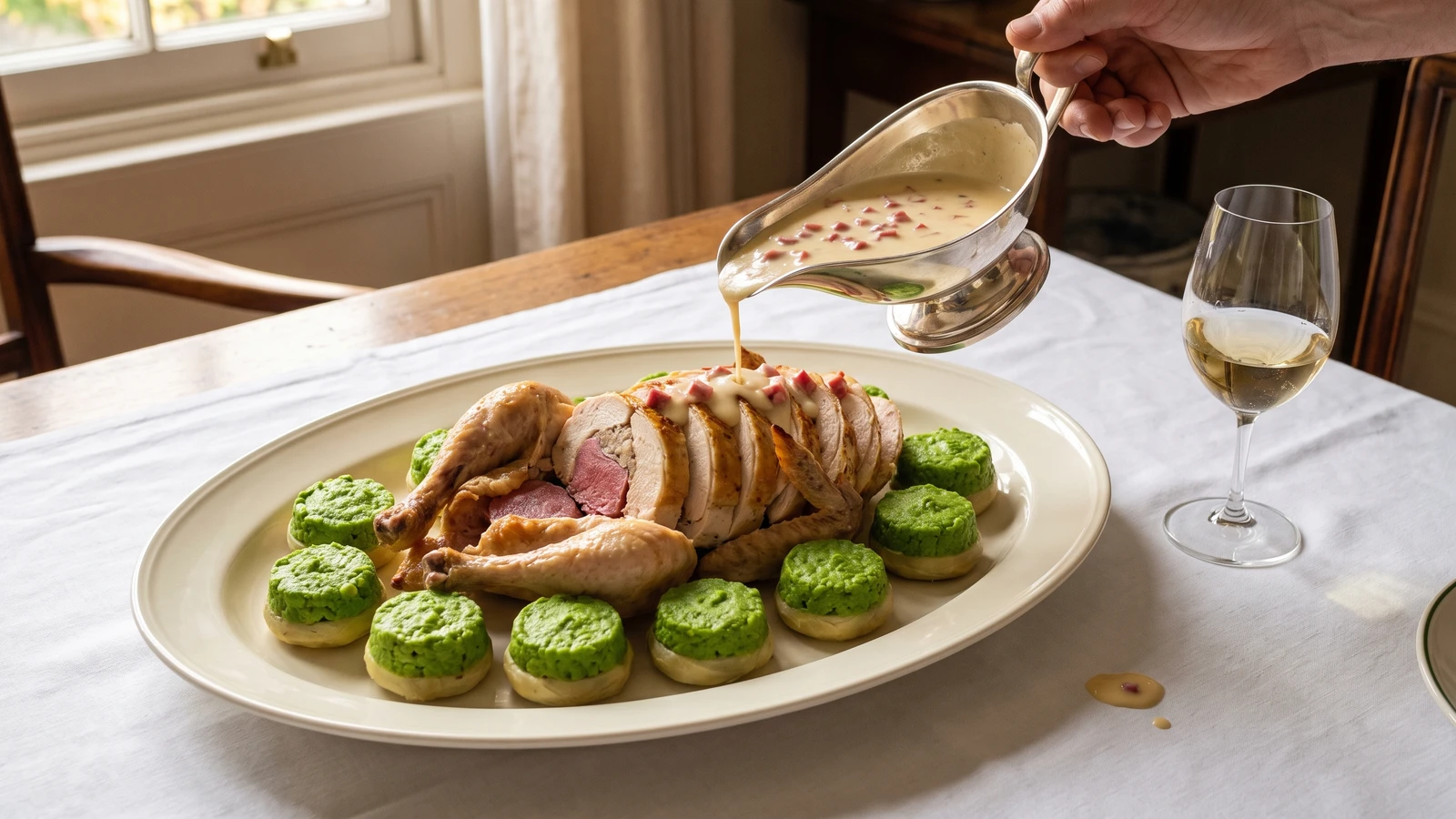
Boned poularde, cream-rich forcemeat, and a rose-red tongue at the center, poached gently, reconstructed on the platter, and finished with sauce Allemande and pea timbales.
Poularde Devonshire (a poached young hen stuffed with chicken forcemeat and salted calf's tongue) teaches one discipline before all others: leave room for the filling to swell. A seam sewn tight tears; a seam with a finger's breadth of play holds the bird's shape and keeps the forcemeat around the tongue, where the first slice can show its pale ring and rose-red center. Space, not force, is the principle.
The source recipe assumed a skilled boning hand, a saucier on staff, stock never off the fire, and enough hands to keep pea timbales warm while another cook carved and rebuilt the bird. It doesn't call for a salamander because Poularde Devonshire is poached and lightly sauced, never browned. At home, ask the butcher to remove the breast cage, use a narrow stockpot for the poach, and turn the strained poaching liquor into sauce Allemande in one saucepan. The fine sausage meat remains exactly half the weight of the cream-made chicken forcemeat. One cook, one stove, one evening.
The low decorative cushion goes; that was service scaffolding. Deboning the breast, centering the tongue, stitching loosely, poaching gently, reconstructing the slices, and setting the pea timbales on artichoke bottoms all stay, because those steps are the dish. Before touching a pan, check that the stitched belly yields under one fingertip. That little margin decides the whole platter.
Poularde Devonshire belongs to the named-dish repertory of formal Parisian cookery, where a whole bird could be boned, stuffed, poached, carved, and rebuilt before it reached the dining room. The English title does not make it a Devon farmhouse dish; its sauce Allemande, cured tongue, and ordered border of pea timbales on artichoke bottoms speak the language of the French grand kitchen. From professional service it passed to ambitious bourgeois tables, where the platter remained a demonstration of carving and saucemaking rather than regional identity.
Quantity
1 bird, 4½ to 5 lb (2 to 2.25 kg)
breast cage removed through the body cavity while the skin, breast meat, spine, legs, and wings remain attached
Quantity
1½ teaspoons (7.5 ml / 9 g)
divided
Quantity
¾ teaspoon (3.75 ml / 1.5 g)
divided
Quantity
9 oz (255 g)
cut into small pieces and thoroughly chilled
Quantity
1, about 2 tablespoons (30 ml / 30 g)
thoroughly chilled
Quantity
½ cup (120 ml / 120 g)
thoroughly chilled
Quantity
7 oz (200 g)
thoroughly chilled
Quantity
1 small tongue, about 1 lb (450 g)
cartilage removed; reserve ½ cup (120 ml / 80 g) lean rose-red trimmings and dice finely
Quantity
8 slices, about 4 oz (115 g)
for barding
Quantity
3 quarts (2.8 L / 2.8 kg)
Quantity
Up to 1 quart (950 ml / 950 g)
only if needed to submerge the poularde
Quantity
4 tablespoons (60 ml / 56 g)
3 tablespoons for the roux and 1 tablespoon to finish the sauce
Quantity
⅓ cup (80 ml / 40 g)
Quantity
3 cups (720 ml / 720 g)
Quantity
2, about 2 tablespoons (30 ml / 36 g)
Quantity
½ cup (120 ml / 120 g)
divided
Quantity
2 teaspoons (10 ml / 10 g)
Quantity
8 small timbales of Moulded Pease Purée for Garnish (No. 2196), about 2 tablespoons (30 ml / 30 g) each
kept in their molds until serving
Quantity
8, about 14 oz (400 g)
drained and trimmed flat
| Ingredient | Quantity |
|---|---|
| fine poularde or young roasting henbreast cage removed through the body cavity while the skin, breast meat, spine, legs, and wings remain attached | 1 bird, 4½ to 5 lb (2 to 2.25 kg) |
| fine sea saltdivided | 1½ teaspoons (7.5 ml / 9 g) |
| finely ground white pepperdivided | ¾ teaspoon (3.75 ml / 1.5 g) |
| boneless skinless chicken breastcut into small pieces and thoroughly chilled | 9 oz (255 g) |
| large egg whitethoroughly chilled | 1, about 2 tablespoons (30 ml / 30 g) |
| heavy cream for the chicken forcemeatthoroughly chilled | ½ cup (120 ml / 120 g) |
| very finely ground plain sausage meatthoroughly chilled | 7 oz (200 g) |
| cooked salted calf's tonguecartilage removed; reserve ½ cup (120 ml / 80 g) lean rose-red trimmings and dice finely | 1 small tongue, about 1 lb (450 g) |
| thinly sliced unsmoked streaky baconfor barding | 8 slices, about 4 oz (115 g) |
| light low-sodium chicken stock | 3 quarts (2.8 L / 2.8 kg) |
| wateronly if needed to submerge the poularde | Up to 1 quart (950 ml / 950 g) |
| unsalted butter3 tablespoons for the roux and 1 tablespoon to finish the sauce | 4 tablespoons (60 ml / 56 g) |
| all-purpose flour | ⅓ cup (80 ml / 40 g) |
| strained poularde poaching liquor | 3 cups (720 ml / 720 g) |
| large egg yolks | 2, about 2 tablespoons (30 ml / 36 g) |
| heavy cream for the saucedivided | ½ cup (120 ml / 120 g) |
| fresh lemon juice | 2 teaspoons (10 ml / 10 g) |
| prepared pea timbaleskept in their molds until serving | 8 small timbales of Moulded Pease Purée for Garnish (No. 2196), about 2 tablespoons (30 ml / 30 g) each |
| cooked artichoke bottomsdrained and trimmed flat | 8, about 14 oz (400 g) |
Ask the butcher to remove the breast cage through the body cavity, leaving the breast meat and skin attached to the bird along with the spine, legs, and wings. If doing it yourself, free the wishbone first, then work a small boning knife against the ribs and keel with its edge always turned toward bone; disarticulate and lift out the breast cage without cutting through the outer skin. Season the newly opened interior with ½ teaspoon of the salt and ¼ teaspoon of the white pepper. If you find a small nick in the skin, close it now with two loose stitches. It will disappear beneath the barding.
Chill the food processor bowl and blade. Pulse the cold chicken with the egg white, ½ teaspoon salt, and ¼ teaspoon white pepper until smooth and tacky, then add the cold cream gradually while pulsing, holding back 1 tablespoon for a possible rescue. Press the mixture through a fine-mesh sieve. The finished chicken forcemeat weighs about 14 oz (405 g); fold in the 7 oz (200 g) of very fine sausage meat, exactly half its weight. Poach a teaspoonful in the heating stock and taste it before adjusting the seasoning. If the forcemeat looks oily or grainy, it has warmed too far. Stop, set it over ice for 10 minutes, then pulse briefly with the reserved cold cream until it comes together. Keep it cold.
Lay half the forcemeat inside the opened breast. Trim the calf's tongue into a neat central piece that fits the bird, reserving the lean rose-red trimmings for the sauce, then place it lengthwise in the middle with its thin end pointing toward the tail. Pack the remaining forcemeat around and over it without driving out every bit of give. Bring the belly skin together and sew it with loose stitches spaced about 1 inch (2.5 cm) apart; you must be able to slide a fingertip beneath the string. If the seam is taut, remove a spoonful of forcemeat rather than forcing it closed. Truss the legs and wings. Bardez la poularde, meaning cover the breast with the bacon slices, and secure them lightly with string. Wrap the bird in a loose square of muslin or cheesecloth to support it during the poach.
Heat the chicken stock in a narrow stockpot to 180°F (82°C). Lower in the poularde using the cloth as a sling, then add only enough measured water to submerge it. Hold the liquid between 175°F and 185°F (79°C and 85°C), with only an occasional movement at the surface, for 75 to 95 minutes. Never let it boil: violent movement makes the forcemeat coarse and drives it against the seam. The poularde is ready when the center of the forcemeat reaches 165°F (74°C) in two places. If the seam starts to open, lower the heat immediately and secure the outer cloth with another loop of string without tightening the skin itself; a little escaped forcemeat can simply be strained from the liquor. Lift the bird onto a rack and let it drain and settle for 20 minutes.
Strain and skim the poaching liquor, bring it to a full boil for 2 minutes, then measure 3 cups (720 ml / 720 g). Melt 3 tablespoons of the butter in a saucepan, stir in the flour, and cook the roux gently for 2 minutes without letting it color. Whisk in the hot liquor a little at a time, scraping into every corner, then simmer gently for 15 to 20 minutes until the sauce is smooth, ivory-colored, and lightly coats a spoon. If it is thin, reduce it now; once the yolks enter, boiling is forbidden. If the roux has formed lumps, strain the sauce and continue. Nothing is lost.
Reserve 1 tablespoon of the sauce cream. Whisk the yolks with the remaining cream, then temper this liaison, the yolk-and-cream finish, with two ladlefuls of the warm sauce. Return everything to the saucepan over very low heat and stir until the sauce thickens to a soft ribbon, never allowing it to boil. Add the lemon juice, the final tablespoon of butter, and the reserved diced tongue; taste before using the remaining salt and white pepper because the stock and tongue already carry salt. If the sauce curdles, take it off the heat at once and whisk the reserved cold cream in a clean bowl, followed by the broken sauce a spoonful at a time. Ça se rattrape. Strain only if necessary, then return the tongue dice to the smooth sauce.
Warm the artichoke bottoms for 5 minutes in a shallow pan with a little strained poaching liquor, then drain them very well and keep them covered. Hold the prepared Moulded Pease Purée for Garnish (No. 2196) warm in their molds according to that preparation's directions. Do not unmold them yet; the artichoke bottoms are their bases, and moving the timbales twice only invites breakage.
Remove the cloth, bacon, trussing string, and belly stitches. With the point of a knife, cut an incision around the breast just inside the legs and wings. Slide a long slicing knife horizontally at the level of the spine and detach the breast, forcemeat, and tongue as one block. The source asks for a single stroke; several calm, level strokes are safer at home and change nothing. Cut the block lengthwise through the center of the tongue, then slice each half crosswise into pieces about ⅜ inch (1 cm) thick. Set the carcass, legs and wings still attached, directly on a warm oval platter and return the slices in their original order, overlapping them only enough to reconstruct the bird. If the block separates, rest it another 10 minutes and arrange the slices in two close rows over the carcass. The sauce will settle the joins.
Spoon a light coat of sauce Allemande over the reconstructed breast, allowing the rose-red tongue dice to remain visible. Unmold one pea timbale onto each warm artichoke bottom and arrange all eight around the poularde as a border. Pour the remaining sauce into a warmed sauceboat and bring both to the table at once. This is a generous platter, not a sculpture to admire from across the room. À table!
1 serving (about 800g)
Culinary guides, cultural storytelling, and the editorial depth that makes cooking meaningful.
Discover Culinary ExplorerChef Juliette
John Dory has the delicacy of sole and the firmness of turbot. A light flouring, a quick butter sauté, and nut-brown beurre noisette show exactly why looks never mattered.

Chef Juliette
Fresh haddock proves its delicacy in the meunière pan: a fine flour crust, moist pearly flakes, and beurre noisette sharpened with lemon and parsley, ready from one skillet in half an hour.

Chef Juliette
Éperlans à l’Anglaise turns small fish into a lesson in disciplined coating: boned smelts under a close, crisp crumb, pan-fried in clarified butter and finished with bright, half-melted maître d’hôtel butter.

Chef Juliette
Tiny smelts, shallot, mushrooms, white wine, gratin sauce, and fine bread raspings meet a fierce oven, where the fish must turn tender in the same breath the buttered crust bronzes.