
Chef Juliette
John Dory (St. Pierre)
John Dory has the delicacy of sole and the firmness of turbot. A light flouring, a quick butter sauté, and nut-brown beurre noisette show exactly why looks never mattered.
A cooking platform built around craft, culture, and the stories behind what we eat.
Created by Chef Juliette
Based on No. 1463, Poularde en Demi-Deuil, from Le Guide Culinaire (1907) by Auguste Escoffier
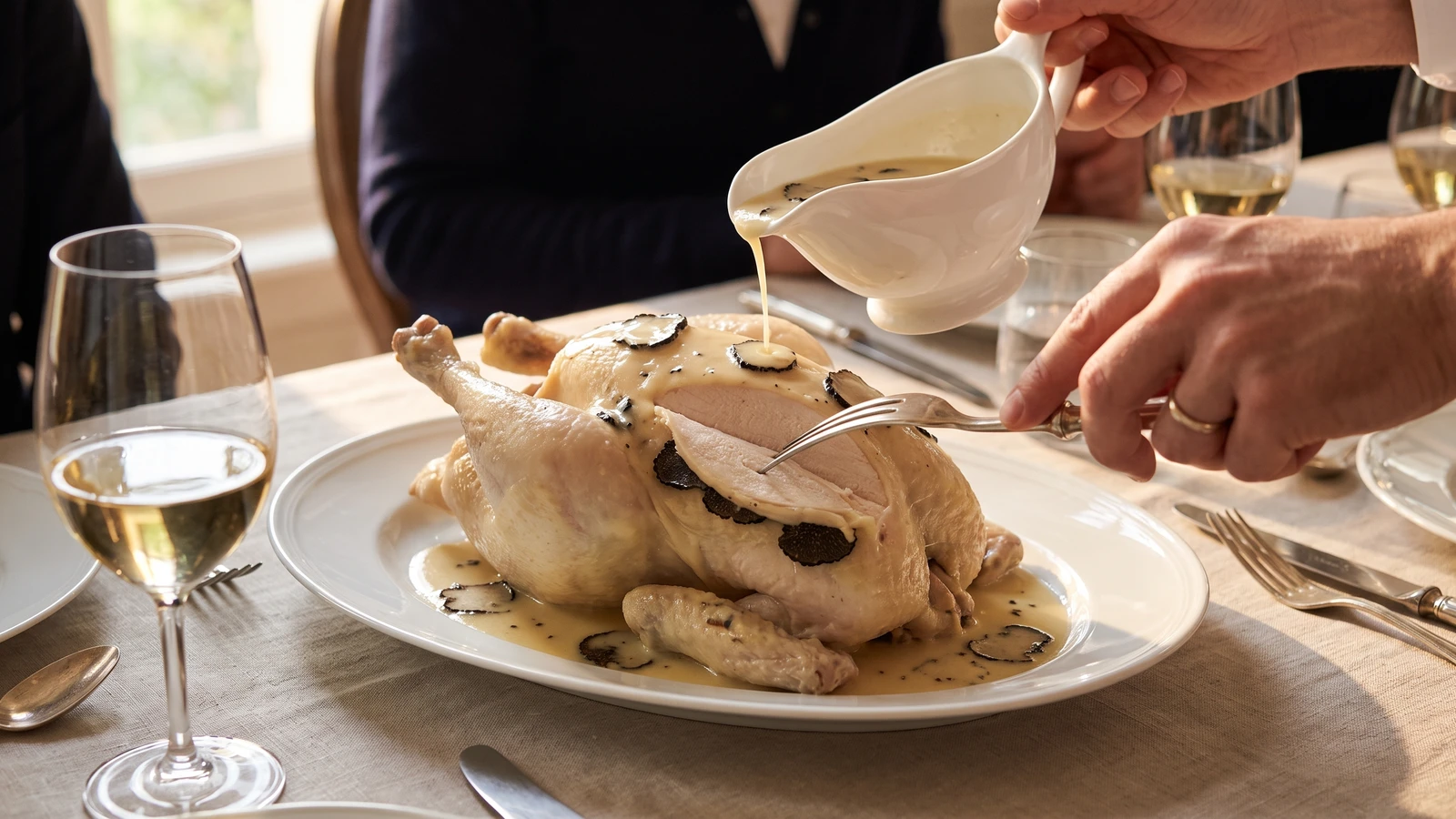
Raw truffle under pale poultry skin, gentle poaching, and a white sauce suprême: Poularde en demi-deuil teaches that perfume depends on sequence, and luxury needs discipline more than complication.
Poularde en demi-deuil (pullet in half-mourning) teaches one uncompromising lesson: the truffle must go beneath the skin while raw. Gentle heat then carries its perfume into the flesh. Cooked or preserved slices tucked in afterward can decorate the bird, but they cannot do this work. The black veil beneath pale skin gives the dish its name; the perfume gives it purpose.
The original entry assumed a fat poularde, a larding needle, a stockpot never cold, a saucier reducing the cooking liquor while maintaining a very white sauce suprême (chicken velouté enriched with cream and butter), and a napkin through which to strain it. At home, a narrow paring knife, good unsalted stock, damp cheesecloth, and one saucepan accomplish the same work for four. We reduce only the liquor required for the sauce rather than the entire poaching pot; that was brigade scaffolding. The raw truffle, larding, gentle poach, pale sauce, and extra sauceboat remain. Those steps are the dish. One cook, one stove, one evening.
Expect ivory sauce, tender white flesh, and dark truffle showing faintly beneath the skin, not the bronzed drama of a roast. The decisive step happens before the pot: slice the raw truffle thinly, slide it flat against the breast fillets, and keep the skin whole enough to hold its perfume close.
Poularde en demi-deuil belongs above all to Lyon, where the mères lyonnaises made truffle slipped beneath pale poultry skin a celebrated part of the city's generous table. Its name refers to the black truffle showing through white skin and sauce like half-mourning dress, not to a funerary custom. Though the dish traveled comfortably through grand kitchens and formal dining rooms, its method remains direct: perfume a fine bird, poach it gently, and serve it with sauce enough for everyone.
Quantity
1 bird, 4½ to 5 lb (2 to 2.3 kg)
neck and giblets removed, bird dried well
Quantity
1 large truffle, about 2 oz (55 g)
brushed clean
Quantity
¼ cup (60 ml / 55 g)
chilled and cut into 8 narrow batons
Quantity
10 cups (2.4 L / about 2.4 kg)
Quantity
Up to 4 cups (950 ml / 950 g)
as needed to cover the bird
Quantity
1 tablespoon (15 ml / 18 g)
divided
Quantity
½ teaspoon (2.5 ml / 1 g)
divided
Quantity
5 tablespoons (75 ml / 70 g)
divided, with 2 tablespoons kept cold
Quantity
⅓ cup (80 ml / 40 g)
Quantity
1 cup (240 ml / 240 g)
kept cold
| Ingredient | Quantity |
|---|---|
| poularde (fattened young hen)neck and giblets removed, bird dried well | 1 bird, 4½ to 5 lb (2 to 2.3 kg) |
| fresh black winter trufflebrushed clean | 1 large truffle, about 2 oz (55 g) |
| unsmoked fatbackchilled and cut into 8 narrow batons | ¼ cup (60 ml / 55 g) |
| unsalted chicken stock | 10 cups (2.4 L / about 2.4 kg) |
| cold wateras needed to cover the bird | Up to 4 cups (950 ml / 950 g) |
| fine sea saltdivided | 1 tablespoon (15 ml / 18 g) |
| finely ground white pepperdivided | ½ teaspoon (2.5 ml / 1 g) |
| unsalted butterdivided, with 2 tablespoons kept cold | 5 tablespoons (75 ml / 70 g) |
| all-purpose flour | ⅓ cup (80 ml / 40 g) |
| heavy creamkept cold | 1 cup (240 ml / 240 g) |
Slice the raw truffle as thinly as you can, using a truffle slicer or very sharp knife. Reserve one-third of the slices for the sauce. Working from the neck and cavity openings, ease your fingers between the skin and each breast fillet without detaching the skin along the centre. Lay the remaining slices flat over both fillets, with their edges barely overlapping, then smooth the skin back into place. Season the cavity and exterior with two-thirds of the salt and half the white pepper. If the skin tears, overlap the edges rather than stitching or pinning them; trussing will hold the truffle in place, and the sauce will cover the small scar.
From the cavity side, push a narrow paring knife lengthwise into the thickest meat of each thigh to make four slim channels per side, taking care not to pierce the outer skin. Follow each channel with a chilled fatback baton. The old kitchen used a larding needle; the knife makes the same passage at home, and keeping the channels in the thighs protects the truffled breast from punctures. Fold the wing tips beneath the bird, draw the legs together, and truss firmly with kitchen twine.
Set the poularde breast-side up in a narrow, heavy pot and pour in the unsalted chicken stock. Add only enough cold water to cover the bird by about 1 inch. Bring the liquid slowly to its first quiver over medium heat, skimming away any grey foam, then lower the heat and cover the surface with a cartouche, a round of parchment. Hold the liquid between 180 and 185°F (82 and 85°C), with an occasional lazy bubble but never a boil, for 55 to 75 minutes. The bird is ready when the thickest breast reaches 165°F (74°C) and the inner thigh reaches 170 to 175°F (77 to 79°C). If the pot boils, lift it off the heat for several minutes, add a little cold water, and return it over the lowest flame. A brief boil has not ruined the bird, but continued boiling will tighten the flesh and disturb the truffle.
Lift the poularde carefully, tip the cavity over the pot to drain it, and transfer the bird to a warm platter. Cover it loosely and let it rest while you make the sauce. Pass the cooking liquor through a fine sieve lined with damp cheesecloth; this replaces the original napkin without sacrificing clarity. Skim off the surface fat, measure 4 cups (950 ml / about 950 g) of liquor into a wide saucepan, and boil it steadily until reduced to 2½ cups (600 ml / about 600 g). Keep the remaining liquor unsalted and unreduced for adjusting the sauce, then cool it promptly for another use.
Melt 3 tablespoons (45 ml / 42 g) of the butter over gentle heat in a clean saucepan. Stir in the flour and cook this roux blanc, a white roux, for 2 minutes without allowing it to color. Whisk in the hot reduced cooking liquor a ladleful at a time, smoothing each addition before the next. Simmer gently for 10 to 12 minutes, whisking often, until the sauce is nappant, thick enough to coat the back of a spoon. Add the cream and simmer for another 5 minutes, then add the reserved truffle slices and warm them for 2 minutes without boiling hard. Taste before adding the remaining salt and white pepper. Remove the pan from the heat and whisk in the remaining 2 tablespoons (30 ml / 28 g) of cold butter, a piece at a time. If the sauce is lumpy, pass it through the fine sieve; if too thick, loosen it with unreduced cooking liquor. If the butter leaves greasy streaks, stop heating and whisk in a tablespoon of cold cream. Ça se rattrape.
Remove the twine and settle the whole poularde on the warmed platter, breast-side up. Spoon enough sauce suprême over the bird to coat it generously, allowing a few dark truffle shadows to remain visible through the pale skin and sauce. Pour the rest, including its truffle slices, into a warmed sauceboat. Do not brown the bird under a broiler; its ivory surface is intentional, and browning would toughen the breast while confusing the half-mourning effect. Bring it whole to the table, carve the legs first and the breast across the grain, then pass the sauceboat without stinginess. À table!
1 serving (about 500g)
Culinary guides, cultural storytelling, and the editorial depth that makes cooking meaningful.
Discover Culinary ExplorerChef Juliette
John Dory has the delicacy of sole and the firmness of turbot. A light flouring, a quick butter sauté, and nut-brown beurre noisette show exactly why looks never mattered.

Chef Juliette
Fresh haddock proves its delicacy in the meunière pan: a fine flour crust, moist pearly flakes, and beurre noisette sharpened with lemon and parsley, ready from one skillet in half an hour.

Chef Juliette
Éperlans à l’Anglaise turns small fish into a lesson in disciplined coating: boned smelts under a close, crisp crumb, pan-fried in clarified butter and finished with bright, half-melted maître d’hôtel butter.

Chef Juliette
Tiny smelts, shallot, mushrooms, white wine, gratin sauce, and fine bread raspings meet a fierce oven, where the fish must turn tender in the same breath the buttered crust bronzes.