
Chef Juliette
Pullets and Capons for Relevés
Three roads through the Paris poultry canon, poach, poêler, or braise, with one rule beneath them all: protect the breast with bacon while the legs cook, then turn the liquor into sauce.
A cooking platform built around craft, culture, and the stories behind what we eat.
Created by Chef Juliette
Based on No. 1446, Poularde Alexandra, from Le Guide Culinaire (1907) by Auguste Escoffier
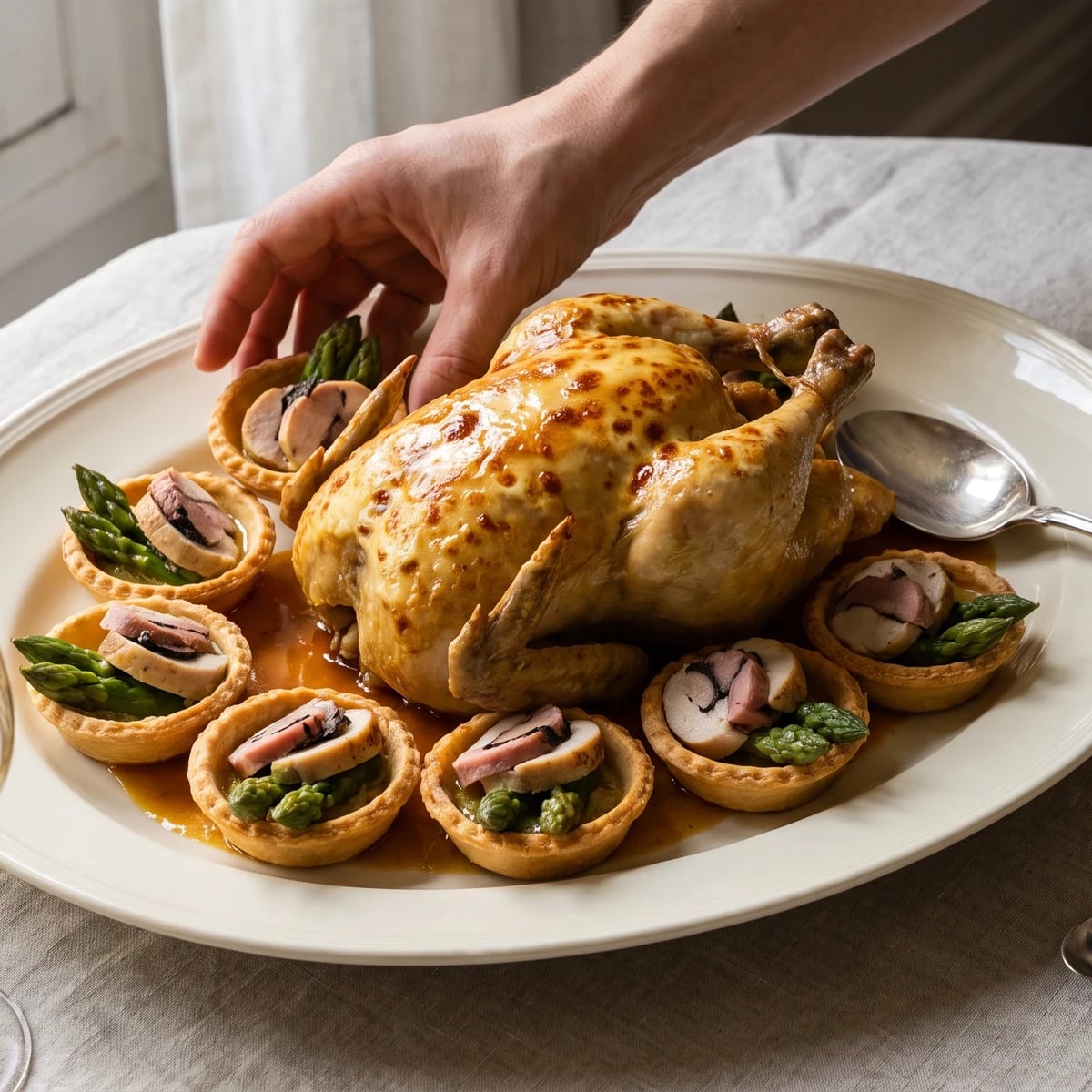
Poularde Alexandra turns one poached bird into a small ceremony: truffle and tongue in the sliced suprêmes, feather-light mousseline beneath a bronzed Mornay coat, and buttered asparagus tartlets all around.
Poularde Alexandra (poached chicken with tongue, truffle, fine chicken forcemeat, and cheese sauce) teaches one exact lesson: temperature, not ornament, decides whether an elaborate dish feels light. The larded suprêmes leave the poached bird to become its garnish, and mousseline forcemeat (a cold chicken-and-cream paste) takes their place beneath a coat of Mornay. It looks ceremonial, but its logic is clear once you see the exchange.
The original assumed a larding needle, a stock never off the fire, a saucier on staff, a cooler place at the front of the oven, and a salamander waiting for the final glaze. At home, a slim knife and skewer make the larding channels, good unsalted stock reduces into the pale glaze, one saucepan builds Mornay sauce (béchamel enriched with Gruyère and Parmesan), a low oven poaches the mousseline, and the broiler supplies the quick colour. I've scaled the display to one plump bird and eight tartlets for four. One cook, one stove, one evening.
Separate hands tending the breasts, tartlets, sauce, and glaze were brigade scaffolding, and those extra hands can go. The tongue-and-truffle larding, gentle poach, exchange of suprêmes for mousseline, Mornay coat, quick glaze, and asparagus tartlets must stay, because they are the dish. The step that matters most is the second poach: hold it low and gentle, or the mousseline weeps and sinks before the Mornay ever reaches it.
Poularde Alexandra belongs to the Parisian grand-kitchen table, among named poultry pièces in which a whole poached bird was reshaped, sauced, and presented with its garnish as architecture. Its surprise is structural: the tongue-and-truffle-larded suprêmes are removed to crown the asparagus tartlets, while mousseline forcemeat takes their place on the carcass beneath Mornay. Mousselines usually describe individual molded portions of the same fine forcemeat; here the mixture is shaped directly on the bird, one reason the dish demands gentler heat than its grand appearance suggests.
Quantity
1, about 4 to 4½ lb (1.8 to 2 kg)
giblets removed
Quantity
½ cup (120 ml / 90 g)
cut into 8 slender batons
Quantity
1 small, about 1 oz (25 g)
cut into 8 slender batons
Quantity
12 cups (2.8 L / 2.8 kg)
Quantity
2 tablespoons (30 ml / 36 g)
divided
Quantity
½ teaspoon (2.5 ml / 1 g)
divided
Quantity
10½ oz (300 g)
diced and thoroughly chilled
Quantity
1
thoroughly chilled
Quantity
Up to ⅔ cup (160 ml / 160 g)
Quantity
1¼ cups (300 ml / 150 g)
Quantity
⅓ cup (80 ml / 75 g)
diced
Quantity
2
divided between the pastry and Mornay sauce
Quantity
2 to 3 tablespoons (30 to 45 ml / 30 to 45 g)
Quantity
¼ cup (60 ml / 55 g)
Quantity
⅓ cup plus 1 tablespoon (95 ml / 55 g)
Quantity
2 cups (480 ml / 495 g)
hold back 2 tablespoons cold
Quantity
1 cup (240 ml / 100 g)
finely grated
Quantity
⅓ cup (80 ml / 30 g)
finely grated
Quantity
¼ cup (60 ml / 60 g)
Quantity
⅛ teaspoon (0.6 ml / 0.3 g)
Quantity
24, about 8 oz (225 g)
trimmed to fit the tartlet shells
Quantity
2 tablespoons (30 ml / 28 g)
Quantity
1 tablespoon (15 ml / 14 g)
| Ingredient | Quantity |
|---|---|
| poularde or plump roasting chickengiblets removed | 1, about 4 to 4½ lb (1.8 to 2 kg) |
| cooked cured beef or veal tonguecut into 8 slender batons | ½ cup (120 ml / 90 g) |
| whole black truffle, fresh or preservedcut into 8 slender batons | 1 small, about 1 oz (25 g) |
| unsalted, gelatin-rich chicken stock | 12 cups (2.8 L / 2.8 kg) |
| fine sea saltdivided | 2 tablespoons (30 ml / 36 g) |
| finely ground white pepperdivided | ½ teaspoon (2.5 ml / 1 g) |
| raw skinless chicken breast, for the mousselinediced and thoroughly chilled | 10½ oz (300 g) |
| large egg whitethoroughly chilled | 1 |
| cold heavy cream, for the mousseline | Up to ⅔ cup (160 ml / 160 g) |
| all-purpose flour, for the tartlet crusts | 1¼ cups (300 ml / 150 g) |
| cold unsalted butter, for the tartlet crustsdiced | ⅓ cup (80 ml / 75 g) |
| large egg yolksdivided between the pastry and Mornay sauce | 2 |
| ice water | 2 to 3 tablespoons (30 to 45 ml / 30 to 45 g) |
| unsalted butter, for the Mornay sauce | ¼ cup (60 ml / 55 g) |
| all-purpose flour, for the Mornay sauce | ⅓ cup plus 1 tablespoon (95 ml / 55 g) |
| whole milkhold back 2 tablespoons cold | 2 cups (480 ml / 495 g) |
| Gruyèrefinely grated | 1 cup (240 ml / 100 g) |
| Parmesanfinely grated | ⅓ cup (80 ml / 30 g) |
| heavy cream, for the Mornay sauce | ¼ cup (60 ml / 60 g) |
| freshly grated nutmeg | ⅛ teaspoon (0.6 ml / 0.3 g) |
| asparagus headstrimmed to fit the tartlet shells | 24, about 8 oz (225 g) |
| unsalted butter, for the asparagus | 2 tablespoons (30 ml / 28 g) |
| cold unsalted butter, for the pale glaze | 1 tablespoon (15 ml / 14 g) |
Work the 1¼ cups flour, cold diced butter, and ¼ teaspoon salt together with your fingertips until the mixture resembles coarse crumbs. Add one egg yolk and 2 tablespoons ice water, mixing only until the dough gathers; add the final spoonful of water only if dry flour remains. Flatten into a disc, wrap, and chill for 30 minutes. This rest keeps the little shells tender and prevents them shrinking away from their tins.
Pat the poularde dry. Working from the neck opening so the breast skin remains intact, loosen the skin carefully with your fingers. Use a slim boning knife or metal skewer to make four narrow tunnels lengthwise through each breast, keeping the blade nearly parallel to the breastbone. Push one tongue baton and one truffle baton together into each channel with the skewer. Season the cavity and exterior with 1½ teaspoons salt and a little white pepper, then truss the legs and wings close to the body.
Heat the chicken stock in a close-fitting stockpot to 180°F (82°C). Lower in the poularde breast-side up; the stock should cover it, so add a little boiling water only if the shape of your pot demands it. Lay a parchment round on the surface and hold the liquid between 175 and 185°F (80 and 85°C), with only an occasional lazy bubble, for 55 to 70 minutes. The breast must reach 165°F (74°C) and the thickest part of the thigh at least the same temperature. A rolling boil tightens the meat and batters the skin. Lift the bird onto a rack for 10 minutes, strain the liquor, and reserve at least 4 cups.
While the poularde poaches, heat the oven to 375°F (190°C). Roll the rested pastry between two sheets of parchment to about ⅛ inch (3 mm), cut eight rounds, and line eight 2¾-inch (7 cm) tartlet tins. Prick the bases, chill for 10 minutes, then line with small parchment squares and baking weights. Bake for 12 to 14 minutes, remove the weights, and bake for another 5 to 7 minutes until crisp and evenly golden. If a base has puffed, press it down gently while still warm. Turn the oven down to 300°F (150°C).
Chill the food-processor bowl and blade for 10 minutes. Process the diced raw chicken with ¾ teaspoon salt and ¼ teaspoon white pepper until smooth and tacky, then add the cold egg white. With the motor running, add ½ cup of the cold cream in a thin stream. Stop and scrape often, because friction warms the paste. Add the remaining cream a spoonful at a time only while the mousseline remains glossy and stiff enough to hold a mound. Poach a teaspoonful in barely trembling water until its centre reaches 165°F (74°C), then taste it. If it is rubbery, work in another spoonful of cream. If it spreads or sheds liquid, stop adding cream and set the bowl over ice for 10 minutes before testing again.
Cut an oval through the skin around each breast, then follow the keel and ribs with the knife to lift both larded suprêmes whole. Cover them in a shallow dish with ½ cup hot poaching liquor and keep them warm. Set the remaining poularde breast-side up in the broiler-safe serving dish. Spoon the mousseline into the two breast hollows, reserving 2 tablespoons for repairs, and smooth it with a wet spatula into the original rounded shape of the bird. Pour 1 cup hot poaching liquor around, but not over, the mousseline, and tent loosely with parchment. Poach in the 300°F (150°C) oven for 20 to 25 minutes, until the centre of the mousseline reaches 165°F (74°C). If fat or cream beads on the surface and the shape begins to sink, lower the oven to 275°F (135°C), blot without pressing, patch the hollow with the reserved mousseline, and continue gently until the repair also reaches 165°F (74°C). Ça se rattrape.
While the mousseline poaches, boil 3 cups strained poaching liquor in a wide pan until reduced to about ½ cup, pale, glossy, and lightly syrupy. Skim away any fat as it rises. If salt becomes strong before the glaze gains body, add a little unsalted stock and reduce again. Whisk in the cold tablespoon of butter at the end and keep this pale glaze warm. For the Mornay sauce, melt the ¼ cup butter in a saucepan, stir in the ⅓ cup plus 1 tablespoon flour, and cook this white roux for 2 minutes without colouring it. Add the milk gradually, whisking smooth, and simmer gently for 8 minutes. Off the heat, stir in the Gruyère and Parmesan. Whisk the remaining egg yolk with the ¼ cup cream, temper it with a ladle of sauce, then whisk it back into the Mornay with the nutmeg, salt, and white pepper. Warm it over the lowest heat just until it coats a spoon heavily, but never let it boil. If it turns grainy, pull it from the heat, whisk in the reserved cold milk, and pass it through a fine sieve.
Blanch the asparagus heads in well-salted water for 2 to 3 minutes, until tender at the cut end but still bright green. Drain and dry them thoroughly, then turn them in the 2 tablespoons butter over low heat until cohered by a fine, glossy coating. Warm the tartlet shells for 3 minutes, divide the asparagus among them, and arrange the tips neatly. Lift the reserved suprêmes from their liquor and slice each crosswise into four even collops, so the tongue and truffle show in every cut. Set one collop on each tartlet and brush it lightly with warm pale glaze. Cover loosely and keep warm.
Heat the broiler fully. Lift the poularde from its poaching liquor, drain the serving dish, and blot the mousseline and skin carefully; Mornay slides from a wet surface. Spoon the sauce over the upper surface and sides in a generous, even coat. If it runs rather than clings, return the remaining sauce to the pan for a minute of gentle reduction, blot the bird again, and recoat it. Set the dish 5 to 6 inches (13 to 15 cm) beneath the broiler for 2 to 4 minutes, turning once if necessary, until the Mornay is butter-gold in scattered patches. Watch without leaving. This is a quick glaze, not another cooking.
Arrange the eight warm tartlets closely around the glazed poularde. Spoon a narrow, unbroken thread of pale glaze around the base of the bird, keeping it off the bronzed Mornay. Bring the whole piece to the table, then give each person two tartlets, some leg or wing meat, and a spoonful of the tender mousseline. À table!
1 serving (about 670g)
Culinary guides, cultural storytelling, and the editorial depth that makes cooking meaningful.
Discover Culinary Explorer
Chef Juliette
Three roads through the Paris poultry canon, poach, poêler, or braise, with one rule beneath them all: protect the breast with bacon while the legs cook, then turn the liquor into sauce.

Chef Juliette
The service method that protects a grand poultry dish: carve the suprêmes in the kitchen, keep them in their liquor, rebuild the bird with pilaf, and send every guest a hot, complete plate.

Chef Juliette
The marshal’s poularde teaches gentle poaching: a rice-stuffed bird held at a bare tremble, then cloaked in sauce Albuféra and surrounded by truffle tartlets, tiny quenelles, mushrooms, and salted tongue.

Chef Juliette
A truffle-studded poularde, gently braised in Matignon, rebuilt over buttered asparagus, and coated with sauce suprême that clings in an ivory veil, with glazed lamb sweetbreads ringing the platter.