
Chef Juliette
John Dory (St. Pierre)
John Dory has the delicacy of sole and the firmness of turbot. A light flouring, a quick butter sauté, and nut-brown beurre noisette show exactly why looks never mattered.
A cooking platform built around craft, culture, and the stories behind what we eat.
Created by Chef Juliette
Based on No. 1441, Mousse de Jambon au Blanc de Poulet, from Le Guide Culinaire (1907) by Auguste Escoffier
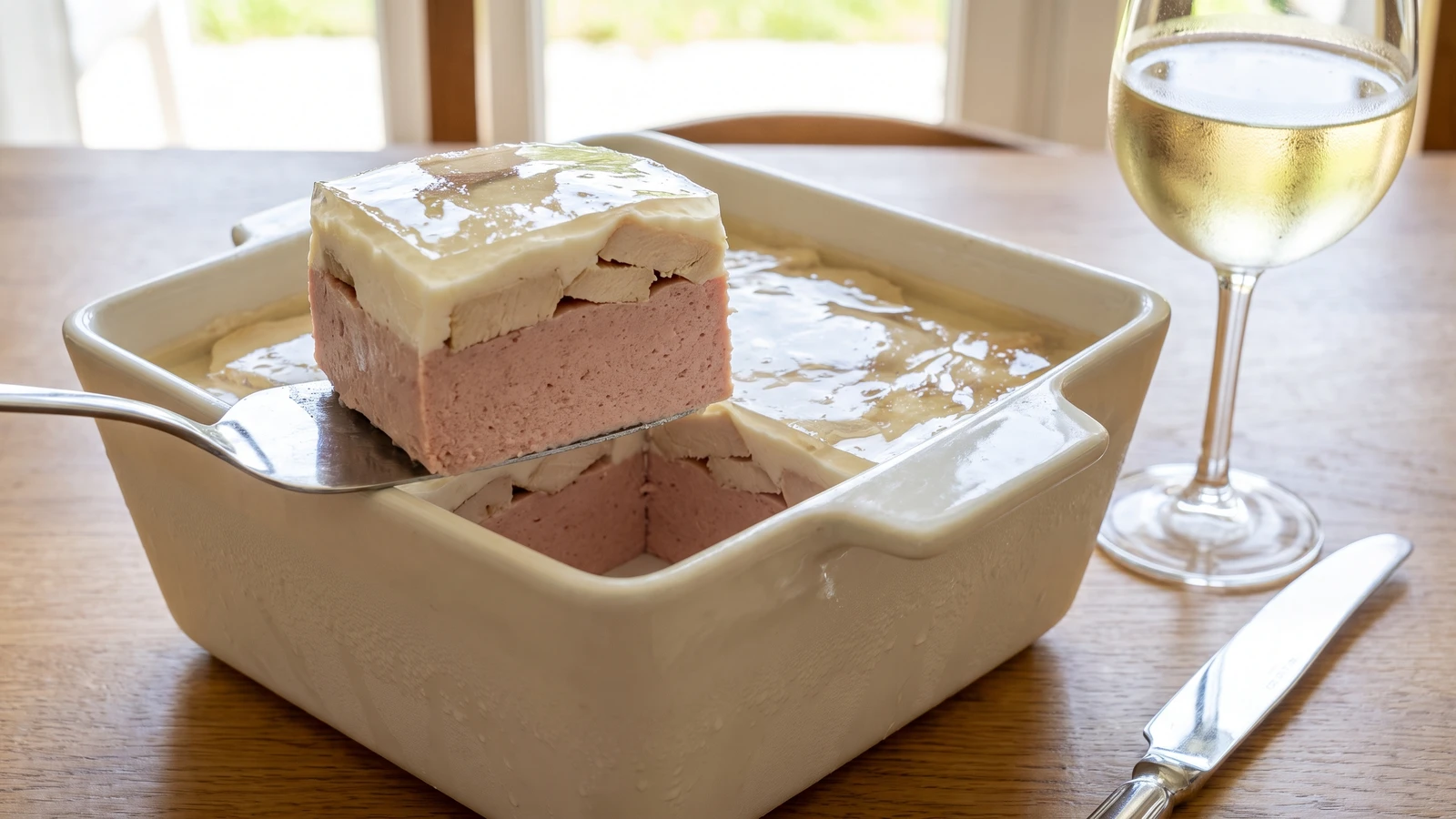
A pale, gleaming composition of savory ham mousse, white-poached chicken suprêmes, chaud-froid, and clear aspic, built in patient layers so every chilled slice stands clean and generous.
Mousse de Jambon au Blanc de Poulet (ham mousse with poached chicken breast) teaches the architecture of cold cookery: each layer must be cold and firm enough to carry the next. The one true thing is simple. Let the ham mousse set completely before you arrange the chicken, or the suprêmes sink and the clear geometry of the dish disappears.
The original assumed a garde-manger with ham mousse and clarified aspic ready, a saucier on staff to send white chaud-froid, and a stockpot never off the fire. At home, clear packaged stock, powdered gelatin, a food processor, and one small square dish do the same work for four. I have removed the brigade's separate batches and elaborate stock clarification, which were service scaffolding; I have kept the roux-built sauce, individually coated collops, and sequential setting, because those are the dish. One cook, one stove, one evening at table, with the cold work begun in the afternoon.
When cut, the Mousse de Jambon should show three clean registers: pale rose mousse, ivory chicken beneath its smooth chaud-froid, and transparent aspic gleaming above. Nothing is difficult in isolation, but you cannot hurry the cold. Test the mousse before the first collop touches it.
Mousse de Jambon au Blanc de Poulet belongs to the Parisian garde-manger tradition, where savory mousses, chaud-froid, and aspic made cold service as technically exact as anything sent from the stove. The composition traveled from grand buffet tables into bourgeois dining rooms, where a deep serving dish replaced elaborate molds without changing its layered structure. The name chaud-froid records the method rather than a serving trick: the sauce is cooked warm, laid over the suprêmes, and presented cold beneath protective aspic.
Quantity
5 cups (1.2 L / 1.2 kg)
divided
Quantity
2 (about 12 ounces / 340 g total)
Quantity
1 (about 1 ounce / 30 g)
peeled and halved
Quantity
1
Quantity
1½ teaspoons (7.5 ml / 9 g)
divided
Quantity
12 ounces (340 g)
chilled and cubed
Quantity
3½ tablespoons (52 ml / 49 g)
divided
Quantity
4½ tablespoons (68 ml / 36 g)
divided
Quantity
2 teaspoons (10 ml / 6 g)
Quantity
1 teaspoon (5 ml / 3 g)
Quantity
2½ teaspoons (12.5 ml / 7.5 g)
Quantity
6 tablespoons (90 ml / 90 g)
divided
Quantity
¾ cup (180 ml / 180 g)
very cold and divided
Quantity
1 tablespoon (15 ml / 15 g)
divided
Quantity
¼ teaspoon (1.25 ml / 0.6 g)
divided
| Ingredient | Quantity |
|---|---|
| clear low-sodium chicken stockdivided | 5 cups (1.2 L / 1.2 kg) |
| boneless, skinless chicken breast suprêmes | 2 (about 12 ounces / 340 g total) |
| small shallotpeeled and halved | 1 (about 1 ounce / 30 g) |
| bouquet garni | 1 |
| fine sea saltdivided | 1½ teaspoons (7.5 ml / 9 g) |
| mild cooked unsmoked hamchilled and cubed | 12 ounces (340 g) |
| unsalted butterdivided | 3½ tablespoons (52 ml / 49 g) |
| all-purpose flourdivided | 4½ tablespoons (68 ml / 36 g) |
| unflavored powdered gelatin, for the ham mousse | 2 teaspoons (10 ml / 6 g) |
| unflavored powdered gelatin, for the chaud-froid | 1 teaspoon (5 ml / 3 g) |
| unflavored powdered gelatin, for the aspic | 2½ teaspoons (12.5 ml / 7.5 g) |
| cold waterdivided | 6 tablespoons (90 ml / 90 g) |
| heavy creamvery cold and divided | ¾ cup (180 ml / 180 g) |
| fresh lemon juicedivided | 1 tablespoon (15 ml / 15 g) |
| ground white pepperdivided | ¼ teaspoon (1.25 ml / 0.6 g) |
Reserve ¾ cup (180 ml) of the stock for the mousse and 1½ cups (360 ml) for the aspic, keeping the aspic portion covered in the refrigerator. Put the remaining stock in a snug saucepan with the shallot, bouquet garni, and ½ teaspoon of the salt. Bring it just below a simmer, add the suprêmes, the breast fillets, and cover. Poach at the barest tremble until the thickest part reaches 165°F / 74°C, about 12 to 16 minutes. Boiling toughens the chicken and clouds the liquid. Lift the suprêmes onto a shallow plate, cool briefly, then cover and refrigerate. Strain the poaching liquid and reserve ¾ cup (180 ml) for the chaud-froid.
Sprinkle the mousse gelatin over 2 tablespoons (30 ml) of the cold water and leave it to bloom for 5 minutes. Melt 2 tablespoons of the butter in a small saucepan, stir in 2 tablespoons of the flour, and cook this white roux for 2 minutes without letting it color. Whisk in the reserved ¾ cup stock little by little, then simmer gently until the sauce is smooth, thick, and free of raw flour flavor, about 4 minutes. Remove it from the heat and stir in the bloomed gelatin until completely dissolved. Let the base cool until barely warm but still fluid.
Process the chilled ham with the mousse base until very smooth, scraping down the bowl as needed. For the finest texture, press the mixture through a fine-mesh sieve. Season with up to ¼ teaspoon of the salt and half the white pepper, remembering that cold mutes seasoning. Whip ½ cup (120 ml) of the cream to soft peaks and fold it through the ham mixture without knocking out its lightness. Spread the mousse evenly in a chilled 8-inch / 20-cm square serving dish, tap the dish once to release large air pockets, smooth the surface, and refrigerate until firm, 1½ to 2 hours.
Bloom the chaud-froid gelatin in 1 tablespoon (15 ml) of the cold water for 5 minutes. Melt the remaining 1½ tablespoons butter in a small saucepan, add the remaining 2½ tablespoons flour, and cook the white roux for 2 minutes without browning. Gradually whisk in the reserved ¾ cup poaching liquid, then add the remaining ¼ cup (60 ml) cream. Simmer gently for 5 minutes, stirring, until the sauce coats the back of a spoon in an opaque ivory layer. Remove it from the heat and dissolve in the bloomed gelatin with 1 teaspoon of the lemon juice. Season with salt and white pepper, strain, then set the bowl over cold water and stir until the sauce is cool and as thick as pouring cream. If it sets before the chicken is ready, warm it over barely warm water until it flows again. Ça se rattrape.
Pat the chilled suprêmes completely dry and cut them across the grain into regular collops, even oval slices about ¼ inch / 6 mm thick. Dry each cut surface. Dip or spoon the cool chaud-froid over every collop so the top and sides carry a smooth white coat, then place them on a rack over a tray. If the sauce slides off, either the chicken is damp or the sauce is too warm; dry the collop, cool the sauce until it thickens, and coat again. Refrigerate for 20 to 30 minutes, until the coating no longer marks under a light fingertip.
Sprinkle the aspic gelatin over the remaining 3 tablespoons (45 ml) cold water and let it bloom for 5 minutes. Warm ½ cup (120 ml) of the reserved clear stock without boiling, remove it from the heat, and stir in the bloomed gelatin until no granules remain. Add the remaining 1 cup (240 ml) stock and 2 teaspoons lemon juice. Season a little more boldly than you would a warm broth, then pass the aspic through a dampened fine cloth or coffee filter. Cool it over cold water, stirring occasionally, until it becomes slightly syrupy but has not begun to set.
Press one clean fingertip lightly against the centre of the mousse. It should feel cold, firm, and spring back without leaving a wet hollow. Arrange the coated collops over it in neat overlapping rows, working from one side so you do not disturb the surface. This pause is the dish, not brigade ceremony. If a collop begins to settle into the mousse, lift it off immediately and return the dish to the refrigerator until the foundation is firm.
Spoon a very thin layer of syrupy aspic around and over the arranged collops, using only enough to anchor them. Refrigerate for 15 to 20 minutes, until this first layer is set. Pour the remaining aspic slowly over the back of a spoon so it covers the chicken without disturbing the chaud-froid, forming a clear layer about ¼ inch / 6 mm deep. If the aspic sets in its bowl, stand the bowl in barely warm water and stir just until fluid. Never boil it.
Cover the dish without touching the aspic and refrigerate for at least 3 hours, preferably overnight. Let it stand at room temperature for 10 minutes before cutting. Dip a thin knife in hot water, wipe it dry, and cut four generous squares, cleaning the blade between cuts so the pale rose mousse, ivory chaud-froid, and clear aspic remain distinct. Serve cold from the dish. À table!
1 serving (about 520g)
Culinary guides, cultural storytelling, and the editorial depth that makes cooking meaningful.
Discover Culinary ExplorerChef Juliette
John Dory has the delicacy of sole and the firmness of turbot. A light flouring, a quick butter sauté, and nut-brown beurre noisette show exactly why looks never mattered.

Chef Juliette
Fresh haddock proves its delicacy in the meunière pan: a fine flour crust, moist pearly flakes, and beurre noisette sharpened with lemon and parsley, ready from one skillet in half an hour.

Chef Juliette
Éperlans à l’Anglaise turns small fish into a lesson in disciplined coating: boned smelts under a close, crisp crumb, pan-fried in clarified butter and finished with bright, half-melted maître d’hôtel butter.

Chef Juliette
Tiny smelts, shallot, mushrooms, white wine, gratin sauce, and fine bread raspings meet a fierce oven, where the fish must turn tender in the same breath the buttered crust bronzes.