
Chef Juliette
John Dory (St. Pierre)
John Dory has the delicacy of sole and the firmness of turbot. A light flouring, a quick butter sauté, and nut-brown beurre noisette show exactly why looks never mattered.
A cooking platform built around craft, culture, and the stories behind what we eat.
Created by Chef Juliette
Based on No. 1440, Mousse Froide de Jambon à l’Alsacienne, from Le Guide Culinaire (1907) by Auguste Escoffier
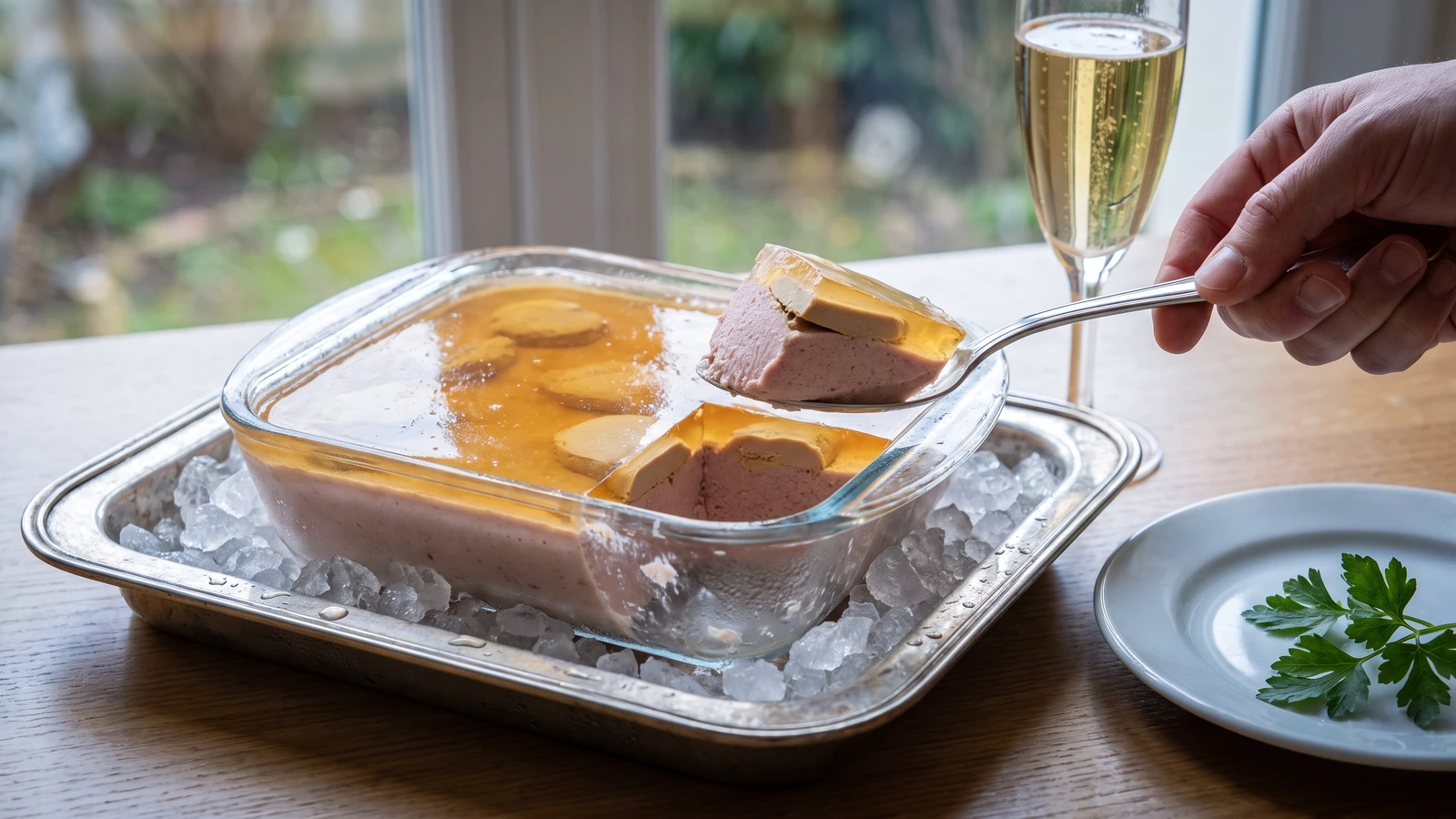
A cold Alsatian centerpiece of fine ham mousse, chilled foie-gras Parfait shells, and clear Madeira chicken aspic, built layer by layer so every spoonful stays distinct, rich, and clean.
Mousse Froide de Jambon à l’Alsacienne (cold Alsatian-style ham mousse) teaches one thing above all: cold preparations are built by timing, not force. The ham mousse must be level and fully set, the foie-gras Parfait cold enough to hold the spoon’s shell marks, and the Madeira aspic half-melted, thick but pourable, before it covers them. Rush one layer and the next runs through it.
The original assumed a garde-manger with fine mousse and foie-gras Parfait ready, a saucier on staff, chicken stock never off the fire, brigade quantities, and a block of ice carved for service. A salamander, useful elsewhere in the canon, has no place in this cold preparation. Your honest equivalents are concentrated stock reinforced with measured gelatin, an 18 cm square dish, prepared foie-gras Parfait from a good charcutier, and crushed ice in a shallow tray. The brigade scale and ice carving were scaffolding, so they go; the fine mousse, shaped foie-gras shells, Madeira aspic, and separate setting of each layer are the dish, so they stay. One cook, one stove, one evening.
When it is right, the dish shows a pale rose foundation beneath clear amber aspic, with ivory foie-gras shells suspended between them as neatly as decoration beneath glass. Before touching a pan, clear one perfectly flat shelf in the refrigerator. Level, complete chilling between additions is the step that decides the whole dish.
Mousse Froide de Jambon à l’Alsacienne belongs to the classical garde-manger, the cold station that turned charcuterie, molded mousses, and aspic into composed dishes for the formal table. Its Alsatian name is earned by foie gras, associated particularly with Strasbourg and the region’s rich pork tradition, while Madeira aspic supplies the grand-kitchen frame around those charcuterie flavors. The block of ice was a practical cold serving stand rather than ornament, and a deep bed of crushed ice performs the same duty at a home table.
Quantity
3 cups (720 ml / 720 g)
divided
Quantity
5 teaspoons (25 ml / 15 g)
Quantity
¼ cup (60 ml / 60 g)
Quantity
2½ packed cups (600 ml / 350 g)
rind and excess fat removed, chilled and diced
Quantity
¾ cup (180 ml / 180 g)
well chilled
Quantity
¼ teaspoon (1.25 ml / 0.5 g)
Quantity
Only if needed after tasting
Quantity
1 cup (240 ml / 225 g)
well chilled
Quantity
10 cups (2.4 L / about 1.5 kg)
for serving
| Ingredient | Quantity |
|---|---|
| unsalted chicken stockdivided | 3 cups (720 ml / 720 g) |
| unflavored powdered gelatin | 5 teaspoons (25 ml / 15 g) |
| dry Madeira | ¼ cup (60 ml / 60 g) |
| mild fully cooked hamrind and excess fat removed, chilled and diced | 2½ packed cups (600 ml / 350 g) |
| heavy creamwell chilled | ¾ cup (180 ml / 180 g) |
| finely ground white pepper | ¼ teaspoon (1.25 ml / 0.5 g) |
| fine salt (optional) | Only if needed after tasting |
| prepared foie-gras Parfaitwell chilled | 1 cup (240 ml / 225 g) |
| crushed icefor serving | 10 cups (2.4 L / about 1.5 kg) |
Clear a flat refrigerator shelf and chill an 18 cm square dish at least 5 cm deep. Measure ½ cup (120 ml) of the cold chicken stock into a wide bowl, sprinkle the gelatin evenly over the surface, and leave it undisturbed for 10 minutes. Every grain must drink before it meets heat; stirring dry gelatin into hot liquid makes stubborn little pearls.
Pour the remaining 2½ cups (600 ml) chicken stock into a saucepan and hold it at a lively simmer until reduced to 2 cups (480 ml), about 12 to 15 minutes. Remove it from the heat, add the bloomed gelatin with its stock, and stir gently until completely dissolved. Stir in the Madeira without boiling it, then pass the liquid through a dampened fine sieve or cheesecloth. Measure ¾ cup (180 ml) into one bowl for the ham mousse and pour the remaining 2 cups (480 ml) into a jug for the covering aspic. Cool both until no longer warm and just beginning to gain body.
Process the cold diced ham with the reserved ¾ cup (180 ml) Madeira aspic and the white pepper until no visible pieces remain, scraping the bowl several times. Press the purée through a fine-mesh sieve; this is what makes it a fine mousse rather than minced ham held in jelly, and it must stay. Whip the cold cream to soft peaks, fold one third into the ham to loosen it, then fold in the rest without beating out the air. Taste before adding salt, since both ham and reduced stock may already provide enough. If the gelatin begins setting into threads before the cream is incorporated, stand the bowl over barely warm water and fold slowly just until smooth. Ça se rattrape.
Spoon the mousse into the chilled square dish until it is half full. Press it gently into the corners, tap the dish once against a folded towel to settle hidden pockets, and level the surface with a small offset spatula dipped in hot water and wiped dry. Refrigerate on the prepared flat shelf for 1½ to 2 hours, until the surface feels firm and does not cling to a fingertip. Do not arrange the foie-gras Parfait on a merely chilled mousse. It must be set.
Keep the foie-gras Parfait cold while you work. Dip a dessertspoon into hot water, wipe it dry, and scoop a shallow oval of parfait, rolling it from the spoon onto the set mousse. Use the spoon’s edge to draw light curved ridges across the oval so it resembles a small shell. Repeat to make 8 evenly spaced shells. If the parfait cracks, let it soften for 5 minutes; if it slumps or smears, return it and the dish to the refrigerator for 10 minutes. Work cleanly, then proceed at once.
Bring the remaining Madeira aspic to the half-melted stage described by the source: thick enough to coat a spoon, completely pourable, and cool to the touch. If it has set solid, stand its jug in warm water and stir gently until it loosens, then cool it again before pouring. Direct the aspic slowly down the inside wall of the dish and around the foie-gras shells before covering their tops by about 6 mm. Aspic that is warm melts the parfait; aspic that is too cold lands in ridges. If the first spoonful makes a cloudy smear, stop, chill the dish for 10 minutes, skim away the loose smudge, and cool the aspic further before continuing. Ça se rattrape.
Return the dish to its flat shelf without disturbing the shells. Chill uncovered for 20 minutes so the surface cannot catch marks from a covering, then cover without touching the aspic and refrigerate for at least 4 hours, preferably overnight. The aspic is ready when it is clear, firmly trembles as one piece, and springs back from a light touch.
Just before serving, pack the crushed ice into a shallow tray and hollow out a level bed for the square dish. Nestle the dish deeply enough that the ice reaches halfway up its sides, the home equivalent of incrusting it in a carved block. Cut down through all three elements with a narrow knife dipped in hot water and wiped dry, then lift each serving with a broad spoon or small square server. Keep the dish properly cold and return any remainder to the refrigerator after service. À table!
1 serving (about 340g)
Culinary guides, cultural storytelling, and the editorial depth that makes cooking meaningful.
Discover Culinary ExplorerChef Juliette
John Dory has the delicacy of sole and the firmness of turbot. A light flouring, a quick butter sauté, and nut-brown beurre noisette show exactly why looks never mattered.

Chef Juliette
Fresh haddock proves its delicacy in the meunière pan: a fine flour crust, moist pearly flakes, and beurre noisette sharpened with lemon and parsley, ready from one skillet in half an hour.

Chef Juliette
Éperlans à l’Anglaise turns small fish into a lesson in disciplined coating: boned smelts under a close, crisp crumb, pan-fried in clarified butter and finished with bright, half-melted maître d’hôtel butter.

Chef Juliette
Tiny smelts, shallot, mushrooms, white wine, gratin sauce, and fine bread raspings meet a fierce oven, where the fish must turn tender in the same breath the buttered crust bronzes.