
Chef Juliette
John Dory (St. Pierre)
John Dory has the delicacy of sole and the firmness of turbot. A light flouring, a quick butter sauté, and nut-brown beurre noisette show exactly why looks never mattered.
A cooking platform built around craft, culture, and the stories behind what we eat.
Created by Chef Juliette
Based on No. 1438, Jambon Soufflé Froid, from Le Guide Culinaire (1907) by Auguste Escoffier
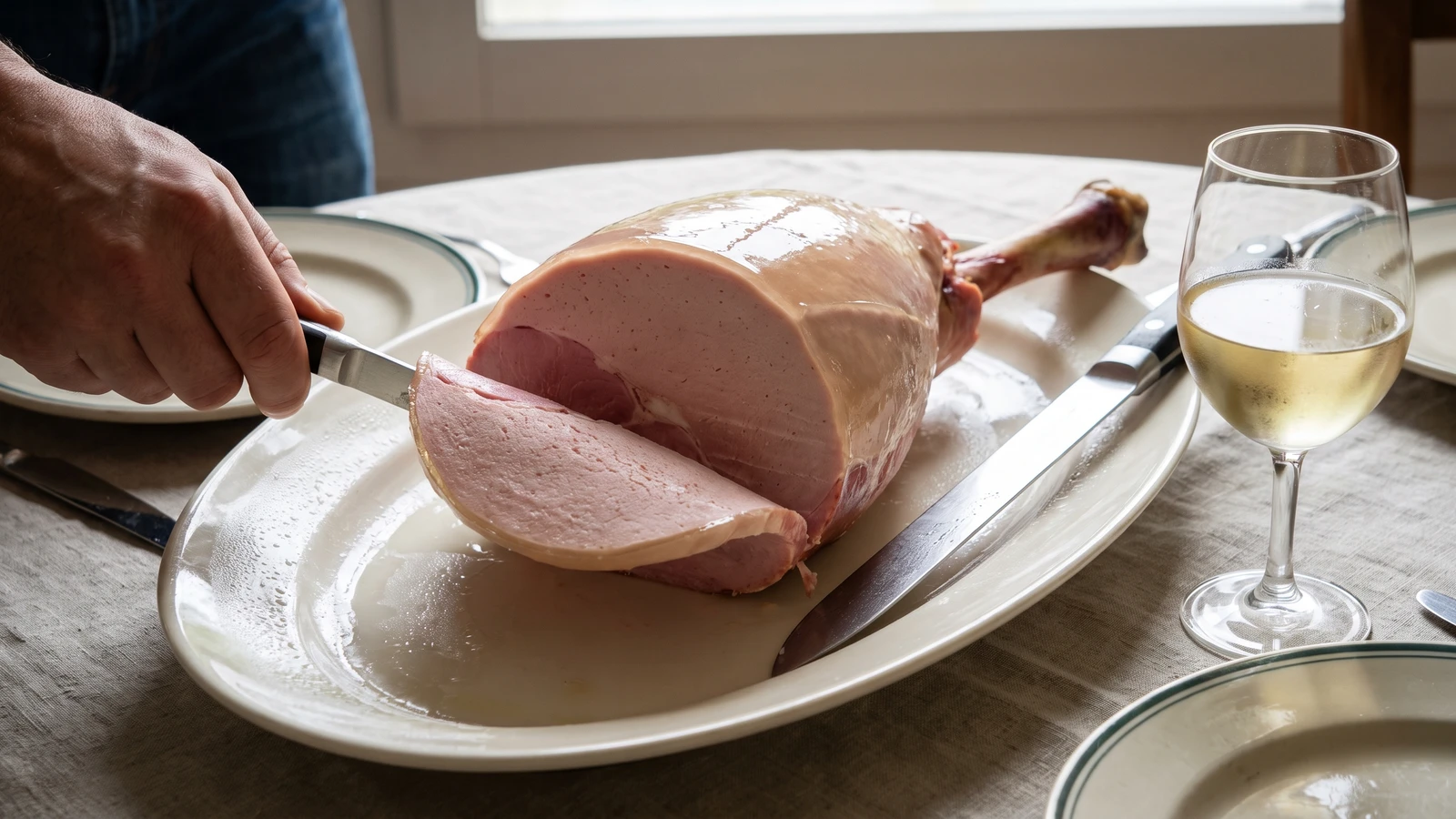
A bone-in ham rebuilt with cool, satin-smooth mousse, where concentrated stock supplies structure and whipped cream gives the lift. Grand in outline, generous on the plate, and manageable by one cook.
Jambon Soufflé Froid (cold souffléd ham) teaches the governing rule of every cold mousse: temperature is structure. The ham purée must be thoroughly cool yet still supple when it meets the whisked cream. Too warm and the cream collapses; too cold and the gelatin catches in little lumps. Bring both mixtures to the same cool, soft consistency before folding, and the mousse will set as smooth as satin.
The source entry sends the cook to Jambon Soufflé (No. 1421) and assumes a whole ham, several hands to bone and carve it, a saucier with clear jellied stock always ready, and a cold room. A salamander serves the hot cousin, but it has no work here. At home, use the smallest fully cooked, unsliced bone-in ham end your butcher can provide, a food processor in place of the pounding mortar, unsalted stock reinforced with gelatin, and an ordinary refrigerator. The active work belongs comfortably to one cook, one stove, one evening; the refrigerator does the long shift.
Full-joint butchery and a stockpot that never goes cold are brigade scaffolding. Reconstructing the ham on its retained bone, passing the purée through a sieve, and lifting it with whisked cream are the dish, so those remain. The fold is the step that matters most: lighten the ham base first, then work gently and stop the moment no white streaks remain.
The precise home of Jambon Soufflé Froid is the Parisian grande-cuisine cold buffet, where cooks rebuilt carved joints into generous presentation pieces that could be prepared before the guests arrived. Its name corrects a common misconception within the canon: a soufflé need not be hot or raised with egg whites, since cold soufflés and Mousses take their lightness from whisked cream. The retained bone and reconstructed outline preserve its kinship with carved ham, rather than turning it into an anonymous moulded pâté.
Quantity
1 base from Jambon Soufflé (No. 1421), about 3 lb / 1.4 kg before carving
prepared through trimming and buttered-paper banding, then thoroughly chilled
Quantity
2½ cups (600 ml / 340 g)
diced and thoroughly chilled
Quantity
1 cup (240 ml / 240 g)
Quantity
2¼ teaspoons (11 ml / 7 g)
Quantity
3 tablespoons (45 ml / 45 g)
Quantity
2 tablespoons (30 ml / 30 g)
Quantity
1⅓ cups (320 ml / 320 g)
divided
Quantity
1 teaspoon (5 ml / 5 g)
Quantity
¼ teaspoon (1.25 ml / 0.6 g)
Quantity
1 small pinch (less than 1 ml / 0.1 g)
Quantity
as needed after tasting
| Ingredient | Quantity |
|---|---|
| prepared bone-in ham baseprepared through trimming and buttered-paper banding, then thoroughly chilled | 1 base from Jambon Soufflé (No. 1421), about 3 lb / 1.4 kg before carving |
| cooked lean hamdiced and thoroughly chilled | 2½ cups (600 ml / 340 g) |
| unsalted chicken stock | 1 cup (240 ml / 240 g) |
| unflavored powdered gelatin | 2¼ teaspoons (11 ml / 7 g) |
| cold water | 3 tablespoons (45 ml / 45 g) |
| dry Madeira | 2 tablespoons (30 ml / 30 g) |
| cold heavy creamdivided | 1⅓ cups (320 ml / 320 g) |
| fresh lemon juice | 1 teaspoon (5 ml / 5 g) |
| ground white pepper | ¼ teaspoon (1.25 ml / 0.6 g) |
| cayenne | 1 small pinch (less than 1 ml / 0.1 g) |
| fine salt (optional) | as needed after tasting |
Prepare the ham base according to Jambon Soufflé (No. 1421), stopping once the trimmed meat and retained end bone are enclosed by the strong buttered-paper band. Do not add or poach the hot soufflé preparation. Chill the banded base completely, keeping it below 40°F (4°C), and reserve 2½ cups (340 g) of lean meat from the removed cushion for the cold mousse.
Sprinkle the gelatin evenly over the cold water and leave it for 5 minutes to bloom. Meanwhile, simmer the unsalted stock in a small saucepan until reduced by half to ½ cup (120 ml). Take it off the heat, stir in the bloomed gelatin until perfectly clear, then add the Madeira and lemon juice. Reserve 2 tablespoons (30 ml) for glazing. Let the remainder cool until fluid but no longer warm. If it sets before you need it, warm it very gently until it loosens; do not let it simmer.
Process the chilled diced ham with ¼ cup (60 ml) of the cream, the white pepper, cayenne, and the fluid setting stock until as fine as the machine will make it. Press the purée through a fine-mesh sieve into a chilled bowl. Taste a spoonful after chilling it briefly, then add salt only if the ham needs it. Set the bowl over ice and stir until the mixture thickens to the consistency of soft custard. If gelatin sets around the edges or forms lumps, lift the bowl over barely warm water and stir until smooth, then cool it again. Ça se rattrape.
Reserve about 1 tablespoon (20 ml) of the remaining cream, then whisk the other 1 cup (240 ml) in a chilled bowl until it holds soft, bending peaks. Stir one-quarter of the whisked cream into the ham base to lighten it, then fold in the rest in two additions with broad strokes from the bottom of the bowl. Stop as soon as the colour is even. If the cream was taken too far and looks grainy, fold the reserved liquid cream into it before combining; soft cream gives lift, stiff cream gives a coarse mousse.
Spoon the mousse inside the paper band a little at a time, pressing the first layer firmly against the remaining meat so no hollow seam forms. Continue until the removed cushion has been rebuilt and the joint has regained its rounded ham contour. Smooth the surface with the flat of a knife dipped in cold water. If the mousse begins to slump, refrigerate the joint for 10 minutes before finishing the shape; patience, not more gelatin.
Refrigerate the reconstructed ham for at least 6 hours, preferably overnight, until the mousse is firm from surface to centre. Peel away the paper band slowly. If it grips, slide a thin knife dipped in hot water and wiped dry between the paper and mousse. Warm the reserved gelatin stock only until liquid, cool it until slightly thickened, then brush a very thin coat over the ham. If the glaze runs straight off, chill both ham and glaze for 5 minutes before trying again.
Set the Jambon Soufflé Froid on a chilled oval platter and let it stand for 10 minutes, just long enough to soften its chill without loosening the mousse. Carve generous slices with a thin knife dipped in hot water and wiped dry between cuts, cutting down toward the retained bone so each portion carries both mousse and ham. Bring the whole joint to the table before carving. À table!
1 serving (about 550g)
Culinary guides, cultural storytelling, and the editorial depth that makes cooking meaningful.
Discover Culinary ExplorerChef Juliette
John Dory has the delicacy of sole and the firmness of turbot. A light flouring, a quick butter sauté, and nut-brown beurre noisette show exactly why looks never mattered.

Chef Juliette
Fresh haddock proves its delicacy in the meunière pan: a fine flour crust, moist pearly flakes, and beurre noisette sharpened with lemon and parsley, ready from one skillet in half an hour.

Chef Juliette
Éperlans à l’Anglaise turns small fish into a lesson in disciplined coating: boned smelts under a close, crisp crumb, pan-fried in clarified butter and finished with bright, half-melted maître d’hôtel butter.

Chef Juliette
Tiny smelts, shallot, mushrooms, white wine, gratin sauce, and fine bread raspings meet a fierce oven, where the fish must turn tender in the same breath the buttered crust bronzes.