
Chef Juliette
John Dory (St. Pierre)
John Dory has the delicacy of sole and the firmness of turbot. A light flouring, a quick butter sauté, and nut-brown beurre noisette show exactly why looks never mattered.
A cooking platform built around craft, culture, and the stories behind what we eat.
Created by Chef Juliette
Based on No. 1435, Mousselines de Jambon à la Hongroise, from Le Guide Culinaire (1907) by Auguste Escoffier
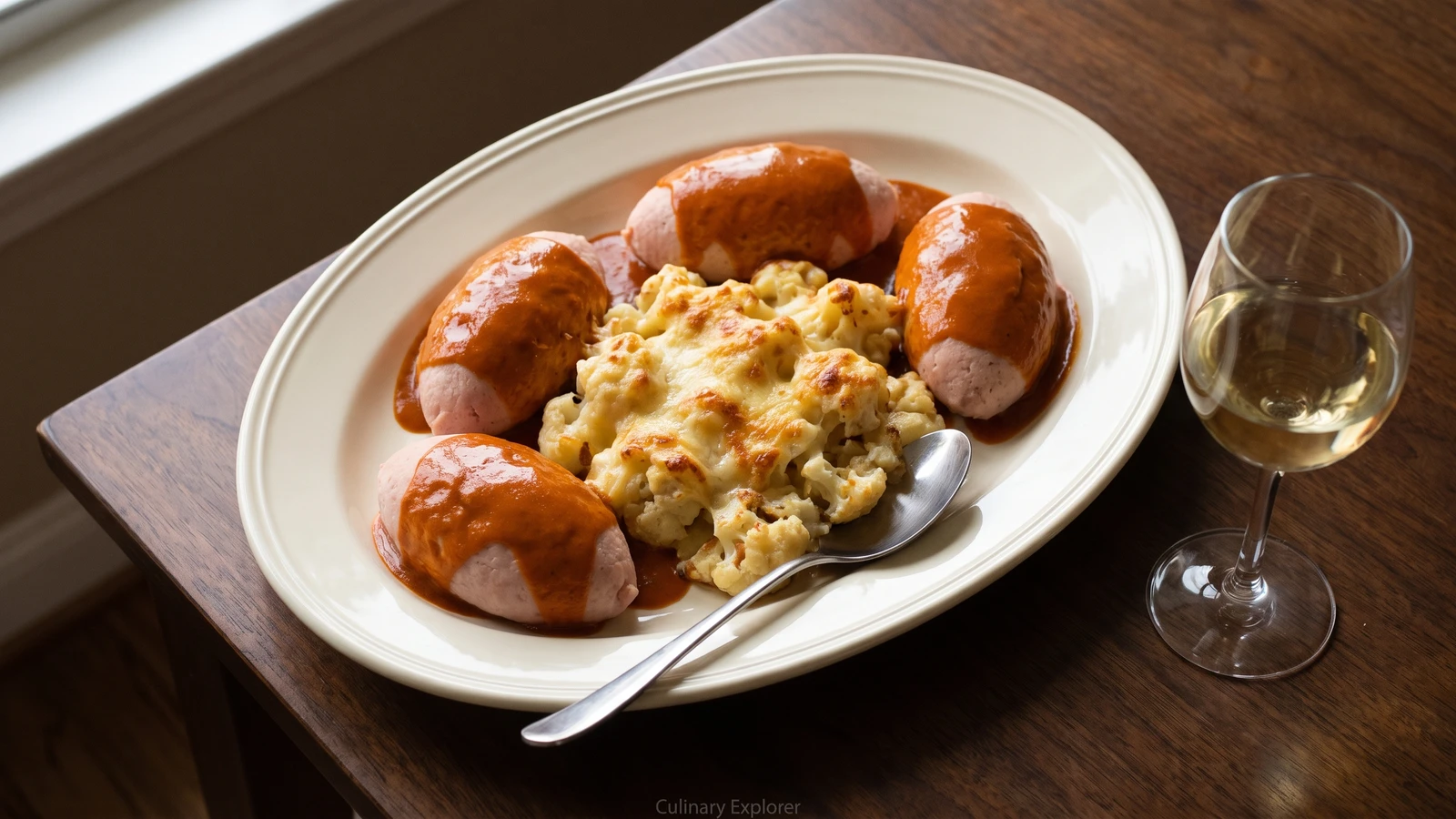
Paprika is the character in these silken ham mousselines, gently poached, coated with onion-rich Sauce Hongroise, quickly glazed, and gathered around a golden mound of cauliflower gratin.
Mousselines de Jambon à la Hongroise (individual poached ham forcemeats in paprika sauce) teaches one governing principle: a mousseline is only as fine as its temperature control. Keep the ham, egg whites, processor bowl, blade, and cream cold, and the forcemeat poaches into a tender, close-grained cushion. Let the mixture warm while the cream is worked in and its emulsion loosens. Paprika is not decoration here. It seasons both the mousselines and the Sauce Hongroise, carrying its sweet pepper fragrance through the whole plate.
The original entry assumed a saucier on staff, velouté and stock never off the fire, a row of individual molds, and a salamander waiting to glaze the platter. Your home equivalent is a small Sauce Hongroise built fresh from butter, roux, wine, and good stock, four ramekins in a bain-marie, and the broiler. The food processor and one pass through a fine sieve replace the mortar and repeated tamis work. Holding a sauce all afternoon and producing brigade portions are scaffolding, so they go. The cold forcemeat, gentle poach, complete coat of sauce, quick glaze, and cauliflower at the center are the dish, so they stay. One cook, one stove, one evening.
When it reaches the table, the mousselines should be pale rose beneath a glossy brick-gold sauce, with the bronzed cauliflower standing generously in the middle. Before touching a pan, chill the processor bowl and blade for twenty minutes. That small preparation decides the texture of everything that follows.
Mousselines de Jambon à la Hongroise belongs to the formal Parisian classical table, where smooth forcemeats were portioned into individual mousselines, sauced, glazed, and arranged around a vegetable garnish. In the French canon, à la Hongroise does not claim Hungarian origin for the whole dish; it names paprika as the governing accent, absorbed into the French sauce system with onion, white wine, velouté, and cream. The cauliflower gratin at the center reflects service by composition: meat, sauce, and vegetable arrive as one finished platter.
Quantity
2 cups (475 ml / 300 g)
diced and very cold
Quantity
2 (1/4 cup / 60 ml / 60 g)
very cold
Quantity
1 cup (240 ml / 240 g)
very cold
Quantity
2 teaspoons (10 ml / 5 g)
Quantity
1 tablespoon (15 ml / 14 g)
softened
Quantity
1, about 3/4 cup (180 ml / 100 g)
thinly sliced
Quantity
3 tablespoons (45 ml / 42 g)
divided
Quantity
1 tablespoon (15 ml / 7 g)
Quantity
2 tablespoons (30 ml / 16 g)
Quantity
1/2 cup (120 ml / 120 g)
Quantity
2 cups (475 ml / 475 g)
Quantity
1/2 cup (120 ml / 120 g)
Quantity
4 cups (950 ml / 450 g)
Quantity
1 tablespoon (15 ml / 14 g)
Quantity
1 tablespoon (15 ml / 8 g)
Quantity
3/4 cup (180 ml / 185 g)
Quantity
1 cup (240 ml / 100 g)
finely grated and divided
Quantity
1 tablespoon (15 ml / 18 g)
divided
Quantity
1/2 teaspoon (2.5 ml / 1 g)
divided
| Ingredient | Quantity |
|---|---|
| cooked unsmoked hamdiced and very cold | 2 cups (475 ml / 300 g) |
| large egg whitesvery cold | 2 (1/4 cup / 60 ml / 60 g) |
| heavy cream for the mousselinesvery cold | 1 cup (240 ml / 240 g) |
| sweet Hungarian paprika for the mousselines | 2 teaspoons (10 ml / 5 g) |
| unsalted butter for the moldssoftened | 1 tablespoon (15 ml / 14 g) |
| small yellow onionthinly sliced | 1, about 3/4 cup (180 ml / 100 g) |
| unsalted butter for Sauce Hongroisedivided | 3 tablespoons (45 ml / 42 g) |
| sweet Hungarian paprika for Sauce Hongroise | 1 tablespoon (15 ml / 7 g) |
| all-purpose flour for Sauce Hongroise | 2 tablespoons (30 ml / 16 g) |
| dry white wine | 1/2 cup (120 ml / 120 g) |
| unsalted chicken stock | 2 cups (475 ml / 475 g) |
| heavy cream for Sauce Hongroise | 1/2 cup (120 ml / 120 g) |
| small cauliflower florets | 4 cups (950 ml / 450 g) |
| unsalted butter for the cauliflower | 1 tablespoon (15 ml / 14 g) |
| all-purpose flour for the cauliflower | 1 tablespoon (15 ml / 8 g) |
| whole milk | 3/4 cup (180 ml / 185 g) |
| Gruyèrefinely grated and divided | 1 cup (240 ml / 100 g) |
| fine sea saltdivided | 1 tablespoon (15 ml / 18 g) |
| ground white pepperdivided | 1/2 teaspoon (2.5 ml / 1 g) |
Put the food processor bowl and blade in the cold for twenty minutes. Keep the ham, egg whites, and mousseline cream cold until they are called for. Heat the oven to 425°F (220°C), with a rack in the upper third. Butter four 6-ounce (180 ml) oval molds or ramekins thoroughly, bring a saucepan of water to the boil for the cauliflower, and heat a kettle of water for the bain-marie, the water bath used to poach the mousselines gently.
Melt 2 tablespoons of the sauce butter over medium-low heat. Add the onion with a pinch of salt and cook for 7 to 8 minutes, stirring, until completely soft but not browned. Pull the pan from the heat, stir in the tablespoon of paprika for thirty seconds, then add the 2 tablespoons of flour. Return to low heat and cook the roux for one minute without letting the paprika darken. Whisk in the wine and reduce it by half, then add the chicken stock in four additions, whisking each smooth before the next. If the roux seizes into lumps, take the pan from the heat and whisk in the stock a spoonful at a time, then strain it. Ça se rattrape. Simmer gently for 15 minutes, strain, and return the sauce to the clean pan. Add the sauce cream and simmer until Sauce Hongroise coats the back of a spoon while remaining pourable, about 5 minutes. Season carefully with salt and white pepper, then whisk in the final tablespoon of sauce butter away from the heat. Cover and hold warm.
Salt the boiling water with 2 teaspoons of the measured salt. Add the cauliflower and cook for 5 to 6 minutes, until a knife enters with slight resistance. Drain thoroughly and let the florets dry while you make their cheese coating. Melt the cauliflower butter in a small saucepan, stir in its tablespoon of flour, and cook for one minute. Add the milk gradually, whisking, then simmer for 2 minutes until thick. Fold in two-thirds of the Gruyère and season lightly with salt and white pepper. Coat the cauliflower, arrange it in a small shallow gratin dish, and scatter over the remaining cheese. Bake for 15 to 18 minutes, until the edges bubble and the top is golden. Set it aside loosely covered, then lower the oven to 325°F (165°C).
Put the cold ham, the 2 teaspoons of mousseline paprika, and about half the remaining white pepper into the chilled processor. Pulse until the ham becomes very fine, then add the egg whites and process in short bursts until the mixture is smooth and tacky. With the machine pulsing, pour in the cold mousseline cream gradually. Stop as soon as the cream is incorporated. Press the forcemeat once through a fine-mesh sieve into a bowl set over ice. If the mixture begins to soften or looks greasy at the edge, stop working it and chill it over ice for 10 minutes before continuing. Ça se rattrape. Poach a teaspoonful in barely simmering water for 3 minutes, taste it, and adjust the salt, white pepper, or paprika before filling the molds.
Divide the forcemeat among the buttered molds, pressing it into the corners so no air pockets remain, then smooth the tops. Cover each mold tightly with a small piece of foil. Set them in a deep roasting pan and pour in enough hot water to reach halfway up their sides. Poach in the 325°F (165°C) oven for 25 to 30 minutes, until the centers reach 160°F (71°C) and spring gently beneath a fingertip. The water should barely tremble. If it begins to boil, add a little cold water to the pan and lower the oven slightly; hard boiling makes holes and toughens the edges.
Lift the molds from the bain-marie and keep them covered. Turn the broiler to high. Return the cauliflower gratin to the upper rack for 1 to 2 minutes, only until its cheese bubbles at the edges and deepens to a warm bronze. Set it beside the stove and place a broiler-safe oval serving platter nearby.
Run a thin knife around each mold and invert the mousselines onto a folded clean kitchen towel. Blot their bases and sides gently, then arrange them evenly in a circle on the serving platter, leaving a generous open space in the center. If one tears, set the torn side downward. The sauce will cover the evidence, and the texture beneath remains perfectly sound.
Reheat Sauce Hongroise over gentle heat. If it has tightened while standing, loosen it with a spoonful of hot water; it must flow slowly, not sit like paste. Spoon it over every mousseline so each is completely coated, with a little sauce pooling around the ring. Place the platter about 6 inches (15 cm) beneath the broiler for 45 to 90 seconds, just until the sauce gleams and takes the faintest bronze at its highest points. Glaze quickly and watch without interruption. This step is measured in seconds.
Withdraw the glazed platter from the oven. With a broad serving spoon, transfer the baked cauliflower into the center, keeping its browned cheese uppermost and building the fine, generous heap called for by the dish. Carry the platter straight to the table while the sauce still holds its gloss. À table!
1 serving (about 475g)
Culinary guides, cultural storytelling, and the editorial depth that makes cooking meaningful.
Discover Culinary ExplorerChef Juliette
John Dory has the delicacy of sole and the firmness of turbot. A light flouring, a quick butter sauté, and nut-brown beurre noisette show exactly why looks never mattered.

Chef Juliette
Fresh haddock proves its delicacy in the meunière pan: a fine flour crust, moist pearly flakes, and beurre noisette sharpened with lemon and parsley, ready from one skillet in half an hour.

Chef Juliette
Éperlans à l’Anglaise turns small fish into a lesson in disciplined coating: boned smelts under a close, crisp crumb, pan-fried in clarified butter and finished with bright, half-melted maître d’hôtel butter.

Chef Juliette
Tiny smelts, shallot, mushrooms, white wine, gratin sauce, and fine bread raspings meet a fierce oven, where the fish must turn tender in the same breath the buttered crust bronzes.