
Chef Juliette
John Dory (St. Pierre)
John Dory has the delicacy of sole and the firmness of turbot. A light flouring, a quick butter sauté, and nut-brown beurre noisette show exactly why looks never mattered.
A cooking platform built around craft, culture, and the stories behind what we eat.
Created by Chef Juliette
Based on No. 1434, Mousselines de Jambon à la Florentine, from Le Guide Culinaire (1907) by Auguste Escoffier
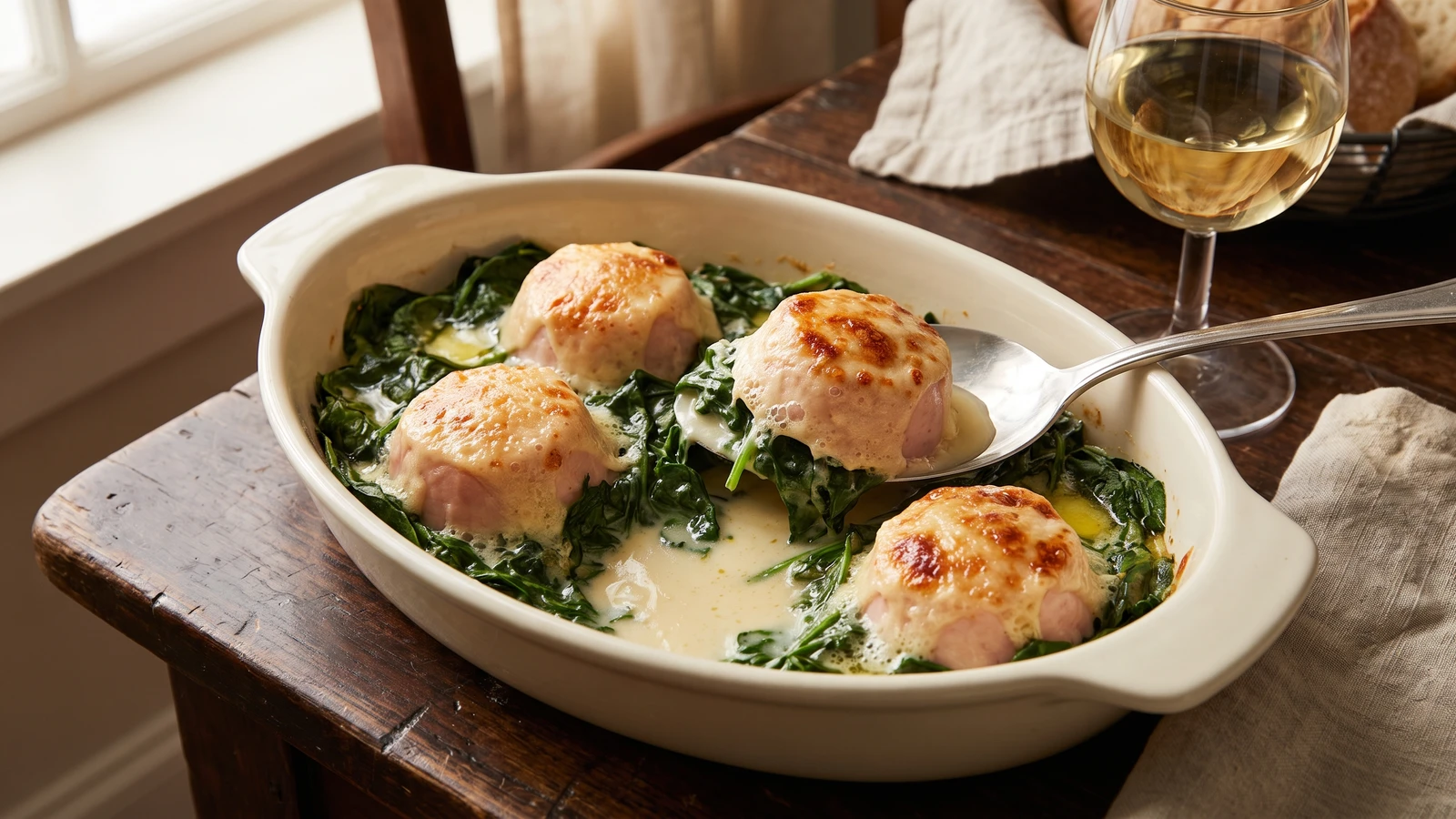
Mousselines de Jambon à la Florentine turn chilled ham forcemeat into four tender individual moulds, set over buttered spinach, napped with sauce Allemande, and flashed beneath the broiler until Parmesan bronzes.
Mousselines de Jambon à la Florentine (silken ham mousselines on buttered spinach) teaches the discipline of temperature. The ham, egg whites, cream, bowl, and blade must stay cold, or the forcemeat loses its fine emulsion before it ever reaches the poaching water. Keep it cold and the individual moulds set tender, not bouncy, against spinach fried in butter and a glossy coat of sauce Allemande.
The book sends its sauce work to the preparation used for Mousselines Alexandra. A grand kitchen had a saucier on staff, velouté drawn from stock never off the fire, and a salamander waiting to glaze each order. Here the mortar and tamis become a food processor and fine sieve, the service batch becomes four ramekins, the stockpot becomes a careful small velouté, and the salamander becomes your broiler. The separate sauce station is brigade scaffolding and can go. The cold forcemeat, gentle poach, dry buttered spinach, sauce Allemande, and fast glaze are the dish, so they stay. One cook, one stove, one evening.
If the emulsion warms, chill it and bring it back with cold cream. If the liaison threatens to curdle, take it off the heat at once. Ça se rattrape. At the finish, glaze only long enough to colour the Parmesan, but the decisive work happens first: keep the forcemeat cold.
Mousselines de jambon belong to the Parisian grand-kitchen canon, where smooth forcemeats were set in individual moulds so each diner received a delicate portion rather than a slice from a larger mousse. In French classical menu language, à la florentine means a bed or garnish of spinach, usually buttered, and does not establish that this ham preparation came from a Florentine household. The dish passed naturally into cuisine bourgeoise because ramekins, a water bath, and a fierce domestic broiler preserve the same practice without a brigade.
Quantity
2½ packed cups (590 ml / 340 g)
well chilled, trimmed and diced
Quantity
2
separated
Quantity
¾ cup (180 ml / 180 g)
very cold
Quantity
2 tablespoons (30 ml / 30 g)
for adjusting or rescuing the mousseline
Quantity
¼ teaspoon (1.25 ml / 0.6 g)
divided
Quantity
⅛ teaspoon (0.6 ml / 0.25 g)
Quantity
1 tablespoon (15 ml / 14 g)
softened
Quantity
24 loosely packed cups (5.7 L / 680 g)
washed, tough stems removed
Quantity
3 tablespoons (45 ml / 42 g)
Quantity
¼ teaspoon (1.25 ml / 1.5 g), plus more only after tasting
divided
Quantity
2 tablespoons (30 ml / 28 g)
Quantity
3 tablespoons (45 ml / 24 g)
Quantity
1½ cups (360 ml / 360 g)
hot
Quantity
¼ cup (60 ml / 60 g)
Quantity
2 teaspoons (10 ml / 10 g)
Quantity
½ cup (120 ml / 45 g)
| Ingredient | Quantity |
|---|---|
| unsmoked cooked hamwell chilled, trimmed and diced | 2½ packed cups (590 ml / 340 g) |
| large eggsseparated | 2 |
| heavy cream for the mousselinevery cold | ¾ cup (180 ml / 180 g) |
| additional cold heavy cream (optional)for adjusting or rescuing the mousseline | 2 tablespoons (30 ml / 30 g) |
| ground white pepperdivided | ¼ teaspoon (1.25 ml / 0.6 g) |
| freshly grated nutmeg | ⅛ teaspoon (0.6 ml / 0.25 g) |
| unsalted butter for the mouldssoftened | 1 tablespoon (15 ml / 14 g) |
| fresh spinachwashed, tough stems removed | 24 loosely packed cups (5.7 L / 680 g) |
| unsalted butter for the spinach | 3 tablespoons (45 ml / 42 g) |
| fine sea saltdivided | ¼ teaspoon (1.25 ml / 1.5 g), plus more only after tasting |
| unsalted butter for the sauce | 2 tablespoons (30 ml / 28 g) |
| all-purpose flour | 3 tablespoons (45 ml / 24 g) |
| unsalted light veal stock or pale chicken stockhot | 1½ cups (360 ml / 360 g) |
| heavy cream for the sauce | ¼ cup (60 ml / 60 g) |
| fresh lemon juice | 2 teaspoons (10 ml / 10 g) |
| finely grated Parmesan | ½ cup (120 ml / 45 g) |
Chill the processor bowl and blade for fifteen minutes. Heat the oven to 325°F (165°C), set a kettle of water to heat, and butter four 6-fluid-ounce (180 ml) ramekins generously. Cut four parchment circles to fit their tops and butter one side of each. Cold equipment protects the forcemeat while the buttered moulds let the delicate mousselines release without tearing.
Process the chilled ham until it becomes a fine, even paste, scraping the bowl as necessary. Add the egg whites one at a time, processing only until each disappears, then add half the white pepper and the nutmeg. With the machine running, pour in the ¾ cup (180 ml) cold cream in a thin stream and stop as soon as the mixture is smooth. If it turns slick, grainy, or warm, stop immediately. Nest the bowl over ice for ten minutes, then pulse in the optional cold cream one teaspoon at a time until the paste becomes smooth again. Ça se rattrape. Press the mixture through a fine-mesh sieve into a chilled bowl. Poach a teaspoonful in barely simmering water for three minutes and taste it; add salt only if the ham truly needs it. The test should hold its shape but yield softly under the teeth. If it is bouncy, fold in a little of the optional cream. If it is very soft, chill the mixture for fifteen minutes rather than adding flour.
Reserve 2 tablespoons (30 ml) of the hot stock. Melt the sauce butter in a small saucepan, stir in the flour, and cook this roux blanc, or white roux, over gentle heat for two minutes without letting it colour. Whisk in the remaining hot stock a little at a time, scraping into the corners so no flour hides there. Bring it to a bare simmer and cook for ten to twelve minutes, stirring often, until smooth and lightly coating the back of a spoon. If lumps appear, whisk firmly and strain the sauce while hot. Lay parchment directly on its surface and hold it off the heat.
Divide the ham mixture among the prepared ramekins and smooth the tops without packing them hard. Cover each with a buttered parchment circle, buttered side down, and set the moulds in a deep roasting pan. Pour hot water around them to reach halfway up their sides. Poach in the oven for twenty-two to twenty-eight minutes, until the centres register 160°F (71°C) and feel just set with a gentle spring. The water should barely tremble. If it bubbles actively, replace a cupful with cold water and lower the oven by 25°F (15°C); boiling makes the mousselines tighten. Rest them for five minutes, loosen the rims with a thin knife, then unmould onto a clean folded towel and drain well.
Put the washed spinach into a large covered pot with only the water clinging to its leaves. Wilt it in batches over medium-high heat, turning until every leaf collapses. Drain, let it cool just enough to handle, then squeeze it very dry in a clean towel and shred it across the leaves. Melt the spinach butter in a wide skillet and fry the shredded spinach for five to seven minutes, tossing and separating it until glossy but no longer wet. If liquid puddles in the pan, keep cooking until it evaporates before seasoning. Add a cautious pinch of salt and the remaining white pepper, then spread the spinach in an even layer across a shallow 2-quart (1.9 L) gratin dish.
Whisk the reserved egg yolks with the ¼ cup (60 ml) cream in a heatproof bowl. Reheat the velouté until hot but not boiling, then whisk about ½ cup (120 ml) of it slowly into the yolk mixture. Return everything to the saucepan and stir over the lowest heat until the sauce Allemande, the velouté enriched with yolks and cream, reaches about 175°F (80°C) and nappes the spoon in a glossy coat. It must not boil. At the first sign of graininess, set the saucepan in cold water, whisk in a spoonful of cold cream, and strain it; ça se rattrape. Off the heat, add the lemon juice. Taste before adding any salt. If the sauce is too tight, loosen it with the reserved stock a teaspoon at a time.
Heat the broiler fully and place an oven rack 4 to 6 inches (10 to 15 cm) below it. Arrange the drained mousselines on the buttered spinach and spoon the sauce Allemande over them, coating the tops and sides completely. Scatter the Parmesan evenly over the sauce. Broil for one to three minutes, watching without turning away, until the Parmesan bronzes and the sauce shows small bubbles at the edges. Rotate the dish if one side colours first. Do not leave it longer merely to deepen the crust; the quick glaze colours the top without overcooking the mousselines.
Bring the gratin dish directly to the table while its sauce remains glossy. Give each person one mousseline with a generous bed of spinach, then spoon the Allemande gathered around the dish over the top. This needs no decorative herb and no second sauce. The browned Parmesan, ivory Allemande, and dark spinach have already said everything. À table!
1 serving (about 340g)
Culinary guides, cultural storytelling, and the editorial depth that makes cooking meaningful.
Discover Culinary ExplorerChef Juliette
John Dory has the delicacy of sole and the firmness of turbot. A light flouring, a quick butter sauté, and nut-brown beurre noisette show exactly why looks never mattered.

Chef Juliette
Fresh haddock proves its delicacy in the meunière pan: a fine flour crust, moist pearly flakes, and beurre noisette sharpened with lemon and parsley, ready from one skillet in half an hour.

Chef Juliette
Éperlans à l’Anglaise turns small fish into a lesson in disciplined coating: boned smelts under a close, crisp crumb, pan-fried in clarified butter and finished with bright, half-melted maître d’hôtel butter.

Chef Juliette
Tiny smelts, shallot, mushrooms, white wine, gratin sauce, and fine bread raspings meet a fierce oven, where the fish must turn tender in the same breath the buttered crust bronzes.