
Chef Juliette
John Dory (St. Pierre)
John Dory has the delicacy of sole and the firmness of turbot. A light flouring, a quick butter sauté, and nut-brown beurre noisette show exactly why looks never mattered.
A cooking platform built around craft, culture, and the stories behind what we eat.
Created by Chef Juliette
Based on No. 1428, Soufflé de Jambon Milanaise, from Le Guide Culinaire (1907) by Auguste Escoffier
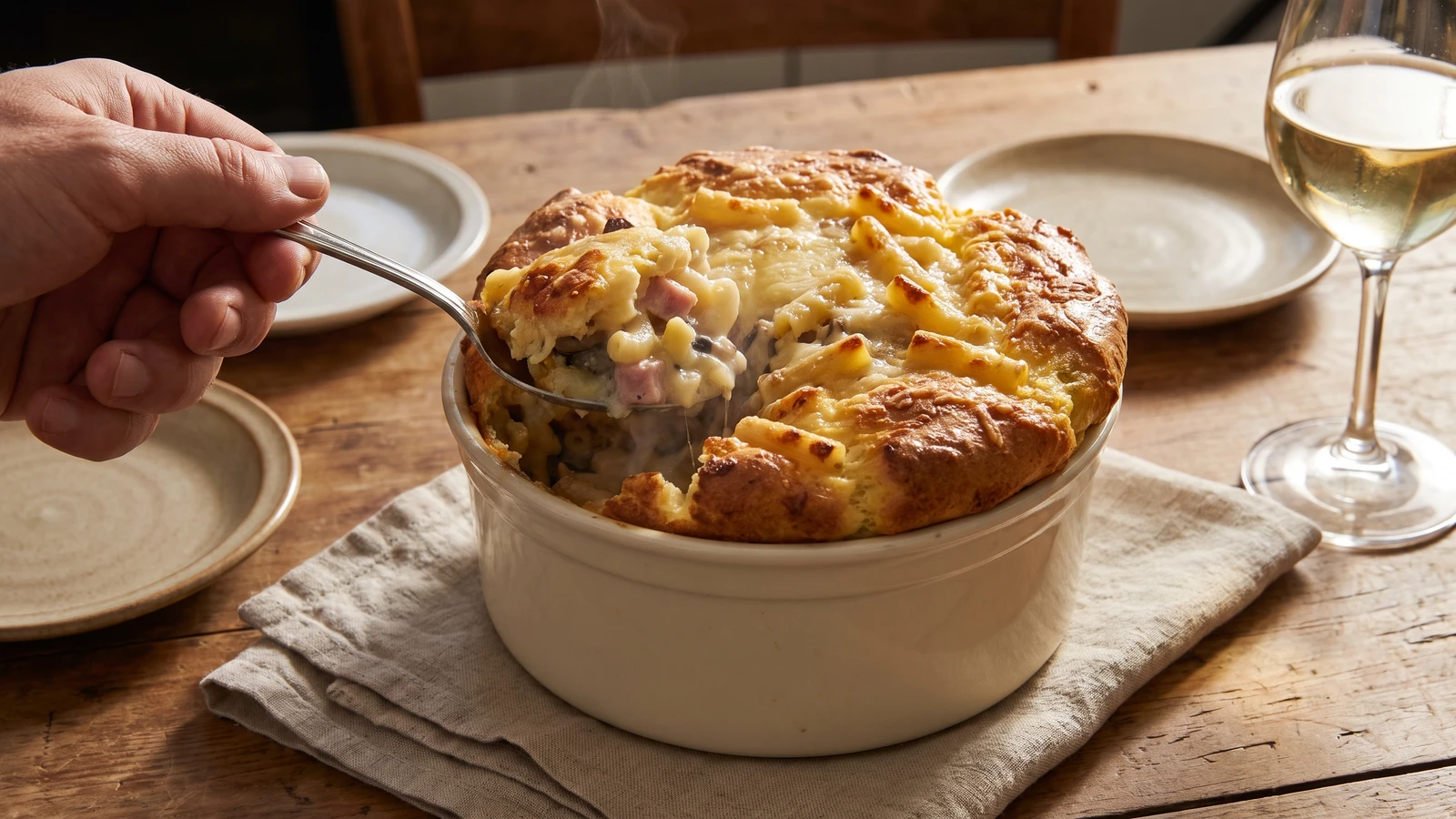
Soufflé de Jambon Milanaise rises around layers of macaroni, ham, tongue, mushroom, and truffle, then takes a crisp crown of butter-fried macaroni and cheese, rich, poised, and ready for immediate serving.
Soufflé de Jambon Milanaise (ham soufflé with a Milanaise garnish) teaches the discipline of moderate heat. A violent oven can force up an impressive crown while leaving the centre unset; once that weak middle meets the air, down it comes. This richer, layered soufflé must rise steadily enough for the eggs to set around the garnish.
The original shorthand assumed a saucier on staff, a stockpot never off the fire behind him, a finished garnish arriving from another station, and a salamander waiting to colour whatever required it. At home, prepare the referenced garnish as its own finished component, build the ham base in one saucepan, crisp the macaroni in one skillet, and let a moderate oven do the rest. The separate hands and salamander are brigade scaffolding and can go. The alternate layers, butter-fried macaroni, cheese, and gentle baking are the dish, so they stay. One cook, one stove, one evening.
When it is right, the crown stands butter-gold and bronzed, the fried macaroni catches beneath the cheese, and each spoonful reveals pale ham soufflé crossed by the darker, glossy garnish. Set the oven accurately before you whisk the whites. That moderate, unwavering heat is the step that decides the dish.
Soufflé de Jambon Milanaise belongs to the Parisian grand-kitchen repertoire, where savory soufflés were paired with formally named garnishes and served as substantial entrées or light main dishes. À la Milanaise here does not describe a Milanese household recipe; it is the French classical name for a composed garnish of macaroni, cheeses, tomato, ham, tongue, mushrooms, truffle, and Madeira. The combination shows how the French canon absorbed an Italianate vocabulary while keeping its own system of sauces, garnishes, and service.
Quantity
1 tablespoon (15 ml / 14 g)
softened
Quantity
1/3 cup (80 ml / 45 g)
Quantity
1 1/2 teaspoons (7.5 ml / 9 g)
Quantity
1 tablespoon (15 ml / 14 g)
Quantity
1/3 cup (80 ml / 30 g)
finely grated and mixed in equal parts
Quantity
3 tablespoons (45 ml / 42 g)
Quantity
1/3 cup (80 ml / 42 g)
Quantity
1 cup (240 ml / 245 g)
Quantity
1/4 cup (60 ml / 60 g)
Quantity
1 cup loosely packed (240 ml / 150 g)
very finely chopped
Quantity
1 cup (240 ml / 225 g), prepared from Côte de Veau Milanaise (No. 1258)
warmed until supple but not hot
Quantity
5
separated
Quantity
1/4 teaspoon (1.25 ml / 1.5 g), plus more only after tasting
Quantity
1/4 teaspoon (1.25 ml / 0.6 g)
Quantity
1/8 teaspoon (0.6 ml / 0.25 g)
| Ingredient | Quantity |
|---|---|
| unsalted butter for the timbalesoftened | 1 tablespoon (15 ml / 14 g) |
| dried small macaroni | 1/3 cup (80 ml / 45 g) |
| fine sea salt for the macaroni water | 1 1/2 teaspoons (7.5 ml / 9 g) |
| unsalted butter for frying the macaroni | 1 tablespoon (15 ml / 14 g) |
| Gruyère and Parmesanfinely grated and mixed in equal parts | 1/3 cup (80 ml / 30 g) |
| unsalted butter for the soufflé base | 3 tablespoons (45 ml / 42 g) |
| plain flour | 1/3 cup (80 ml / 42 g) |
| whole milk | 1 cup (240 ml / 245 g) |
| heavy cream | 1/4 cup (60 ml / 60 g) |
| mild cooked hamvery finely chopped | 1 cup loosely packed (240 ml / 150 g) |
| fine garnish à la Milanaisewarmed until supple but not hot | 1 cup (240 ml / 225 g), prepared from Côte de Veau Milanaise (No. 1258) |
| large eggsseparated | 5 |
| fine sea salt | 1/4 teaspoon (1.25 ml / 1.5 g), plus more only after tasting |
| finely ground white pepper | 1/4 teaspoon (1.25 ml / 0.6 g) |
| freshly grated nutmeg | 1/8 teaspoon (0.6 ml / 0.25 g) |
Set a rack in the lower-middle of the oven and heat it to 350°F (180°C), conventional rather than fan-assisted. Brush a deep 2-quart (1.9-litre) porcelain timbale or soufflé dish generously with the softened butter, carrying every stroke upward along the sides. Chill the buttered dish while you prepare the components. Have the table ready now; a soufflé waits for nobody.
Boil the macaroni in well-salted water until fully tender, about one minute beyond the firmness you would choose for a pasta dish. Drain it thoroughly and blot away surface water; wet macaroni spits in butter and refuses to brown. If the pieces are long, cut them into short lengths. Melt the frying butter in a skillet over medium heat, add the macaroni, and turn it until several edges are crisp and golden. Lift it onto a plate and reserve it for the crown.
Melt the butter for the base in a heavy saucepan over medium-low heat. Add the flour and stir for two minutes without letting it colour; this roux must lose its raw taste while staying pale. Whisk in the milk gradually, then the cream, scraping into every corner. Cook, whisking, until the mixture becomes very thick, smooth, and glossy, and a spoon drawn across the pan leaves a clear path for a moment. If lumps appear, take the pan off the heat and whisk hard; if they persist, ça se rattrape, press the sauce through a sieve before adding the ham.
Stir the finely chopped ham, salt, white pepper, and nutmeg into the roux. Cook gently for two minutes, stirring, then take the pan off the heat and let it cool for five minutes. It should feel warm, not fiercely hot. Beat in the egg yolks one at a time, making each disappear before adding the next. Taste before adding more salt, because the ham, cheese, and Milanaise garnish all bring their own.
Warm the fine garnish à la Milanaise prepared from Côte de Veau Milanaise (No. 1258) over the gentlest heat until it is supple and coherent, then take it off the heat. It must be warm enough to spread but never hot enough to cook the egg foam on contact. If the garnish sheds a little liquid, keep stirring it gently until the butter and cheese bind it again. Ça se rattrape.
Whisk the egg whites in a spotless bowl until they form firm, glossy peaks whose tips bend slightly. Dry, clotted whites have gone too far, so stop while they still shine. Stir one-quarter of the whites firmly into the ham base to loosen it, then fold in the remainder in two additions with a broad spatula, cutting down through the centre and lifting from the bottom. Turn the bowl as you work. Stop as soon as no white streaks remain; every unnecessary stroke spends the air you need in the oven.
Spoon one-third of the soufflé mixture into the buttered timbale. Spread half the warm Milanaise garnish over it, stopping about 3/4 inch (2 cm) short of the dish wall so an unbroken collar of soufflé can rise around the heavier centre. Add another third of the soufflé, the remaining garnish, and the final soufflé mixture. Level the top lightly without pressing it down. Alternate layers are essential here; stirring the garnish through would weigh down every part of the foam at once.
Scatter the butter-fried macaroni over the surface and sprinkle with the grated Gruyère and Parmesan. Bake immediately for 30 to 35 minutes without opening the door during the first 25 minutes. The soufflé is ready when it has risen well above the rim, the crown is deep butter-gold, and the centre trembles gently without looking liquid. If the cheese colours too quickly after the rise has set, lay a loose sheet of foil over the top and finish the bake. Bring it straight to the table. If the crown dips on the journey, spoon it proudly from the firm edges; the structure may settle, but the dish remains splendid. À table!
1 serving (about 270g)
Culinary guides, cultural storytelling, and the editorial depth that makes cooking meaningful.
Discover Culinary ExplorerChef Juliette
John Dory has the delicacy of sole and the firmness of turbot. A light flouring, a quick butter sauté, and nut-brown beurre noisette show exactly why looks never mattered.

Chef Juliette
Fresh haddock proves its delicacy in the meunière pan: a fine flour crust, moist pearly flakes, and beurre noisette sharpened with lemon and parsley, ready from one skillet in half an hour.

Chef Juliette
Éperlans à l’Anglaise turns small fish into a lesson in disciplined coating: boned smelts under a close, crisp crumb, pan-fried in clarified butter and finished with bright, half-melted maître d’hôtel butter.

Chef Juliette
Tiny smelts, shallot, mushrooms, white wine, gratin sauce, and fine bread raspings meet a fierce oven, where the fish must turn tender in the same breath the buttered crust bronzes.