
Chef Juliette
John Dory (St. Pierre)
John Dory has the delicacy of sole and the firmness of turbot. A light flouring, a quick butter sauté, and nut-brown beurre noisette show exactly why looks never mattered.
A cooking platform built around craft, culture, and the stories behind what we eat.
Created by Chef Juliette
Based on No. 1426, Soufflé de Jambon Carmen, from Le Guide Culinaire (1907) by Auguste Escoffier
Rosy with tomato and red pepper, rich with finely cut ham, this savoury soufflé teaches the discipline behind every rise: reduce the purée until dry, then fold gently and bake without hesitation.
Soufflé de Jambon Carmen (Carmen-style ham soufflé) teaches one true thing: a soufflé is governed by water. The tomato and capsicum must become a thick, concentrated purée before they meet the eggs. Leave that purée wet and even beautifully whisked whites will struggle to lift it.
The original entry assumed a savoury soufflé preparation already waiting, a buttered timbale to hand, a fine sieve nearby, and a brigade quantity built around one pound of ham. For four, I have halved the ham, tomato, and capsicum together, chosen a béchamel-based panade, and exchanged the timbale for a 2-quart straight-sided soufflé dish. The ready-made base was brigade scaffolding and can go. The roux, hard reduction, fine-cut ham, whipped whites, and immediate baking are the dish, so they stay. One cook, one stove, one evening.
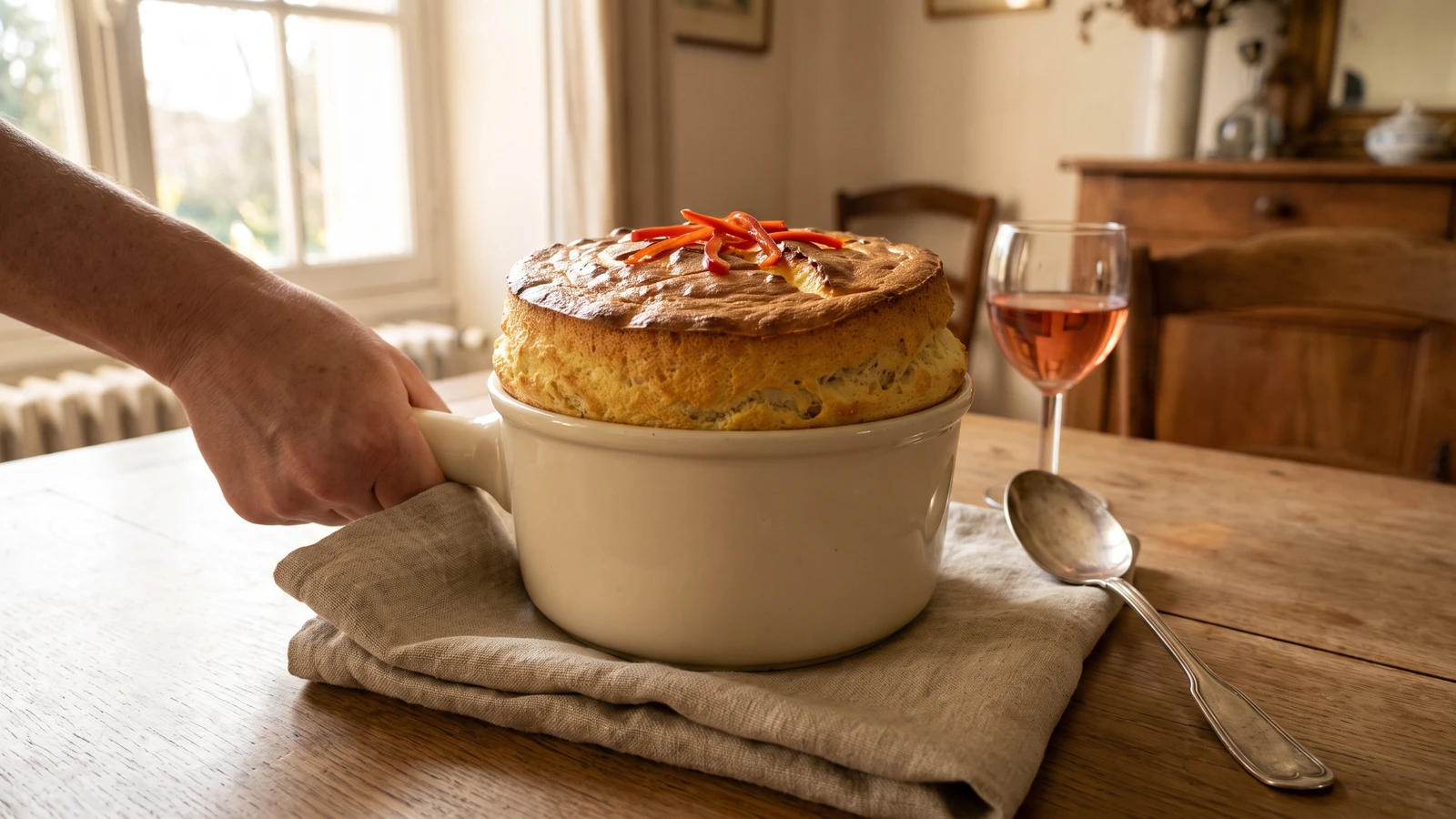
The finished Soufflé de Jambon Carmen rises rose-gold above its dish, with a tender savoury middle and red pepper julienne caught across the crown. Have everyone seated before it comes out. Before you touch the eggs, reduce the tomato purée until a spatula drawn through it leaves the pan clean.
Soufflé de Jambon Carmen belongs to the formal vocabulary of Parisian classical kitchens rather than to one French region. In that vocabulary, Carmen signaled a red treatment of tomato and capsicum, a Spanish allusion interpreted through French technique, not a Provençal or Lyonnais garnish. The capsicum is aromatic rather than fiercely hot, while reducing the tomato protects the rise that defines the soufflé.
Quantity
1/2 cup (120 ml / 115 g)
drained, pressed, and roughly chopped
Quantity
3 tablespoons (45 ml / 35 g)
finely chopped
Quantity
1 tablespoon (15 ml / 10 g)
cut in fine julienne (match-shaped rods)
Quantity
5 tablespoons (75 ml / 70 g)
divided
Quantity
1/3 cup (80 ml / 40 g)
Quantity
1 1/4 cups (300 ml / 305 g)
Quantity
1 2/3 cups (395 ml / 225 g)
finely chopped
Quantity
5
separated
Quantity
1/4 teaspoon (1.25 ml / 1.5 g)
Quantity
1/4 teaspoon (1.25 ml / 0.6 g)
| Ingredient | Quantity |
|---|---|
| canned whole tomatoesdrained, pressed, and roughly chopped | 1/2 cup (120 ml / 115 g) |
| red bell pepper (capsicum)finely chopped | 3 tablespoons (45 ml / 35 g) |
| red bell peppercut in fine julienne (match-shaped rods) | 1 tablespoon (15 ml / 10 g) |
| unsalted butterdivided | 5 tablespoons (75 ml / 70 g) |
| all-purpose flour | 1/3 cup (80 ml / 40 g) |
| whole milk | 1 1/4 cups (300 ml / 305 g) |
| plain cooked hamfinely chopped | 1 2/3 cups (395 ml / 225 g) |
| large eggsseparated | 5 |
| fine salt | 1/4 teaspoon (1.25 ml / 1.5 g) |
| ground white pepper | 1/4 teaspoon (1.25 ml / 0.6 g) |
Set a rack in the lower-middle of the oven and heat it to 400°F (200°C). Use 1 tablespoon of the butter to coat the bottom and sides of a 2-quart (1.9-litre) straight-sided soufflé dish, brushing upward along the walls. Chill the dish while you work. Finely chop the ham and separate the eggs now; once the whites are folded, the soufflé must go straight into the oven.
Melt 1 tablespoon of the butter in a small heavy saucepan over medium heat. Add the pressed tomatoes and chopped capsicum, then cook for 6 to 8 minutes, stirring, until the vegetables soften and their loose juices disappear. Rub everything through a fine-mesh sieve, pressing firmly, and return the smooth purée to the clean pan. Reduce over medium-low heat until only about 1/4 cup (60 ml / 65 g) remains and a spatula drawn across the bottom leaves a clean trail for several seconds. This reduction is the dish. If the purée is still loose, don't continue and hope for the best. Ça se rattrape: return it to the heat and reduce until it sits in a mound rather than flowing.
Melt 3 tablespoons of the butter in a medium saucepan over medium-low heat. Stir in the flour and cook the roux for 2 minutes without letting it colour. Add the milk a little at a time, whisking each addition smooth before the next, then cook for 3 to 4 minutes until the béchamel becomes a very thick panade that pulls cleanly from the pan. If lumps appear, take the pan off the heat and whisk firmly before adding more milk. Season with the white pepper and half the salt.
Remove the panade from the heat and let it cool for 5 minutes. Stir in the reduced Carmen purée and the finely chopped ham until the colour is even and no heavy pockets remain. Beat in the yolks one at a time, fully incorporating each before adding the next. The base should be thick, rosy, and warm rather than hot. Taste before the yolks go in and add the remaining salt only if the ham needs it.
Reserve 1 tablespoon of the unwhipped egg whites in a small cup. Whisk the rest in a spotless bowl until they form glossy medium-stiff peaks, upright at the base with tips that bend slightly. Stop before they turn dry or granular. If they begin to look grainy, whisk in the reserved white by hand until the foam becomes supple again. Ça se rattrape, but only while some moisture remains.
Stir one-quarter of the whipped whites firmly into the ham base to lighten it. Add half the remaining whites and fold with a broad spatula, cutting down through the centre, sweeping along the bottom, and turning the mixture over itself. Fold in the last whites just until no large white streaks remain. A few fine streaks are safer than a perfectly uniform mixture beaten flat.
Spoon the mixture into the chilled dish and smooth the surface lightly. Run a clean thumb around the inside rim to make a shallow channel, helping the centre rise cleanly. Scatter the fine red pepper julienne lightly over the surface, exactly as the Carmen finish requires. Do not press it into the mixture.
Bake for 12 minutes, then reduce the oven to 375°F (190°C) without opening the door. Continue for 18 to 23 minutes, until the soufflé stands well above the rim, its crown is rose-gold with fine fissures, and the centre reaches at least 160°F (71°C) while retaining a slight tremble. Bring it directly to the table. If it settles on the journey, never apologize at your own table; the flavour and tenderness remain. Serve from the dish at once. À table!
1 serving (about 230g)
Culinary guides, cultural storytelling, and the editorial depth that makes cooking meaningful.
Discover Culinary ExplorerChef Juliette
John Dory has the delicacy of sole and the firmness of turbot. A light flouring, a quick butter sauté, and nut-brown beurre noisette show exactly why looks never mattered.

Chef Juliette
Fresh haddock proves its delicacy in the meunière pan: a fine flour crust, moist pearly flakes, and beurre noisette sharpened with lemon and parsley, ready from one skillet in half an hour.

Chef Juliette
Éperlans à l’Anglaise turns small fish into a lesson in disciplined coating: boned smelts under a close, crisp crumb, pan-fried in clarified butter and finished with bright, half-melted maître d’hôtel butter.

Chef Juliette
Tiny smelts, shallot, mushrooms, white wine, gratin sauce, and fine bread raspings meet a fierce oven, where the fish must turn tender in the same breath the buttered crust bronzes.