
Chef Juliette
John Dory (St. Pierre)
John Dory has the delicacy of sole and the firmness of turbot. A light flouring, a quick butter sauté, and nut-brown beurre noisette show exactly why looks never mattered.
A cooking platform built around craft, culture, and the stories behind what we eat.
Created by Chef Juliette
Based on No. 1425, Soufflé de Jambon Alexandra, from Le Guide Culinaire (1907) by Auguste Escoffier
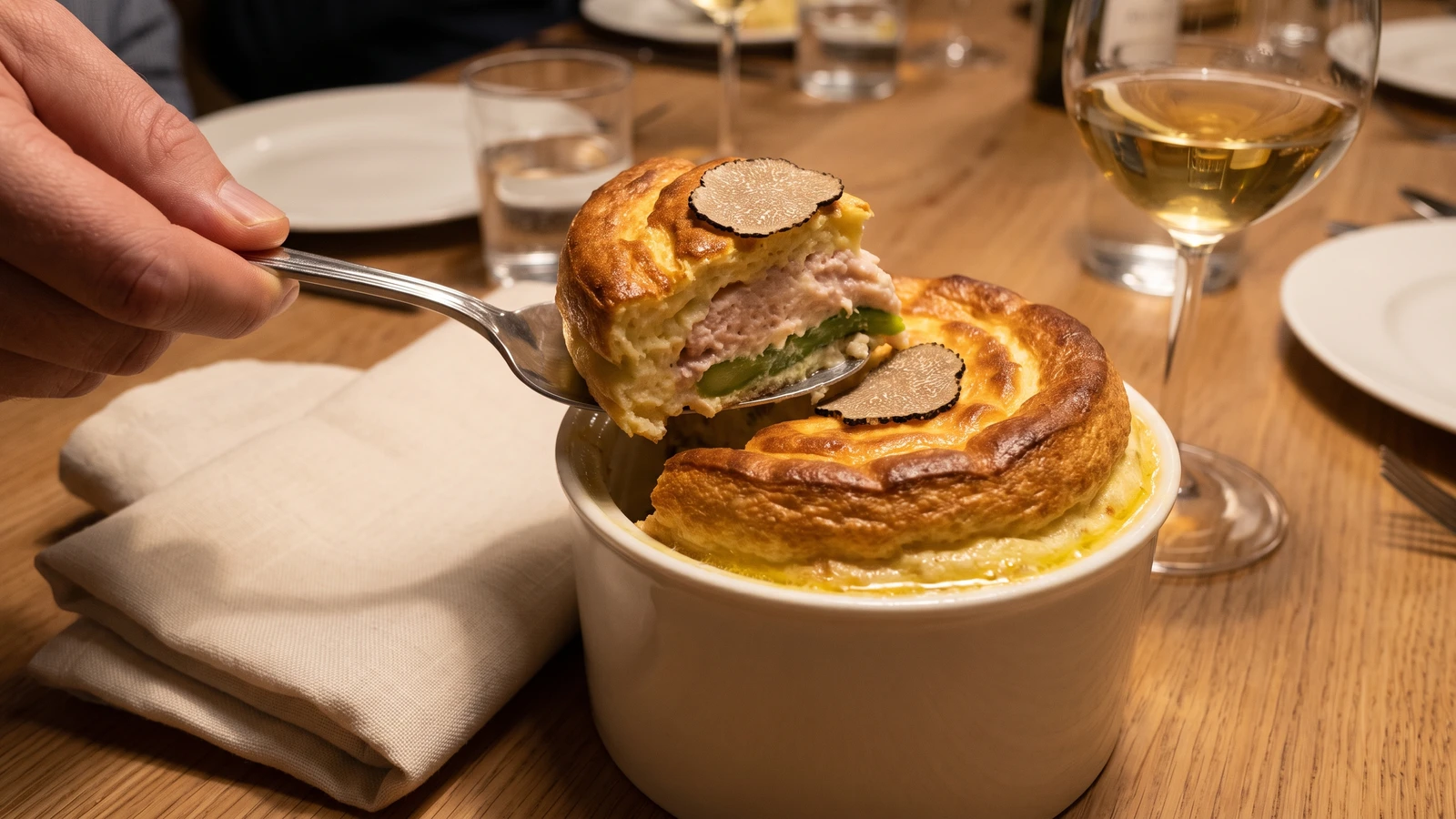
Soufflé de Jambon Alexandra rises around a green heart of buttered asparagus, with ham in every tender spoonful and one dark truffle slice on its dome. Fold gently, bake steadily, and serve without delay.
Soufflé de Jambon Alexandra (ham soufflé layered with buttered asparagus tips and crowned with truffle) teaches one governing truth: the oven creates no air. It only expands the air you fold into the base, so glossy egg whites, a gentle hand, and immediate baking matter more than any grand equipment.
The original entry assumes the soufflé preparation already lives in the cook's hands, the asparagus heads are trimmed, the truffle is waiting, and a moderate oven can be judged without a dial. A grand kitchen could pass the work among vegetable cook, saucier, and oven station, with stock never off the fire and a salamander ready for dishes that needed it, though this soufflé needs neither stock nor top heat. At home, a straight-sided 1½-quart dish, a roux-thickened panade, and one central asparagus layer do the work for four. I cut the brigade's multiple garnish layers because the source itself reserves one layer for a small soufflé; the buttered timbale, folded whites, domed top, truffle crown, and immediate service stay because they are the dish.
When it is right, the dome stands butter-gold over a tender ham interior, and the first spoonful reveals a clean green band of asparagus beneath the truffle. One cook, one stove, one evening. The step that decides everything is the final fold: stop while the mixture still holds the air you worked to put there.
Soufflé de Jambon Alexandra belongs to the named repertory of the Parisian grand kitchen, where a personal name often identified a fixed garnish rather than a region. Here Alexandra specifies a ham soufflé layered with asparagus heads bound in butter and crowned with truffle; the pairing also shows how the classical pantry brought spring asparagus together with preserved truffle. In formal home dining, the preparation became practical at a smaller scale, using one asparagus layer in a timbale while preserving the immediate service that defines every hot soufflé.
Quantity
1 tablespoon (15 ml / 14 g)
softened
Quantity
18 tips (about 6 oz / 170 g)
trimmed to 2½ inches (6 cm)
Quantity
2 quarts (1.9 L / 1.9 kg)
Quantity
1 tablespoon (15 ml / 18 g)
Quantity
1 tablespoon (15 ml / 14 g)
Quantity
2 tablespoons (30 ml / 28 g)
Quantity
¼ cup (60 ml / 30 g)
Quantity
1 cup (240 ml / 245 g)
warmed
Quantity
¼ cup (60 ml / 60 g)
warmed
Quantity
1½ cups (355 ml / 225 g)
finely minced
Quantity
4
Quantity
5
brought to room temperature
Quantity
1
reserved for rescuing overbeaten whites
Quantity
½ teaspoon (2.5 ml / 3 g)
divided
Quantity
¼ teaspoon (1.25 ml / 0.6 g)
Quantity
⅛ teaspoon (0.6 ml / 0.25 g)
Quantity
⅛ teaspoon (0.6 ml / 0.25 g)
Quantity
1 paper-thin slice (about 1/16 oz / 2 g)
| Ingredient | Quantity |
|---|---|
| unsalted butter for the timbalesoftened | 1 tablespoon (15 ml / 14 g) |
| asparagus tipstrimmed to 2½ inches (6 cm) | 18 tips (about 6 oz / 170 g) |
| water for blanching | 2 quarts (1.9 L / 1.9 kg) |
| fine sea salt for blanching | 1 tablespoon (15 ml / 18 g) |
| unsalted butter for the asparagus | 1 tablespoon (15 ml / 14 g) |
| unsalted butter for the soufflé base | 2 tablespoons (30 ml / 28 g) |
| all-purpose flour | ¼ cup (60 ml / 30 g) |
| whole milkwarmed | 1 cup (240 ml / 245 g) |
| heavy creamwarmed | ¼ cup (60 ml / 60 g) |
| cooked unsmoked hamfinely minced | 1½ cups (355 ml / 225 g) |
| large egg yolks | 4 |
| large egg whitesbrought to room temperature | 5 |
| additional large egg white (optional)reserved for rescuing overbeaten whites | 1 |
| fine sea saltdivided | ½ teaspoon (2.5 ml / 3 g) |
| ground white pepper | ¼ teaspoon (1.25 ml / 0.6 g) |
| freshly grated nutmeg | ⅛ teaspoon (0.6 ml / 0.25 g) |
| cayenne pepper | ⅛ teaspoon (0.6 ml / 0.25 g) |
| black truffle | 1 paper-thin slice (about 1/16 oz / 2 g) |
Set a rack in the lower third of the oven and heat it to 375°F (190°C). Butter a 1½-quart (1.4 L) straight-sided timbale or soufflé dish generously, brushing from bottom to rim in upward strokes. Keep the rim perfectly clean, because butter smeared across it can catch the rising mixture. Chill the prepared dish while you make the filling.
Bring the water and blanching salt to a full boil. Add the asparagus tips and cook until vivid green and just tender when pierced, 2 to 3 minutes depending on thickness. Drain, rinse briefly under cold water, and dry them with great care; trapped water will loosen the soufflé around the middle layer. Melt the asparagus butter in a small skillet, roll the tips through it with a pinch of the measured salt, then spread them on a plate to cool until barely warm.
Melt the butter for the base in a heavy saucepan over medium-low heat. Stir in the flour and cook the roux, the butter-and-flour foundation, for 90 seconds without letting it colour. Pour in the warm milk and cream gradually, whisking after each addition, then cook for 3 to 4 minutes until the panade is smooth, very thick, and leaves a broad trail across the pan floor. If it lumps, take it off the heat and whisk hard; ça se rattrape. Pass it through a fine sieve before proceeding if any lumps remain. If it still pours like sauce, keep cooking. It must be stout enough to carry the ham.
Take the pan from the heat and let the panade cool for 5 minutes, until warm rather than scalding. Stir in the minced ham, white pepper, nutmeg, cayenne, and half the remaining salt. Taste before adding more, because ham brings salt of its own. Beat in the yolks one at a time until the base is glossy and cohesive. Transfer it to a broad mixing bowl and let it cool until no longer hot to the touch; a hot base cooks the whites on contact and steals their lift.
Beat the egg whites in a spotless bowl until they hold a bec d'oiseau, a glossy peak whose tip bends like a bird's beak. Stop there. Dry, cottony whites break into lumps instead of folding; if yours go too far, add the reserved fresh white and whisk only until the mixture becomes glossy again. Stir one quarter of the whites firmly into the ham base to lighten it. Fold in the rest in two additions with a flexible spatula, cutting down through the centre, sweeping across the bottom, and turning the mixture over itself. A few pale streaks are better than a perfectly uniform mixture beaten flat.
Spoon slightly less than half the soufflé into the chilled timbale. Arrange the buttered asparagus tips in one level layer, leaving a ½-inch (1 cm) border so the mixture can join around them. Cover with the remaining soufflé, filling the dish no more than three quarters full. If there is extra, bake it separately in a buttered ramekin rather than overloading the timbale. Smooth the surface into a gentle dome without pressing out the air, then lay the fine truffle slice at its crown.
Put the timbale into the oven immediately and bake without opening the door for 25 minutes. Continue until the soufflé has risen well above the rim, the dome is deep butter-gold, and the centre gives a gentle tremble rather than a liquid slosh, usually 30 to 35 minutes in total. An instant-read thermometer inserted just off-centre should register at least 160°F (71°C). If the top colours too quickly after the first 25 minutes, lower the oven to 350°F (175°C) and lay foil loosely over the dome. By then the structure can bear the interruption.
Carry the timbale straight to the table. Use two large spoons to open the dome and serve downward through the centre so every portion receives ham soufflé, the buttered asparagus layer, and some tender golden crown. Do not leave it waiting while the table is rearranged. The soufflé keeps no one. À table!
1 serving (about 225g)
Culinary guides, cultural storytelling, and the editorial depth that makes cooking meaningful.
Discover Culinary ExplorerChef Juliette
John Dory has the delicacy of sole and the firmness of turbot. A light flouring, a quick butter sauté, and nut-brown beurre noisette show exactly why looks never mattered.

Chef Juliette
Fresh haddock proves its delicacy in the meunière pan: a fine flour crust, moist pearly flakes, and beurre noisette sharpened with lemon and parsley, ready from one skillet in half an hour.

Chef Juliette
Éperlans à l’Anglaise turns small fish into a lesson in disciplined coating: boned smelts under a close, crisp crumb, pan-fried in clarified butter and finished with bright, half-melted maître d’hôtel butter.

Chef Juliette
Tiny smelts, shallot, mushrooms, white wine, gratin sauce, and fine bread raspings meet a fierce oven, where the fish must turn tender in the same breath the buttered crust bronzes.