
Chef Juliette
John Dory (St. Pierre)
John Dory has the delicacy of sole and the firmness of turbot. A light flouring, a quick butter sauté, and nut-brown beurre noisette show exactly why looks never mattered.
A cooking platform built around craft, culture, and the stories behind what we eat.
Created by Chef Juliette
Based on No. 1423, The Preparation of the Soufflé with Cooked Ham, from Le Guide Culinaire (1907) by Auguste Escoffier
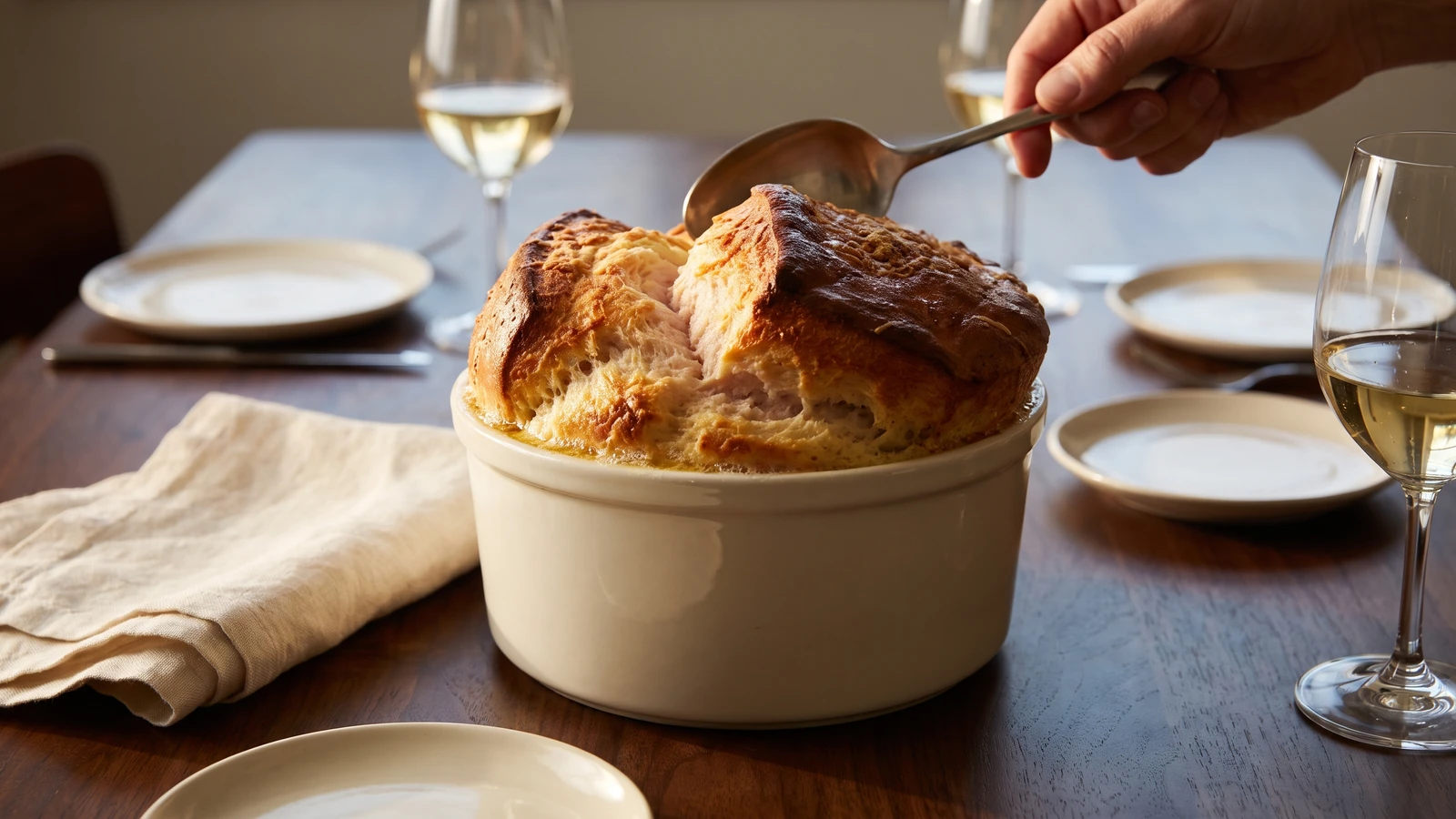
Soufflé de jambon cuit turns lean ham, Béchamel, yolks, and stiffly beaten whites into a tall, bronzed main whose fine, savory crumb proves that lifting a dense base is all in the fold.
Soufflé de jambon cuit (soufflé with cooked ham) teaches the central law of every savory soufflé: the seasoned base must carry enough flavor and body to stand, but the whites must still be able to lift it. Before you touch a pan, know this one true thing. The first spoonful of white is allowed to disappear into the ham purée; it loosens the base so the rest can remain airy.
The book's kitchen assumed a mortar, a tamis (fine drum sieve), a saucier keeping Béchamel (milk sauce thickened with a white roux) at the proper temperature, and, for the grand Jambon Soufflé, a whole boned ham rebuilt around its bone beneath a buttered-paper band. A stockpot never off the fire and a salamander belonged to the same brigade world, but neither does the work here. At home, a food processor replaces the mortar, a fine-mesh sieve keeps the silk, and a straight-sided soufflé dish replaces the reconstructed joint. That whole-ham architecture is service scaffolding, so I cut it. The pounded ham, cold spoonfuls of Béchamel, sieve, yolks, and stiffly beaten whites are the dish, so they stay. I scale every source quantity to three-quarters, enough for four main portions without changing its ratios. One cook, one stove, one evening.
The finished soufflé rises with a bronzed crown and a tender ivory-rose center, tasting first of ham and only then of cream. Have the oven ready and your guests sitting down before you whip the whites. Fold gently, fill immediately, and bake at once. The fold is the step that matters most.
Soufflé de jambon belongs to Parisian classical cookery and the bourgeois dining room, where savory soufflés carried the grand kitchen's Béchamel-bound method onto smaller household tables. In its grandest service, Jambon Soufflé (No. 1421) rebuilt a cooked ham around the retained end bone and filled the missing cushion with this preparation, an elaborate presentation sustained by brigade labor. The quieter version baked in a soufflé dish is not merely a cheese soufflé with scraps stirred through it: the ham is pounded and sieved into the base, so pork remains both its structure and principal flavor.
Quantity
2 tablespoons (30 ml / 28 g)
divided between the Béchamel and soufflé dish
Quantity
1/4 cup (60 ml / 60 g)
reduced to 2 teaspoons (10 ml / 10 g) for the ham essence
Quantity
1 tablespoon plus 2 teaspoons (25 ml / 14 g)
Quantity
1/2 cup (120 ml / 124 g)
Quantity
2 tablespoons (30 ml / 30 g)
Quantity
12 ounces (340 g)
rind and visible fat removed, chilled and finely diced
Quantity
3 (about 3 tablespoons / 45 ml / 54 g)
Quantity
1/2 cup plus 1 tablespoon (135 ml / 135 g)
about 4½ large whites, at room temperature
Quantity
3/4 cup (180 ml / 64 g)
Quantity
1 Jambon Soufflé (No. 1421)
prepared according to its separate entry
| Ingredient | Quantity |
|---|---|
| unsalted butterdivided between the Béchamel and soufflé dish | 2 tablespoons (30 ml / 28 g) |
| unsalted ham cooking liquorreduced to 2 teaspoons (10 ml / 10 g) for the ham essence | 1/4 cup (60 ml / 60 g) |
| all-purpose flour | 1 tablespoon plus 2 teaspoons (25 ml / 14 g) |
| whole milk | 1/2 cup (120 ml / 124 g) |
| heavy cream | 2 tablespoons (30 ml / 30 g) |
| lean cooked hamrind and visible fat removed, chilled and finely diced | 12 ounces (340 g) |
| large egg yolks | 3 (about 3 tablespoons / 45 ml / 54 g) |
| egg whitesabout 4½ large whites, at room temperature | 1/2 cup plus 1 tablespoon (135 ml / 135 g) |
| finely grated Parmesan (optional) | 3/4 cup (180 ml / 64 g) |
| prepared ham form, optional host (optional)prepared according to its separate entry | 1 Jambon Soufflé (No. 1421) |
Heat the oven to 375°F (190°C) with a rack in the lower third. Brush a 1.5-quart (1.4-liter) straight-sided soufflé dish with half the butter, working upward from base to rim so the rising mixture meets no dry patches. Wrap a buttered parchment collar around the outside, extending about 3 inches (7.5 cm) above the rim, and secure it with kitchen twine. Set the dish on a baking sheet.
Put the unsalted ham cooking liquor in a small saucepan and boil it down to 2 teaspoons (10 ml / 10 g). It should taste distinctly of ham without tasting aggressively salty. If the original liquor is already salty, dilute it with a little water before reducing; concentration is the purpose here, not added salt. Set this ham essence aside.
Melt the remaining butter over medium-low heat, add the flour, and stir for 2 minutes to cook a roux blanc, a white roux that stays pale and smells faintly of warm biscuits. Add the milk in small installments, whisking each one smooth before the next, then whisk in the cream and simmer gently for 4 to 5 minutes. The Béchamel should fall from the whisk in a broad, creamy ribbon. If lumps form, ça se rattrape: press the sauce through the fine sieve and return it to the pan. Measure 2¼ tablespoons (34 ml / 35 g) into a shallow bowl and chill it over ice until very cold. Reserve exactly 7 tablespoons (105 ml / 110 g) for the hot portion; the little extra in the pan covers transfer losses.
Put the chilled diced ham in the food processor and work it to a fine paste, stopping often to scrape down the bowl. Add the very cold Béchamel in three small additions, processing each completely into the ham before adding the next. Press the resulting purée through a fine-mesh sieve with a flexible scraper, working in small batches. The processor replaces the mortar, but the sieve stays; it removes the last resistant fibers and gives the soufflé its fine, tender crumb.
Put the sieved ham purée in a clean sauté pan. Bring the reserved 7 tablespoons (105 ml / 110 g) of Béchamel to a boil, whisk in the reduced ham essence, and stir the hot sauce into the purée in three additions until perfectly smooth. If the base is loose enough to pour, stir it over low heat until the spatula leaves a track for a moment; if it has tightened into a paste, gentle warmth will restore its suppleness. Remove it from the heat and wait 2 minutes, then beat in the yolks one at a time. Fold in the Parmesan now, if using. Transfer the base to a broad bowl and cool until barely warm, about 105°F (40°C); a hot base cooks the whites before the oven can lift them.
Set aside 1 tablespoon of the measured egg whites. Beat the remainder in a scrupulously clean bowl until soft peaks form, then add the reserved white gradually and continue beating until the peaks stand stiff but remain smooth and glossy. Stiff does not mean dry. If the whites begin looking grainy, the reserved liquid white will bring them back together; beat only until the surface smooths, then stop.
Whisk one-quarter of the beaten whites firmly into the warm ham base. This first addition is sacrificial: let it disappear, because its job is to loosen the dense purée so the remaining whites can keep their air. Fold in the rest in two additions, cutting down through the center, sweeping across the bottom, and lifting the base over the whites. Stop when only a few pale streaks remain. Scrape the mixture into the prepared soufflé dish, smooth the surface lightly, and run a clean thumb around the inside rim. If making the full joint presentation, reach instead for the prepared Jambon Soufflé (No. 1421) ham form and use this mixture exactly as that separate entry directs; its boning, banding, shaping, and moist poaching remain whole in that recipe.
Bake immediately for 30 to 35 minutes without opening the oven during the first 25. The soufflé is ready when it stands well above the collar, its crown is deep butter-gold, and the center gives only a slight tremble; an instant-read thermometer inserted discreetly near the center should register at least 160°F (71°C). If the top colors too quickly after 25 minutes, lay a loose sheet of foil above it without touching the crown. Remove the collar and carry the dish straight to the table. Every soufflé settles a little after leaving the oven, which is its nature, not a failure. Never apologize at your own table. À table!
1 serving (about 175g)
Culinary guides, cultural storytelling, and the editorial depth that makes cooking meaningful.
Discover Culinary ExplorerChef Juliette
John Dory has the delicacy of sole and the firmness of turbot. A light flouring, a quick butter sauté, and nut-brown beurre noisette show exactly why looks never mattered.

Chef Juliette
Fresh haddock proves its delicacy in the meunière pan: a fine flour crust, moist pearly flakes, and beurre noisette sharpened with lemon and parsley, ready from one skillet in half an hour.

Chef Juliette
Éperlans à l’Anglaise turns small fish into a lesson in disciplined coating: boned smelts under a close, crisp crumb, pan-fried in clarified butter and finished with bright, half-melted maître d’hôtel butter.

Chef Juliette
Tiny smelts, shallot, mushrooms, white wine, gratin sauce, and fine bread raspings meet a fierce oven, where the fish must turn tender in the same breath the buttered crust bronzes.