
Chef Juliette
John Dory (St. Pierre)
John Dory has the delicacy of sole and the firmness of turbot. A light flouring, a quick butter sauté, and nut-brown beurre noisette show exactly why looks never mattered.
A cooking platform built around craft, culture, and the stories behind what we eat.
Created by Chef Juliette
Based on No. 1422, Soufflés au Jambon, from Le Guide Culinaire (1907) by Auguste Escoffier
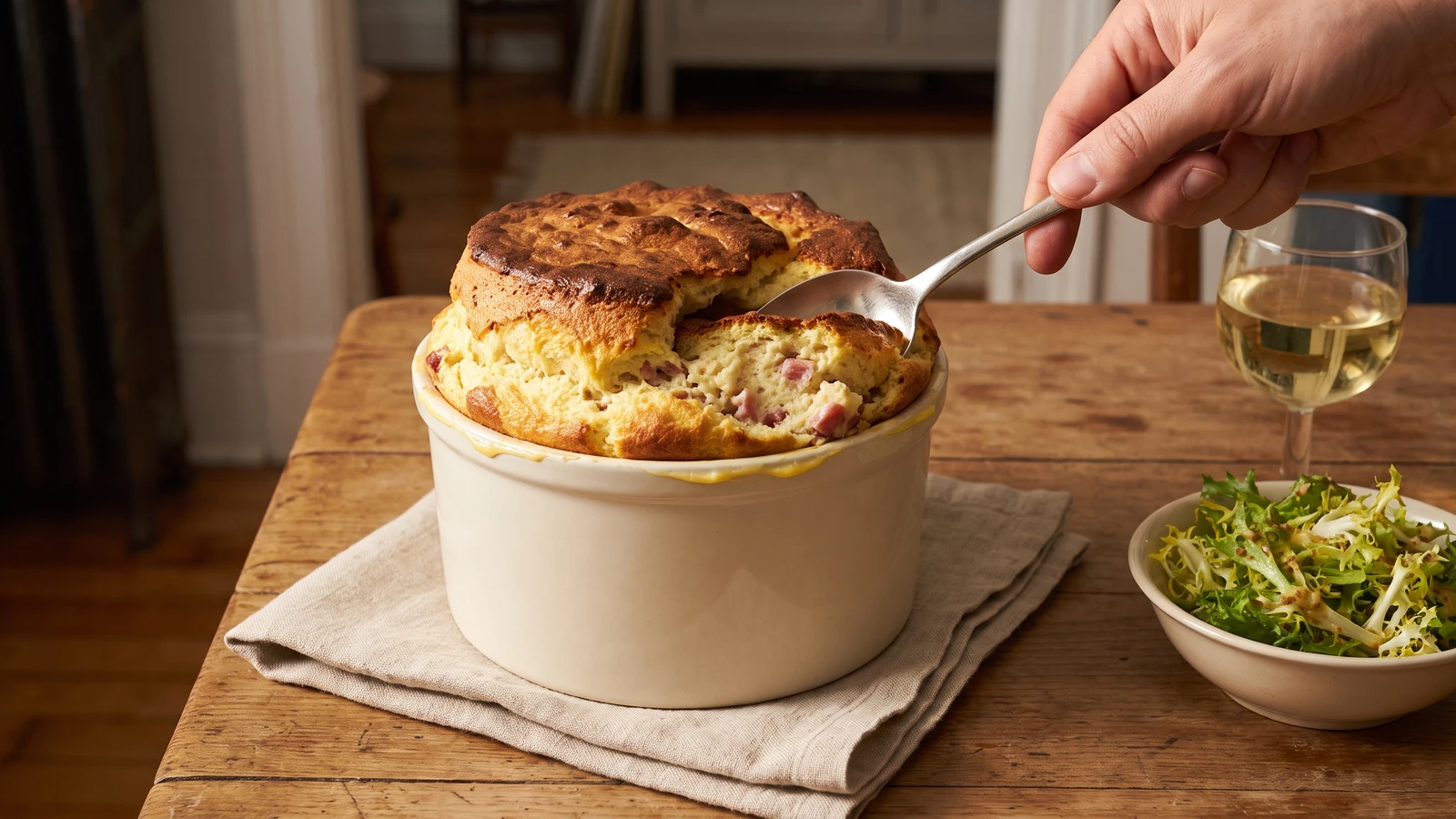
Soufflés au Jambon take two classical paths: cooked ham for the lightest rise, raw-ham mousseline for steadier service, both brought home as one generous golden dish for four.
Soufflés au Jambon (ham soufflés) teach structure. A concentrated base carries the ham, properly whipped egg whites carry the rise, and neither can do the other's work. The one true thing is simple: once those whites are folded, the soufflé goes straight into a fully heated oven.
The old formula offered two paths and assumed several hands: a saucier tending the roux blanc (white roux), another cook pounding raw ham into mousseline forcemeat (silken raw forcemeat), and a line ready to carry each dish the moment it rose. Unlike many grand preparations, this one needs neither a stockpot kept on the fire nor a salamander. A saucepan, a food processor, an electric mixer, and one 1.5-liter dish do the work at home. The quantity is reduced to four servings; the mortar, routine sieving, and brigade-sized row of molds were scaffolding and can go. The thick roux for cooked ham, the ice-cold mousseline for raw ham, the whipped whites, and the immediate bake are the dish and must stay.
Choose cooked ham for the most delicate, airy result. Choose uncured fresh ham when steadier service matters; its raw proteins set into a firmer frame as the soufflé rises. Before touching a pan, butter the dish, clear the path to the table, and heat the oven thoroughly. The final fold decides everything. One cook, one stove, one evening.
Soufflés au jambon belong to the national French bourgeois table and the Parisian grand kitchen rather than to a single provincial larder. The classical entry preserves two working methods: cooked ham in a roux-based soufflé for the lightest result, and uncured fresh ham treated as mousseline forcemeat for a firmer rise when many guests must be served; raw ham here does not mean dry-cured jambon cru. Its glossary places Soufflé and Mousselines in one family of light preparations, with mousselines molded as individual portions, proof that shape and service have always guided the canon.
Quantity
1 tablespoon (15 ml / 14 g)
for the dish
Quantity
3 tablespoons (45 ml / 18 g)
for the dish
Quantity
1 cup (240 ml / 150 g)
very finely minced
Quantity
1 cup (240 ml / 245 g)
Quantity
2 tablespoons (30 ml / 28 g)
Quantity
1/4 cup (60 ml / 30 g)
Quantity
up to 1/4 teaspoon (1.25 ml / 1.5 g)
Quantity
1/4 teaspoon (1.25 ml / 0.6 g)
Quantity
4
Quantity
5
Quantity
1 1/2 cups (360 ml / 225 g)
trimmed and diced
Quantity
3/4 cup (180 ml / 180 g)
Quantity
3/4 teaspoon (3.75 ml / 4.5 g)
Quantity
1/4 teaspoon (1.25 ml / 0.6 g)
Quantity
3
Quantity
5
divided
| Ingredient | Quantity |
|---|---|
| softened unsalted butter, either versionfor the dish | 1 tablespoon (15 ml / 14 g) |
| fine dry breadcrumbs, either versionfor the dish | 3 tablespoons (45 ml / 18 g) |
| mild cooked ham, cooked-ham routevery finely minced | 1 cup (240 ml / 150 g) |
| whole milk, cooked-ham route | 1 cup (240 ml / 245 g) |
| unsalted butter, cooked-ham route | 2 tablespoons (30 ml / 28 g) |
| plain flour, cooked-ham route | 1/4 cup (60 ml / 30 g) |
| fine salt, cooked-ham route | up to 1/4 teaspoon (1.25 ml / 1.5 g) |
| ground white pepper, cooked-ham route | 1/4 teaspoon (1.25 ml / 0.6 g) |
| large egg yolks, cooked-ham route | 4 |
| large egg whites, cooked-ham route | 5 |
| uncured fresh ham or lean pork leg, raw-ham routetrimmed and diced | 1 1/2 cups (360 ml / 225 g) |
| cold heavy cream, raw-ham route | 3/4 cup (180 ml / 180 g) |
| fine salt, raw-ham route | 3/4 teaspoon (3.75 ml / 4.5 g) |
| ground white pepper, raw-ham route | 1/4 teaspoon (1.25 ml / 0.6 g) |
| large egg yolks, raw-ham route | 3 |
| large egg whites, raw-ham routedivided | 5 |
Set a rack in the lower third of the oven and heat it to 400°F (200°C conventional / 180°C fan) for at least 30 minutes. Butter the bottom and sides of a 1.5-liter straight-sided soufflé dish, brushing upward along the walls, then coat it evenly with the breadcrumbs and tap out the excess. Keep the prepared dish at room temperature. The oven and dish must be ready before the whites are whipped; a finished soufflé mixture left waiting loses the air you just worked to give it.
For the cooked-ham route, melt the 2 tablespoons butter in a heavy saucepan over medium-low heat. Add the flour and stir for 90 seconds without allowing it to color; this roux blanc must cook long enough to lose its raw flour taste. Add the milk in three additions, whisking each smooth before pouring the next. Bring it to a full simmer and beat for 2 minutes, until the base is glossy, very thick, and falls from the whisk in heavy folds. If it remains loose, simmer another minute; a thin base cannot support the ham. Remove from the heat, cool for 3 minutes, then beat in the yolks one at a time. Fold in the minced cooked ham and white pepper, taste, and add only as much salt as the ham needs. Let the base stand until warm rather than hot. If the sauce has small lumps, press it through a fine sieve before adding the ham. Ça se rattrape.
For the raw-ham route, chill the processor bowl and blade for 15 minutes. Reserve 1 tablespoon of the cream, then process the diced fresh ham with the salt and white pepper until the meat becomes fine and tacky. Add 1 egg white and process until absorbed. With the machine running, pour in the remaining cream gradually, stopping to scrape the bowl as needed, until the mousseline is smooth, glossy, and still colder than 50°F (10°C). Add the 3 yolks and pulse only until combined. If the mixture warms or looks greasy, stop, set the processor bowl over ice for 10 minutes, then pulse in the reserved cold cream. Ça se rattrape. Cook a teaspoonful completely in a small skillet, taste it, and correct the seasoning without ever tasting the raw mixture. Transfer the mousseline to a large bowl and wash every surface that touched the uncooked pork.
For the cooked-ham route, use all 5 whites. For the raw-ham route, use the 4 whites remaining after the mousseline is made. Reserve 1 tablespoon of these whites, then beat the rest in a spotless bowl at medium speed until glossy medium-firm peaks form and the tip bends slightly when the whisk is lifted. Stop there. Whites beaten until dry and clumpy refuse to fold; if they have just begun to turn grainy, whisk in the reserved unbeaten white by hand until they become supple again.
Stir one quarter of the whipped whites firmly into the chosen ham base to loosen it. Add the remaining whites in two additions, cutting the spatula down through the center, sweeping across the bottom, and lifting the heavier mixture over the top. Turn the bowl as you work and stop as soon as no large pockets of white remain; a few pale streaks do less harm than overmixing. Spoon the mixture into the prepared dish, filling it no more than three quarters full. Smooth the top lightly, then run a clean thumb around the inside rim to make a narrow channel. Do not bang or shake the dish. Put it into the oven at once.
Place the soufflé directly on the oven rack and immediately reduce the setting to 375°F (190°C conventional / 170°C fan). Do not open the door for the first 25 minutes. Bake the cooked-ham version for 30 to 35 minutes and the raw-ham version for 38 to 44 minutes. It is ready when the crown stands well above the rim, the top is deeply butter-gold, and the center reaches 160°F (71°C) on a quick thermometer check through a natural crack. The center may tremble, but it must not be liquid. If the soufflé slumps after testing and the center is still under temperature, return it immediately and bake in 3-minute intervals; it can recover part of its rise. If the top colors too quickly late in baking, shield it loosely with foil and finish cooking the center.
Carry the soufflé straight to the table in its baking dish. Break through the crown with a broad serving spoon and reach down to the bottom so every portion receives bronzed crust, soft center, and plenty of ham. A soufflé begins settling as soon as it leaves the oven, which is its nature, not a failure. The guests wait for it, never the reverse. À table!
1 serving (about 160g)
Culinary guides, cultural storytelling, and the editorial depth that makes cooking meaningful.
Discover Culinary ExplorerChef Juliette
John Dory has the delicacy of sole and the firmness of turbot. A light flouring, a quick butter sauté, and nut-brown beurre noisette show exactly why looks never mattered.

Chef Juliette
Fresh haddock proves its delicacy in the meunière pan: a fine flour crust, moist pearly flakes, and beurre noisette sharpened with lemon and parsley, ready from one skillet in half an hour.

Chef Juliette
Éperlans à l’Anglaise turns small fish into a lesson in disciplined coating: boned smelts under a close, crisp crumb, pan-fried in clarified butter and finished with bright, half-melted maître d’hôtel butter.

Chef Juliette
Tiny smelts, shallot, mushrooms, white wine, gratin sauce, and fine bread raspings meet a fierce oven, where the fish must turn tender in the same breath the buttered crust bronzes.