
Chef Juliette
John Dory (St. Pierre)
John Dory has the delicacy of sole and the firmness of turbot. A light flouring, a quick butter sauté, and nut-brown beurre noisette show exactly why looks never mattered.
A cooking platform built around craft, culture, and the stories behind what we eat.
Created by Chef Juliette
Based on No. 1420, Various Garnishes for Braised Ham, from Le Guide Culinaire (1907) by Auguste Escoffier
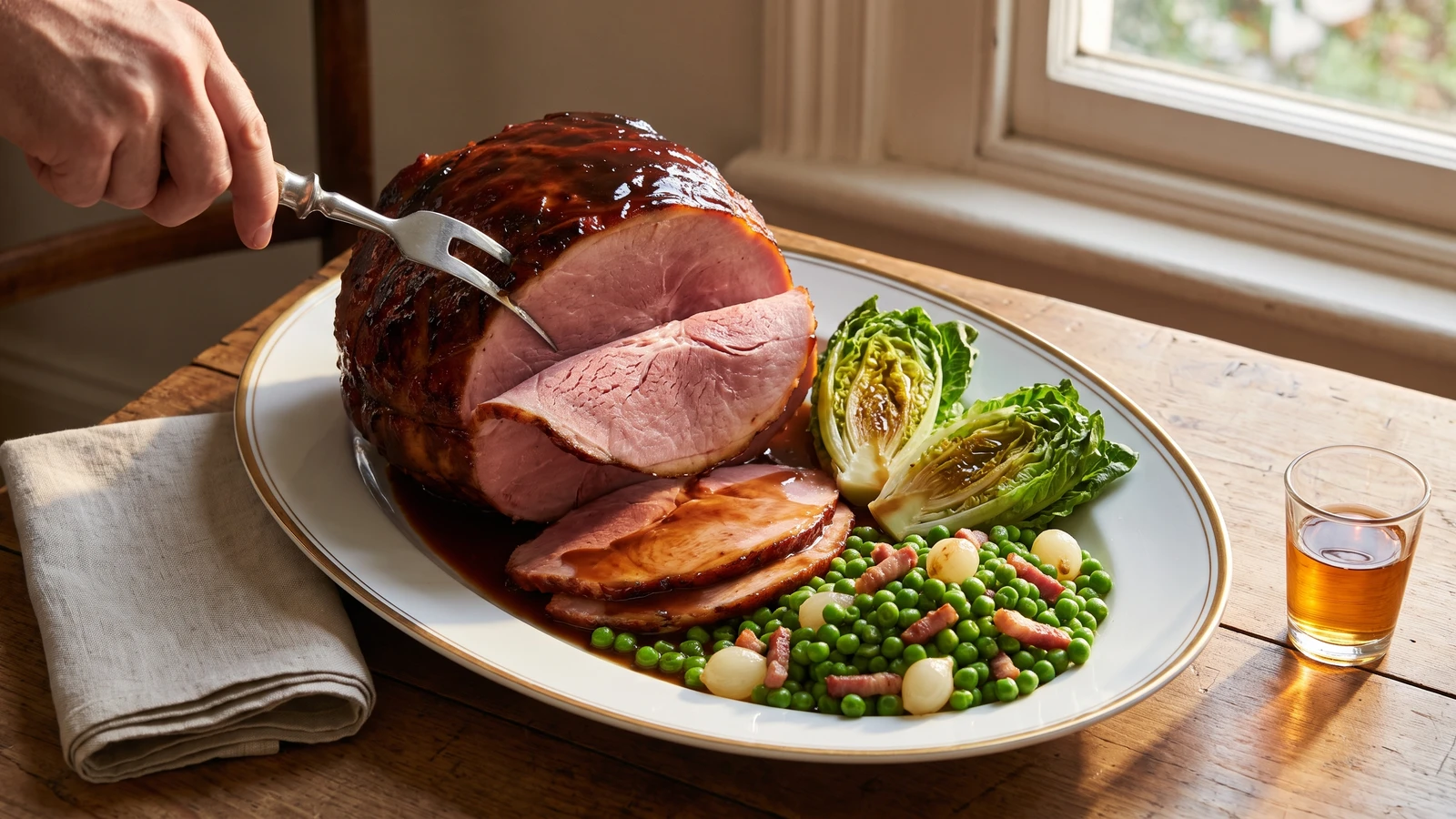
One braised ham, many proper companions: buttered spinach, broad beans, tender braised greens, peas à la paysanne, pasta, or purée, all gathered by a glossy demi-glace au Madère.
Garnitures variées pour jambon braisé (various garnishes for braised ham) teaches a useful classical truth: a garnish is not decoration. It is the second voice on the platter. Salted, yielding ham wants green freshness, a soft braised bitterness, a buttered starch, or a smooth bean purée. Petits pois à la paysanne (country-style peas) bring all four pleasures at once, while demi-glace au Madère (Madeira half-glaze) gathers meat and garnish into one dish.
The original entry assumed a saucier, stock never off the fire, several garnish pans, and a relevé large enough for a formal table. Your honest equivalent is good prepared demi-glace, one sauce pan, one pan for a chosen garnish, and a ham scaled for four. The simultaneous assortment was brigade scaffolding, so it goes; the reduced Madeira sauce and a garnish finished with attention are the dish, so they stay. One cook, one stove, one evening.
Choose one garnish, or two if you want both a vegetable and a starch, then halve each quantity. The list is a vocabulary, not a dare. Before you touch the pan, know the step that decides everything: reduce the Madeira before adding the demi-glace, then stop when the sauce coats a spoon in a thin, shining layer.
Garnishes for braised ham belong to the formal Parisian table and the classical relevé, the substantial joint course that gave a ham room to arrive whole and be carved. The long list was a cook's repertoire of compatible choices, not a command to pile spinach, pasta, peas, and purée onto one platter. Demi-glace au Madère traveled from the saucier's station to bind salt pork, vegetables, and starch with one glossy sauce, an organizing principle that remains sound at the home table.
Quantity
1, about 3 pounds (1.4 kg)
rested for 15 minutes
Quantity
1¼ cups (300 ml / 315 g)
Quantity
½ cup (120 ml / 118 g)
Quantity
1 tablespoon (15 ml / 14 g)
diced
Quantity
to taste
Quantity
10 packed cups (450 g)
thick stems removed
Quantity
2 tablespoons (30 ml / 28 g)
Quantity
3 cups (450 g)
Quantity
2 tablespoons (30 ml / 28 g)
Quantity
4 small lettuces or 6 medium endives
Quantity
3 tablespoons (45 ml / 42 g)
Quantity
¾ cup (180 ml / 180 g)
Quantity
½ cup (120 ml / 85 g)
cut into small batons
Quantity
1 tablespoon (15 ml / 14 g)
Quantity
8
peeled
Quantity
1 small head
finely shredded
Quantity
4 cups (950 ml / 560 g)
Quantity
½ cup (120 ml / 120 g)
Quantity
1 teaspoon (5 ml / 4 g)
Quantity
12 ounces (340 g; about 4 cups for short shapes)
Quantity
3 tablespoons (45 ml / 42 g)
Quantity
4 cups (950 ml / 600 g)
Quantity
1 cup (240 ml / 240 g)
Quantity
3 tablespoons (45 ml / 42 g)
| Ingredient | Quantity |
|---|---|
| hot braised hamrested for 15 minutes | 1, about 3 pounds (1.4 kg) |
| prepared demi-glace | 1¼ cups (300 ml / 315 g) |
| dry Madeira | ½ cup (120 ml / 118 g) |
| cold unsalted butter for the saucediced | 1 tablespoon (15 ml / 14 g) |
| fine salt and freshly ground black pepper | to taste |
| spinach leaves (optional)thick stems removed | 10 packed cups (450 g) |
| unsalted butter for spinach (optional) | 2 tablespoons (30 ml / 28 g) |
| shelled new broad beans (optional) | 3 cups (450 g) |
| unsalted butter for broad beans (optional) | 2 tablespoons (30 ml / 28 g) |
| Little Gem lettuces or Belgian endives (optional) | 4 small lettuces or 6 medium endives |
| unsalted butter for braising lettuce or endive (optional) | 3 tablespoons (45 ml / 42 g) |
| light unsalted stock or strained ham braising liquor (optional) | ¾ cup (180 ml / 180 g) |
| lardons (optional)cut into small batons | ½ cup (120 ml / 85 g) |
| unsalted butter for peas à la paysanne (optional) | 1 tablespoon (15 ml / 14 g) |
| pearl onions (optional)peeled | 8 |
| tender lettuce (optional)finely shredded | 1 small head |
| shelled fresh peas (optional) | 4 cups (950 ml / 560 g) |
| light unsalted stock for peas (optional) | ½ cup (120 ml / 120 g) |
| granulated sugar (optional) | 1 teaspoon (5 ml / 4 g) |
| egg noodles, spaghetti, macaroni, or gnocchi (optional) | 12 ounces (340 g; about 4 cups for short shapes) |
| unsalted butter for pasta (optional) | 3 tablespoons (45 ml / 42 g) |
| shelled fresh beans or peeled broad beans (optional) | 4 cups (950 ml / 600 g) |
| light unsalted stock for bean purée (optional) | 1 cup (240 ml / 240 g) |
| unsalted butter for bean purée (optional) | 3 tablespoons (45 ml / 42 g) |
Choose one garnish for a generous platter serving four. For a larger holiday table, choose one vegetable and one starch, then prepare half the stated quantity of each. Time the garnish to finish while the braised ham rests; holding nine little saucepans was the brigade's concern, not yours.
Pour the Madeira into a small heavy saucepan and boil it steadily until reduced by half. Add the demi-glace and hold at a lively simmer until the sauce coats the back of a spoon in a thin, glossy layer, about 8 minutes. If it is thin, reduce it before adding butter; if it tightens too far, loosen it with a spoonful of light stock. Take the pan off the heat and whisk in the cold butter. If the butter separates, stop heating and whisk in 1 teaspoon of cold water. Ça se rattrape. Taste only now, because both the demi-glace and ham carry salt.
Wash the spinach and leave only the water clinging to its leaves. Pack it into a wide pan, cover, and cook over medium heat until collapsed, turning once. Drain thoroughly, press out excess water, and chop it coarsely. Return it to the pan with the butter, salt, and pepper, tossing over medium-high heat until the leaves shine and no liquid collects underneath. If the spinach begins to weep on the platter, return it to the hot pan and cook off the moisture; never bury watery spinach beneath more sauce.
Blanch the new broad beans in salted boiling water until tender, 3 to 5 minutes according to their size, then drain. Slip off the pale outer skins if they are thick; very young beans need no such ceremony. Warm the peeled beans gently with the butter, salt, and pepper, rolling the pan until every bean carries a bright sheen. Keep the heat moderate, because hard frying splits their tender centres.
Halve the lettuces or endives lengthwise and trim the bases without cutting away the core that holds each half together. Melt the butter in a sauté pan and color the cut sides lightly. Add the stock or ham liquor, season cautiously, cover, and braise at the barest simmer until a knife enters the cores easily, about 20 minutes for lettuce or 30 minutes for endive. Lift the greens out, then reduce the cooking liquor to a glaze and spoon it back over them. If the liquid remains thin, reduce it alone; boiling the tender greens harder will only undo your work.
Render the lardons in a covered sauté pan until their edges begin to bronze. Add the butter, pearl onions, and shredded lettuce, then cook gently for 3 minutes without coloring the lettuce. Add the peas, stock, sugar, and a little pepper. Cover and simmer until the peas and onions are tender, about 8 minutes for fresh peas. Uncover and toss until the remaining liquid glazes them. If the peas become tender while liquid still pools below, lift them out, reduce the liquid quickly, and fold them back in.
Cook egg noodles, spaghetti, or macaroni in well-salted boiling water until tender but still holding its shape. For gnocchi, lift them out shortly after they rise and feel softly resilient at the centre. Reserve a cupful of cooking water, drain thoroughly, and toss with the butter and black pepper. If the pasta clumps while the ham is carved, loosen it with hot cooking water and another small piece of butter, not oil.
Simmer the fresh shelling beans or broad beans in the stock until completely tender, adding a little water if needed. Drain while reserving the liquid, then process the beans with the butter and enough hot cooking liquid to make a thick, flowing purée. Pass it through a fine sieve and season. The sieve is not empty fuss here; if you choose purée, silkiness is the point. If it is loose, cook it gently until a spoon leaves a track; if stiff, beat in more hot stock.
Set the rested braised ham on a warmed oval platter and carve several slices so the pink interior shows. Arrange the chosen garnish in a generous mound or in tidy braised halves beside it, never as a crowded ring of every option. Spoon the demi-glace au Madère over the exposed ham and let a little pool beside the garnish, serving the remainder from a warm sauceboat. À table!
1 serving (about 1470g)
Culinary guides, cultural storytelling, and the editorial depth that makes cooking meaningful.
Discover Culinary ExplorerChef Juliette
John Dory has the delicacy of sole and the firmness of turbot. A light flouring, a quick butter sauté, and nut-brown beurre noisette show exactly why looks never mattered.

Chef Juliette
Fresh haddock proves its delicacy in the meunière pan: a fine flour crust, moist pearly flakes, and beurre noisette sharpened with lemon and parsley, ready from one skillet in half an hour.

Chef Juliette
Éperlans à l’Anglaise turns small fish into a lesson in disciplined coating: boned smelts under a close, crisp crumb, pan-fried in clarified butter and finished with bright, half-melted maître d’hôtel butter.

Chef Juliette
Tiny smelts, shallot, mushrooms, white wine, gratin sauce, and fine bread raspings meet a fierce oven, where the fish must turn tender in the same breath the buttered crust bronzes.