Culinary Explorer

A cooking platform built around craft, culture, and the stories behind what we eat.
Discover Culinary Explorer
Jambon de Prague à la Metternich

Jambon de Prague à la Metternich

Created by Chef Juliette

Based on No. 1419a, Jambon de Prague à la Metternich, from Le Guide Culinaire (1907) by Auguste Escoffier

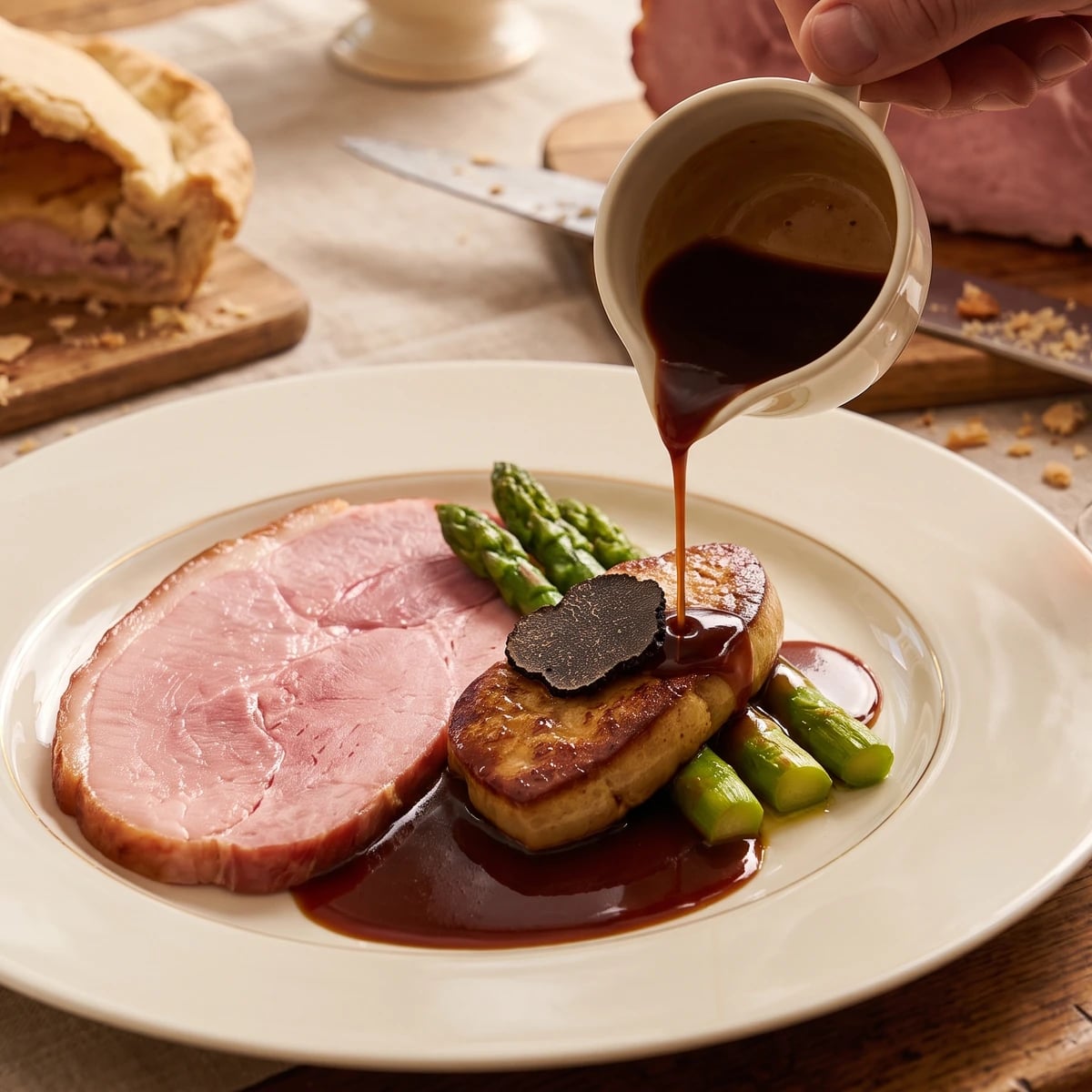
Prague ham emerges juicy from its flour paste shell, then meets foie gras, black truffle, buttered asparagus tips, and glossy Madeira sauce, a grand service reduced cleanly to four plates.

Main Dishes
French
Special Occasion
Dinner Party
45 min
Active Time
1 hr 30 min cook2 hr 15 min total
Yield4 servings

Jambon de Prague à la Metternich (Prague ham in a paste crust with foie gras, truffle, asparagus tips, and Madeira sauce) teaches the discipline of orchestration: the ham may wait, the foie gras may not. Before you touch a pan, know this one true thing. Every component must arrive hot, but only the sauce and asparagus can be held.

The classical entry assumed a full ham, a saucier beside a stock never off the fire, an ash hearth for the cuisson sous la cendre (cooking under the ashes), a salamander for last-minute heat, and a waiter assembling each plate. Your equivalent is a small fully cooked smoked ham sealed in flour paste and baked in an ordinary oven, a brown roux and stock reduction made in one saucepan, and one hot skillet used at the final moment. The brigade quantity has become four generous servings. One cook, one stove, one evening.

The separate sauce station and waiter service were brigade scaffolding, so they go. The sealed paste crust, one foie gras collop and truffle slice per diner, the timbale of asparagus heads, and the truffle-scented Madeira sauce are the dish, so they stay. Build the sauce early, but sauté the foie gras last. That brief turn in butter is the step that decides the plate.

Jambon de Prague begins in Prague, Bohemia, where lightly smoked cured ham became prized well beyond its own table before French classical kitchens enclosed it in paste and adopted it into grand service. The phrase sous la cendre records hearth practice: the paste protected the ham from direct ashes while gentle heat reached the meat, much as a sealed oven crust does now. The name à la Metternich points toward the courtly table of Central Europe, but the composition is French in grammar, joining foie gras, truffle, asparagus heads, and Madeira sauce around the Bohemian ham.

The technique, the tradition, and the story behind every dish.

Discover Culinary Explorer

Ingredients

fully cooked, unsliced Prague-style lightly smoked boneless ham

Quantity

1 ham, about 2½ pounds (1.1 kg)

unbleached all-purpose flour for the paste crust

Quantity

4¼ cups (1 L / 510 g), plus a little for rolling

fine sea salt for the paste crust

Quantity

1 tablespoon (15 ml / 18 g)

cool water

Quantity

1¼ cups (300 ml / 300 g), plus up to 2 tablespoons (30 ml / 30 g) if needed

unsalted butter for the Madeira sauce

Quantity

2 tablespoons (30 ml / 28 g), divided

all-purpose flour for the brown roux

Quantity

1 tablespoon (15 ml / 8 g)

unsalted brown veal or beef stock

Quantity

2 cups (475 ml / 475 g)

preferably gelatinous

dry Madeira

Quantity

½ cup (120 ml / 120 g)

natural black truffle essence

Quantity

1 teaspoon (5 ml / 5 g)

asparagus tips

Quantity

3 cups (710 ml / 340 g)

cut to 2-inch (5 cm) lengths

unsalted butter for the asparagus

Quantity

1 tablespoon (15 ml / 14 g)

cold foie gras collops

Quantity

4 collops, 1½ ounces (43 g) each, about 6 ounces (170 g) total

clarified butter for the foie gras

Quantity

1 tablespoon (15 ml / 14 g)

fresh or whole preserved black truffle

Quantity

1 small truffle, about ¾ ounce (20 g)

cut into 4 broad slices with the trimmings finely chopped

fine sea salt

Quantity

as needed

freshly ground white pepper

Quantity

as needed

Equipment Needed

  • Large rimmed baking sheet
  • Rolling pin
  • Parchment paper
  • Instant-read thermometer
  • 2-quart heavy saucepan
  • 10-inch heavy skillet
  • Small covered timbale or 1-quart serving bowl
  • Sharp carving knife

Instructions

  1. 1

    Make the paste

    Heat the oven to 400°F (200°C) with a rack in the middle. Mix the 4¼ cups flour with the tablespoon of salt, then work in the 1¼ cups water until a firm, smooth dough forms, adding only enough extra water to gather dry crumbs. Knead for 3 minutes, cover, and rest for 20 minutes. This paste is a heat shield, not pastry for eating, so it should be sturdy rather than tender.

    Reserve a walnut-sized piece of dough for repairs before rolling the rest. A dampened scrap closes a tear without weakening the whole shell.
  2. 2

    Seal the ham

    Dry the ham thoroughly. Roll the paste on a lightly floured surface to an even ¼-inch (6 mm) thickness, large enough to enclose the ham without stretching. Set the ham in the centre, draw the paste over it, and pinch every seam firmly closed. Place it seam-side down on a parchment-lined baking sheet. If the paste cracks while wrapping, dampen the edges and press on a thin patch from the reserved dough. Ça se rattrape. What matters is an unbroken shell that holds the ham's moisture inside.

  3. 3

    Bake sous la cendre

    Bake the sealed ham for 55 to 75 minutes, until the paste is hard and lightly bronzed and an instant-read thermometer pushed through the bottom seam reaches 140°F (60°C) at the centre. The conventional oven replaces the ash hearth honestly: the paste still buffers the heat and keeps the cured meat succulent. If the crust colours quickly before the centre is hot, lower the oven to 375°F (190°C). Rest the ham inside its shell for 15 minutes.

  4. 4

    Build the Madeira sauce

    While the ham bakes, reserve ¼ cup of the stock. Melt 1 tablespoon of the sauce butter in a saucepan, stir in the tablespoon of flour, and cook over medium heat until the roux turns hazelnut brown and smells toasted, 3 to 4 minutes. Whisk in the remaining stock by small additions, making each one smooth before adding the next. Simmer gently until reduced to about 1¼ cups and able to coat a spoon lightly, then add the Madeira and reduce to about 1 cup. If the sauce lumps, take it off the heat and whisk hard; if any remain, strain them out. Hold the sauce over the lowest heat.

  5. 5

    Blanch the asparagus

    Bring a saucepan of well-salted water to a boil. Add the asparagus tips and cook for 2 to 4 minutes, according to thickness, until tender at the surface with a faint bite at the centre. Transfer them immediately to ice water, then drain and dry them well. This pause fixes their green colour and stops the cooking, allowing them to wait without collapsing while the ham finishes.

  6. 6

    Finish the accompaniments

    Warm a small covered timbale or serving bowl and four dinner plates. Bring the Madeira sauce just back to a simmer, then remove it from the heat and whisk in the remaining tablespoon of sauce butter, the truffle essence, and the chopped truffle trimmings. If it tightens too far, loosen it with the reserved stock, a spoonful at a time. Do not boil it after the butter goes in. Warm the asparagus tips gently in their tablespoon of butter, season with salt and white pepper, and transfer them to the warm timbale.

  7. 7

    Open and carve

    Split the rested paste shell along its top and lift the ham free, presenting the opened crust at the table first if you wish. Brush away any crumbs and carve the ham across the grain into broad slices about ¼ inch (6 mm) thick. The shell has done its work and may now be discarded. Lay one generous slice on each warm plate and keep the remaining ham loosely covered.

  8. 8

    Sauté the foie gras

    Season the cold foie gras collops lightly with salt and white pepper. Heat the clarified butter in a heavy skillet over medium-high heat, then sauté the collops for 20 to 30 seconds per side, just until their faces bronze and their centres barely yield. If the first collop leaks heavily and begins to slump, lift it at once, raise the heat, and shorten the contact for the others. Set the softened collop intact-side up and serve it confidently. Place one collop beside each ham slice and cover it with a broad slice of truffle.

  9. 9

    Assemble and serve

    Put a generous serving spoonful of buttered asparagus heads beside the ham and foie gras on every plate. Spoon the glossy Madeira sauce beneath and around the components, leaving the truffle visible rather than drowning it. Serve at once, with the extra ham, asparagus timbale, and sauce brought separately to the table. À table!

Chef Tips

  • Ask for an unsliced, fully cooked ham with restrained smoke and no sweet glaze. Prague ham should taste of cured pork and wood smoke, not syrup; a moist boneless ham is the practical home size.
  • Foie gras must be refrigerator-cold and cut into even collops. A warm piece melts before it colours, while a cold one can take a swift turn in butter and hold its shape.
  • Use natural truffle essence in the sauce, not perfumed truffle oil. Fresh black truffle gives the cleanest result, but a good whole preserved truffle is an honest classical-pantry answer when fresh truffles are unavailable.
  • Fresh asparagus tips give the best bite. Out of season, use the tip halves of good frozen young asparagus, thaw them on a towel, and warm them directly in butter without blanching. The texture will be softer, and that is better than tired fresh asparagus.
  • Pour a mature dry white Burgundy or a dry Loire Chenin Blanc. The wine needs enough breadth for foie gras and smoked ham, but enough freshness to meet the asparagus and Madeira sauce.

Advance Preparation

  • The paste dough can be made up to 4 hours ahead, wrapped, and chilled. Let it soften for about 20 minutes before rolling so it bends without cracking.
  • The Madeira sauce can be prepared through its wine reduction up to 2 days ahead and chilled. Reheat it gently, then add the finishing butter, truffle essence, and truffle trimmings immediately before service.
  • Blanch and chill the asparagus tips up to 8 hours ahead. Dry them thoroughly before refrigerating, then warm them in butter only when the ham is resting.
  • Cut the foie gras collops earlier on the day of service and keep them tightly covered in the cold. Sautéing belongs to the final minutes and cannot be moved forward.
  • Leftover ham keeps for 4 days in the refrigerator and is excellent served cold. Foie gras collops do not improve on reheating, so cook only the number needed.

Frequently Asked Questions

Nutrition Information

1 serving (about 470g)

Calories
750 calories
Total Fat
46 g
Saturated Fat
18 g
Trans Fat
0 g
Unsaturated Fat
27 g
Cholesterol
370 mg
Sodium
3750 mg
Total Carbohydrates
10 g
Dietary Fiber
2 g
Sugars
3 g
Protein
71 g

Note: Chef personas and recipes are created with AI assistance. Cook with care: follow safe food-handling practices, check doneness with a thermometer when needed, and adapt for allergies and your kitchen.

Where cooking meets culture.

Culinary guides, cultural storytelling, and the editorial depth that makes cooking meaningful.

Discover Culinary Explorer

More from Relevés and Entrées - PORK

Browse the full collection