Culinary Explorer

A cooking platform built around craft, culture, and the stories behind what we eat.
Discover Culinary Explorer
Jambon à la Maillot

Jambon à la Maillot

Created by Chef Juliette

Based on No. 1418, Jambon à la Maillot, from Le Guide Culinaire (1907) by Auguste Escoffier

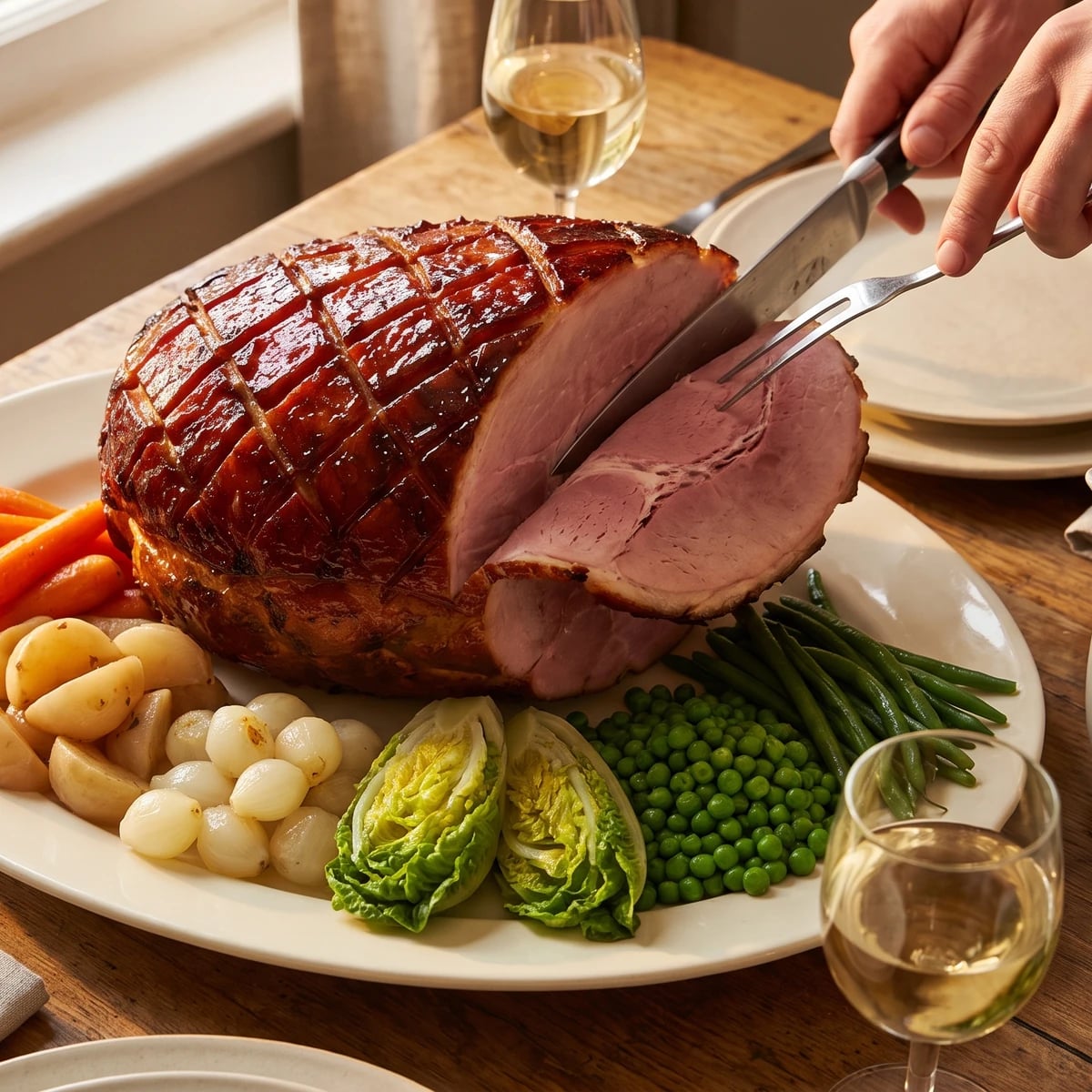
Poached, braised, and lacquered at the last moment, Jambon à la Maillot gathers turned roots, glazed onions, lettuce, peas, and beans around one gleaming ham, with its gravy properly served apart.

Main Dishes
French
Special Occasion
Dinner Party
Holiday
45 min
Active Time
2 hr 30 min cook3 hr 15 min total
Yield4 servings

Jambon à la Maillot (poached and braised ham with separately glazed garden vegetables) teaches timing through separation. Each part is cooked to its own point, then gathered around the ham in alternate heaps, so carrots remain carrots and peas remain peas. The one true thing to know before you touch a pan is this: the ham is glazed last. Shine applied early dissolves into the braise; shine applied beneath the broiler just before service becomes a lacquer.

The original assumed a full ham, a saucier holding thickened gravy, consommé never far from the fire, several pans moving at once, and a salamander waiting to set the glaze. At home, a small cured ham, good unsalted beef consommé (clear, concentrated broth), one saucepan reused in sequence, and the broiler do the honest work. The brigade's separate gravy base is scaffolding, so the degreased braising liquor is reduced and finished with beurre manié (soft butter kneaded with flour). It gives body without requiring another stockpot. One cook, one stove, one evening.

What doesn't go is the dish itself: the ham is poached, then braised; the carrots and turnips are tournés into elongated olives and cooked separately; the greens meet butter only when ready; the sauce is cleared of every trace of grease and served apart. Have every garnish hot and waiting before you glaze. Those final two minutes decide whether Jambon à la Maillot arrives merely brown or gleaming.

Jambon à la Maillot belongs to the Parisian grand-kitchen repertory of named garnishes, in which a title often preserved a place or patron while the composition gave working cooks the dependable definition. Its eponym is less securely recorded than its garnish: a glazed braised ham, individually handled vegetables in alternate heaps, and completely degreased gravy served separately. It moved naturally onto the bourgeois celebration table because that formal architecture could be scaled to a family ham without changing its grammar.

The technique, the tradition, and the story behind every dish.

Discover Culinary Explorer

Ingredients

uncooked, unsmoked cured ham or gammon joint

Quantity

1 small joint, about 3 lb 2 oz (1.4 kg)

rind on

cold water

Quantity

3 quarts (2.8 L / 2.8 kg), plus more as needed

unsalted beef consommé

Quantity

8 cups (1.9 L / 1.9 kg)

divided

medium carrots

Quantity

4, about 1 lb (450 g)

peeled

medium white turnips

Quantity

3, about 1 lb (450 g)

peeled

small pearl onions

Quantity

12, about 7 oz (200 g)

peeled

baby gem lettuces

Quantity

2, about 10 oz (280 g)

outer leaves removed

fresh or frozen peas

Quantity

1½ cups (355 ml / 225 g)

haricots verts

Quantity

3 cups loosely packed (710 ml / 225 g)

trimmed

unsalted butter

Quantity

10 tablespoons (150 ml / 142 g)

divided and softened where directed

all-purpose flour

Quantity

2 tablespoons (30 ml / 16 g)

fine sea salt and freshly ground white pepper

Quantity

to taste

Equipment Needed

  • 5 to 6-quart heavy Dutch oven with lid
  • 1½ to 2-quart saucepan, reused for the garnishes
  • Small sharp paring knife for tournage
  • Instant-read thermometer
  • Fat separator or fine-mesh strainer
  • Rimmed broiler-safe pan
  • Long oval serving platter and sauceboat

Instructions

  1. 1

    Poach the ham gently

    Rinse the ham under cold water. If its label calls for soaking, do that in advance; a mild-cured joint can go directly into the pot. Set it in a snug Dutch oven, cover it by 1 inch (2.5 cm) with the cold water, and bring the water up slowly. Skim away the grey foam, then hold the liquid between 180 and 190°F (82 and 88°C), where the surface barely trembles, for 70 to 85 minutes. Do not boil it. The centre should reach about 130°F (54°C), since the braise will finish the cooking. If the liquid tastes fiercely salty after 20 minutes, drain it, refill with fresh hot water, and return it to a tremble. Ça se rattrape.

  2. 2

    Turn and glaze roots

    While the ham poaches, make the tournage, turning the carrots and turnips into even olive shapes. Cut each root into pieces about 2 inches (5 cm) long, then curve the sides with a small paring knife to make 12 elongated olives of each vegetable. This is not idle decoration: equal shapes cook evenly and give the Maillot garnish its architecture. Save the trimmings for soup. Put the carrots in a small saucepan with 1¼ cups (300 ml / 300 g) consommé and 1 tablespoon (15 ml / 14 g) butter. Cover with a parchment round and simmer gently until tender, 12 to 16 minutes. Uncover and roll them through the reducing liquid until glossy. Transfer them to a covered dish. Wash the pan and repeat separately with the turnips, another 1¼ cups (300 ml / 300 g) consommé, and another tablespoon of butter; they may need only 10 to 14 minutes. If either vegetable becomes tender while plenty of liquid remains, lift it out, reduce the liquid alone, then return the pieces for the final glaze. Soft vegetables need not be boiled to pieces for the sake of a shiny finish.

  3. 3

    Braise the ham

    Heat the oven to 325°F (160°C). Lift the poached ham out and let it cool only until you can handle it. Peel away the rind while leaving a layer of fat about ¼ inch (6 mm) thick, then score that fat shallowly in diamonds without cutting into the meat. Set the ham fat-side up in the cleaned Dutch oven and add 4 cups (950 ml / 950 g) consommé. Lay a parchment round directly over it, cover, and braise for 40 to 50 minutes, turning once and finishing fat-side up. The liquid should barely move. If it boils, lower the oven. The ham is ready when its centre reaches 145°F (63°C). Lift it onto a rimmed pan, cover it loosely, and let it rest while you finish the garnish. Strain the braising liquor and keep every drop.

  4. 4

    Braise onions and lettuce

    Cook the onions while the ham braises. Melt 1½ tablespoons (22 ml / 21 g) butter in the small saucepan, add the onions and ¼ cup (60 ml / 60 g) water, then cover with parchment. Cook gently for 12 to 16 minutes, rolling them occasionally, until tender and coated in butter but still pale. If they begin to colour before their centres soften, add another spoonful of water and lower the heat. Halve each lettuce lengthwise through its core, giving four firm halves. Melt another 1½ tablespoons (22 ml / 21 g) butter in the pan, settle the lettuce cut-side down, and cook for 2 minutes. Add 1 cup (240 ml / 240 g) consommé, cover, and braise gently for 10 to 14 minutes, turning once. Lift the halves out, drain them well, and trim any loose outer edges into compact boats while leaving the cores intact. Hold the onions and lettuce separately.

  5. 5

    Clear and thicken gravy

    Let the strained braising liquor stand for 5 minutes, then pass it through a fat separator or spoon off every visible bead of fat. This matters. The finished gravy should gleam from reduction and butter, not wear an oily slick. Measure 1 cup (240 ml / 240 g) of the cleared liquor into the smallest saucepan and reduce it to about ¼ cup (60 ml / 60 g), thick enough to cling to a brush; this is the ham glaze. Measure 2 cups (475 ml / 475 g) of the remaining liquor into a saucepan, topping it up with reserved consommé if needed. Knead 2 tablespoons (30 ml / 28 g) softened butter with the flour to make a smooth beurre manié. Bring the liquor to a simmer and whisk in the beurre manié a small piece at a time. Simmer for 4 to 5 minutes, until the gravy naps the back of a spoon, then remove it from the heat and whisk in 1 tablespoon (15 ml / 14 g) cold butter. Taste before adding salt and season lightly with white pepper. If the liquor is already salty, do not reduce it further; dilute it with unsalted consommé, then thicken it. If the gravy forms lumps, strain it. Keep it hot for the sauceboat.

  6. 6

    Bind the green vegetables

    Bring a saucepan of lightly salted water to a boil. Cook the haricots verts until tender but still lively green, 3 to 5 minutes, then drain them thoroughly. Return them to the dry warm pan with 1 tablespoon (15 ml / 14 g) butter and toss until the butter clings to every bean. Transfer them to a covered dish. Cook the peas separately in fresh simmering water, 1 to 3 minutes depending on whether they are fresh or frozen. Drain well and return them to the pan with another tablespoon of butter. Toss gently until they gather into a glossy, coherent spoonful. This is cohérer au beurre, binding with butter, and it is why the peas form a neat heap instead of rolling across the platter. Keep the peas and beans separate.

  7. 7

    Apply the final glaze

    Heat the broiler and set a rack about 6 inches (15 cm) below it. Pat the ham's fat dry, brush it with a thin layer of the reduced braising-liquor glaze, and broil for 30 to 45 seconds. Brush again and repeat until two or three fine coats have tightened into a deep amber lacquer. Do not walk away. The broiler is the home salamander, and its work is fast. If one patch colours too quickly, shield that spot with a small piece of foil and continue glazing the rest. This happens only after the vegetables and gravy are ready; glazing early is the shortcut that ruins the shine.

  8. 8

    Arrange the Maillot garnish

    Warm a long oval platter and set the glazed ham in its centre. Around it, make alternate, distinct heaps of carrots, peas, turnips, haricots verts, onions, and trimmed lettuce halves, then repeat the sequence along the other side. Do not mix or scatter them. The separate colours and shapes are the presentation the recipe promises. Carry the ham to the table whole, with the hot, completely degreased gravy in a warmed sauceboat beside it. Carve generous slices and pass the vegetables around. À table!

Chef Tips

  • Ask for an uncooked, unsmoked cured ham, sold as gammon in some markets. A fully cooked holiday ham has already received its cooking and will dry if poached and braised again. If only smoked ham is available, it will work, but the smoke becomes a new and noticeable flavour.
  • Use unsalted consommé because cured ham brings enough salt of its own. If true beef consommé isn't available, reduce a clear unsalted beef stock by one quarter before measuring it. Cloudy, salty bouillon muddies both the glaze and the gravy.
  • The turned carrots and turnips are worth keeping. Their equal size gives you even cooking, and their long olive shape is part of the Maillot garnish, not brigade scaffolding. Your first pieces may look uncertain; by the sixth, your hand will understand.
  • Fresh peas are splendid in their season, but frozen peas picked at their peak are the classical pantry's honest answer. Add them directly to simmering water and cook them only until hot and tender.
  • Serve a dry Vouvray or a light Beaujolais with the ham. Both have enough freshness for the cured pork and enough fruit for the sweet roots, without trampling the peas and lettuce.

Advance Preparation

  • The carrots and turnips can be turned up to one day ahead and refrigerated in separate containers of cold water. Drain and dry them before cooking.
  • The ham can be poached and braised one day ahead. Cool it promptly, refrigerate it separately from the strained braising liquor, and remove the hardened fat from that liquor before reheating. Warm the ham covered with a splash of consommé, then glaze it only at service.
  • The roots, onions, and lettuce can be cooked several hours ahead and kept separately. Reheat each gently with a spoonful of consommé or a small piece of butter. Cook and bind the peas and haricots verts just before glazing the ham.

Frequently Asked Questions

Nutrition Information

1 serving (about 800g)

Calories
950 calories
Total Fat
54 g
Saturated Fat
27 g
Trans Fat
1 g
Unsaturated Fat
23 g
Cholesterol
225 mg
Sodium
3350 mg
Total Carbohydrates
41 g
Dietary Fiber
12 g
Sugars
18 g
Protein
75 g

Note: Chef personas and recipes are created with AI assistance. Cook with care: follow safe food-handling practices, check doneness with a thermometer when needed, and adapt for allergies and your kitchen.

Where cooking meets culture.

Culinary guides, cultural storytelling, and the editorial depth that makes cooking meaningful.

Discover Culinary Explorer

More from Relevés and Entrées - PORK

Browse the full collection