
Chef Juliette
John Dory (St. Pierre)
John Dory has the delicacy of sole and the firmness of turbot. A light flouring, a quick butter sauté, and nut-brown beurre noisette show exactly why looks never mattered.
A cooking platform built around craft, culture, and the stories behind what we eat.
Created by Chef Juliette
Based on No. 1417, Jambon à la Choucroûte, from Le Guide Culinaire (1907) by Auguste Escoffier
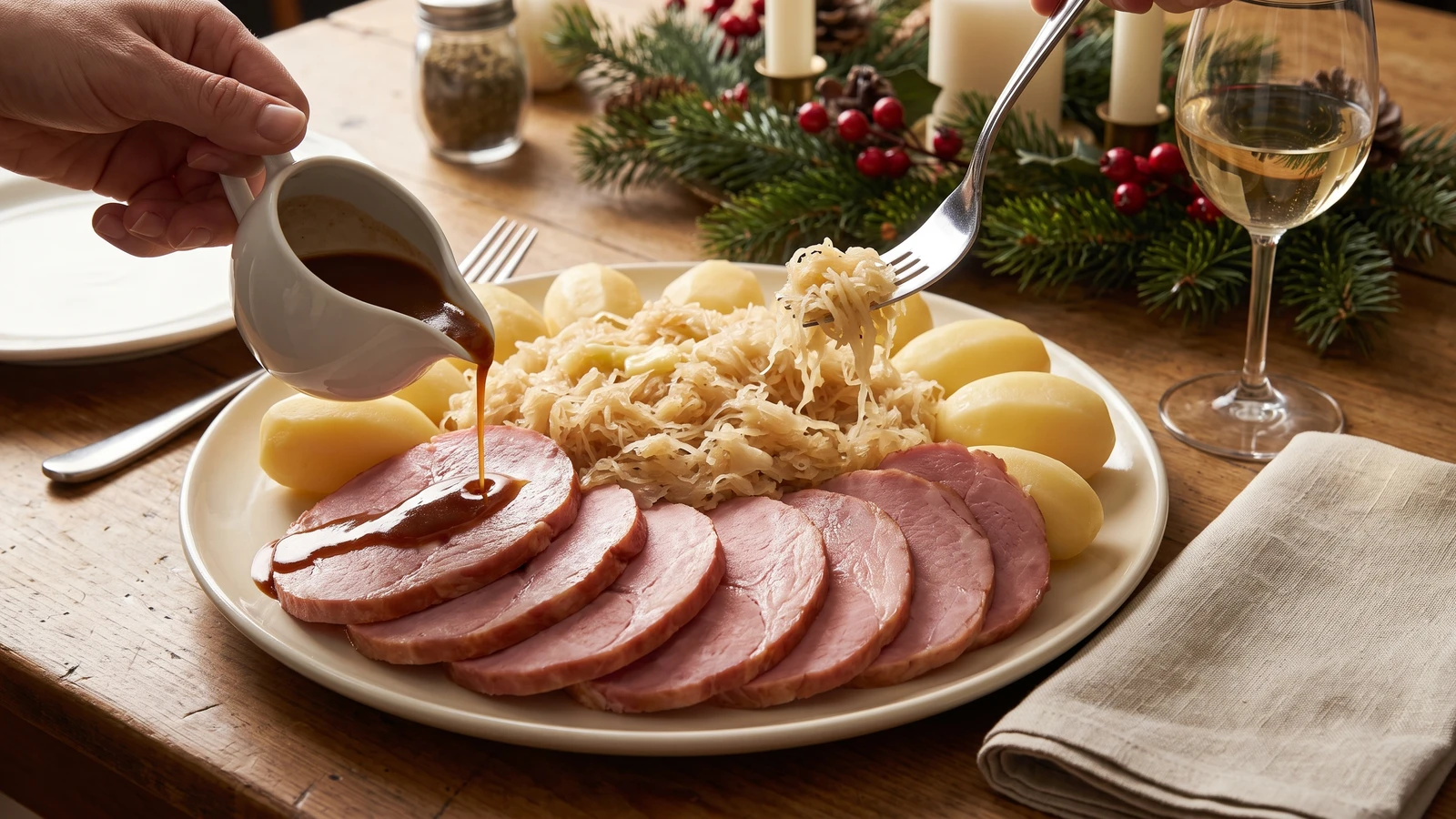
Jambon à la Choucroûte brings poached ham, wine-braised sauerkraut, and potatoes à l’anglaise together with a glossy Rhine-wine half-glaze, an Alsatian lesson in timing three plain preparations to arrive as one feast.
Jambon à la Choucroûte (poached ham with braised sauerkraut) teaches the discipline of gentle heat. Know one thing before touching a pan: the ham must poach below a simmer. Boiling tightens cured pork and pushes out its moisture, while quiet water cooks it through and leaves every slice rosy, supple, and generous.
The entry assumed a whole ham, brigade portions, a saucier on staff, and demi-glace waiting beside a stockpot that never left the fire. For four, a 3-pound cured ham joint replaces the banquet-sized leg, while gelatin-rich unsalted stock reduced with dry Rhine wine becomes an honest demi-glace au vin du Rhin (half-glaze with Rhine wine). The choucroute, sauce, and pommes à l’anglaise (potatoes cooked plainly in water) overlap across ordinary saucepans. One cook, one stove, one evening.
The grand whole-ham presentation is scaffolding and can go. The book itself permits carving first, so the slices will circle a mound of choucroute, with the potatoes at the edge and the sauce sent separately. What cannot go is the quiet poach, the patient cabbage braise, or the Rhine-wine reduction. Watch the poaching water more closely than the clock, and the dish will take care of you.
Jambon à la Choucroûte belongs to Alsace, where pork from the curing room and cabbage preserved by lactic fermentation meet the dry white wines of the Rhine. The household dish and the winstub platter share the same logic: choucroute carries the richness, plain potatoes steady it, and a whole poached ham makes it fit for a holiday table. Classical service added a demi-glace sharpened with Rhine wine, but the Alsatian heart of this particular plate remains preserved cabbage and ham, not the better-known procession of sausages.
Quantity
1 joint, about 3 lb (1.35 kg)
skin-on if available
Quantity
12 cups (2.8 L / 2.8 kg), or enough to cover by 2 inches
Quantity
6 cups (1.4 L / 900 g)
drained
Quantity
4 tablespoons (60 ml / 56 g)
divided
Quantity
1, about 1 cup (240 ml / 180 g)
thinly sliced
Quantity
2 cups (475 ml / 470 g)
divided
Quantity
1 cup (240 ml / 240 g)
Quantity
6
lightly crushed
Quantity
1
Quantity
1/2 teaspoon (2.5 ml / 1 g)
lightly crushed
Quantity
8, about 1 1/2 lb (680 g)
peeled
Quantity
10 cups (2.4 L / 2.4 kg)
Quantity
1 tablespoon (15 ml / 18 g), plus as needed
for the potato water
Quantity
1, about 2 tablespoons (30 ml / 30 g)
thinly sliced
Quantity
3 cups (710 ml / 710 g)
Quantity
1 teaspoon (5 ml / 3 g)
| Ingredient | Quantity |
|---|---|
| uncooked cured boneless ham or gammon jointskin-on if available | 1 joint, about 3 lb (1.35 kg) |
| cold water for poaching | 12 cups (2.8 L / 2.8 kg), or enough to cover by 2 inches |
| refrigerated or jarred sauerkrautdrained | 6 cups (1.4 L / 900 g) |
| unsalted butterdivided | 4 tablespoons (60 ml / 56 g) |
| medium onionthinly sliced | 1, about 1 cup (240 ml / 180 g) |
| dry Rhine wine, preferably dry Riesling, Pinot Blanc, or Sylvanerdivided | 2 cups (475 ml / 470 g) |
| reserved ham poaching liquor, or water if the liquor is too salty | 1 cup (240 ml / 240 g) |
| juniper berrieslightly crushed | 6 |
| bay leaf | 1 |
| black peppercornslightly crushed | 1/2 teaspoon (2.5 ml / 1 g) |
| small waxy potatoespeeled | 8, about 1 1/2 lb (680 g) |
| cold water for the potatoes | 10 cups (2.4 L / 2.4 kg) |
| fine saltfor the potato water | 1 tablespoon (15 ml / 18 g), plus as needed |
| small shallotthinly sliced | 1, about 2 tablespoons (30 ml / 30 g) |
| gelatin-rich unsalted veal or beef stock | 3 cups (710 ml / 710 g) |
| unflavored powdered gelatin (optional) | 1 teaspoon (5 ml / 3 g) |
Check the ham’s label before beginning. If the producer calls for soaking, do that in cold water before the cooking time begins. Taste the drained sauerkraut as well. If it is pleasantly sour, leave it alone; if the salt or acidity bites harshly, rinse one-third of it briefly under cold water, then mix it back with the unrinsed portion and squeeze everything dry. This corrects excess without washing away the character the plate depends upon.
Set the ham in a stockpot and cover it with the cold water by about 2 inches. Bring the water up slowly over medium heat, skimming any grey foam, then lower the heat when the surface reaches a lazy quiver, about 180°F to 185°F (82°C to 85°C). Hold it there without boiling until the centre reaches 155°F (68°C), about 1 hour 15 minutes to 1 hour 30 minutes. If the water breaks into a boil, pull the pot off the heat and add a cup of cold water. Ça se rattrape. Return it gently and keep going; a brief boil is recoverable, a rolling one dries the meat.
While the ham poaches, put 1 cup of the Rhine wine and the shallot into a small saucepan. Simmer until only about 1/3 cup remains and the raw alcoholic sharpness has softened. If using the optional gelatin, reserve 2 tablespoons of the cold stock and bloom the gelatin in it. Add the remaining stock to the wine reduction and simmer steadily until the liquid measures about 1 1/4 cups and tastes deep rather than merely salty, 30 to 40 minutes. Strain and set aside. This reduction replaces the ready demi-glace and dedicated saucier the original kitchen took for granted.
Once the ham has poached for about 30 minutes, melt 2 tablespoons of the butter in a heavy saucepan or small cocotte. Add the onion and cook gently until soft and translucent without browning, about 8 minutes. Fold in the sauerkraut, juniper, bay leaf, and peppercorns, then add the remaining 1 cup Rhine wine and 1 cup of the ham poaching liquor. Taste the liquor first; if it is fiercely salty, use water instead. Cover and braise at the barest simmer for 45 to 55 minutes, turning the cabbage several times, until tender, fragrant, and moist without being soupy. If it catches, add another spoonful of poaching liquor. If it remains wet, uncover it for the final 10 minutes. Ça se rattrape in either direction.
When the ham has about 30 minutes left, place the peeled potatoes in a saucepan with the cold potato water and measured salt. Bring them gradually to a gentle simmer and cook until a small knife enters the centre without resistance, 20 to 25 minutes depending on size. Drain at once, then return them to the empty pan over low heat for 30 seconds, rolling them carefully so their surfaces dry. This is à l’anglaise: water, salt, and correct timing. If a potato begins to split, drain the lot immediately and let residual heat finish them; place the cracked one beneath the choucroute rather than cooking every potato to collapse.
Lift the cooked ham from its liquor and rest it for 10 minutes. Remove any netting. While the exterior is still warm, work a small knife beneath the skin and peel it away, then trim the fat to an even layer about 1/4 inch (6 mm) thick and neaten any ragged edges. Slice the ham across the grain into pieces about 1/4 inch (6 mm) thick. Keep the slices covered near the stove while the sauce is finished; do not return them to boiling liquid.
Return the strained wine reduction to gentle heat. If using the bloomed gelatin, whisk it in and simmer for 30 seconds. The sauce should nap the back of a spoon in a thin, glossy coat. Reduce it further if thin, or loosen it with a spoonful of unsalted stock if tight. Take the pan off the heat and whisk in the remaining 2 tablespoons cold butter a little at a time. If the butter floats in greasy beads, whisk in 1 teaspoon cold water away from the heat. Ça se rattrape. Mound the choucroute in the middle of a warmed round platter, overlap the ham slices in a circle around it, and border them with the potatoes. Send the demi-glace au vin du Rhin separately in a warm sauceboat, exactly as the entry directs. À table!
1 serving (about 770g)
Culinary guides, cultural storytelling, and the editorial depth that makes cooking meaningful.
Discover Culinary ExplorerChef Juliette
John Dory has the delicacy of sole and the firmness of turbot. A light flouring, a quick butter sauté, and nut-brown beurre noisette show exactly why looks never mattered.

Chef Juliette
Fresh haddock proves its delicacy in the meunière pan: a fine flour crust, moist pearly flakes, and beurre noisette sharpened with lemon and parsley, ready from one skillet in half an hour.

Chef Juliette
Éperlans à l’Anglaise turns small fish into a lesson in disciplined coating: boned smelts under a close, crisp crumb, pan-fried in clarified butter and finished with bright, half-melted maître d’hôtel butter.

Chef Juliette
Tiny smelts, shallot, mushrooms, white wine, gratin sauce, and fine bread raspings meet a fierce oven, where the fish must turn tender in the same breath the buttered crust bronzes.