
Chef Juliette
John Dory (St. Pierre)
John Dory has the delicacy of sole and the firmness of turbot. A light flouring, a quick butter sauté, and nut-brown beurre noisette show exactly why looks never mattered.
A cooking platform built around craft, culture, and the stories behind what we eat.
Created by Chef Juliette
Based on No. 1408, Boudins Noirs à l’Anglaise, from Le Guide Culinaire (1907) by Auguste Escoffier
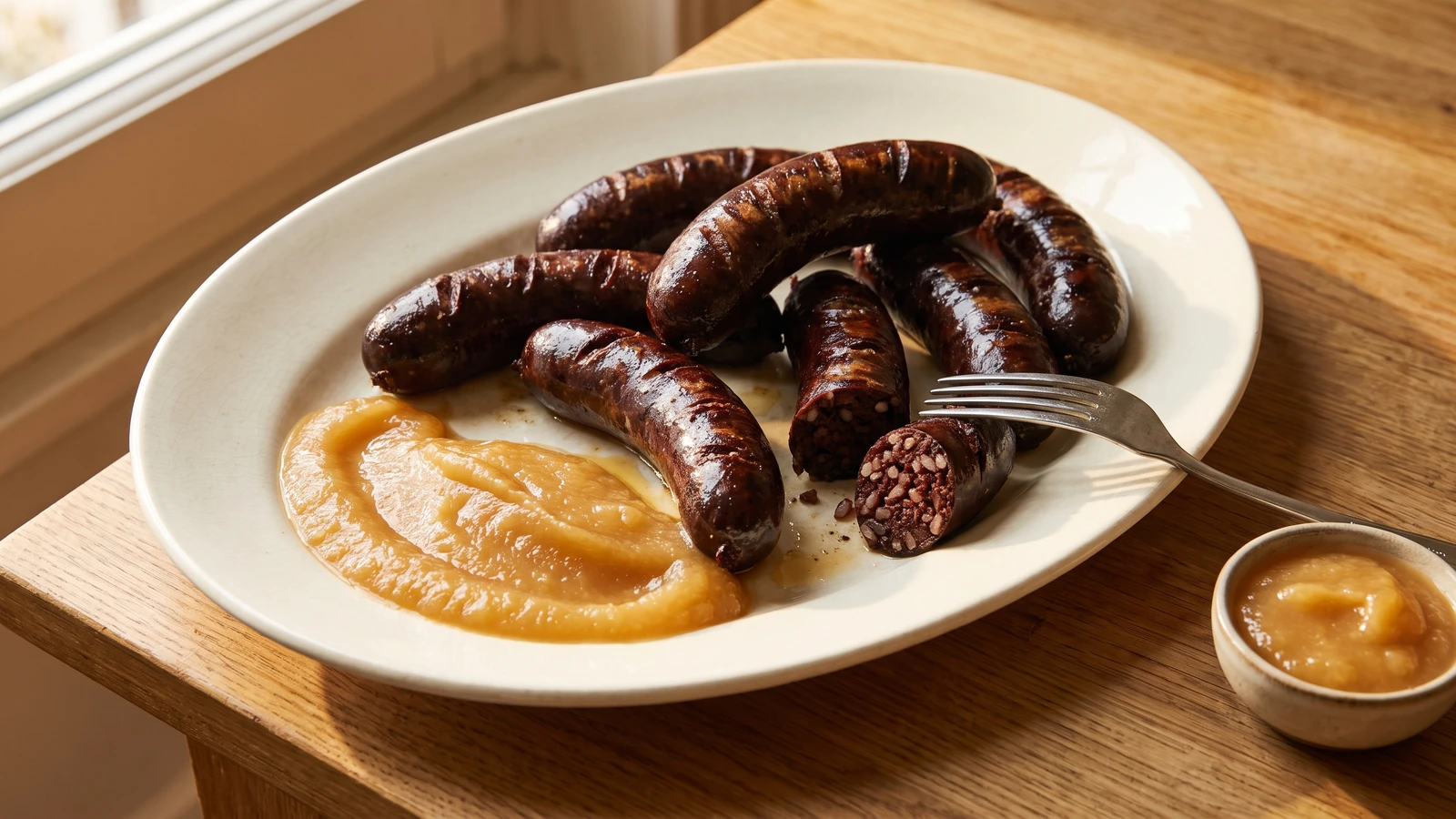
Firm consommé-cooked rice gives these boudins noirs their English-fashion character: gently poached, cooled, ciselés, and grilled until bronzed, with tart apple purée beside them to answer every rich bite.
Boudins Noirs à l’Anglaise (rice-bound blood sausages, English fashion) teach the discipline of gentle heat. The one true thing to know before touching the grill pan is this: the poaching water must never boil. A quiet poach sets the blood and fat into a tender, close farce; boiling bursts the casings and turns that farce coarse.
The original entry assumed that a black-boudin preparation already waited in the kitchen, along with consommé from a stockpot never off the fire, several hands for filling casings, and a moderate charcoal grill. Here the base is made in one chilled bowl, a good prepared consommé cooks the rice, kitchen string replaces the practiced link-maker, and a cast-iron grill pan supplies the moderate fire. The brigade quantity has been reduced to eight small boudins for four people. Quantity and equipment changed because they were scaffolding; firm rice, gentle poaching, complete cooling, ciselés, grilling, and apple purée remain because they are the dish.
When it lands correctly, the casing is mahogany-dark and lightly crisp, the filling is mineral and peppery with distinct grains of rice, and the apple purée is buttery, tart, and generous. Fruit against blood sausage is the point. Guard the poaching temperature, and the rest belongs comfortably to one cook, one stove, one evening.
Boudin noir belongs to charcuterie practice across France, where fresh blood, pork fat, and onions were turned immediately into food, with Lyonnais, Norman, and other local versions keeping their own distinct seasonings and accompaniments. Boudins noirs à l’Anglaise belong more specifically to the codified Parisian grand-kitchen repertoire, where firm rice cooked in consommé binds the farce before poaching and grilling. The title is French classical shorthand, not a claim that English black pudding normally contains rice, and the apple purée is structural contrast rather than decoration.
Quantity
Scant 1/2 cup (110 ml / 85 g)
Quantity
3/4 cup (180 ml / 185 g)
Quantity
1 1/2 cups (360 ml / 225 g)
finely chopped
Quantity
3 tablespoons (45 ml / 42 g)
divided
Quantity
1 1/4 cups (300 ml / 315 g)
well chilled and strained
Quantity
1 cup (240 ml / 180 g)
cut into 5 mm dice and chilled
Quantity
1 1/2 teaspoons (7.5 ml / 9 g)
use less if the blood is salted
Quantity
1 teaspoon (5 ml / 2 g)
Quantity
1/2 teaspoon (2.5 ml / 1 g)
Quantity
6 feet (1.8 m)
soaked and rinsed
Quantity
4 medium (about 1 3/4 pounds / 800 g)
peeled, cored, and sliced
Quantity
1/4 cup (60 ml / 60 g)
Quantity
3 tablespoons (45 ml / 42 g)
Quantity
1/4 teaspoon (1.25 ml / 1.5 g)
| Ingredient | Quantity |
|---|---|
| long-grain white rice | Scant 1/2 cup (110 ml / 85 g) |
| clear beef consommé | 3/4 cup (180 ml / 185 g) |
| yellow onionfinely chopped | 1 1/2 cups (360 ml / 225 g) |
| rendered pork fatdivided | 3 tablespoons (45 ml / 42 g) |
| food-grade liquid pig's bloodwell chilled and strained | 1 1/4 cups (300 ml / 315 g) |
| fresh pork back fatcut into 5 mm dice and chilled | 1 cup (240 ml / 180 g) |
| fine saltuse less if the blood is salted | 1 1/2 teaspoons (7.5 ml / 9 g) |
| freshly ground black pepper | 1 teaspoon (5 ml / 2 g) |
| quatre-épices, a pepper, clove, nutmeg, and ginger blend | 1/2 teaspoon (2.5 ml / 1 g) |
| natural hog casing, 30 to 32 mm widesoaked and rinsed | 6 feet (1.8 m) |
| tart-sweet applespeeled, cored, and sliced | 4 medium (about 1 3/4 pounds / 800 g) |
| water | 1/4 cup (60 ml / 60 g) |
| unsalted butter | 3 tablespoons (45 ml / 42 g) |
| fine salt for the apple purée | 1/4 teaspoon (1.25 ml / 1.5 g) |
Put the rice and consommé in a small saucepan and bring them to a gentle simmer. Cover, lower the heat, and cook for 10 to 12 minutes, until the grains are tender outside but retain a small firm core. Drain any consommé that remains, then spread the rice over a cold tray and chill it completely. The grains must stay distinct inside the boudin. If they have gone softer than intended, ça se rattrape: spread them very thin, chill them uncovered until dry, and use three-quarters of the cooked amount so excess starch does not smother the farce.
Warm 2 tablespoons of the rendered pork fat in a wide pan over low heat. Add the onion and cook for 15 to 20 minutes, stirring often, until completely tender and translucent without browning. Colour would make the onion sweet and assertive; here it must melt quietly into the blood and fat. Spread the onion on a tray and chill it completely.
Set a large bowl over ice. Combine the cold onion, diced back fat, rice, black pepper, quatre-épices, and half the salt. Pour in the strained blood gradually, folding with a sturdy spoon until everything is evenly suspended without crushing the rice. Keep the mixture cold and loose. Fry a tablespoonful in a small pan until fully cooked, then taste it before adding the remaining salt; blood sold for cooking is sometimes already salted, and raw farce must never be tasted.
Slide the rinsed casing onto a sausage funnel or a wide piping nozzle and tie the far end securely. Fill it only three-quarters full, guiding the fluid farce gently so the fat and rice remain evenly distributed. Tie the casing with kitchen string into eight links about 5 inches (13 cm) long, leaving a little softness in each for expansion. Prick only visible air pockets with a fine sterilized needle. A tightly packed boudin is already planning its escape from the casing.
Heat a wide pot of water to 176 to 180°F (80 to 82°C). Lower in the boudins and hold the water between 172 and 180°F (78 and 82°C) for 25 to 30 minutes, adjusting the burner before so much as a simmering bubble appears. The links are cooked when the centre reaches 160°F (71°C); insert the thermometer lengthwise through a tied end to limit leaking. If a casing splits, lower the heat at once, lift the filling into a buttered ramekin, cover it, and finish it in the hot-water bath to the same internal temperature. You will have sliceable boudin instead of a link. Ça se rattrape.
Transfer the cooked boudins to ice water for 10 minutes, then dry them carefully and set them uncovered on a rack in the refrigerator for at least 1 hour. Cooling is part of the method, not a pause for convenience: it sets the blood and fat so the links can be cut and grilled without collapsing.
Put the apples, water, and salt in a covered saucepan over low heat. Cook for 15 to 20 minutes, stirring once or twice, until the fruit collapses under the spoon. Pass it through a food mill or mash it thoroughly, then return the purée to low heat and stir until it holds a soft mound. Beat in the butter a piece at a time. If the purée is loose, cook it uncovered for another minute; if it is too stiff, loosen it with a spoonful of water. Keep it warm.
Ciseler the chilled boudins, meaning make close, shallow diagonal cuts through the casing only, about 1/2 inch (1 cm) apart. Heat a cast-iron grill pan over moderate heat and grease it lightly with the remaining rendered pork fat. Grill the links for 8 to 10 minutes, turning carefully with a broad spatula, until their skins are mahogany-dark, lightly crisp, and the centres reach 165°F (74°C). If a cut opens, turn that side upward and finish the link over gentler heat rather than squeezing it with tongs.
Spoon a generous bank of warm apple purée onto each plate and set two grilled boudins beside it. Serve at once, while the ciselés are crisp at their edges and the filling is soft within. Each forkful wants sausage and fruit together. À table!
1 serving (about 420g)
Culinary guides, cultural storytelling, and the editorial depth that makes cooking meaningful.
Discover Culinary ExplorerChef Juliette
John Dory has the delicacy of sole and the firmness of turbot. A light flouring, a quick butter sauté, and nut-brown beurre noisette show exactly why looks never mattered.

Chef Juliette
Fresh haddock proves its delicacy in the meunière pan: a fine flour crust, moist pearly flakes, and beurre noisette sharpened with lemon and parsley, ready from one skillet in half an hour.

Chef Juliette
Éperlans à l’Anglaise turns small fish into a lesson in disciplined coating: boned smelts under a close, crisp crumb, pan-fried in clarified butter and finished with bright, half-melted maître d’hôtel butter.

Chef Juliette
Tiny smelts, shallot, mushrooms, white wine, gratin sauce, and fine bread raspings meet a fierce oven, where the fish must turn tender in the same breath the buttered crust bronzes.