
Chef Juliette
John Dory (St. Pierre)
John Dory has the delicacy of sole and the firmness of turbot. A light flouring, a quick butter sauté, and nut-brown beurre noisette show exactly why looks never mattered.
A cooking platform built around craft, culture, and the stories behind what we eat.
Created by Chef Juliette
Based on No. 1406, Boudins Blancs de Volaille, from Le Guide Culinaire (1907) by Auguste Escoffier
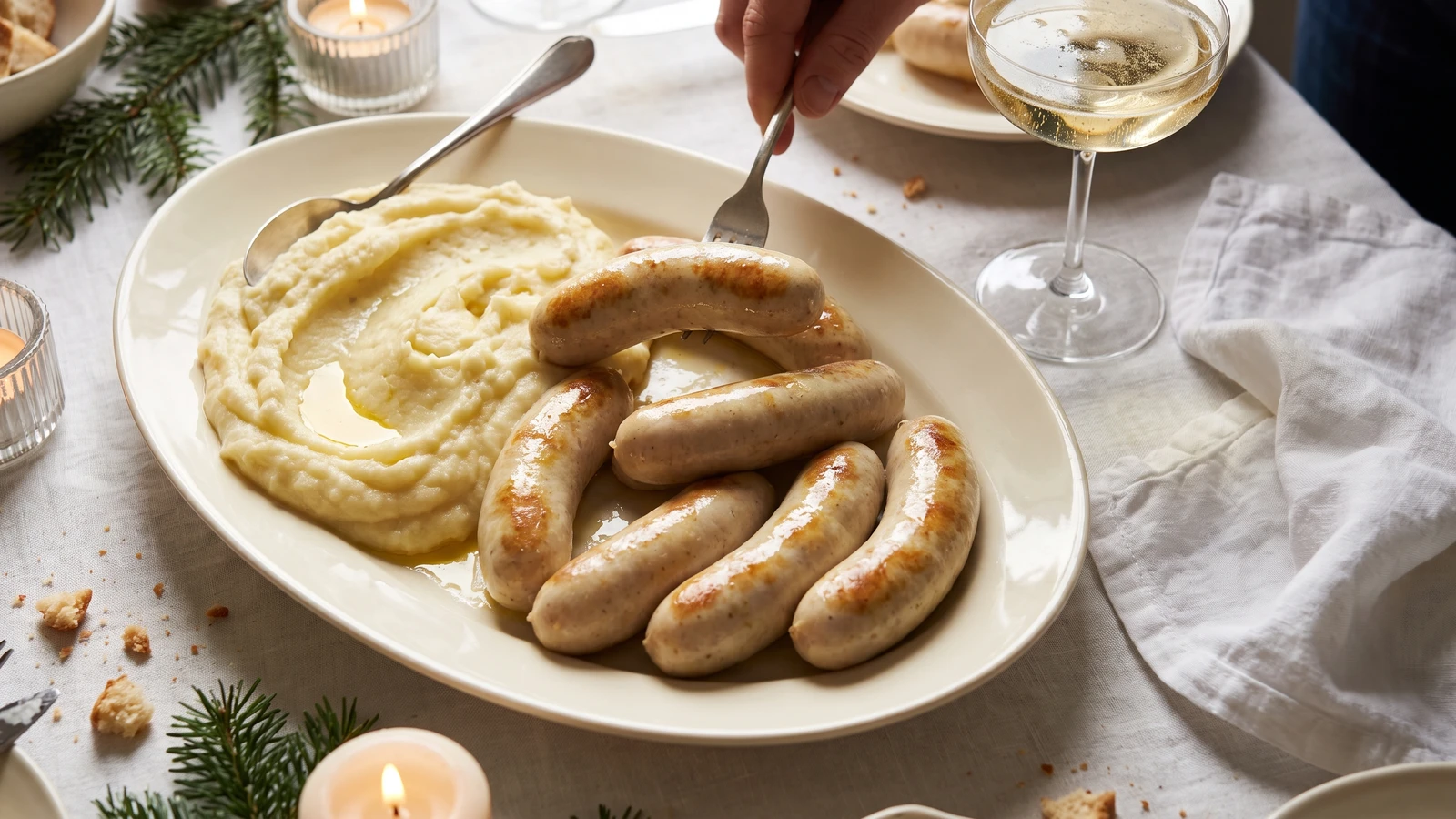
Boudins blancs de volaille turn a fine, cold chicken forcemeat into tender ivory sausages, poached at a bare tremble, bronzed gently, and brought to the holiday table with cream-rich potato purée.
Boudins Blancs de Volaille (white chicken sausages) teach the central law of a fine forcemeat: cold is structure. Chicken, fresh fat bacon, eggs, and milk must become one smooth emulsion before they enter the casing. Let the bowl grow warm and the fat separates, leaving a grainy sausage where there should be a tender, springing one.
The original recipe assumed a cook working mortar and pestle, a fine sieve, prepared gut, and a salamander waiting to colour the links. At home, a food processor does the pounding, a small sausage stuffer replaces the practiced hand, and the broiler supplies the final gentle bronze. The repeated mortar work was brigade scaffolding and can go. The four-to-three ratio of chicken to fresh fat bacon, the sieve, the gradual addition of boiled cold milk, and the bain-marie (hot-water bath) are the dish itself and must stay. This is exactly half the original batch, with its proportions intact: eight plump links for four people. One cook, one stove, one evening.
Properly made, the boudins are ivory beneath their butter-gold patches, delicate enough to yield under the fork but firm enough to hold their shape beside the purée. The one step that decides them is the poach. Keep the bath at a bare tremble, because a hard boil splits the casing and breaks the emulsion you worked so carefully to build.
Boudin blanc belongs to the charcuterie traditions of northern and eastern France, with Rethel in the Ardennes particularly renowned for its finely worked white sausages of pale meat, milk, and eggs. The volaille branch carried the charcutier's method into the classical poultry repertoire, replacing the principal meat with chicken while retaining fresh fat bacon for structure and succulence. Unlike boudin noir, boudin blanc contains no blood; blanc describes both its composition and its pale appearance, not a lesser relation to the darker sausage.
Quantity
About 1⅔ cups (395 ml / 227 g)
cut into 1-inch pieces and very cold
Quantity
About 1 cup (240 ml / 170 g)
rind removed, cubed, and very cold
Quantity
⅓ cup (80 ml / 43 g)
finely chopped
Quantity
1 tablespoon (15 ml / 14 g)
Quantity
¼ teaspoon (1.25 ml / 0.25 g)
finely chopped
Quantity
1
Quantity
1¼ teaspoons (6 ml / 7 g)
Quantity
⅛ teaspoon (0.6 ml / 0.3 g)
Quantity
1 small pinch (0.3 ml / 0.1 g)
Quantity
2 large (about 6 tablespoons / 90 ml / 100 g without shells)
very cold
Quantity
1 cup plus 3 tablespoons (285 ml / 293 g)
brought to a boil and chilled thoroughly
Quantity
5 feet (1.5 m)
soaked and rinsed
Quantity
1 tablespoon (15 ml / 14 g)
melted
Quantity
About 4½ cups (1.1 L / 680 g)
peeled and cut into 1-inch pieces
Quantity
2 teaspoons (10 ml / 12 g), plus more if needed
Quantity
½ cup (120 ml / 120 g)
Quantity
4 tablespoons (60 ml / 57 g)
cubed
| Ingredient | Quantity |
|---|---|
| raw chicken breast filletscut into 1-inch pieces and very cold | About 1⅔ cups (395 ml / 227 g) |
| fresh fat bacon, preferably unsmoked fatty pork belly or pork back fatrind removed, cubed, and very cold | About 1 cup (240 ml / 170 g) |
| yellow onionfinely chopped | ⅓ cup (80 ml / 43 g) |
| unsalted butter for the onion | 1 tablespoon (15 ml / 14 g) |
| fresh thyme leavesfinely chopped | ¼ teaspoon (1.25 ml / 0.25 g) |
| small bay leaf | 1 |
| fine salt for the forcemeat | 1¼ teaspoons (6 ml / 7 g) |
| ground white pepper | ⅛ teaspoon (0.6 ml / 0.3 g) |
| freshly grated nutmeg | 1 small pinch (0.3 ml / 0.1 g) |
| large eggsvery cold | 2 large (about 6 tablespoons / 90 ml / 100 g without shells) |
| whole milkbrought to a boil and chilled thoroughly | 1 cup plus 3 tablespoons (285 ml / 293 g) |
| natural hog casing, 32 to 35 mm widesoaked and rinsed | 5 feet (1.5 m) |
| unsalted butter for grillingmelted | 1 tablespoon (15 ml / 14 g) |
| floury potatoespeeled and cut into 1-inch pieces | About 4½ cups (1.1 L / 680 g) |
| fine salt for the potato water | 2 teaspoons (10 ml / 12 g), plus more if needed |
| heavy cream | ½ cup (120 ml / 120 g) |
| unsalted butter for the puréecubed | 4 tablespoons (60 ml / 57 g) |
Bring the milk just to a boil, then pour it into a shallow metal bowl and set that bowl over ice until the milk is thoroughly cold, no warmer than 40°F (4°C). Chill the processor bowl and blade for fifteen minutes, and keep the chicken, fresh fat bacon, and eggs cold. Soak and rinse the casing according to the butcher's directions, running cold water through its length to find any holes.
Melt 1 tablespoon of butter over low heat. Add the onion, thyme, and bay leaf, then cook gently for 8 to 10 minutes, stirring often, until the onion is soft and translucent without a trace of browning. Discard the bay leaf, spread the onion thinly on a cold plate, and chill it completely. Warm onion would loosen the emulsion before it begins.
Process the chicken alone until very finely minced, then scrape it into a chilled bowl. Process the fresh fat bacon separately to the same fineness. Return both to the processor with the cold onion, salt, white pepper, and nutmeg, then process until thoroughly combined. Add the eggs one at a time, processing until each disappears before adding the next. Stop and scrape the bowl as needed. If the mixture becomes greasy or rises above 50°F (10°C), stop at once, spread it on a chilled tray, and refrigerate it for ten minutes before continuing.
Press the forcemeat through a fine drum sieve with a flexible scraper, discarding any sinew left behind. Return the sieved mixture to the chilled processor. With the motor running, add the boiled, very cold milk in four small additions, letting each one bind completely before the next. Stop as soon as the forcemeat is smooth, glossy, and tacky enough to cling to a spoon. If milk or fat begins to bead around the bowl, stop. Chill the mixture over ice, process one-quarter of it until tacky again, then feed the remainder back a spoonful at a time. Ça se rattrape. If it still refuses to bind, poach it in buttered ramekins in the bain-marie; you lose the sausage shape, not supper.
Fit the casing onto a small sausage stuffer and fill it gently, supporting the sausage with one hand so the casing remains plump but not taut. Twist it into eight links about 5 inches (13 cm) long and tie the ends. Prick only visible air bubbles with a fine sterilized needle. If the casing tears, cut it cleanly at the tear, tie both new ends, and continue. Chill the links for fifteen minutes while you prepare the potato purée.
Cover the potatoes with cold water, add the salt, and bring them gradually to a simmer. Cook for 18 to 22 minutes, until a knife passes through without resistance. Drain well, return them to the dry pan for one minute over low heat, then pass them through a ricer. Warm the cream with the 4 tablespoons of butter just until the butter melts. Fold this into the potatoes in two additions, working only until smooth, then taste for salt. Keep the purée covered over barely warm water for no longer than thirty minutes. Vigorous beating makes potatoes gluey; fold, don't punish them.
Heat a wide pan of water to 170°F (77°C), then lower in the boudins in a single layer. Hold this bain-marie between 165°F and 175°F (74°C and 79°C), with the surface barely trembling and never bubbling hard. Poach for 18 to 25 minutes, turning once, until the centre of a link reaches 160°F (71°C). A boil can split the casing and force out the emulsion. If one link opens, lower the heat immediately and remove that link once cooked; cool it briefly, slice it thickly, and brown the slices in butter while the intact boudins finish.
Heat the broiler and position a rack 6 to 8 inches (15 to 20 cm) below it. Lift the boudins from the bath, dry them carefully, and brush them with the melted butter. Grill gently for 5 to 7 minutes, turning every minute or two, until the skins carry pale butter-gold patches and the centres reach 165°F (74°C). Do not chase a dark crust; these casings are delicate. Spoon the cream-rich purée onto a warm platter, arrange two boudins per person, and carry them straight to the table. À table!
1 serving (about 400g)
Culinary guides, cultural storytelling, and the editorial depth that makes cooking meaningful.
Discover Culinary ExplorerChef Juliette
John Dory has the delicacy of sole and the firmness of turbot. A light flouring, a quick butter sauté, and nut-brown beurre noisette show exactly why looks never mattered.

Chef Juliette
Fresh haddock proves its delicacy in the meunière pan: a fine flour crust, moist pearly flakes, and beurre noisette sharpened with lemon and parsley, ready from one skillet in half an hour.

Chef Juliette
Éperlans à l’Anglaise turns small fish into a lesson in disciplined coating: boned smelts under a close, crisp crumb, pan-fried in clarified butter and finished with bright, half-melted maître d’hôtel butter.

Chef Juliette
Tiny smelts, shallot, mushrooms, white wine, gratin sauce, and fine bread raspings meet a fierce oven, where the fish must turn tender in the same breath the buttered crust bronzes.