
Chef Juliette
Fresh Leg of Pork
Jambon frais rôti teaches the quiet discipline of the roast: fierce heat for bronze, gentle heat for an even center, then a proper rest before carving into juicy slices.
A cooking platform built around craft, culture, and the stories behind what we eat.
Created by Chef Juliette
Based on No. 1401, Oreilles à la Rouennaise, from Le Guide Culinaire (1907) by Auguste Escoffier
Pig's ears, patiently poached, then minced with sausage meat, wrapped in caul, and gently grilled until bronze. Madeira sauce gives Rouen's thrifty crépinettes their dark, glossy finish.
Oreilles à la Rouennaise (Rouen-style pig's-ear patties wrapped in caul fat) teaches that thrift becomes generosity through texture, not disguise. The ears must be tender at their fleshy base while the thinner cartilage retains a little spring. Cook them to collapse and the crépinettes lose their character before they're even shaped.
The original kitchen assumed a stockpot never off the fire, a saucier holding demi-glace and Madeira sauce, a grill cook, and a salamander ready for the final browning. Here, gelatin-rich stock reduces in one saucepan, a heavy skillet supplies the grill's gentle heat, and the home broiler stands in for the salamander. The brigade's separate sauce pots are scaffolding and can go. The long poach, the thirty-minute glazing, the division between minced thick ear and thin collops, and the caul wrapping are the dish and must stay. The book's three-ounce portion remains three ounces; only the count comes down to eight for four people. One cook, one stove, one evening.
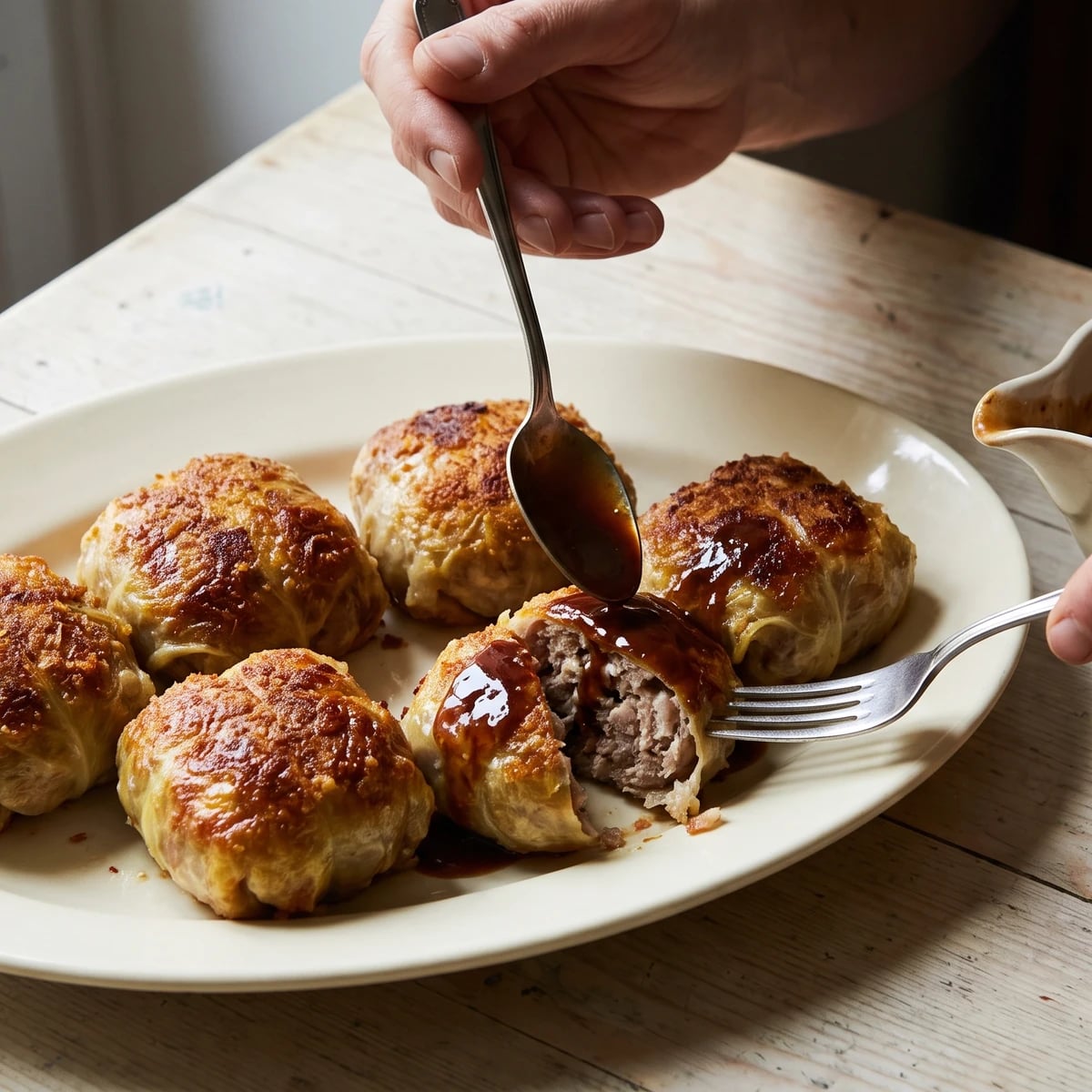
The finished crépinettes are deeply bronzed, their caul rendered into a delicate casing, with Madeira sauce gleaming alongside. Before you touch the skillet, attend to the poach: a knife must enter the thickest part without force, but the ear should still hold its shape. That one judgment decides everything that follows.
Oreilles à la Rouennaise belongs to Rouen and the Norman pork table, where ears and caul were treated as useful parts of the animal rather than scraps. The codified grand-kitchen preparation joins that household thrift to Madeira-enriched demi-glace, carrying a charcuterie instinct into the national sauce canon. Despite the Rouennaise name, cream is not the regional marker here; the identity lies in the ear, the crépinette form, and the dark fortified-wine sauce.
Quantity
2 medium (about 14 oz / 400 g total)
butcher-cleaned and singed
Quantity
10 cups (2.4 L / 2.4 kg)
Quantity
4 teaspoons (20 ml / 24 g)
Quantity
1 medium
scrubbed and cut into large pieces
Quantity
1 small
cleaned and halved
Quantity
1 small
peeled and halved
Quantity
1 stalk
cut into large pieces
Quantity
1
Quantity
3 cups (720 ml / 720 g)
Quantity
3/4 cup (180 ml / 175 g)
divided
Quantity
about 2 cups (480 ml / 450 g)
Quantity
1 tablespoon (15 ml / 4 g)
finely chopped
Quantity
8 squares, each about 8 inches / 20 cm wide (about 5 oz / 140 g total)
rinsed
Quantity
3 tablespoons (45 ml / 42 g)
divided
Quantity
1/3 cup (80 ml / 35 g)
| Ingredient | Quantity |
|---|---|
| pig's earsbutcher-cleaned and singed | 2 medium (about 14 oz / 400 g total) |
| cold water | 10 cups (2.4 L / 2.4 kg) |
| fine sea salt | 4 teaspoons (20 ml / 24 g) |
| carrotscrubbed and cut into large pieces | 1 medium |
| leekcleaned and halved | 1 small |
| onionpeeled and halved | 1 small |
| celerycut into large pieces | 1 stalk |
| bouquet garni of parsley stems, thyme, and bay | 1 |
| low-sodium, gelatin-rich veal or beef stock | 3 cups (720 ml / 720 g) |
| dry Madeiradivided | 3/4 cup (180 ml / 175 g) |
| plain fresh pork sausage meat | about 2 cups (480 ml / 450 g) |
| flat-leaf parsleyfinely chopped | 1 tablespoon (15 ml / 4 g) |
| caul fatrinsed | 8 squares, each about 8 inches / 20 cm wide (about 5 oz / 140 g total) |
| unsalted butterdivided | 3 tablespoons (45 ml / 42 g) |
| fine dry bread raspings or breadcrumbs | 1/3 cup (80 ml / 35 g) |
Inspect every fold of the ears, removing any remaining bristles and scraping away dark residue. Put them in a heavy pot with the cold water, salt, carrot, leek, onion, celery, and bouquet garni. The salt reproduces the book's proportion of roughly one-third ounce per quart. Bring the liquid slowly to a bare simmer, skim the surface, and cook uncovered for 2 to 2 1/2 hours. Add a little hot water if the ears become exposed. They are ready when a knife enters the thick base easily but the ear can still be lifted intact. Lift them onto a tray, strain and reserve 1 cup of the poaching liquid, and let the ears cool until manageable.
While the ears poach, boil the stock in a wide saucepan until about 1 1/4 cups remain. Add 1/2 cup of the Madeira and reduce again to about 1 cup. This is the home demi-glace, the classical half-glaze, built in one pan rather than drawn from a stockpot and handed to a saucier. It should be dark, glossy, and able to coat a spoon without setting like glue. If it tightens too far, loosen it with the reserved poaching liquid, one tablespoon at a time. Measure 1/3 cup for the ears and reserve the remainder.
Cut each ear across the natural change in thickness, separating the fleshy base from the thinner upper cartilage. Mince the thick portions finely. Cut the thin portions across into eight neat collops, meaning thin oval slices, trimming only what prevents them from lying flat. Put the mince and collops into a small saucepan with the measured 1/3 cup Madeira demi-glace. Hold them at the gentlest simmer for 30 minutes, stirring the mince and turning the collops occasionally. If the glaze threatens to catch, add a spoonful of poaching liquid. Ça se rattrape. Separate the collops, spread everything on a tray, and chill until fully cold.
Combine the cold minced ear, sausage meat, and chopped parsley. Mix with cold hands just until evenly distributed and cohesive; prolonged kneading makes the filling rubbery. If the ear is still warm, stop and chill it before mixing, since warmth smears the sausage fat and costs you the juicy texture. Divide the mixture into eight portions of about 3 ounces, or 85 grams, and shape each into a squat oval patty.
Soak the rinsed caul fat in cold water for 15 minutes if it feels stiff, then drain and pat it gently dry. Lay out one square, place a patty in the centre, and set one reserved ear collop flat against its upper face. Fold the caul snugly around the patty in a single layer, trimming heavy overlaps, and place it seam-side down. Repeat with the remaining portions, then chill the crépinettes for 30 minutes so their shape firms.
Set an oven rack about 6 inches, or 15 centimetres, below the broiler and heat the broiler. Place a large ovenproof skillet over medium-low heat. Add the crépinettes seam-side down without extra fat and cook for 5 to 6 minutes, then turn and cook the second side for 4 to 5 minutes. The caul should render slowly and turn golden while the centres reach about 140°F, or 60°C. If a parcel sticks, wait rather than forcing it; rendered caul releases when browned. Melt 2 tablespoons of the butter, brush it over the tops, and scatter on the raspings. Broil until deeply bronzed and cooked to 160°F, or 71°C, about 2 to 4 minutes. If the crumbs colour before the centres are ready, move the skillet to a 350°F, or 180°C, oven to finish gently.
Transfer the crépinettes to a warm platter and let them settle while you finish the sauce. Bring the reserved reduction to a gentle simmer with the remaining 1/4 cup Madeira and cook for 3 to 5 minutes, until the wine's raw edge has gone and the sauce again coats a spoon. Remove it from the heat and whisk in the remaining tablespoon of cold butter. If the sauce looks greasy, whisk a teaspoon of hot poaching liquid in a clean warm pan, then add the sauce gradually until it comes back together. Ça se rattrape.
Arrange the eight crépinettes in a generous circle on the warm platter, keeping their buttered, bronzed faces upward. Pour the Madeira sauce into a warmed sauceboat and pass it at the table, allowing each person to spoon on as much as wanted. Serve at once. À table!
1 serving (about 270g)
Culinary guides, cultural storytelling, and the editorial depth that makes cooking meaningful.
Discover Culinary Explorer
Chef Juliette
Jambon frais rôti teaches the quiet discipline of the roast: fierce heat for bronze, gentle heat for an even center, then a proper rest before carving into juicy slices.

Chef Juliette
Filet de porc frais rôti teaches the quiet discipline of roasting: brown the loin, lower the heat, rest it fully, then turn its fond into a glossy jus beside a spoon-soft vegetable purée.

Chef Juliette
Collet de porc frais rôti teaches the honest roast: steady basting, patient heat, and a full cook that melts the neck’s seams into succulent slices beneath a burnished crust.

Chef Juliette
Fresh pork neck and choucroûte share one oven and one rich exchange: the roast bastes the cabbage with its own fat, while gentle heat carries the meat to a bronzed, tender, thoroughly cooked finish.