
Chef Juliette
John Dory (St. Pierre)
John Dory has the delicacy of sole and the firmness of turbot. A light flouring, a quick butter sauté, and nut-brown beurre noisette show exactly why looks never mattered.
A cooking platform built around craft, culture, and the stories behind what we eat.
Created by Chef Juliette
Based on No. 1398, Roast Stuffed Sucking Pig à l’Anglaise, from Le Guide Culinaire (1907) by Auguste Escoffier
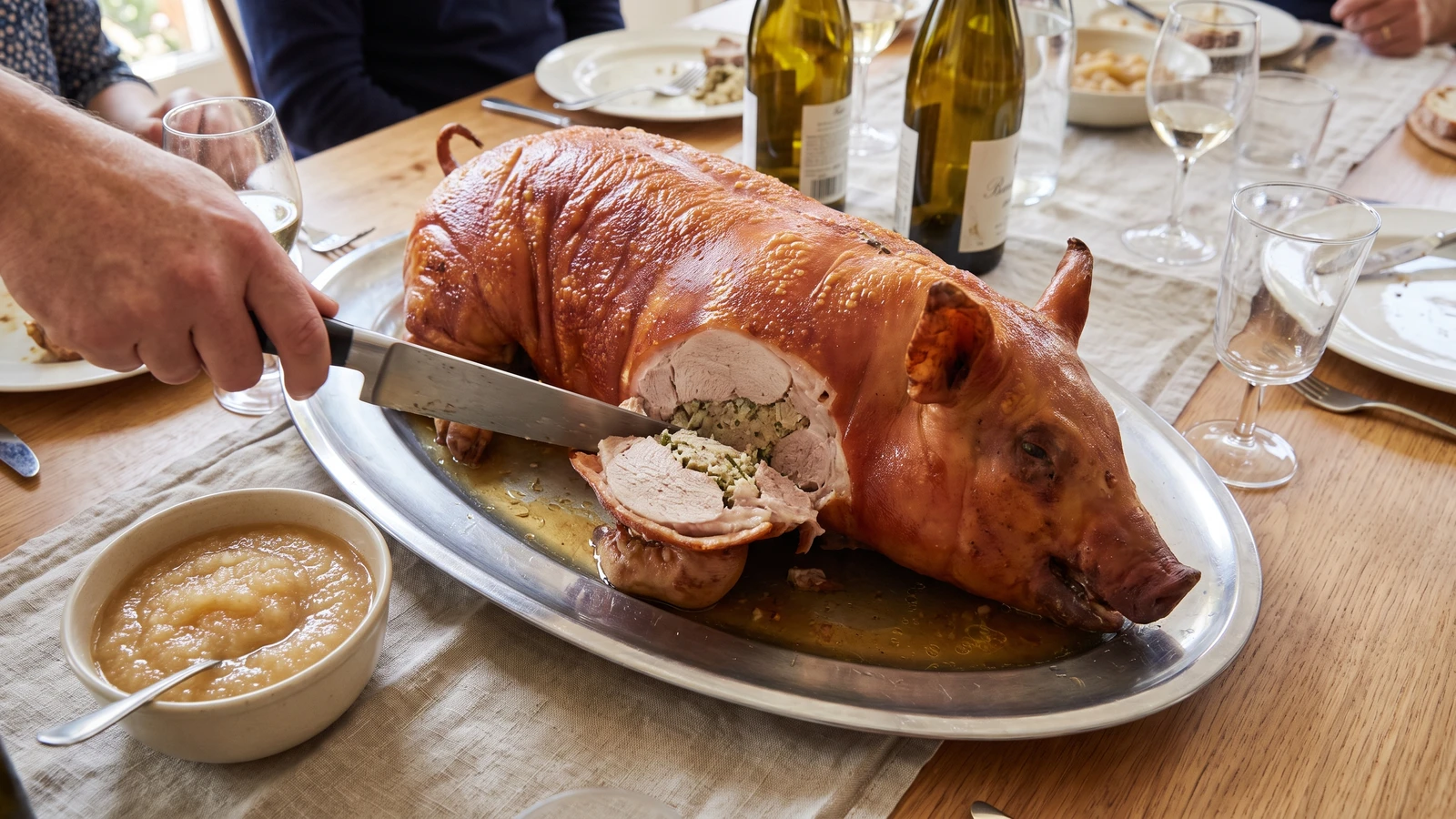
A whole suckling pig with crackling skin and a sage, onion, breadcrumb, and beef-suet heart, scaled for one home oven and brought to the table with sharp apple sauce apart.
Cochon de lait farci à l’anglaise (roast sucking pig with English-style stuffing) teaches the discipline of contrast: crisp skin over tender pork, with a rich, soft farce at the centre. One true thing governs the whole roast. Water is the enemy of crackling, so the skin must be thoroughly dry before it enters the oven and must never be basted.
The source assumed a medium pig, a turning spit, and enough hands to tend both while a celebration moved around them. It needs no saucier, no stockpot kept hot, and no salamander. At home, a sturdy rack replaces the spit, one rotation replaces its attendant, and a final burst of high oven heat corrects the skin. I have quartered the original farce exactly, including the unusual half egg, because this is the amount that fits a small pig and feeds four generously. One cook, one stove, one evening.
The spit and its attendant were brigade scaffolding, and the formal timbale for the apple sauce can become a warm serving bowl. The cooked onions, beef kidney suet, pressed bread, parboiled sage, stitched cavity, and apple sauce passed apart are the dish itself, so they stay. Before you meet the oven, dry the skin until it no longer feels tacky; that is the step that decides everything.
Roast suckling pig à l’anglaise belongs to the French grand-kitchen category of preparations named for another national table, not to Lyon, Burgundy, Normandy, or any single French region. Its English markers are exact: sage and onion farce enriched with beef kidney fat, followed by apple sauce served apart, a feast treatment French cooks absorbed into the classical repertory without blurring its origin. The optional raisins are not a modern flourish; the source fixes them at four ounces for every pound of apples.
Quantity
1 whole (6 to 8 lb / 2.7 to 3.6 kg)
cleaned, hair removed, and cavity ready for stuffing
Quantity
2 large (12 oz / 340 g)
skins left on
Quantity
1 cup (240 ml / 113 g)
finely chopped
Quantity
1 packed cup (240 ml / 113 g)
weighed after soaking in cold water and pressing dry
Quantity
1 packed cup (240 ml / 28 g)
Quantity
1/2 large egg (1 tablespoon plus 2 teaspoons / 25 ml / 25 g)
beaten
Quantity
1 1/4 teaspoons (6 ml / 7 g)
for the farce
Quantity
1 pinch
Quantity
1 pinch
Quantity
2 teaspoons (10 ml / 12 g)
for the skin
Quantity
4 medium (1 lb / 454 g)
peeled, cored, and chopped
Quantity
1/4 cup (60 ml / 60 g)
Quantity
3/4 cup (180 ml / 113 g)
| Ingredient | Quantity |
|---|---|
| whole dressed sucking pigcleaned, hair removed, and cavity ready for stuffing | 1 whole (6 to 8 lb / 2.7 to 3.6 kg) |
| large onionsskins left on | 2 large (12 oz / 340 g) |
| beef kidney suetfinely chopped | 1 cup (240 ml / 113 g) |
| soft white breadcrumbweighed after soaking in cold water and pressing dry | 1 packed cup (240 ml / 113 g) |
| fresh sage leaves | 1 packed cup (240 ml / 28 g) |
| large eggbeaten | 1/2 large egg (1 tablespoon plus 2 teaspoons / 25 ml / 25 g) |
| fine saltfor the farce | 1 1/4 teaspoons (6 ml / 7 g) |
| freshly ground black pepper | 1 pinch |
| freshly grated nutmeg | 1 pinch |
| fine sea saltfor the skin | 2 teaspoons (10 ml / 12 g) |
| tart cooking applespeeled, cored, and chopped | 4 medium (1 lb / 454 g) |
| water | 1/4 cup (60 ml / 60 g) |
| selected raisins (optional) | 3/4 cup (180 ml / 113 g) |
Confirm that the pig fits your roasting pan and oven before anything else. Set it on a rack, blot the cavity and skin repeatedly, then prick the skin all over with a clean trussing needle without driving the point into the meat. Leave it uncovered in the refrigerator for at least 1 hour, or under a cool kitchen fan for 45 to 60 minutes if cooking entirely this evening. The surface should feel dry rather than tacky. If it still clings to your fingers, blot it again and wait another 20 minutes; the clock can wait, wet skin cannot be persuaded into good crackling.
Put the unpeeled onions in a saucepan, cover them with cold water, and simmer until a skewer passes through their centres without resistance, about 30 to 40 minutes. Drain and cool them, then peel and chop them finely. If the chopped onions shed a puddle, let them drain in a sieve for 10 minutes. Parboil the sage leaves for 1 minute, drain, cool, squeeze them thoroughly, and chop them. Soak soft white bread in cold water for 5 minutes, then press it firmly in a clean towel and weigh out 4 ounces (113 g) of the pressed crumb.
Combine all the cooked onion with the chopped beef kidney suet, pressed breadcrumb, sage, beaten half egg, 1 1/4 teaspoons salt, pepper, and nutmeg. Mix until evenly bound but still loose, without kneading it into a paste. The farce should hold together when squeezed and fall apart under a spoon. If it looks wet enough to flow, chill it for 15 minutes rather than adding more bread, which would change the source ratio. Let it become completely cold before it enters the pig.
Fill the cavity evenly with the cold farce, leaving it loose enough for heat to move through it. Bring the belly edges together and stitch them securely with butcher's twine at roughly 1-inch (2.5 cm) intervals. If the cavity is smaller than expected, stop before packing it tight; put any extra farce in a small covered baking dish and cook it beside the pig until its centre reaches 165°F (74°C). Tuck the legs into a stable crouch, pat the skin dry once more, and rub it evenly with the exterior salt.
Heat the oven to 325°F (165°C), or 300°F (150°C) with a fan, with a shelf in the lower third. Place the pig belly-seam down on a sturdy rack set inside the roasting pan. Add enough hot water beneath the rack to keep the drippings from burning, without letting the water touch the pig. Roast for about 2 1/2 to 3 hours, turning the pan front to back once. Shield the ears, snout, and tail with small pieces of foil as soon as they bronze. Do not baste the skin. Basting helps meat but ruins crackling, and this young pig carries enough fat to look after itself.
Test the centre of the farce and the thickest parts of the ham and shoulder without touching bone. The farce must reach 165°F (74°C), while the pork must pass 145°F (63°C). If the skin is already dark before the farce is safe, cover only those dark patches loosely with foil and continue at the lower heat. Once the temperatures are correct, raise the oven to 475°F (245°C) and roast for 10 to 20 minutes, rotating the pan as needed, until the skin is taut, blistered, and crisp under a light tap. If a pale or flexible patch remains, shield the finished areas and return the pig to the hot oven in 5-minute intervals. Ça se rattrape.
During the final hour of roasting, put the apples and 1/4 cup water in a covered saucepan. Cook over gentle heat for 15 to 20 minutes, stirring occasionally, until the fruit collapses. Uncover and beat it into a coarse, sharp purée. If it is watery, simmer uncovered until it mounds softly on the spoon; if it is too stiff, loosen it with a spoonful of water. For the source's optional variation, swell the raisins in tepid water for 20 minutes, drain them well, and fold them into the sauce. The quantity preserves its ratio of 4 ounces of raisins for 1 pound of apples.
Transfer the pig to its serving platter and rest it uncovered for 25 to 30 minutes. Foil over the skin traps moisture, so leave the crackling exposed. Remove every stitch, open the belly, and spoon the farce into a warm serving dish. Detach the legs at their joints, then cut the loin and rib sections into manageable portions with a carving knife and sturdy shears. Pass the apple sauce separately so each guest can take it without softening the skin. À table!
1 serving (about 685g)
Culinary guides, cultural storytelling, and the editorial depth that makes cooking meaningful.
Discover Culinary ExplorerChef Juliette
John Dory has the delicacy of sole and the firmness of turbot. A light flouring, a quick butter sauté, and nut-brown beurre noisette show exactly why looks never mattered.

Chef Juliette
Fresh haddock proves its delicacy in the meunière pan: a fine flour crust, moist pearly flakes, and beurre noisette sharpened with lemon and parsley, ready from one skillet in half an hour.

Chef Juliette
Éperlans à l’Anglaise turns small fish into a lesson in disciplined coating: boned smelts under a close, crisp crumb, pan-fried in clarified butter and finished with bright, half-melted maître d’hôtel butter.

Chef Juliette
Tiny smelts, shallot, mushrooms, white wine, gratin sauce, and fine bread raspings meet a fierce oven, where the fish must turn tender in the same breath the buttered crust bronzes.