
Chef Juliette
John Dory (St. Pierre)
John Dory has the delicacy of sole and the firmness of turbot. A light flouring, a quick butter sauté, and nut-brown beurre noisette show exactly why looks never mattered.
A cooking platform built around craft, culture, and the stories behind what we eat.
Created by Chef Juliette
Based on No. 1396, Fresh-pork Cutlets with Piquante or Robert Sauce, from Le Guide Culinaire (1907) by Auguste Escoffier
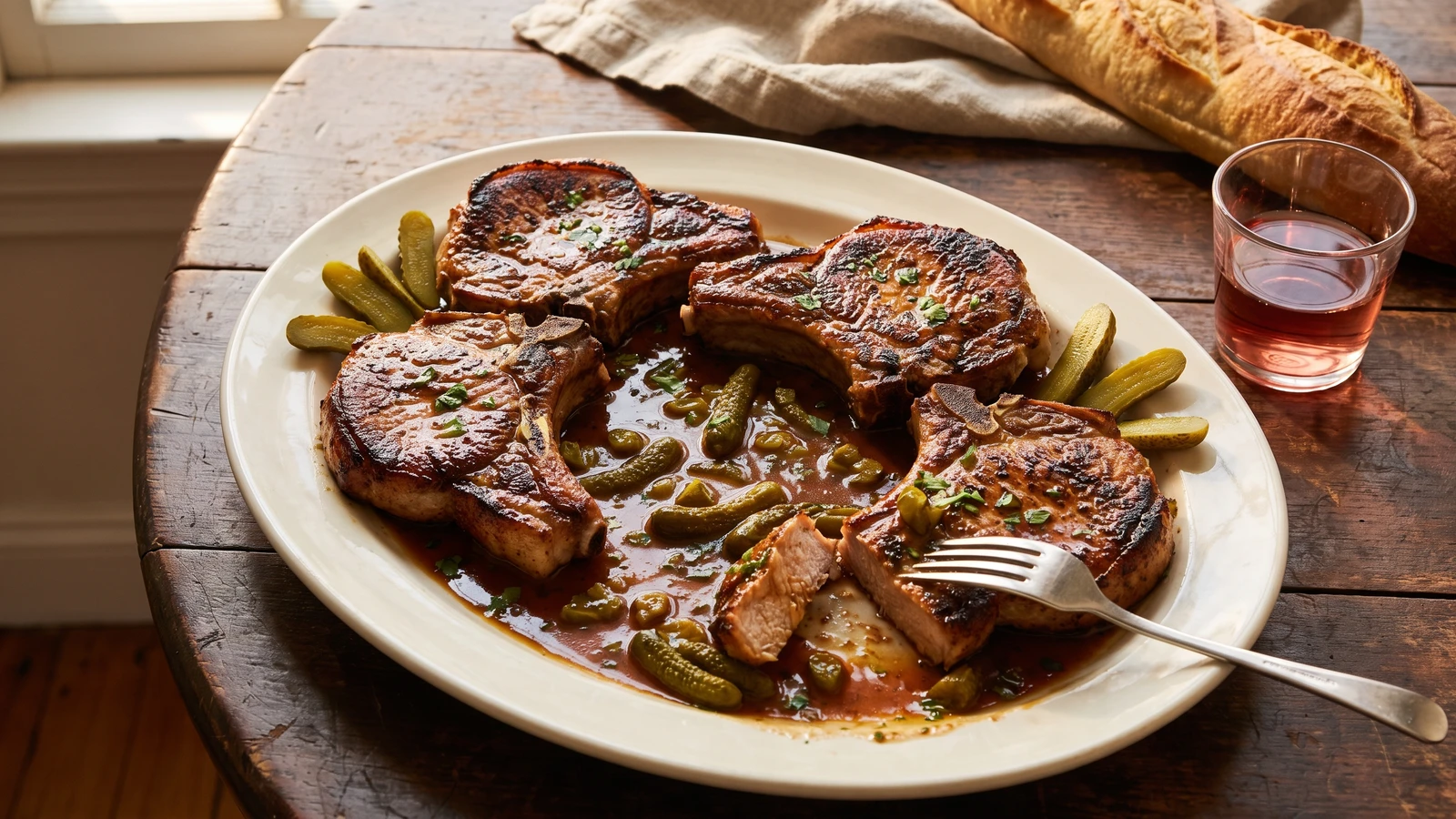
Four butter-sautéed pork cutlets, bronzed at the edges and gathered around your choice of sauce piquante or sauce Robert, prove that vinegar, cornichons, onion, and mustard are pork's best companions.
Côtelettes de porc frais, sauce piquante ou sauce Robert teach one true thing: rich pork needs a deliberate edge. Sauce piquante supplies vinegar and cornichons, bright and direct; sauce Robert takes the rounder road through onion, white wine, and mustard. Both leave the pork tasting more fully of itself.
The original service assumed a saucier at hand, brown stock never off the fire, and enough cutlets to ring a grand dish. At home, reduced unsalted stock gains body from a beurre manié, a butter-flour paste, and depth from the pork's own browned fond. Maintaining a finished sauce at a separate station was brigade scaffolding. The acid reduction, proper sauté, and last-minute cornichons or mustard are the dish, and they stay. Four cutlets make the sensible circle. One cook, one stove, one evening.
For four, sauté is the honest choice because the pan gives us the fond a home stockpot cannot. The source's breadcrumb and grill options remain, but a breaded cutlet keeps its sauce separate so the crust stays crisp. The step that decides everything is the reduction: let the vinegar or wine lose its raw bite and concentrate before the stock enters. Rush that, and the sauce tastes thin however long it simmers.
The dish's real home is the French cuisine bourgeoise table and the classical dining room, not a single province, with browned pork arranged around a prepared sauce for generous service. Sauce Robert pairs onion and mustard with pork, while sauce piquante uses vinegar and cornichons to make the same sharp cut against fat; generations of cooks treated them as sister finishes, not interchangeable names. In the title, fresh-pork means uncured pork, distinguishing the cutlet from salted or smoked pork in the classical larder, not pork butchered that morning.
Quantity
4 cutlets, 6 to 7 ounces (170 to 200 g) each
about 3/4 inch (2 cm) thick
Quantity
1 1/2 teaspoons (7.5 ml / 9 g)
divided
Quantity
1/2 teaspoon (2.5 ml / 1 g)
Quantity
4 tablespoons (60 ml / 56 g)
divided
Quantity
1 tablespoon (15 ml / 14 g)
Quantity
1 small, about 1/3 cup (80 ml / 50 g)
finely chopped
Quantity
1 1/4 cups (300 ml / 300 g)
divided
Quantity
2 teaspoons (10 ml / 6 g)
Quantity
2 tablespoons (30 ml / 30 g)
Quantity
1/3 cup (80 ml / 50 g)
half finely chopped and half halved lengthwise
Quantity
1/3 cup (80 ml / 80 g)
Quantity
1 tablespoon (15 ml / 15 g)
Quantity
2 tablespoons (30 ml / 28 g)
melted
Quantity
1/2 cup (120 ml / 55 g)
| Ingredient | Quantity |
|---|---|
| bone-in pork loin or rib cutletsabout 3/4 inch (2 cm) thick | 4 cutlets, 6 to 7 ounces (170 to 200 g) each |
| fine sea saltdivided | 1 1/2 teaspoons (7.5 ml / 9 g) |
| freshly ground black pepper | 1/2 teaspoon (2.5 ml / 1 g) |
| unsalted butterdivided | 4 tablespoons (60 ml / 56 g) |
| neutral oil | 1 tablespoon (15 ml / 14 g) |
| yellow onionfinely chopped | 1 small, about 1/3 cup (80 ml / 50 g) |
| good unsalted veal, beef, or brown chicken stockdivided | 1 1/4 cups (300 ml / 300 g) |
| all-purpose flour | 2 teaspoons (10 ml / 6 g) |
| white wine vinegar, for Sauce Piquante (optional) | 2 tablespoons (30 ml / 30 g) |
| sharp cornichons, for Sauce Piquante (optional)half finely chopped and half halved lengthwise | 1/3 cup (80 ml / 50 g) |
| dry white wine, for Sauce Robert (optional) | 1/3 cup (80 ml / 80 g) |
| Dijon mustard, for Sauce Robert (optional) | 1 tablespoon (15 ml / 15 g) |
| unsalted butter, for the optional breadcrumb finish (optional)melted | 2 tablespoons (30 ml / 28 g) |
| fine dry breadcrumbs, for the optional breadcrumb finish (optional) | 1/2 cup (120 ml / 55 g) |
Choose Sauce Piquante or Sauce Robert and measure only that branch's ingredients. Take the cutlets from the cold about 20 minutes before cooking, pat them thoroughly dry, and score the outer band of fat in two or three places without cutting into the meat; this keeps the cutlets from curling away from the pan. Season both sides with most of the salt and all the pepper. If using the breadcrumb finish, wait until immediately before cooking, then brush the cutlets with the melted butter and press on a thin, even coat of crumbs. Plan to serve the sauce separately, as the source directs, because sauce poured over crumbs defeats their purpose.
Melt 1 tablespoon of the butter in a small saucepan over medium-low heat. Add the onion and a pinch of the remaining salt. For Sauce Piquante, cook the onion without browning for 3 to 4 minutes, add the vinegar, and reduce until only a glossy spoonful remains and its raw sting has softened. For Sauce Robert, cook the onion for 6 to 8 minutes until supple and pale gold, add the white wine, and reduce it to about 2 tablespoons. Add 1 cup (240 ml / 240 g) of the stock and simmer until reduced to about 3/4 cup (180 ml / 180 g).
Knead 1 tablespoon of softened butter with the flour to make the beurre manié. Whisk it into the simmering sauce in pea-sized pieces, letting each disappear before adding the next, then simmer gently for 3 minutes to cook away the flour's raw taste. The sauce should coat the back of a spoon without sitting like paste. If small lumps appear, take the saucepan off the heat and whisk vigorously; if they persist, pass the sauce through a fine sieve. Ça se rattrape. Set the sauce aside off the heat.
Heat a 12-inch (30 cm) heavy skillet over medium-high heat, or medium heat for breaded cutlets. Add the oil and 1 tablespoon of butter. When the butter's foam subsides, lay in the pork without crowding and sauté, cooking briskly in the shallow fat, for 3 to 5 minutes per side. Leave each side alone long enough to form a deep bronze crust, then briefly hold the fat edge against the pan with tongs. The cutlets are ready when the thickest part, clear of the bone, reaches 145°F (63°C). Transfer them to a warm platter and rest for at least 3 minutes. If the butter blackens before the pork browns, move the cutlets to a plate, wipe out the bitter fat, and resume with fresh butter and oil; browned fond helps the sauce, black fond ruins it.
For unbreaded cutlets, pour the remaining 1/4 cup (60 ml / 60 g) stock into the skillet and scrape up every bronze speck. Reduce by half, then whisk this fond into the sauce. For breaded cutlets, skip the deglazing and keep the sauce clean, using a spoonful of reserved stock only if it needs loosening. Bring the sauce to a gentle simmer. For Sauce Piquante, stir in the chopped cornichons. For Sauce Robert, remove the pan from the heat before whisking in the Dijon mustard so its fragrance stays fresh. Whisk in the final tablespoon of cold butter and taste for salt. If the sauce is thin, reduce it before adding that butter; if too thick, loosen it with stock. If the butter separates into oily beads, take the pan off the heat and whisk in a teaspoon of cold water.
Arrange the four unbreaded cutlets in a loose circle on a warm platter, bones pointing outward, and spoon the sauce into their midst rather than over their browned faces. For Sauce Piquante, border the platter with the reserved halved cornichons. For Sauce Robert, let the glossy onion and mustard sauce stand alone. If the cutlets are breaded, bring the sauce in a warm sauceboat and let each person add it at the table. Never apologize at your own table. À table!
1 serving (about 180g)
Culinary guides, cultural storytelling, and the editorial depth that makes cooking meaningful.
Discover Culinary ExplorerChef Juliette
John Dory has the delicacy of sole and the firmness of turbot. A light flouring, a quick butter sauté, and nut-brown beurre noisette show exactly why looks never mattered.

Chef Juliette
Fresh haddock proves its delicacy in the meunière pan: a fine flour crust, moist pearly flakes, and beurre noisette sharpened with lemon and parsley, ready from one skillet in half an hour.

Chef Juliette
Éperlans à l’Anglaise turns small fish into a lesson in disciplined coating: boned smelts under a close, crisp crumb, pan-fried in clarified butter and finished with bright, half-melted maître d’hôtel butter.

Chef Juliette
Tiny smelts, shallot, mushrooms, white wine, gratin sauce, and fine bread raspings meet a fierce oven, where the fish must turn tender in the same breath the buttered crust bronzes.