
Chef Juliette
John Dory (St. Pierre)
John Dory has the delicacy of sole and the firmness of turbot. A light flouring, a quick butter sauté, and nut-brown beurre noisette show exactly why looks never mattered.
A cooking platform built around craft, culture, and the stories behind what we eat.
Created by Chef Juliette
Based on No. 1394, Fresh-pork Cutlets à la Flamande, from Le Guide Culinaire (1907) by Auguste Escoffier
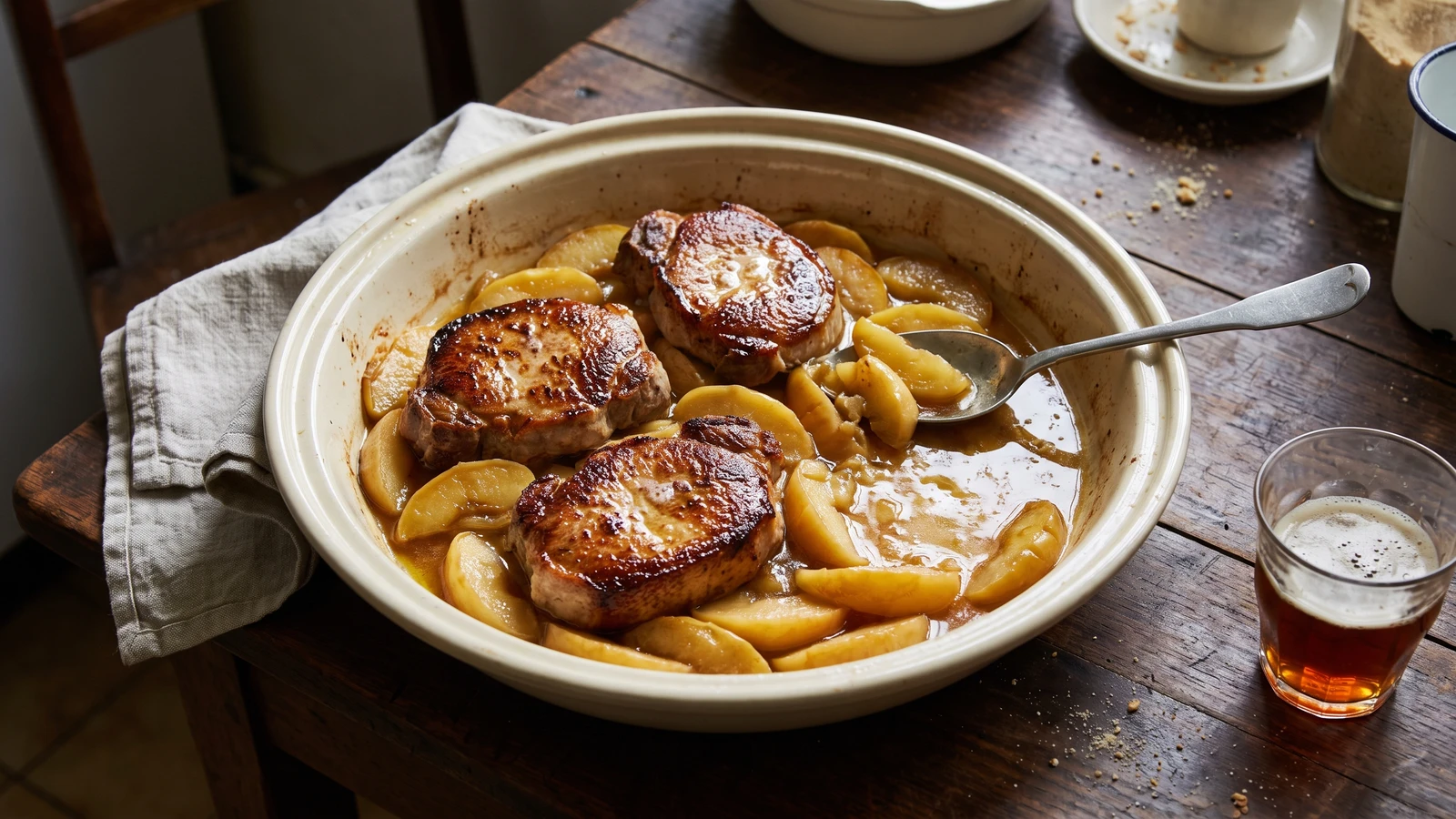
Côtelettes de porc frais à la Flamande teach a precise stop: brown the pork in butter only partway, then finish it over apples so meat, fruit, and juices become one generous dish.
Côtelettes de porc frais à la Flamande (fresh-pork cutlets with apples) teaches the discipline of stopping the pan at the right moment. The cutlets must take a bronze crust in butter while their centers remain underdone; the oven then finishes meat and fruit together, and the apples catch the pork juices until they become the sauce. Cook the cutlets through in the skillet and the oven can only dry them.
The source entry assumes enough hands to peel apples while the cutlets fry, and that “half-fried” needs no explanation. It needs no saucier on staff, no stockpot kept hot, and no salamander, only an earthenware dish and sound judgment at the pan. For one cook, one stove, one evening, prepare the apples first, use a shallow glazed ceramic baker, and keep the book’s exact allowance of 3 ounces of prepared apple per cutlet. Moving that preparation ahead is brigade scaffolding removed; frying in butter, setting the meat over the apples, and finishing both in the oven are the dish and must stay.
When it lands, the cutlets are bronze at the edges, the apples soft but still recognizable, and butter-rich juices shine in the bottom of the dish. The step that decides everything is the first frying: color both faces, then stop while the center remains plainly underdone.
Côtelettes de porc frais à la Flamande belong to French Flanders, the Nord country where pork, orchard fruit, butter, and oven cookery meet at the household table. The classical label à la Flamande is not one fixed garnish; in this preparation it means cutlets partly fried, then finished directly over apples without stock, cream, beer, or a separate sauce. Serving it in the earthenware dish preserves the domestic method within the formal canon.
Quantity
4, about 6 oz / 170 g each
3/4 inch / 2 cm thick and patted dry
Quantity
3 medium, 12 oz / 340 g prepared weight total (3 oz / 85 g per cutlet)
peeled, cored, and sliced 1/4 inch / 6 mm thick
Quantity
4 tablespoons (60 ml / 56 g)
divided
Quantity
1 teaspoon (5 ml / 6 g)
Quantity
1/2 teaspoon (2.5 ml / 1 g)
| Ingredient | Quantity |
|---|---|
| fresh bone-in pork loin or rib cutlets3/4 inch / 2 cm thick and patted dry | 4, about 6 oz / 170 g each |
| firm eating applespeeled, cored, and sliced 1/4 inch / 6 mm thick | 3 medium, 12 oz / 340 g prepared weight total (3 oz / 85 g per cutlet) |
| unsalted butterdivided | 4 tablespoons (60 ml / 56 g) |
| fine sea salt | 1 teaspoon (5 ml / 6 g) |
| freshly ground black pepper | 1/2 teaspoon (2.5 ml / 1 g) |
Heat the oven to 400°F (200°C) with a rack in the center. Spread the apple slices in a shallow 2-quart / 2-liter glazed ceramic baking dish, overlapping them loosely in an even layer rather than piling them into a mound. An even bed lets the apples soften in the same time the pork needs to finish.
Pat the cutlets thoroughly dry, especially around the bone, then season both faces with the salt and pepper. Dry pork browns; wet pork sheds water into the butter and turns pale. Leave the apples unseasoned, because they will receive salt and richness from the pork juices above.
Melt 1 1/2 tablespoons (22 ml / 21 g) butter in a heavy skillet over medium-high heat until it foams vigorously. Add two cutlets and fry for 2 to 3 minutes per side, until each face is properly bronze but the center remains underdone. Transfer them to the apple bed, then repeat with another 1 1/2 tablespoons (22 ml / 21 g) butter and the remaining cutlets. This partway cooking is the principle of the dish. If the milk solids turn black before the pork colors, move the pan off the heat, lift out the cutlets, wipe away the scorched butter, and continue with some of the reserved butter; burnt fat must not follow the meat into the oven.
Set all four cutlets in a single layer over the apples. Spoon the clean butter and pork juices from the skillet over them, then dot on the remaining 1 tablespoon (15 ml / 14 g) butter. Bake for 8 to 12 minutes, until the pork reaches 145°F (63°C) at the thickest part away from the bone and a knife enters the apples easily, though the slices still hold their shape. If the pork reaches temperature before the apples soften, lift the cutlets to a warm plate and return the apples to the oven for 5 minutes. Ça se rattrape. If the apples are ready first, cover the dish loosely and continue checking the pork every 2 minutes.
Rest the cutlets in the baking dish for 5 minutes so their juices settle into the apples. Spoon the glossy butter and juices from the bottom back over the meat, then carry the dish directly to the table. No separate sauce, no transferred platter, no garnish. Serve it as it stands. À table!
1 serving (about 185g)
Culinary guides, cultural storytelling, and the editorial depth that makes cooking meaningful.
Discover Culinary ExplorerChef Juliette
John Dory has the delicacy of sole and the firmness of turbot. A light flouring, a quick butter sauté, and nut-brown beurre noisette show exactly why looks never mattered.

Chef Juliette
Fresh haddock proves its delicacy in the meunière pan: a fine flour crust, moist pearly flakes, and beurre noisette sharpened with lemon and parsley, ready from one skillet in half an hour.

Chef Juliette
Éperlans à l’Anglaise turns small fish into a lesson in disciplined coating: boned smelts under a close, crisp crumb, pan-fried in clarified butter and finished with bright, half-melted maître d’hôtel butter.

Chef Juliette
Tiny smelts, shallot, mushrooms, white wine, gratin sauce, and fine bread raspings meet a fierce oven, where the fish must turn tender in the same breath the buttered crust bronzes.