
Chef Juliette
John Dory (St. Pierre)
John Dory has the delicacy of sole and the firmness of turbot. A light flouring, a quick butter sauté, and nut-brown beurre noisette show exactly why looks never mattered.
A cooking platform built around craft, culture, and the stories behind what we eat.
Created by Chef Juliette
Based on No. 1390, Fresh Neck of Pork à la Soissonnaise, from Le Guide Culinaire (1907) by Auguste Escoffier
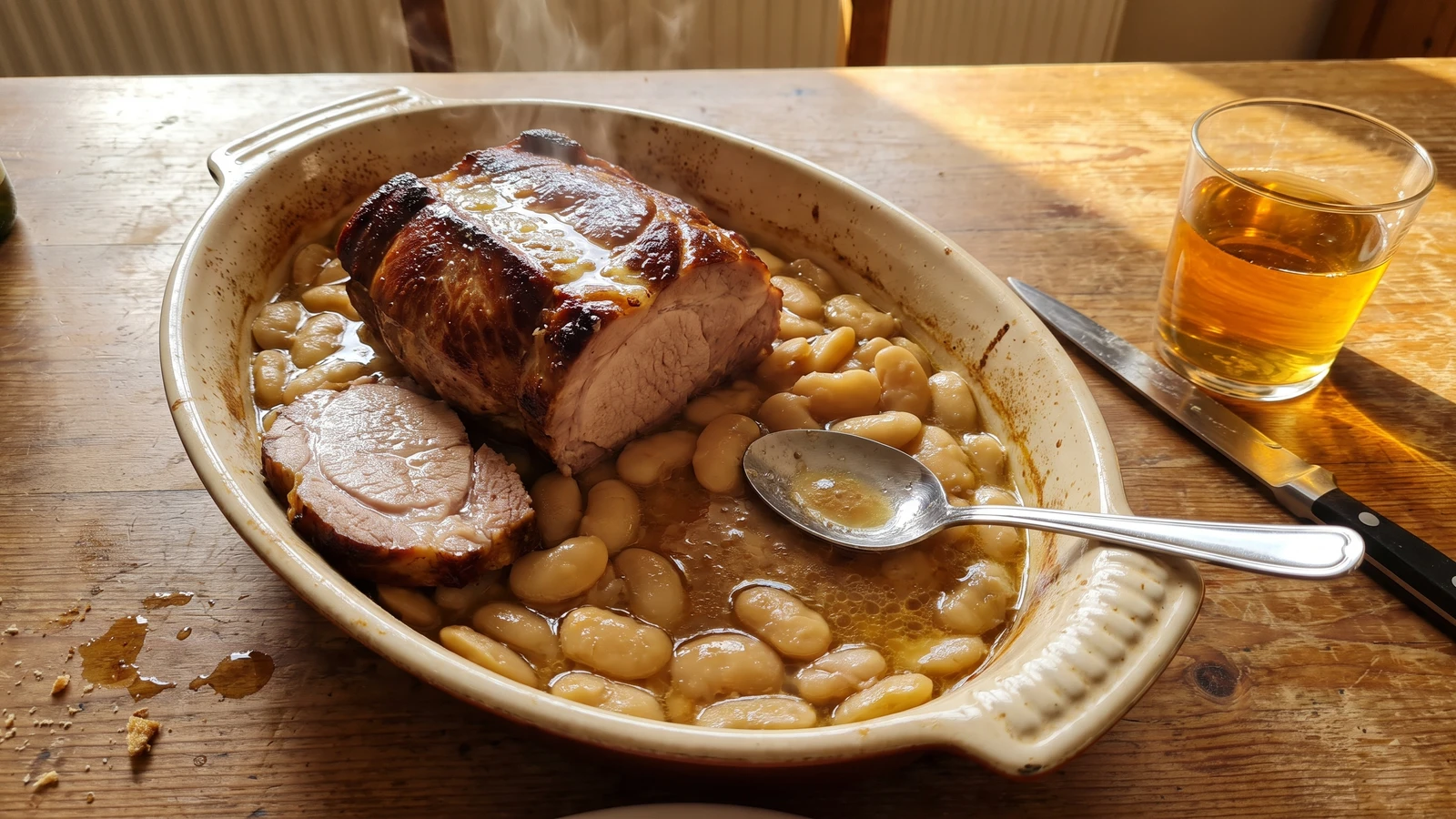
Burnished pork collar finishes gently over Soissons beans, which drink the roast juices and become both garnish and sauce. One oven-to-table dish carries the whole generous business.
Échine de porc frais à la Soissonnaise (uncured pork neck with Soissons beans) teaches one true thing: a garnish becomes part of the roast when it finishes in the meat's own juices. The beans go in only when the pork is three-quarters done. Earlier, they collapse and parch; later, they merely sit beside it.
Many grand-kitchen recipes assumed a saucier on staff, a stock never off the fire, and a salamander. This spare entry assumes none of them. Its professional convenience is quieter: a joint trimmed for service, cooked Soissons beans waiting in the larder, and a roasting dish handsome enough to meet the table. For four, I use a 2¾-pound boneless collar and reduce the book's quart of beans to 1⅔ cups, roughly two-fifths of its service quantity. A home gratin dish replaces the large service platter, while a thermometer translates the vague instruction “three-parts done.” Jarred or canned beans are the honest equivalent of that waiting larder pot because the source begins with them already cooked. That preparation is scaffolding. Roasting first, adding well-drained beans, and completing everything gently together is the dish, and it stays.
Expect a deeply bronzed roast surrounded by broad ivory beans, their skins glossy with pork juices and their edges just beginning to color. No separate sauce is wanted. Wait until the centre of the meat reaches 140 to 145°F (60 to 63°C) before adding the beans; that moment decides the whole preparation. One cook, one stove, one evening.
À la Soissonnaise belongs to Soissons and the surrounding Soissonnais in the Aisne, within historic Picardy, where the notably large white Haricot de Soissons has long been a prized local crop. Grand kitchens carried the bean's place-name into classical nomenclature, but the practice stayed close to household cookery: a joint roasts, cooked beans absorb its juices, and the same dish goes to the table. In classical usage, fresh means uncured pork rather than salted or smoked meat, and the beans are meant to finish around it without a separate sauce.
Quantity
1 roast, about 2¾ lb (1.25 kg)
tied
Quantity
2 teaspoons (10 ml / 12 g)
divided
Quantity
½ teaspoon (2.5 ml / 1 g)
Quantity
1⅔ cups (400 ml / 300 g)
well drained
Quantity
Up to ¼ cup (60 ml / 60 g)
| Ingredient | Quantity |
|---|---|
| boneless pork neck or collar roasttied | 1 roast, about 2¾ lb (1.25 kg) |
| fine sea saltdivided | 2 teaspoons (10 ml / 12 g) |
| freshly ground black pepper | ½ teaspoon (2.5 ml / 1 g) |
| cooked Soissons white beanswell drained | 1⅔ cups (400 ml / 300 g) |
| hot water (optional) | Up to ¼ cup (60 ml / 60 g) |
Heat the oven to 425°F (220°C) with a rack in the lower-middle position. Pat the pork completely dry, then season every surface with 1½ teaspoons of the salt and all the pepper. If the butcher has not tied it, loop kitchen string around the roast at 1½-inch (4 cm) intervals so the irregular neck holds an even shape. Set it fat-side up in a snug oven-to-table roasting dish. Use no rack: the beans will need direct access to the rendered juices.
Roast for 20 minutes, until the upper surface begins to turn a firm Maillard bronze. Lower the oven to 325°F (165°C) and continue roasting for 60 to 75 minutes, checking the centre with a thermometer after the first hour. Stop this first stage when it reads 140 to 145°F (60 to 63°C). This is the honest home measure of three-quarters done. If the juices around the meat begin darkening faster than the crust, lower the heat early and add 1 tablespoon of the hot water around the edge of the dish; brown is flavor, black is bitterness.
While the pork roasts, leave the cooked beans in a colander for at least 10 minutes. They must be tender all the way through but still intact, and their surfaces should feel well drained rather than wet. The oven is finishing their flavor, not cooking hard centres. Taste one and use some or all of the remaining ½ teaspoon salt only if needed.
When the pork reaches 140 to 145°F (60 to 63°C), draw out the dish. If the neck has released a deep pool of clear fat, spoon off the excess, leaving about 2 tablespoons along with every browned meat juice. Set the beans closely around the roast and turn them once, gently, through those juices without breaking their skins. Do not build a separate sauce. The fond, rendered pork fat, and beans are the complete foundation of the entry.
Return the dish to the 325°F (165°C) oven and roast for another 35 to 50 minutes. The pork is ready when its centre reaches 167 to 172°F (75 to 78°C), the crust is burnished, and a probe enters with little resistance; the beans should be glossy, hot throughout, and lightly colored where they touch the dish. If the beans begin to parch before the pork is ready, drizzle a spoonful or two of the remaining hot water around the rim and lay a loose strip of foil over the beans while leaving the meat exposed. Ça se rattrape. Never pour water over the crust.
Rest the pork for 20 minutes in its serving dish, tenting only the meat loosely with foil. The beans will continue drinking in the settled juices as the fibres of the roast relax. Remove the string, carve the neck into generous slices, and spoon the Soissons beans and every remaining drop of juice alongside. Serve the dish exactly as it stands. À table!
1 serving (about 300g)
Culinary guides, cultural storytelling, and the editorial depth that makes cooking meaningful.
Discover Culinary ExplorerChef Juliette
John Dory has the delicacy of sole and the firmness of turbot. A light flouring, a quick butter sauté, and nut-brown beurre noisette show exactly why looks never mattered.

Chef Juliette
Fresh haddock proves its delicacy in the meunière pan: a fine flour crust, moist pearly flakes, and beurre noisette sharpened with lemon and parsley, ready from one skillet in half an hour.

Chef Juliette
Éperlans à l’Anglaise turns small fish into a lesson in disciplined coating: boned smelts under a close, crisp crumb, pan-fried in clarified butter and finished with bright, half-melted maître d’hôtel butter.

Chef Juliette
Tiny smelts, shallot, mushrooms, white wine, gratin sauce, and fine bread raspings meet a fierce oven, where the fish must turn tender in the same breath the buttered crust bronzes.