
Chef Juliette
John Dory (St. Pierre)
John Dory has the delicacy of sole and the firmness of turbot. A light flouring, a quick butter sauté, and nut-brown beurre noisette show exactly why looks never mattered.
A cooking platform built around craft, culture, and the stories behind what we eat.
Created by Chef Juliette
Based on No. 1389, Fresh Neck of Pork with Stewed Apples, from Le Guide Culinaire (1907) by Auguste Escoffier
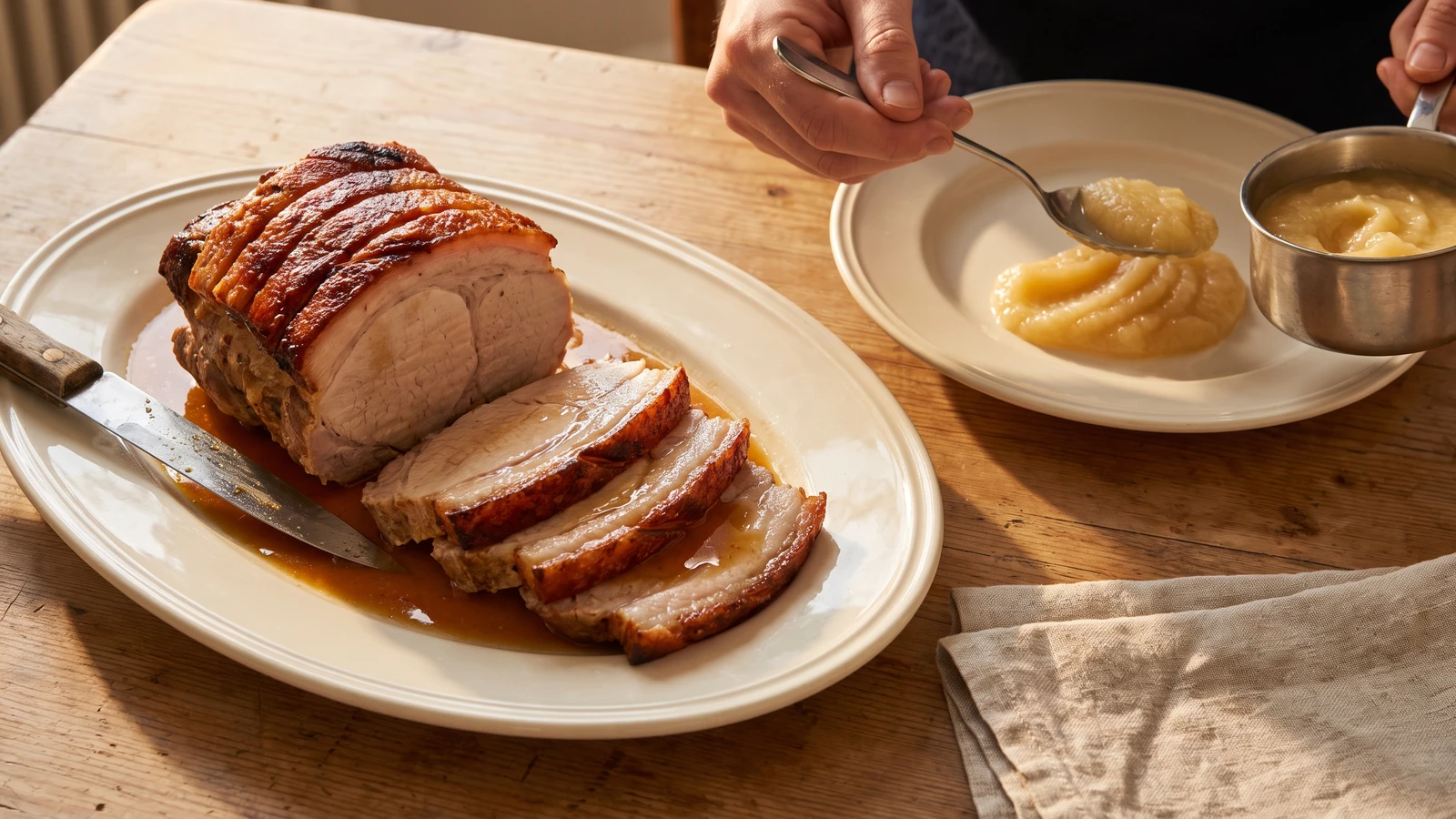
A burnished roast of fresh pork neck with clear, savory pan gravy and a bright apple purée, where patient roasting and a tightly sealed saucepan turn modest ingredients into proper weeknight comfort.
Échine de porc fraîche aux pommes étuvées (fresh pork neck with tightly stewed apples) teaches a useful classical opposition: patient heat for the pork, quick captured heat for the fruit. The one true thing to know before you touch a pan is that the lid makes the apple purée. Seal the saucepan firmly, and the apples soften in their own concentrated moisture; let that moisture escape, and they dry, catch, and lose their bright edge.
The original entry assumed a roasting station, a hand free to watch the joint, a second burner for the apples, and someone to clear the gravy at service. It calls for no saucier, no stock kept on the fire, and no salamander, so we invent none. For four, the joint becomes a 3-pound boneless collar, while the book's pound of apples to one ounce of sugar remains exactly as written. A probe thermometer replaces constant brigade attention, foil beneath a snug lid seals the home saucepan, and a warmed bowl stands in for the timbale. One cook, one stove, one evening.
Constant attendance and formal serving silver are scaffolding. The dish itself is the pork roasted until fully done yet yielding, the apples cooked quickly without losing their moisture, the gravy cleared of about three quarters of its fat, and the purée served apart so each diner chooses the balance. Before you touch the pan, find the lid that truly fits. That seal is the step that decides the dish.
The pairing has its clearest home in Normandy's cuisine bourgeoise, where orchard apples have long balanced the richness of fresh pork at household tables. This exact formula belongs to the national classical roasting repertoire rather than to a named Norman specialty: household practice was formalized by clearing the roast gravy and serving the quickly stewed apple purée separately in a timbale. That separation matters, because the apples are a bright counterpoint to the pork, not a sweet sauce cooked onto it.
Quantity
1 roast, 3 lb (1.36 kg)
tied into an even shape if needed
Quantity
2 teaspoons (10 ml / 12 g)
Quantity
About 3 medium, 1 lb (454 g) before peeling
peeled, cored, and finely minced shortly before cooking
Quantity
2 generous tablespoons (30 ml / 1 oz / 28 g)
Quantity
3 tablespoons (45 ml / 45 g)
Quantity
Up to 1/4 cup (60 ml / 60 g)
for loosening the roasting juices or rescuing the apples
| Ingredient | Quantity |
|---|---|
| boneless fresh pork neck or collar roasttied into an even shape if needed | 1 roast, 3 lb (1.36 kg) |
| fine sea salt | 2 teaspoons (10 ml / 12 g) |
| tart cooking applespeeled, cored, and finely minced shortly before cooking | About 3 medium, 1 lb (454 g) before peeling |
| granulated sugar | 2 generous tablespoons (30 ml / 1 oz / 28 g) |
| water for the apples | 3 tablespoons (45 ml / 45 g) |
| hot water (optional)for loosening the roasting juices or rescuing the apples | Up to 1/4 cup (60 ml / 60 g) |
Heat the oven to 450°F (230°C). Pat the pork completely dry, tie it into a compact, even roast if the butcher has not already done so, and season every surface with the salt. Set it fat-side up in a shallow metal roasting pan with a little space around it. No added fat is needed; a properly marbled neck brings its own.
Roast for 20 minutes, until the exposed surface begins to bronze, then lower the oven to 325°F (165°C). Continue roasting for 1 hour 30 minutes to 1 hour 50 minutes, beginning to check at the shorter time. The neck is ready when its crust is deep Maillard bronze, a probe enters the centre with little resistance, and the internal temperature reaches 185 to 190°F (85 to 88°C). The source asks for the meat well done, and neck rewards that instruction: its fat renders and its connective tissue softens instead of leaving the joint tough. If the crust darkens too quickly, cover it loosely with foil. If the pan juices threaten to burn, add hot water 1 tablespoon at a time around the meat, never over its crust; if a patch has already blackened, move the roast to a clean pan and leave the bitter patch behind.
During the final 20 minutes of roasting, peel, core, and finely mince the apples. Put them in a small heavy saucepan with the sugar and 3 tablespoons water. Crimp a sheet of foil tightly over the rim, then clamp on the lid. Set the pan over medium-high heat until bubbling is audible, about 2 minutes, then reduce to medium and cook quickly for 10 to 12 minutes without lifting the lid. Shake the closed pan once or twice so the apples settle evenly. If a caramel smell appears early, remove the pan from the heat at once; lift the pale apples into a clean saucepan without scraping the dark bottom, add 1 tablespoon hot water, reseal, and finish gently. Ça se rattrape.
Transfer the finished pork to a warm platter, cover it loosely, and rest it for 20 minutes. Pour the roasting juices into a heatproof jug and let the fat rise for 5 minutes. Spoon away roughly three quarters of the visible fat, reserving a teaspoon, but leave enough to give the gravy a proper sheen. Return the dark juices and remaining fat to the roasting pan, add only enough hot water to release the brown fond, and scrape over medium heat. Simmer for 2 to 3 minutes, until the flavor is concentrated but the gravy remains fluid. If over-skimming made it taste thin, whisk back a little reserved pork fat. This is clear roast gravy, not a flour-thickened sauce.
Just before carving, return the covered apples to low heat for 1 minute. Uncover and work them thoroughly with a wire whisk until the purée is smooth and softly mounded. If firm pieces remain, add 1 teaspoon hot water, reseal, and cook for another 2 minutes before whisking again. If the purée is loose, cook it uncovered for a minute while whisking. Keep it warm under its lid; no cream, spice, or blender is needed.
Cut the pork across the grain into slices about 1/2 inch (1.25 cm) thick and arrange them on the warm platter. Spoon the cleared gravy over and around the meat, letting its gloss show without drowning the crust. Transfer the pommes étuvées to a warmed small bowl, the honest home equivalent of the original timbale, and serve them separately. Each forkful should carry as much or as little apple as its owner wants. À table!
1 serving (about 340g)
Culinary guides, cultural storytelling, and the editorial depth that makes cooking meaningful.
Discover Culinary ExplorerChef Juliette
John Dory has the delicacy of sole and the firmness of turbot. A light flouring, a quick butter sauté, and nut-brown beurre noisette show exactly why looks never mattered.

Chef Juliette
Fresh haddock proves its delicacy in the meunière pan: a fine flour crust, moist pearly flakes, and beurre noisette sharpened with lemon and parsley, ready from one skillet in half an hour.

Chef Juliette
Éperlans à l’Anglaise turns small fish into a lesson in disciplined coating: boned smelts under a close, crisp crumb, pan-fried in clarified butter and finished with bright, half-melted maître d’hôtel butter.

Chef Juliette
Tiny smelts, shallot, mushrooms, white wine, gratin sauce, and fine bread raspings meet a fierce oven, where the fish must turn tender in the same breath the buttered crust bronzes.