
Chef Juliette
John Dory (St. Pierre)
John Dory has the delicacy of sole and the firmness of turbot. A light flouring, a quick butter sauté, and nut-brown beurre noisette show exactly why looks never mattered.
A cooking platform built around craft, culture, and the stories behind what we eat.
Created by Chef Juliette
Based on No. 1387, Fresh Neck of Pork with Brussels Sprouts, from Le Guide Culinaire (1907) by Auguste Escoffier
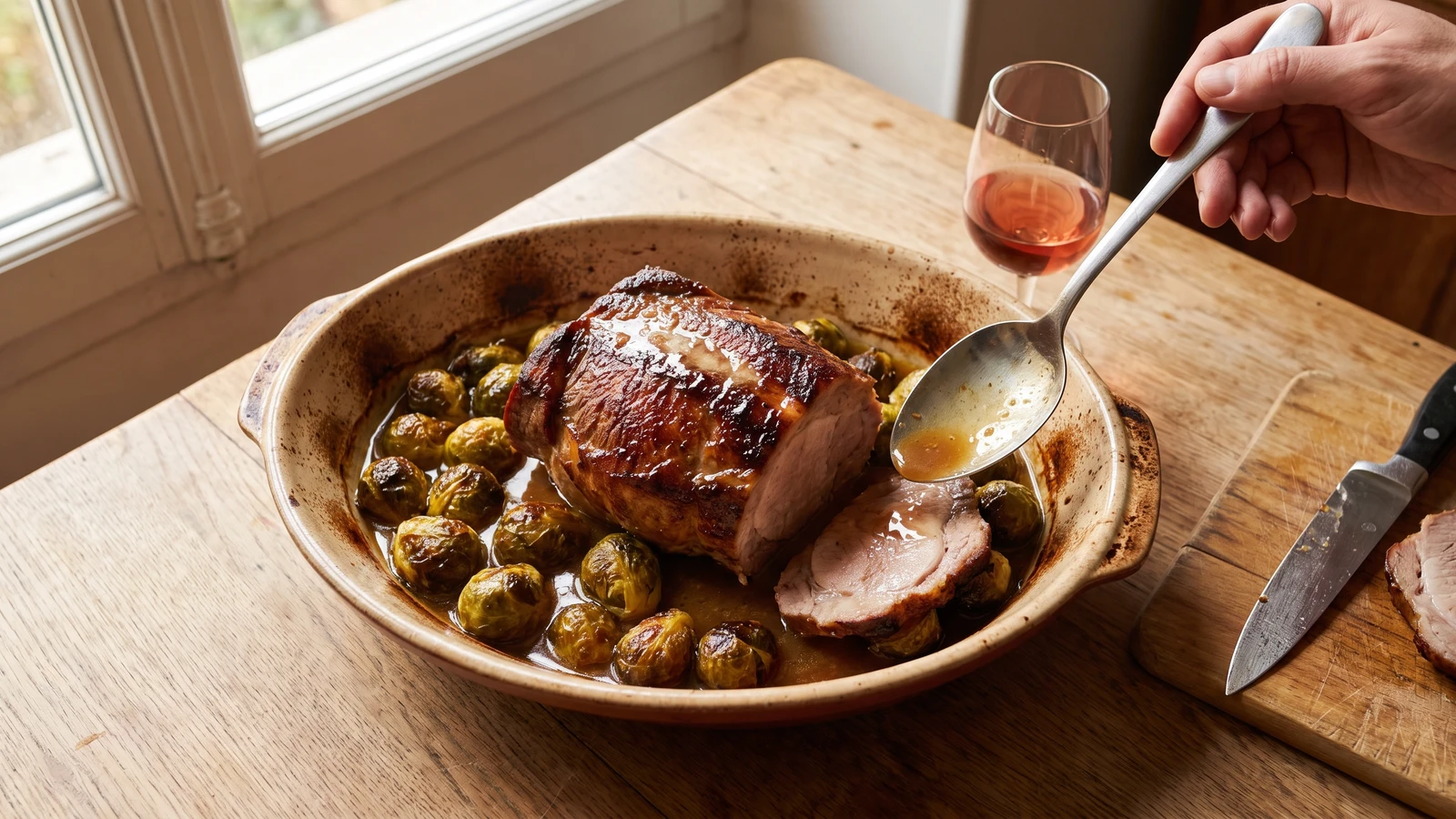
A marbled pork neck roasts in the earthenware that comes to the table, while Brussels sprouts finish in its gravy and fat, basted until tender and bronzed.
Échine de porc fraîche aux choux de Bruxelles (fresh pork neck with Brussels sprouts) teaches one true thing: the garnish must finish in the roast. These sprouts are not boiled greens parked beside pork at the end. Cook them only three-quarters through, drain them until their surfaces are dry, then let the pork's gravy and fat do the final cooking.
The original entry assumed an unspecified service-sized joint, a cook free to baste repeatedly, and an earthenware dish sturdy enough to pass from oven to table. It assumes neither a saucier, a stock never off the fire, nor a salamander, so none belongs here. For one cook, one stove, one evening, a 3-pound tied neck and a 3-quart oven-safe earthenware dish serve four. A separate presentation platter is service scaffolding and goes, while the par-cooking, complete drainage, shared roasting, and frequent basting are the dish and must stay.
Done properly, the neck is deeply bronzed and succulent, the sprouts tender at the heart with browned outer leaves, and the gravy tastes of pork because nothing has diluted it. Complete drainage is the decisive step. If the sprouts still glisten with water, dry them briefly in the warm empty pan before they meet the roast. Ça se rattrape.
Échine de porc fraîche aux choux de Bruxelles belongs to the cuisine bourgeoise table across France rather than to one province: a well-marbled fresh joint, winter sprouts, and the oven dish brought directly to the family table. The word fraîche distinguishes uncured pork from the salted pork of many potées and the smoked meats served with choucroute in Alsace. Its classical identity lies in the sequence: the sprouts are partly cooked apart, then become the garnish by finishing in the roast's gravy and fat.
Quantity
1 roast, about 3 pounds (1.35 kg)
tied, with its exterior fat left on
Quantity
about 6 cups (1.4 L / 680 g)
trimmed and kept whole
Quantity
5½ teaspoons (27 ml / 33 g)
divided
Quantity
1 teaspoon (5 ml / 2 g)
Quantity
2 quarts (1.9 L / 1.9 kg)
for par-cooking the Brussels sprouts
Quantity
½ cup (120 ml / 120 g)
only if needed to protect and loosen the fond
| Ingredient | Quantity |
|---|---|
| boneless fresh pork neck or collar roasttied, with its exterior fat left on | 1 roast, about 3 pounds (1.35 kg) |
| Brussels sproutstrimmed and kept whole | about 6 cups (1.4 L / 680 g) |
| fine sea saltdivided | 5½ teaspoons (27 ml / 33 g) |
| freshly ground black pepper | 1 teaspoon (5 ml / 2 g) |
| waterfor par-cooking the Brussels sprouts | 2 quarts (1.9 L / 1.9 kg) |
| boiling water (optional)only if needed to protect and loosen the fond | ½ cup (120 ml / 120 g) |
Heat the oven to 375°F (190°C), or 350°F (180°C) convection, with a rack just below the centre. Do not preheat the earthenware dish. Pat the pork completely dry, leave its fat in place, and retie it at 1½-inch (4 cm) intervals if the butcher's string is loose. Season it all over with 2¼ teaspoons (13 ml / 14 g) of the salt and all the pepper. Set it fat-side up in the centre of a 3-quart (2.8 L) oven-safe earthenware roasting dish.
Roast the pork alone for 45 minutes. After about 30 minutes, tilt the dish carefully and spoon the rendered fat and juices over the meat. The film forming beneath it should be hazelnut brown, never black. If an edge begins to scorch, lower the oven by 25°F (10°C) and add 1 tablespoon (15 ml / 15 g) boiling water down the side of the dish, then loosen the dark fond gently with a wooden spoon. Never pour cold liquid into hot earthenware.
While the pork roasts, bring the 2 quarts (1.9 L / 1.9 kg) water and remaining 3¼ teaspoons (16 ml / 19 g) salt to a full boil. Add the Brussels sprouts and, once the water returns to the boil, cook for 5 to 7 minutes. This is cuire aux trois quarts, cooking about three-quarters through: a small knife should pass easily through the outer layers but meet clear resistance at the centre. Drain them in a wide colander, shake firmly, and leave them exposed for 5 minutes. Do not rinse them. If water still beads on their surfaces, return them to the emptied warm pan over low heat and toss for 30 to 60 seconds. Ça se rattrape. Wet sprouts would dilute the gravy, while dry ones can drink it in.
Begin checking the pork after 60 minutes of roasting. When its centre reaches 135 to 140°F (57 to 60°C), arrange the drained sprouts around it in a snug single layer. If the pork has not reached that point, let it roast alone for another 10 minutes before checking again. Roll every sprout through the rendered fat and gravy, then spoon the juices over the meat and vegetables. Roast for another 25 to 35 minutes, turning and basting the sprouts every 10 minutes, until the pork reaches 165°F (74°C) in its thickest part and the sprouts are tender at the heart with bronzed outer leaves. If the dish becomes dry, add boiling water 1 tablespoon at a time and loosen the fond. If the pork finishes before the sprouts have browned, rest it briefly on a board while the sprouts roast for up to 10 minutes more, then return it to the dish.
Remove the earthenware dish from the oven and tent only the pork loosely with foil, leaving the sprouts uncovered. Rest for 15 minutes, basting the vegetables once with the settling juices. If a deep pool of clear fat remains, spoon off the excess but leave enough to gloss the sprouts and carry the gravy. Bring the roast to the table in its cooking dish. Carve there, or lift it briefly to a board, slice across the grain about ½ inch (1.25 cm) thick, and return the slices to the same earthenware among the sprouts. Spoon the gravy over everything. À table!
1 serving (about 390g)
Culinary guides, cultural storytelling, and the editorial depth that makes cooking meaningful.
Discover Culinary ExplorerChef Juliette
John Dory has the delicacy of sole and the firmness of turbot. A light flouring, a quick butter sauté, and nut-brown beurre noisette show exactly why looks never mattered.

Chef Juliette
Fresh haddock proves its delicacy in the meunière pan: a fine flour crust, moist pearly flakes, and beurre noisette sharpened with lemon and parsley, ready from one skillet in half an hour.

Chef Juliette
Éperlans à l’Anglaise turns small fish into a lesson in disciplined coating: boned smelts under a close, crisp crumb, pan-fried in clarified butter and finished with bright, half-melted maître d’hôtel butter.

Chef Juliette
Tiny smelts, shallot, mushrooms, white wine, gratin sauce, and fine bread raspings meet a fierce oven, where the fish must turn tender in the same breath the buttered crust bronzes.