
Chef Juliette
John Dory (St. Pierre)
John Dory has the delicacy of sole and the firmness of turbot. A light flouring, a quick butter sauté, and nut-brown beurre noisette show exactly why looks never mattered.
A cooking platform built around craft, culture, and the stories behind what we eat.
Created by Chef Juliette
Based on No. 1386, Fresh Neck of Pork à la Choucroûte, from Le Guide Culinaire (1907) by Auguste Escoffier
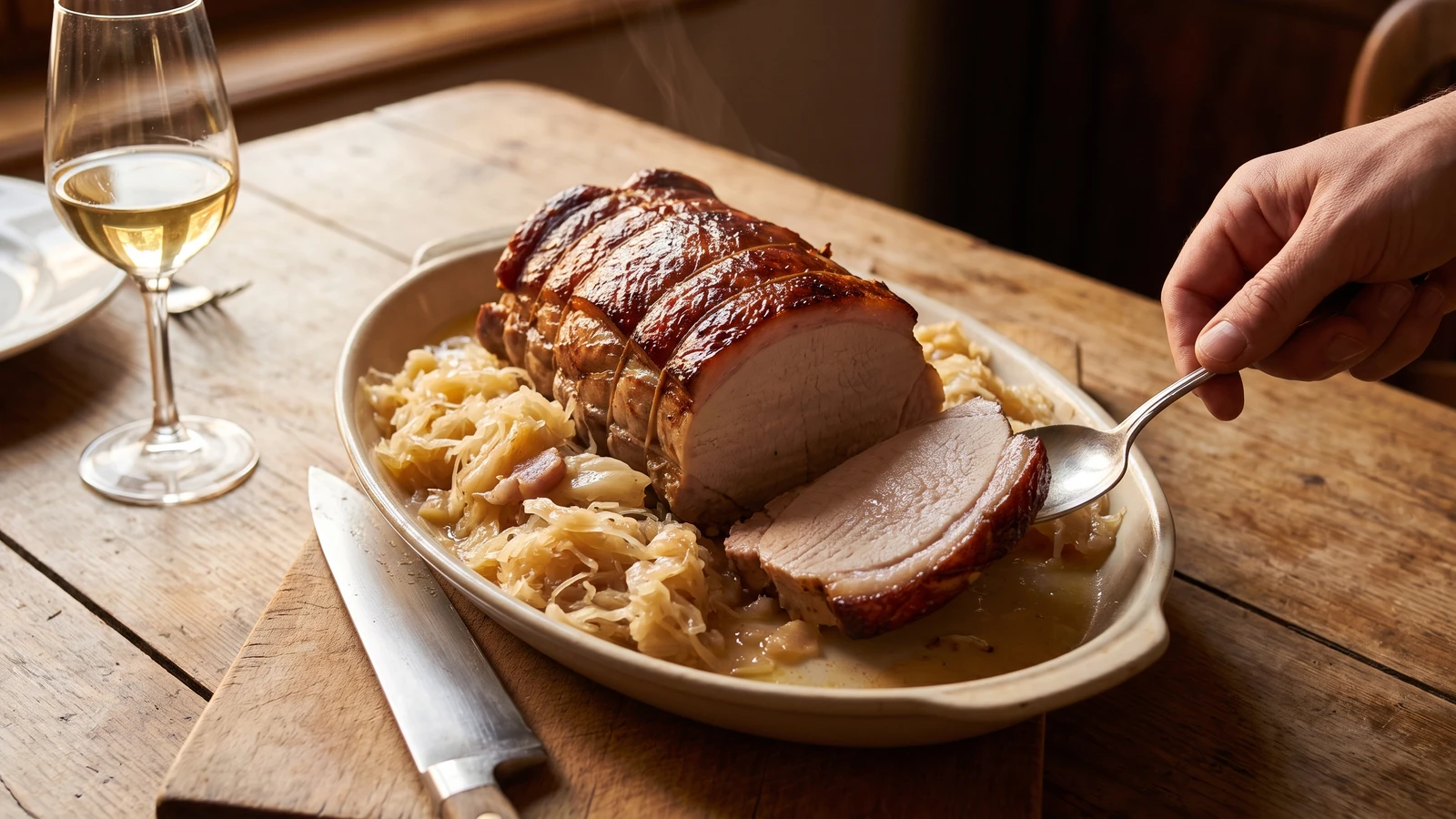
Fresh pork neck and choucroûte share one oven and one rich exchange: the roast bastes the cabbage with its own fat, while gentle heat carries the meat to a bronzed, tender, thoroughly cooked finish.
Échine de porc fraîche à la choucroûte (fresh neck of pork with braised sauerkraut) teaches the discipline of shared fat. The pork seasons the cabbage as it roasts, and the cabbage receives that richness without becoming greasy. The one true thing to know before touching a pan is this: neck must finish completely and gently, because its connective tissue needs time. Underdone pork neck sits heavily; properly cooked neck is moist, giving, and generous.
The original assumed a warm stove compartment, a vast braising pan of Sauerkraut (Choucroûte) (No. 2097), and consommé from a stockpot never off the fire, not a saucier's finishing pan or a salamander. For four, the honest equivalents are a tied 1.4-kilogram joint, a covered home casserole of the referenced preparation entering its final hour, and a low domestic oven watched with a thermometer. The ten-pound cabbage batch and warm holding compartment are brigade scaffolding, so they shrink and become one controlled oven. The repeated basting with neck fat and thorough cooking are the dish, and they stay. One cook, one stove, one evening.
The finished joint should wear a deep bronze fat cap, with moist slices surrounded by pale, glossy choucroûte. If the cabbage becomes oily during basting, drain it and restore only a spoonful of its own liquor. Ça se rattrape. The step that matters most is the gentle final hour: measure the centre of the pork, not your patience, and carry it to 78 to 80°C before resting.
Choucroûte belongs to Alsace, where cabbage preserved by lactic fermentation met a regional table rich in fresh, salted, and smoked pork. Farmhouse crocks became generous communal platters, while grand kitchens arranged the cabbage as a composed garnish around a single roast such as this neck. Here fresh means uncured, not barely cooked; the insistence on cooking the joint through suits the neck's dense connective tissue as much as it answers caution.
Quantity
1 roast (about 3 lb 2 oz / 1.4 kg)
fat cap intact and tied at 1½-inch (4 cm) intervals
Quantity
6 cups (1.5 L / 1.2 kg) Sauerkraut (Choucroûte) (No. 2097)
prepared according to its own entry through all but the final hour of cooking
Quantity
1 tablespoon (15 ml / 18 g)
Quantity
1 teaspoon (5 ml / 2 g)
| Ingredient | Quantity |
|---|---|
| boneless fresh pork neck or collar roastfat cap intact and tied at 1½-inch (4 cm) intervals | 1 roast (about 3 lb 2 oz / 1.4 kg) |
| Sauerkraut (Choucroûte)prepared according to its own entry through all but the final hour of cooking | 6 cups (1.5 L / 1.2 kg) Sauerkraut (Choucroûte) (No. 2097) |
| fine sea salt | 1 tablespoon (15 ml / 18 g) |
| freshly ground black pepper | 1 teaspoon (5 ml / 2 g) |
Take the pork from the refrigerator 45 minutes before roasting. Heat the oven to 230°C (450°F) with a rack in the upper-middle position. Pat the joint completely dry, then season every surface with the salt and pepper. Set it fat-side up on a rack in a shallow roasting pan. Add no oil: the neck carries the fat needed for both its crust and the cabbage.
Roast at 230°C (450°F) for 20 minutes, until the fat begins to render and the upper surface takes a firm bronze colour. Reduce the oven to 165°C (325°F) and continue roasting for 45 to 70 minutes, checking early, until a thermometer inserted sideways into the thickest part reads 65 to 68°C (149 to 154°F). If the drippings begin turning black, pour 2 tablespoons of water around the rack, never over the meat, and scrape the darkening film loose. Ça se rattrape: you want browned juices and clear fat, not a scorched pan.
Set the 6 cups (1.5 L / 1.2 kg) of Sauerkraut (Choucroûte) (No. 2097), prepared according to its own entry through all but the final hour, in a covered 3-litre casserole. If it was made ahead and chilled, warm it gently on the stove until the liquid bubbles at the edges; cold cabbage would steal heat from the oven. Once the pork reaches 65 to 68°C (149 to 154°F), lower the oven to 140°C (285°F), place the covered casserole beside or beneath the roasting pan, and begin the gentle final hour.
Every 15 minutes, tilt the roasting pan and spoon 1 to 2 tablespoons of the clear rendered neck fat over the cabbage, then lift and turn it gently so the fat travels through rather than sitting on top. Keep both vessels in the low oven for 50 to 60 minutes, until the pork reaches 78 to 80°C (172 to 176°F) at its centre. If the temperature stalls below 75°C (167°F), raise the oven to 165°C (325°F) for 10 minutes and check again. If it climbs too quickly, lower the oven to 110°C (230°F) and complete the hour gently. Thoroughly cooked does not mean blasted dry.
Transfer the pork to a warm board, cover it loosely with foil, and rest it for 20 minutes. Remove the casserole from the oven and inspect the cabbage. Spoon away any obvious surface fat; if it feels greasy throughout, drain it in a sieve for a minute, return it to the casserole, and fold in only enough of its own braising liquor to leave it moist and glossy. This is the source instruction to clear away superfluous fat, and it matters after repeated basting.
Remove the strings and set the whole neck in the centre of a warmed oval platter. Arrange the choucroûte around it in generous spoonfuls, pressing each mound lightly so it holds against the roast without becoming compacted. Carve the pork across the grain into slices about 1 cm (⅜ inch) thick, serving each person both the bronzed outer meat and the tender centre. À table!
1 serving (about 560g)
Culinary guides, cultural storytelling, and the editorial depth that makes cooking meaningful.
Discover Culinary ExplorerChef Juliette
John Dory has the delicacy of sole and the firmness of turbot. A light flouring, a quick butter sauté, and nut-brown beurre noisette show exactly why looks never mattered.

Chef Juliette
Fresh haddock proves its delicacy in the meunière pan: a fine flour crust, moist pearly flakes, and beurre noisette sharpened with lemon and parsley, ready from one skillet in half an hour.

Chef Juliette
Éperlans à l’Anglaise turns small fish into a lesson in disciplined coating: boned smelts under a close, crisp crumb, pan-fried in clarified butter and finished with bright, half-melted maître d’hôtel butter.

Chef Juliette
Tiny smelts, shallot, mushrooms, white wine, gratin sauce, and fine bread raspings meet a fierce oven, where the fish must turn tender in the same breath the buttered crust bronzes.