Culinary Explorer

A cooking platform built around craft, culture, and the stories behind what we eat.
Discover Culinary Explorer
Fresh Neck of Pork

Fresh Neck of Pork

Created by Chef Juliette

Based on No. 1385, Fresh Neck of Pork, from Le Guide Culinaire (1907) by Auguste Escoffier

Collet de porc frais rôti teaches the honest roast: steady basting, patient heat, and a full cook that melts the neck’s seams into succulent slices beneath a burnished crust.

Main Dishes
French
Comfort Food
Weeknight
35 min
Active Time
2 hr 20 min cook3 hr 20 min total
Yield4 servings

Collet de porc frais rôti teaches one truth before anything else: pork neck isn't finished merely when it's safe to eat. Its seams of fat and connective tissue need patient heat to soften and baste the meat from within. Stop at the temperature suited to a lean loin and the neck remains waxy and sits heavy; carry it to tenderness and it becomes succulent, deeply browned, and generous.

The original entry is terse because it assumed a roast cook who knew the joint by touch, a larger household portion, and a prepared garnish waiting nearby. It calls for no saucier's sauce and no stockpot, so neither do we. For four, the honest equivalent is a smaller boneless collar tied evenly, a thermometer in place of the roast cook's practiced thumb, a jus made from the pan itself, and purée de pommes de terre chosen from the vegetable purées the entry expressly permits. What changed is scale and control, not intent. One cook, one stove, one evening.

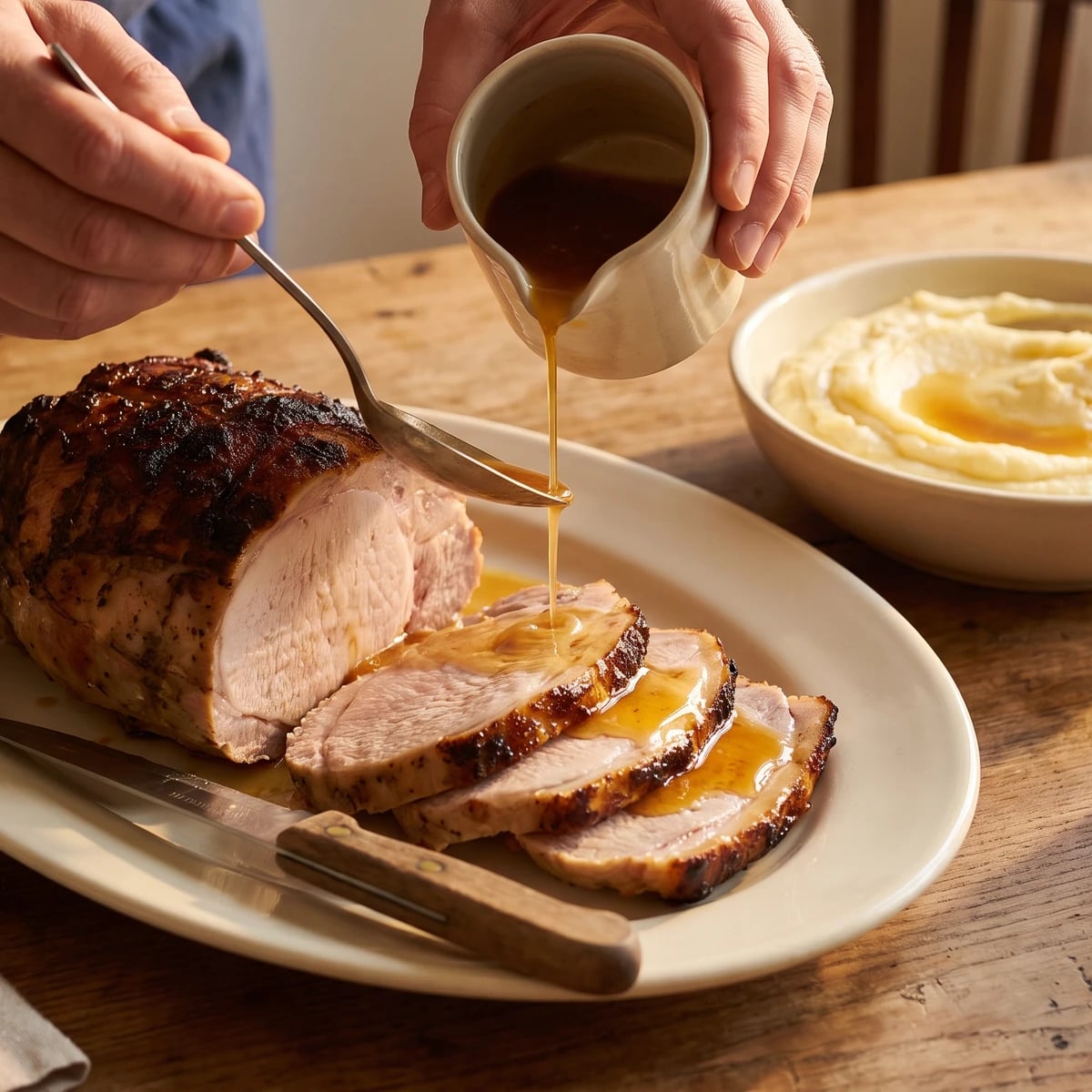
The finished collet should wear a dark bronze crust, with clear, glossy juices gathering beneath each slice and an ivory mound of buttery purée ready to catch them. The step that decides the dish is the basting: tend the pan every twenty minutes, and never let its fond burn dry.

Collet de porc frais rôti belongs to the French family and bourgeois table rather than to any single province; the classical repertory treats it as the representative fresh-pork joint and pairs it freely with vegetables, purées, macaroni, noodles, polenta, or gnocchi. In menu language, relevé meant the substantial joint that carried the meal, while fresh distinguished uncured pork from salted or smoked meat, not meat newly cut that morning. Its absence from grander service was social custom, not a judgment on the cut: the neck's fat and connective tissue made it splendid household roasting meat, provided the cook basted it and cooked it fully.

The technique, the tradition, and the story behind every dish.

Discover Culinary Explorer

Ingredients

boneless fresh pork neck or collar roast

Quantity

1 roast, 3 to 3½ pounds (1.4 to 1.6 kg)

fine sea salt

Quantity

3½ teaspoons (17.5 ml / 21 g)

divided

freshly ground black pepper

Quantity

1 teaspoon (5 ml / 2 g)

unsalted butter

Quantity

10 tablespoons (150 ml / 142 g)

3 tablespoons softened for the roast, 6 tablespoons cubed for the purée, and 1 tablespoon chilled for the jus

yellow onions

Quantity

2 medium, about 2 cups (475 ml / 300 g)

thickly sliced

carrots

Quantity

2 medium, about 1½ cups (355 ml / 200 g)

cut into large pieces

garlic

Quantity

4 cloves, about 4 teaspoons (20 ml / 20 g)

lightly crushed

thyme

Quantity

6 sprigs

bay leaf

Quantity

1

hot water

Quantity

2 cups (480 ml / 480 g)

divided

floury potatoes, such as russets or Yukon Golds

Quantity

2 pounds (900 g)

peeled and evenly quartered

coarse salt

Quantity

1 tablespoon (15 ml / 15 g)

for the potato water

heavy cream

Quantity

¾ cup (180 ml / 180 g)

freshly grated nutmeg

Quantity

1 small pinch

Equipment Needed

  • Heavy 12 by 16-inch (30 by 40 cm) roasting pan with low sides
  • Instant-read meat thermometer
  • Kitchen twine
  • Potato ricer or food mill
  • Fine-mesh sieve
  • Small saucepan

Instructions

  1. 1

    Tie and season

    Take the pork from the cold thirty minutes before roasting. Heat the oven to 450°F (230°C) with a rack in the lower third. Tie the roast at 1½-inch (4 cm) intervals so its thickness is even, then dry it thoroughly. Season every surface with 2½ teaspoons of the fine salt and all the pepper, and rub it with 3 tablespoons of softened butter. Spread the onions, carrots, garlic, thyme, and bay leaf in a snug roasting pan and settle the pork on top, fat side up.

    A snug pan protects the drippings. In a pan much larger than the roast, the juices spread thinly and burn before there is enough liquid for basting.
  2. 2

    Roast and baste

    Roast at 450°F (230°C) for 20 minutes, until the surface begins to bronze. Lower the oven to 325°F (165°C) and pour 1 cup of the hot water around the meat, never over its crust. Continue roasting for 1 hour 45 minutes to 2 hours, basting every 20 minutes with the buttery pan juices. Add the remaining hot water a little at a time whenever the pan approaches dryness. If the crust darkens too quickly, cover only that dark patch loosely with foil. If the fond has already blackened, move the pork and unburned vegetables to a clean pan and continue with fresh hot water; don't scrape bitterness into the jus. The roast is ready at 180 to 185°F (82 to 85°C), when a skewer enters without rubbery resistance and the seams feel yielding.

    The temperature is higher than the minimum needed for pork safety because this is neck, not loin. The extra heat softens its connective tissue and renders the internal fat.
  3. 3

    Cook the potatoes

    During the final forty minutes of roasting, put the potatoes in a saucepan and cover them by 1 inch (2.5 cm) with cold water. Add the coarse salt, bring to a gentle boil, then lower the heat and simmer until a knife passes through the centres without resistance, about 20 minutes. Drain thoroughly and return them to the dry pan over low heat for a minute, shaking gently, until their surfaces look floury. This drives away water that would otherwise thin the purée.

  4. 4

    Make the purée

    Warm the cream with 6 tablespoons of cubed butter and the nutmeg until the butter melts. Pass the hot potatoes through a ricer or food mill, then fold in two-thirds of the cream mixture with the remaining 1 teaspoon fine salt. Add the rest only as needed, beating gently with a wooden spoon until the purée is smooth and falls in a soft mound. Never use a blender or food processor; their blades release too much starch and turn the potatoes gluey. If the purée is loose, ça se rattrape: stir it over very low heat for a minute or two until the excess moisture leaves. Cover and hold it somewhere warm.

  5. 5

    Rest and build jus

    Transfer the pork to a board and cover it loosely with foil for 25 minutes. Strain the roasting-pan contents into a bowl, pressing the vegetables gently, then spoon away the excess surface fat. Set the roasting pan over medium heat, pour in a little of the strained liquid, and scrape up every sound brown patch of fond. Add the remaining strained juices and simmer until reduced to about ¾ cup (180 ml), glossy but still fluid. Remove it from the heat and whisk in the final tablespoon of chilled butter. If the jus looks oily, whisk 1 teaspoon of cold water in a clean bowl and add the jus gradually until it comes together.

  6. 6

    Carve across grain

    Remove the strings and find the direction of the muscle fibres, then carve across them into slices about ⅓ inch (8 mm) thick. Spoon a little jus over the pork, keeping the rest in a warm jug, and serve the purée beside it so each person can catch the juices as they please. The crust should be deeply bronzed, the meat tender enough to cut with the side of a fork, and the purée rich enough to need no disguise. À table!

Chef Tips

  • Ask the butcher for pork neck, collar, or the upper collar end of the shoulder, with its fat left in place. A boneless Boston butt is an honest substitute when neck isn't sold separately; its shape differs, but it has the same useful seams of fat and connective tissue.
  • Don't judge this cut by colour alone. A thermometer tells you when the centre is hot enough, while a skewer tells you whether the connective tissue has softened. You need both readings to agree.
  • Basting is the dish, not brigade scaffolding. It coats the surface with fat, carries the aromatic juices over the crust, and keeps the fond fluid enough to become a clean jus instead of a burnt stain.
  • Pour a lively red with enough freshness for the pork's richness, such as Beaujolais-Villages or Chinon. Heavy, heavily oaked wine makes a generous roast feel ponderous.

Advance Preparation

  • The pork may be tied and seasoned 12 to 24 hours ahead, then left uncovered in the refrigerator. The dry surface browns particularly well; take it out thirty minutes before roasting.
  • The onions, carrots, and garlic may be cut earlier in the day. Peeled potatoes can wait for up to 4 hours submerged in cold water, then must be drained before cooking.
  • Leftover pork and jus keep for up to 3 days in the refrigerator. Reheat the slices covered at 300°F (150°C) with a spoonful of jus, stopping as soon as they are hot so the meat doesn't dry.

Frequently Asked Questions

Nutrition Information

1 serving (about 690g)

Calories
1500 calories
Total Fat
111 g
Saturated Fat
52 g
Trans Fat
2 g
Unsaturated Fat
56 g
Cholesterol
360 mg
Sodium
2450 mg
Total Carbohydrates
54 g
Dietary Fiber
8 g
Sugars
9 g
Protein
72 g

Note: Chef personas and recipes are created with AI assistance. Cook with care: follow safe food-handling practices, check doneness with a thermometer when needed, and adapt for allergies and your kitchen.

Where cooking meets culture.

Culinary guides, cultural storytelling, and the editorial depth that makes cooking meaningful.

Discover Culinary Explorer

More from Relevés and Entrées - PORK

Browse the full collection