
Chef Juliette
Baron (or Pair of Hind-quarters) of Lamb
A whole saddle and its two hind legs, butter-poêlé under a close cover, carved rosy beside new vegetables and clear pan gravy: grand anatomy brought within reach of one home oven.
A cooking platform built around craft, culture, and the stories behind what we eat.
Created by Chef Juliette
Based on No. 1382, Currie d’Agneau, from Le Guide Culinaire (1907) by Auguste Escoffier
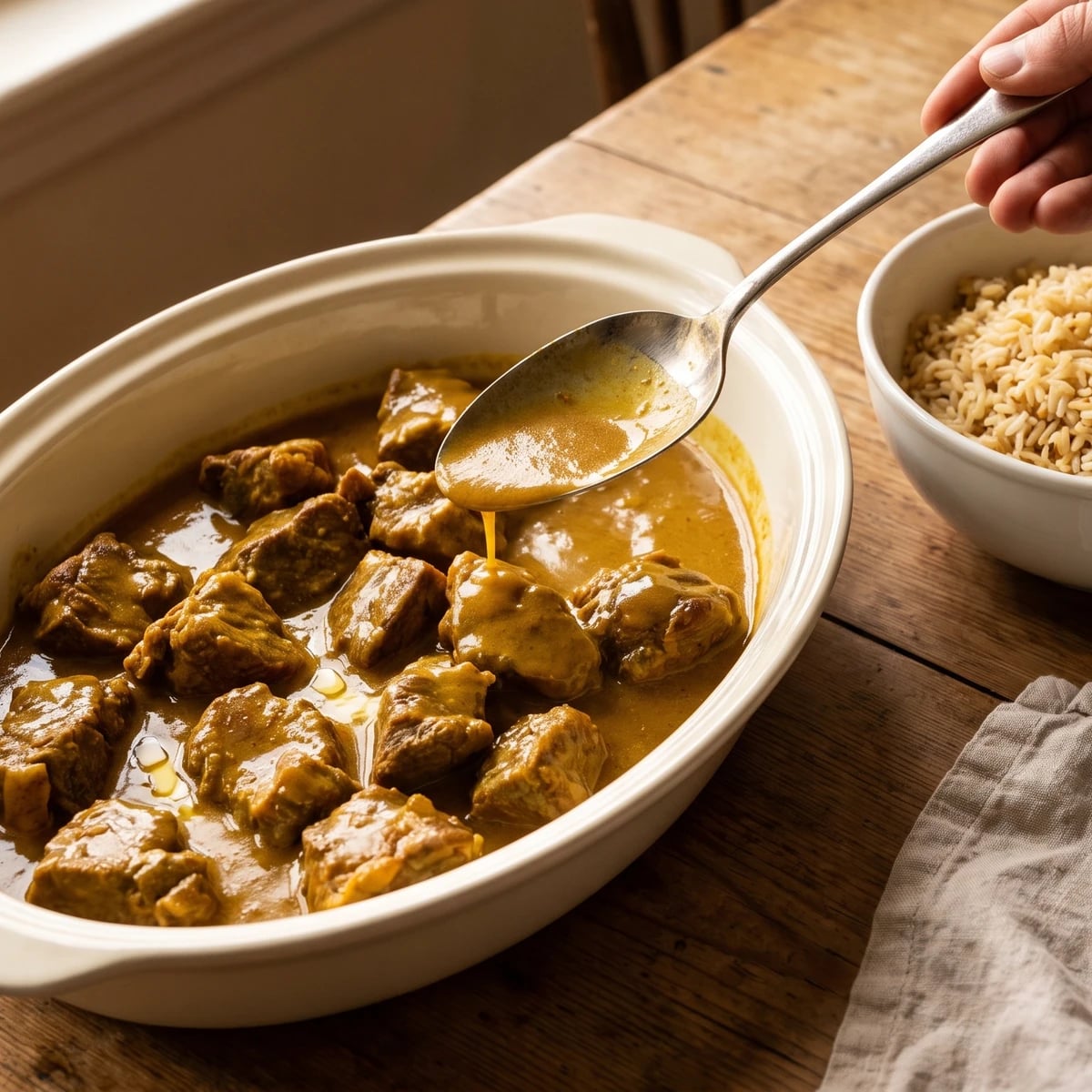
Lamb shoulder, browned in butter and simmered just until tender, teaches the discipline of the French currie: build the fond fully, shorten the braise, and keep the sauce smooth and generous.
Currie d’Agneau teaches one uncompromising thing: lamb is not mutton. Keep the full browning and sauce-building, then shorten the simmer for the young meat. Tenderness changes the clock, not the grammar.
The old entry is barely a sentence, sending the cook back to Currie de Mouton and asking only that the greater tenderness of lamb be respected. That assumes the neighboring formula at hand, a stock never off the fire, brigade portions, and a saucier free to pass and reduce the sauce. At home, the honest equivalents are one kilogram of shoulder, good prepared stock, a heavy cocotte, and a fine-mesh sieve. The quantity and cooking time have changed so the dish feeds four without exhausting the lamb. The separate hands are scaffolding; the fond, the singer, the bare simmer, and the smooth finish are the dish. One cook, one stove, one evening.
Done properly, the lamb stays succulent beneath an ochre-gold sauce that tastes first of meat and butter, then of warm spice. The decisive step is the simmer: keep it at a bare tremble and begin testing at forty-five minutes.
Within the French canon, currie d’agneau belongs to the Parisian professional table rather than to any one French region. Curry preparations reached French kitchens through colonial ports and the Anglo-Indian table, then were translated into the familiar grammar of a French stew: meat browned in butter, flour added by singer, stock, a bouquet garni, and a smooth sauce served with Rice à l’Indienne. It is not an Indian regional curry but a distinct French classical preparation shaped by that contact, and the spelling currie records its place in the French repertoire.
Quantity
2¼ pounds (1 kg)
trimmed and cut into 1½-inch pieces
Quantity
1½ teaspoons (7.5 ml / 9 g), plus more to finish
Quantity
½ teaspoon (2.5 ml / 1 g)
Quantity
4 tablespoons (60 ml / 57 g)
divided
Quantity
1¼ cups (300 ml / 180 g)
thinly sliced
Quantity
2 cloves
finely chopped
Quantity
1½ tablespoons (22.5 ml / 12 g)
Quantity
3 tablespoons (45 ml / 24 g)
Quantity
3 cups (720 ml / 720 g)
divided
Quantity
1
Quantity
4 cups (960 ml / 720 g)
hot, for serving
| Ingredient | Quantity |
|---|---|
| boneless lamb shouldertrimmed and cut into 1½-inch pieces | 2¼ pounds (1 kg) |
| fine salt | 1½ teaspoons (7.5 ml / 9 g), plus more to finish |
| freshly ground black pepper | ½ teaspoon (2.5 ml / 1 g) |
| unsalted butterdivided | 4 tablespoons (60 ml / 57 g) |
| yellow onionthinly sliced | 1¼ cups (300 ml / 180 g) |
| garlicfinely chopped | 2 cloves |
| mild curry powder | 1½ tablespoons (22.5 ml / 12 g) |
| plain flour | 3 tablespoons (45 ml / 24 g) |
| unsalted chicken or lamb stockdivided | 3 cups (720 ml / 720 g) |
| bouquet garni of parsley stems, thyme, and bay leaf | 1 |
| Rice à l’Indiennehot, for serving | 4 cups (960 ml / 720 g) |
Trim away thick surface fat and any tough silver skin, but leave the fine seams of fat running through the shoulder. Cut the meat into even pieces, dry them thoroughly, and season with the salt and pepper. Even pieces finish together, and a dry surface gives you a proper fond instead of grey meat sitting in its own liquid.
Melt 2 tablespoons of the butter in a heavy cocotte over medium-high heat. When the foam subsides, brown the lamb in three batches, leaving space between the pieces and turning them only after the first side has formed a deep bronze crust. Transfer each batch to a bowl. Adjust the heat if the butter darkens too quickly, but keep the brown glaze on the pot floor; that fond is the foundation of the sauce.
Lower the heat to medium and add the remaining butter, followed by the onion. Cook for 7 to 8 minutes, stirring and scraping the pot, until the onion is soft and pale gold. Add the garlic for 30 seconds, then return the lamb and its collected juices. Sprinkle over the curry powder and flour. Singer, meaning dust the meat with flour, by tossing everything over the heat for about 90 seconds. The powder should smell warm and fragrant without taking dark colour.
Pour in 1 cup of the stock gradually, stirring between additions so the flour dissolves into a smooth sauce and every trace of fond lifts from the pot. Add another 1½ cups of stock and the bouquet garni. Bring the sauce just to a simmer, partially cover, and lower the heat until only an occasional bubble breaks the surface. Cook for 45 minutes, then test a piece. Continue for 10 to 20 minutes if it still resists the fork. Young lamb needs tenderness, not endurance; a hard boil or an automatic mutton-length braise will dry it before the sauce is ready.
Lift the tender lamb into a warm bowl and discard the bouquet garni. Skim excess fat from the sauce, then pass it through a fine-mesh sieve, pressing the softened onion and garlic to recover their flavour. Return the sauce to the cocotte and simmer uncovered until glossy and thick enough to coat the back of a spoon. If it is too thick, whisk in some of the reserved stock; if it is thin, reduce it for a few minutes longer. Any small flour lumps disappear in the sieve. Ça se rattrape. Return the lamb only long enough to heat through, then correct the salt.
Spoon the currie d’agneau into a warmed serving dish, coating every piece generously with sauce. Bring the Rice à l’Indienne separately so its dry, distinct grains remain a counterpoint to the smooth sauce. Serve at once. À table!
1 serving (about 540g)
Culinary guides, cultural storytelling, and the editorial depth that makes cooking meaningful.
Discover Culinary Explorer
Chef Juliette
A whole saddle and its two hind legs, butter-poêlé under a close cover, carved rosy beside new vegetables and clear pan gravy: grand anatomy brought within reach of one home oven.

Chef Juliette
Two lamb legs become one burnished joint under a covered butter roast, then their own drippings become a clear, peppery gravy. Gentle heat and faithful basting teach the discipline of poêler.

Chef Juliette
Quartier d’Agneau Poêlé teaches the discipline of basting: a young hindquarter slowly enclosed with butter, then uncovered to bronze, with clear lamb jus and spring vegetables carried proudly to the Sunday table.

Chef Juliette
Butter-basted lamb fillet, rosy within and bronzed outside, with new spring vegetables and a clear pan gravy. Filet d’agneau poêlé teaches the quiet heat and steady spooning that protect a tender cut.