Culinary Explorer

A cooking platform built around craft, culture, and the stories behind what we eat.
Discover Culinary Explorer
Carré d’Agneau Grillé

Carré d’Agneau Grillé

Created by Chef Juliette

Based on No. 1364, Carré d’Agneau Grillé, from Le Guide Culinaire (1907) by Auguste Escoffier

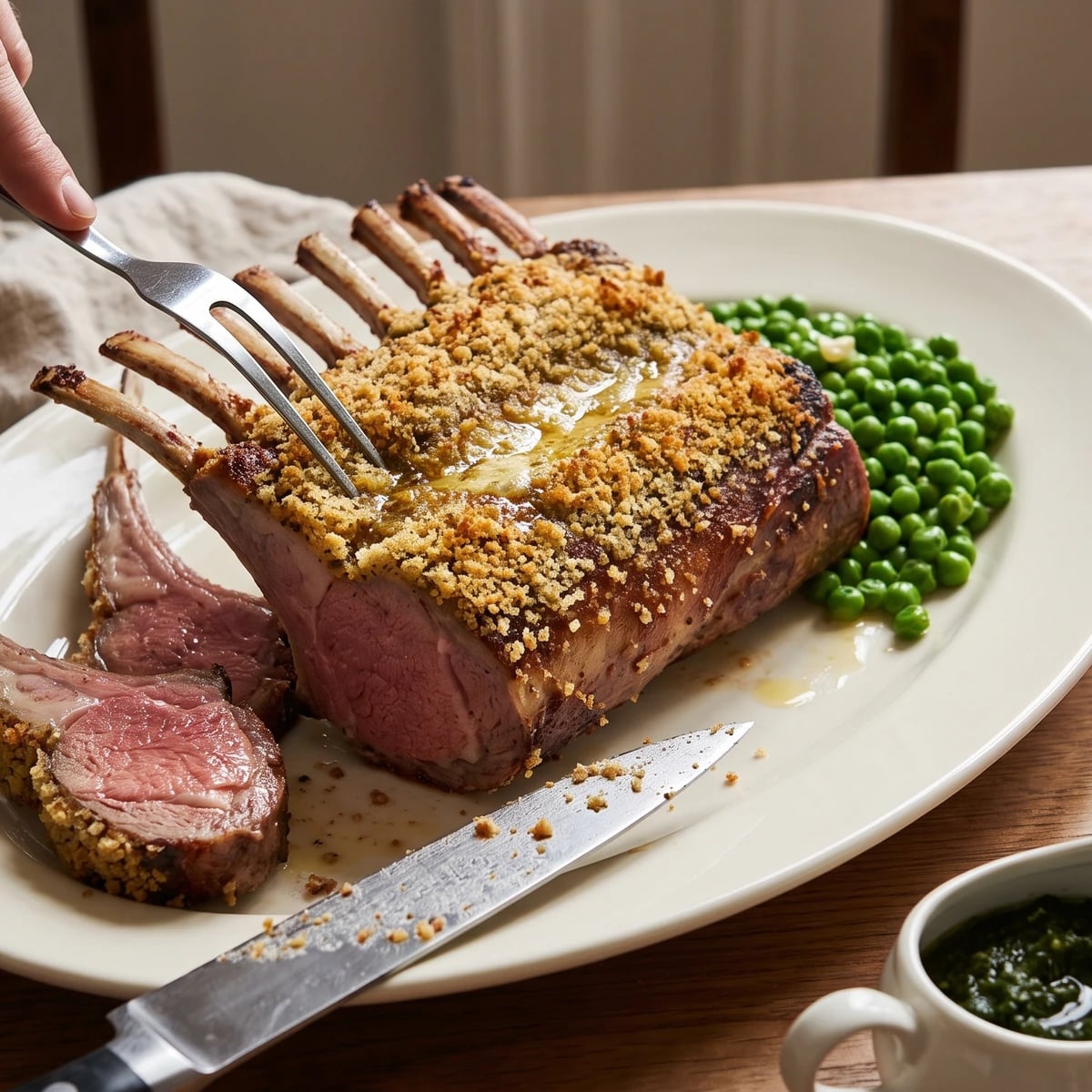
Carré d’agneau grillé teaches the discipline of two heats: a slow buttered cook for rosy meat, then fresh butter and fine crumbs bronzed fast, with sharp mint sauce waiting at the table.

Main Dishes
French
Dinner Party
Special Occasion
Easter
30 min
Active Time
40 min cook1 hr 20 min total
Yield4 servings

Carré d’agneau grillé (gently grilled rack of lamb) teaches the discipline of two heats. The one true thing to know before touching the meat is this: the crumbs go on only when the lamb is nearly cooked. Begin them too early and they burn while the center stays raw; add them late, after a second brush of real butter, and they bronze into a fine savory crust around rosy meat.

The classical entry assumed hands to shorten and trim the rack, an adjustable coal grill, and a salamander ready to colour the last coating. Your butcher removes the chine bone, a two-zone home grill supplies the slow fire, and the oven broiler becomes the salamander. A pastry brush replaces the service spoon because it distributes the same melted butter evenly over a rack scaled for four. There is no stockpot or saucier hiding behind this dish, and none is needed. The unspecified garnish becomes buttered petits pois, which finish during the lamb’s rest and keep one cook’s timing calm.

Elaborate trimming and carving service were brigade scaffolding; they can go. The gentle first cook, two applications of butter, late breadcrumbs, and sharp mint sauce are the dish and must stay. Watch the internal temperature rather than the clock, because colour can be rescued but overcooked lamb cannot. The decisive step is the late crumb coat: not a minute before the lamb is nearly cooked.

Carré d’agneau grillé belongs to the Parisian classical dining room and the national roast-and-grill repertoire rather than to one provincial larder; carré names the whole rib rack, not an individual chop. In classical service, the rack was trimmed, gently grilled whole, coloured beneath fierce overhead heat, and carved at the table, a progression home cooks can reproduce without the service brigade. The sharp mint sauce is a deliberate English accompaniment absorbed into French service, not a Provençal herb sauce, and its vinegar bite answers the butter and lamb fat.

The technique, the tradition, and the story behind every dish.

Discover Culinary Explorer

Ingredients

French-trimmed 8-rib rack of lamb

Quantity

1 rack (about 2 lb / 900 g)

neck end shortened, chine bone removed, and fat cap left ⅛ inch / 3 mm thick

fine sea salt for the lamb

Quantity

1½ teaspoons (7.5 ml / 9 g)

freshly ground black pepper

Quantity

1 teaspoon (5 ml / 2 g)

unsalted butter for brushing

Quantity

4 tablespoons (60 ml / 57 g)

melted

fine fresh white breadcrumbs

Quantity

¾ cup (180 ml / 55 g)

fresh mint leaves

Quantity

1 cup loosely packed (240 ml / 20 g)

finely chopped

boiling water

Quantity

2 to 3 tablespoons (30 to 45 ml / 30 to 45 g)

red wine vinegar

Quantity

¼ cup (60 ml / 60 g)

granulated sugar

Quantity

2 teaspoons (10 ml / 8 g)

fine sea salt for the mint sauce

Quantity

¼ teaspoon (1.25 ml / 1.5 g)

frozen petits pois

Quantity

3 cups (720 ml / 420 g)

unsalted butter for the peas

Quantity

2 tablespoons (30 ml / 28 g)

fine sea salt for the peas

Quantity

¼ teaspoon (1.25 ml / 1.5 g)

Equipment Needed

  • Lidded charcoal or gas grill arranged for two-zone cooking
  • Broiler-safe rimmed sheet pan
  • Instant-read meat thermometer
  • Pastry brush
  • Sharp slicing or carving knife

Instructions

  1. 1

    Trim and season

    Take the lamb from the refrigerator 30 minutes before cooking. Check the butcher’s work: the chine bone should be gone so the rack can be carved cleanly, the rib ends should be scraped, and a thin fat cap should remain. Pat the meat dry, score only the fat in a shallow crosshatch, then season every surface with the lamb salt and black pepper. Dry meat takes colour; wet meat merely sweats.

  2. 2

    Make the mint sauce

    Dissolve the sugar and mint-sauce salt in 2 tablespoons (30 ml / 30 g) of boiling water. Stir in the chopped mint and leave it for 5 minutes, then add 3 tablespoons (45 ml / 45 g) of the vinegar. Let the sauce stand for at least 20 minutes before tasting. It should be herbaceous and decidedly sharp, not sugary. If the vinegar catches too fiercely, add the reserved tablespoon of water. Ça se rattrape. If it tastes flat, add the remaining vinegar a teaspoon at a time.

  3. 3

    Prepare two heats

    Arrange a lidded charcoal or gas grill for two-zone cooking, with one side holding a gentle indirect heat of 325 to 350°F / 165 to 175°C and the other left free of flame. Clean the grate thoroughly. Melt the brushing butter until just liquid, without browning it, and keep the breadcrumbs nearby. The gentle zone cooks the lamb; the oven broiler supplies the fierce overhead heat of the salamander for the final colour.

  4. 4

    Grill gently

    Brush the rack all over with half the melted butter. Set it bone-side down over the indirect zone, with the fat cap facing upward, and close the lid. Grill gently for 20 to 30 minutes, rotating the rack halfway through, until a thermometer inserted into the thickest meat without touching bone reads 130 to 133°F / 54 to 56°C. If the butter begins to scorch or the exterior darkens early, move the rack farther from the fire and lower the heat. Patience, not flame, gives you an evenly rosy center.

    Judge the lamb by temperature, never by a fixed number of minutes. Rack thickness, bone size, weather, and grill construction all change the clock.
  5. 5

    Butter, crumb, bronze

    Heat the oven broiler and set a rack about 6 inches / 15 cm below it. Transfer the lamb, bone-side down, to a broiler-safe rimmed tray. Brush the fat and exposed meat with the remaining melted butter, shower them evenly with the breadcrumbs, and press very lightly so the coating holds. Broil for 2 to 5 minutes, turning the tray as needed, until the crumbs are deep butter-gold and the center reaches 140°F / 60°C. If the crumbs brown before the lamb reaches temperature, shield the crust loosely with foil and return the rack to the indirect grill to finish. If the lamb reaches temperature while the crumbs remain pale, move it closer to the broiler for 20-second bursts, watching without blinking.

    The second buttering is not decoration. It anchors the crumbs and gives them the fat they need to bronze rather than dry.
  6. 6

    Rest and gloss peas

    Transfer the rack to a warm board and rest it for 10 minutes, tented loosely enough that the foil never touches the crust. Carryover heat should bring the center close to 145°F / 63°C. While it rests, melt the pea butter in a wide pan over medium heat. Add the frozen petits pois and their salt, cover for 3 minutes, then uncover and toss for another 2 to 3 minutes, until bright green, tender, and glossy. Take them off the heat before their skins wrinkle.

  7. 7

    Carve and serve

    Cut straight down between the rib bones with a sharp slicing knife, preserving as much of the breadcrumb coat as possible. Arrange two chops per person on a warmed platter with the buttered petits pois gathered alongside. Pass the mint sauce separately so each guest can spoon it over the meat without soaking the crust. Serve the moment the carving is done, very hot and glistening. À table!

Chef Tips

  • Give the butcher the awkward work. Ask for an eight-rib rack with the neck end shortened, chine bone removed, rib ends cleaned, and a thin fat cap left in place. A rack stripped completely bare loses both protection and flavour.
  • Use fine fresh crumbs from plain white bread, not coarse panko. The source calls for a close golden coating that drinks in the second brushing of butter and clings to the curved rack.
  • No outdoor grill is necessary if weather or space refuses. Cook the buttered rack on a wire rack in a 375°F / 190°C oven until it reaches 130 to 133°F / 54 to 56°C, then apply the second butter and crumbs and finish beneath the broiler. You lose the faint edge of live fire, but the method’s intent remains whole.
  • Fresh mint is essential here. Dried mint tastes dusty in an uncooked sauce and cannot provide the green, peppery lift needed against lamb fat. Serve the sauce at room temperature, never refrigerator-cold.
  • A thermometer is not gadget theatre. It is the cleanest way to coordinate pink meat with a golden crumb coat. For guests who prefer lamb cooked beyond pink, shield the browned crumbs with foil and continue gently to their desired temperature.
  • A red Bordeaux with firm acidity suits the butter and lamb, while a Loire Cabernet Franc answers the mint especially well. Pour either without ceremony.
  • Refrigerate leftover lamb within 2 hours and use it within 3 days. Reheat it gently in a 300°F / 150°C oven, uncovered, until hot; the crumb coat will soften somewhat, which is honest leftovers rather than failure.

Advance Preparation

  • The butcher can trim the rack before you bring it home. Season it up to 8 hours ahead and refrigerate it uncovered, then take it out 30 minutes before cooking.
  • Make the mint sauce up to 4 hours ahead, cover it, and refrigerate it. Return it to room temperature for 30 minutes before serving and stir well.
  • Prepare the fine breadcrumbs a day ahead and keep them sealed at room temperature. Leave the petits pois frozen until the lamb begins its rest.

Frequently Asked Questions

Nutrition Information

1 serving (about 290g)

Calories
620 calories
Total Fat
43 g
Saturated Fat
21 g
Trans Fat
1 g
Unsaturated Fat
19 g
Cholesterol
115 mg
Sodium
1250 mg
Total Carbohydrates
23 g
Dietary Fiber
6 g
Sugars
8 g
Protein
36 g

Note: Chef personas and recipes are created with AI assistance. Cook with care: follow safe food-handling practices, check doneness with a thermometer when needed, and adapt for allergies and your kitchen.

Where cooking meets culture.

Culinary guides, cultural storytelling, and the editorial depth that makes cooking meaningful.

Discover Culinary Explorer

More from Relevés and Entrées - House Lamb

Browse the full collection