
Chef Juliette
John Dory (St. Pierre)
John Dory has the delicacy of sole and the firmness of turbot. A light flouring, a quick butter sauté, and nut-brown beurre noisette show exactly why looks never mattered.
A cooking platform built around craft, culture, and the stories behind what we eat.
Created by Chef Juliette
Based on No. 1363, Carré d’Agneau à la Boulangère, from Le Guide Culinaire (1907) by Auguste Escoffier
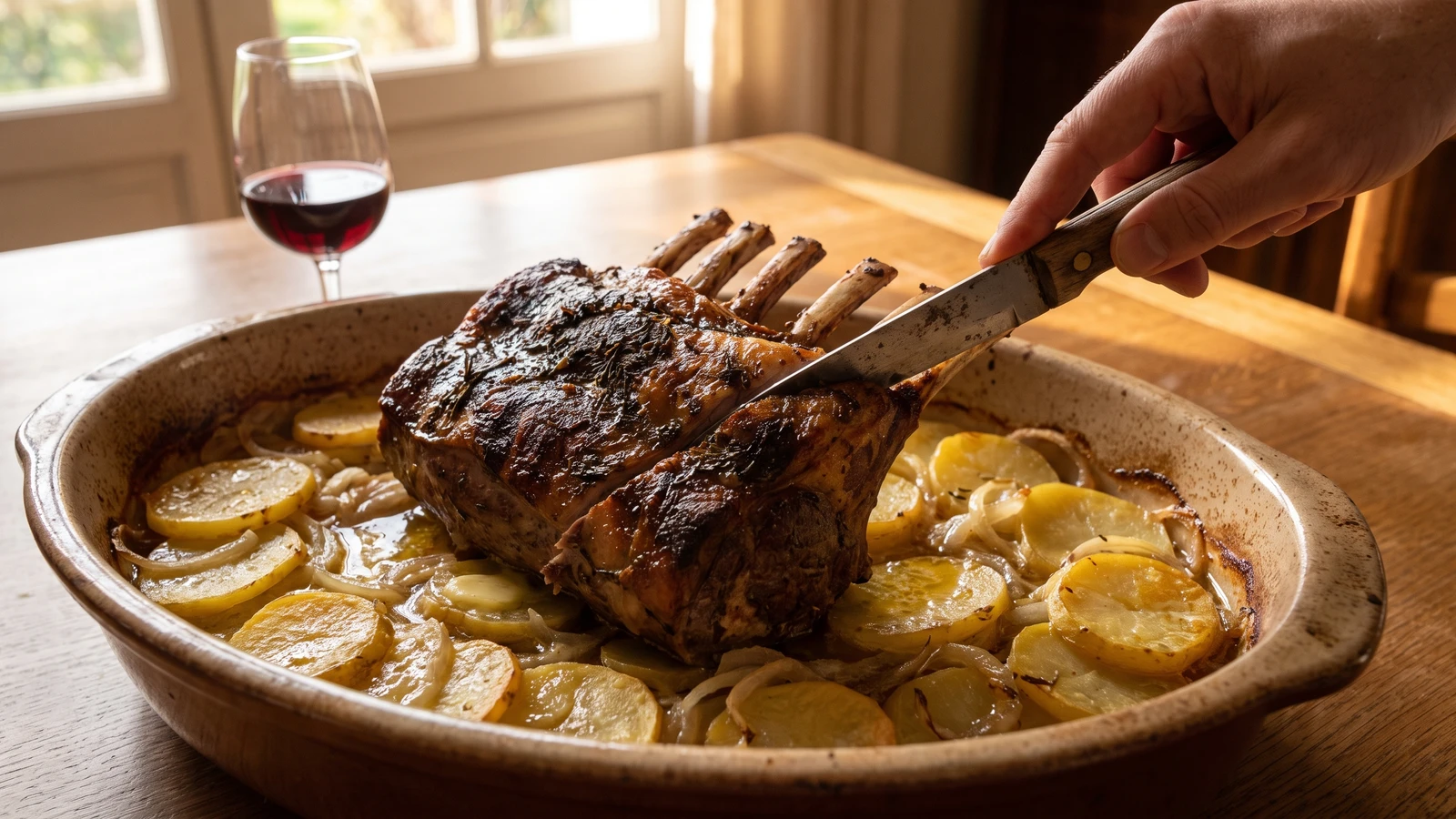
Carré d’Agneau à la Boulangère sets a butter-browned rack over onions and thick potato rounds, letting the joint season its own garnish. The lesson is timing: one dish, two clocks, nothing wasted.
Carré d’Agneau à la Boulangère (rack of lamb with baker’s potatoes) teaches one clean principle: lamb and potatoes do not share a clock. The carré is tender and quick; half-inch potato roundels need time to soften before their edges can bronze. Give the vegetables their head start and the rack can remain rosy while its fat runs down through onions and potatoes.
The entry sends the cook to the canonical procedure for Gigot à la Boulangère (No. 1307), which assumed a substantial joint whose roasting time matched the potatoes beneath it. Its old butchery language points to the neck-end carré, sold at a modern butcher’s counter as a rack. For four people, one eight-rib rack is the honest equivalent, and the only deliberate timing change is to brown the rack, let the vegetables begin cooking without it, then reunite everything for the finish.
The brigade’s synchronized timing is scaffolding and can go. Browning the lamb in butter, coloring the onions, cutting the potatoes a full half-inch thick, bathing them in the joint’s fat, and serving everything in the cooking dish are the dish itself, so they stay. There is no saucier, no stockpot kept constantly hot, and no salamander to replace; the joint supplies the sauce and the oven supplies the color. Watch the rack’s internal temperature before you trust the clock. That is the step that matters.
À la boulangère belongs to working household tables across France, where families entrusted prepared joints and potatoes to neighborhood boulangeries after the bread came out of the oven. Classical kitchens fixed that domestic practice into a method: onions lightly colored in butter, thick rounds of potato, and a joint whose fat seasons them, all served in the baking dish. Although boulangère literally points toward the baker’s wife, the culinary name records the baker’s oven and the household custom, not a separate sauce or a garnish belonging to one province.
Quantity
1 rack (2¼ to 2½ lb / 1 to 1.15 kg)
chine bone removed and fat cap trimmed to ⅛ inch (3 mm)
Quantity
2 large (4 cups / 1 lb / 450 g)
sliced ¼ inch (6 mm) thick
Quantity
6 medium (about 6 cups / 2 lb / 900 g)
peeled and cut into ½-inch (1.25-cm) roundels
Quantity
4 tablespoons (60 ml / 57 g)
divided
Quantity
2 teaspoons (10 ml / 12 g)
divided
Quantity
1 teaspoon (5 ml / 2 g)
divided
Quantity
1 application of Gigot à la Boulangère (No. 1307)
scaled and timed for a tender rack
| Ingredient | Quantity |
|---|---|
| eight-rib rack of lambchine bone removed and fat cap trimmed to ⅛ inch (3 mm) | 1 rack (2¼ to 2½ lb / 1 to 1.15 kg) |
| large yellow onionssliced ¼ inch (6 mm) thick | 2 large (4 cups / 1 lb / 450 g) |
| Yukon Gold potatoespeeled and cut into ½-inch (1.25-cm) roundels | 6 medium (about 6 cups / 2 lb / 900 g) |
| unsalted butterdivided | 4 tablespoons (60 ml / 57 g) |
| fine sea saltdivided | 2 teaspoons (10 ml / 12 g) |
| freshly ground black pepperdivided | 1 teaspoon (5 ml / 2 g) |
| canonical à la Boulangère procedurescaled and timed for a tender rack | 1 application of Gigot à la Boulangère (No. 1307) |
Heat the oven to 450°F (230°C) with a rack in the upper-middle position. Pat the lamb completely dry, because moisture prevents browning, then score only the surface of the fat cap in a shallow diamond pattern without cutting into the meat. Season the rack with 1 teaspoon (5 ml / 6 g) of the salt and ½ teaspoon (2.5 ml / 1 g) of the pepper. Slice the onions and potatoes evenly; unequal potatoes finish at unequal times.
Smear 1 tablespoon (15 ml / 14 g) of the butter over the bottom of a broad oven-safe earthenware or ceramic roasting dish, and rub another tablespoon (15 ml / 14 g) over the lamb. Set the rack fat-side down in the dish and roast for 7 minutes, then turn it fat-side up and roast for another 7 minutes. The meat should be richly golden and the dish floor should carry a nut-brown fond. If the butter turns black and smells acrid, lift out the lamb, wipe away the burnt solids, and continue with fresh butter. Ça se rattrape. Brown butter is useful; burnt butter is not.
Transfer the browned rack to a platter and lower the oven to 400°F (200°C). Following the garnish and proportions of Gigot à la Boulangère (No. 1307), add the remaining 2 tablespoons (30 ml / 28 g) butter and the sliced onions to the hot dish. Turn the onions through the butter and lamb fond, spread them evenly, and bake uncovered for 10 minutes, stirring once, until they soften and acquire pale golden edges.
Add the potato roundels to the onions with the remaining 1 teaspoon (5 ml / 6 g) salt and ½ teaspoon (2.5 ml / 1 g) pepper. Turn everything thoroughly so the potatoes collect the butter, lamb fat, and loosened fond, then arrange them in overlapping layers no more than three deep. Cover the dish snugly with parchment and foil, and bake for 25 minutes. A knife should meet resistance at the centers but enter the outer edges readily. They are not finished yet.
Remove the covering and raise the oven to 425°F (220°C). Set the rack fat-side up over the potatoes, pour any juices from its platter into the dish, and spoon a little of the accumulated fat over the top layer. Roast uncovered for 12 to 18 minutes, until the lamb is done to your liking and the potatoes are tender with bronze edges. For rosy medium-rare, remove the rack at 128 to 130°F (53 to 54°C); for conservative food-safety guidance, cook the lamb to 145°F (63°C) and rest it for at least 3 minutes.
Rest the rack loosely covered for 10 to 15 minutes. If the potatoes are already tender, remove their dish from the oven as well; if they need more color, leave them uncovered while the meat rests. Pour the lamb’s resting juices over the potatoes, return the whole rack to the dish, and carry it directly to the table. Carve between the ribs and give each person two chops with a generous bed of onions and potatoes. À table!
1 serving (about 420g)
Culinary guides, cultural storytelling, and the editorial depth that makes cooking meaningful.
Discover Culinary ExplorerChef Juliette
John Dory has the delicacy of sole and the firmness of turbot. A light flouring, a quick butter sauté, and nut-brown beurre noisette show exactly why looks never mattered.

Chef Juliette
Fresh haddock proves its delicacy in the meunière pan: a fine flour crust, moist pearly flakes, and beurre noisette sharpened with lemon and parsley, ready from one skillet in half an hour.

Chef Juliette
Éperlans à l’Anglaise turns small fish into a lesson in disciplined coating: boned smelts under a close, crisp crumb, pan-fried in clarified butter and finished with bright, half-melted maître d’hôtel butter.

Chef Juliette
Tiny smelts, shallot, mushrooms, white wine, gratin sauce, and fine bread raspings meet a fierce oven, where the fish must turn tender in the same breath the buttered crust bronzes.