
Chef Juliette
John Dory (St. Pierre)
John Dory has the delicacy of sole and the firmness of turbot. A light flouring, a quick butter sauté, and nut-brown beurre noisette show exactly why looks never mattered.
A cooking platform built around craft, culture, and the stories behind what we eat.
Created by Chef Juliette
Based on No. 1361, Carré d’Agneau Beaucaire, from Le Guide Culinaire (1907) by Auguste Escoffier
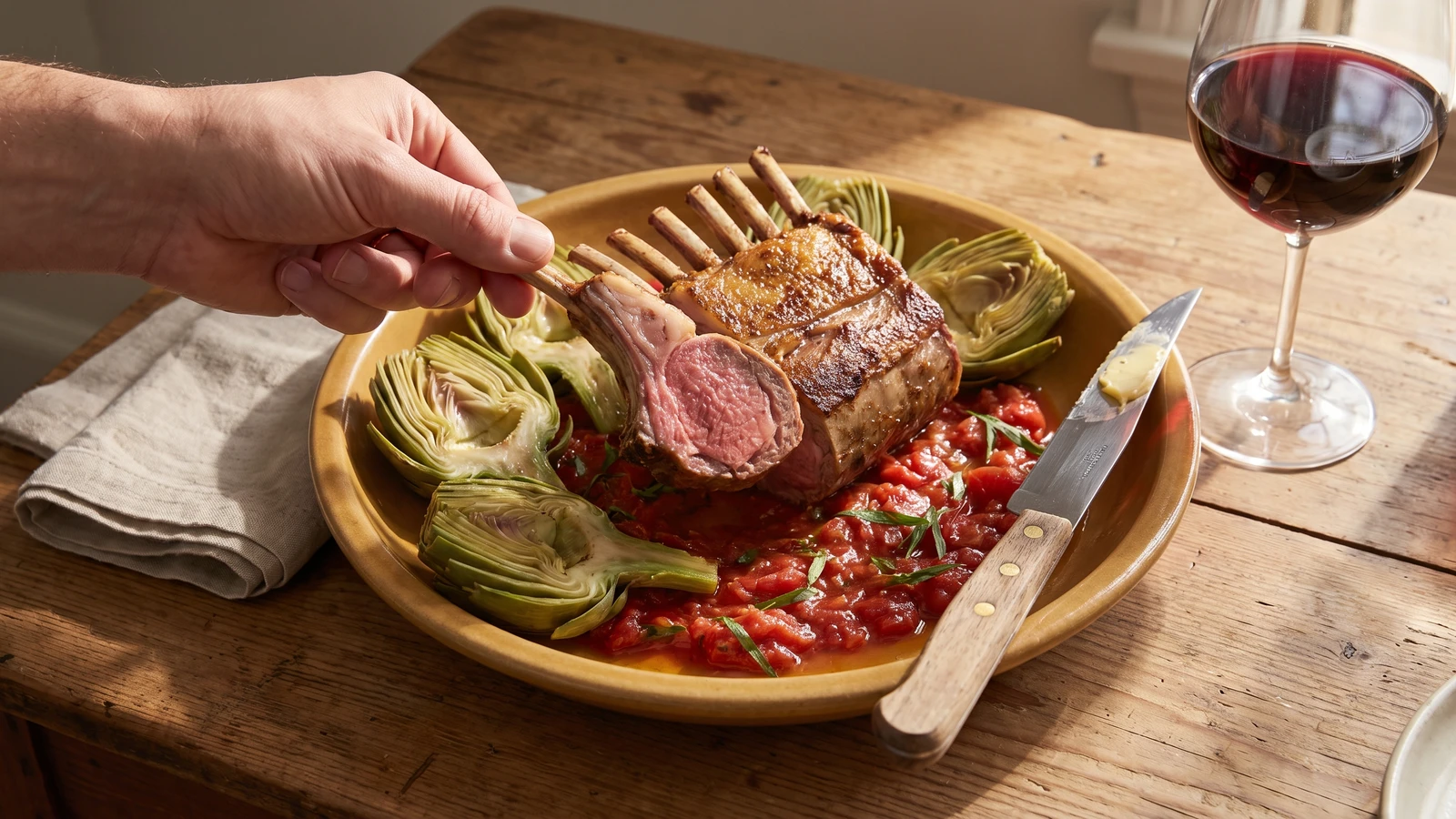
Carré d’Agneau Beaucaire brings the lower Rhône to one platter: a rosy, butter-browned rack set over tarragon tomato fondue, with tender half-artichokes drinking the lamb juices around it.
Carré d’Agneau Beaucaire (rack of lamb with tomato and Provençal artichokes) teaches coordination, not complication. Its one true rule is that none of the three parts may wait itself into ruin: the lamb must remain rosy, the small artichokes must yield to a knife, and the fondue de tomates, tomatoes cooked down in butter, must be concentrated enough to support the meat rather than flood it.
The original instruction assumed a butcher had trimmed the neck-end carré, tiny Provençal artichokes arrived tender and choke-free, and a saucier could concass and cook the tomatoes while another hand watched the roast. For one cook, I set the mise en place first, use one eight-rib rack and four small artichokes cut into the prescribed eight halves, then let an ovenproof skillet and a saucepan divide the work. An instant-read thermometer replaces the cook stationed at the oven. This entry needs neither the brigade’s stockpot, never off the fire, nor its salamander; those were scaffolding elsewhere, not the dish here.
What stays is the dish itself: lamb browned in real butter, artichokes cooked beside it, tomatoes fried in butter, and tarragon added only when the fondue is ready. When it reaches the platter, the carré is bronze outside and pink at the bone, the tomatoes gleam beneath it, and the artichokes carry lamb juices at their cut faces. One cook, one stove, one evening. Watch the shared finish in the oven; that meeting of tender artichoke and properly rested lamb decides the whole plate.
Carré d’Agneau Beaucaire points to Beaucaire in the Gard, on the western bank of the lower Rhône facing Provence, where lamb, tomatoes, tarragon, and small violet artichokes meet naturally at the table. The classical kitchen carried that market combination into the grand repertoire by laying the roasted carré over butter-cooked tomato fondue and preserving the artichokes as a distinct garnish rather than folding everything into a stew. The name is not loose shorthand for Provence: Beaucaire belongs to Bas-Languedoc, while the choke-free Provençal artichokes show the trade and cooking shared across the Rhône.
Quantity
1 rack (1 3/4 to 2 lb / 800 to 900 g)
chine bone removed
Quantity
4 (about 12 oz / 340 g total)
trimmed and halved lengthwise
Quantity
5 (about 3 cups / 600 g before pressing)
peeled, pressed, and concassed
Quantity
6 tablespoons (90 ml / 85 g)
divided
Quantity
1 tablespoon (15 ml / 4 g)
finely chopped
Quantity
1/4 cup (60 ml / 60 g)
Quantity
2 teaspoons (10 ml / 12 g)
divided
Quantity
3/4 teaspoon (3.75 ml / 1.5 g)
divided
| Ingredient | Quantity |
|---|---|
| French-trimmed 8-rib rack of lambchine bone removed | 1 rack (1 3/4 to 2 lb / 800 to 900 g) |
| small violet or baby artichokestrimmed and halved lengthwise | 4 (about 12 oz / 340 g total) |
| ripe medium tomatoespeeled, pressed, and concassed | 5 (about 3 cups / 600 g before pressing) |
| unsalted butterdivided | 6 tablespoons (90 ml / 85 g) |
| fresh tarragonfinely chopped | 1 tablespoon (15 ml / 4 g) |
| water | 1/4 cup (60 ml / 60 g) |
| fine sea saltdivided | 2 teaspoons (10 ml / 12 g) |
| freshly ground black pepperdivided | 3/4 teaspoon (3.75 ml / 1.5 g) |
Heat the oven to 375°F (190°C). Take the lamb from the cold about 30 minutes before cooking, pat it dry, and score only the surface fat in a shallow crosshatch. Score a small cross in the base of each tomato, lower them into boiling water for 20 to 30 seconds, then cool them in cold water and slip off the skins. Halve them across the middle and press gently to expel the seeds and loose juice. Concass, meaning roughly chop, the remaining flesh. Strip each artichoke down to its tender pale leaves, trim away the top third, pare the stem, and halve it lengthwise. True petits violets have no developed choke; if you find any fuzz, scrape it out with a teaspoon.
Season the rack all over with half the salt and pepper. Melt 2 tablespoons of the butter in a 12-inch ovenproof skillet over medium-high heat. When the foam begins to subside, lay in the lamb fat-side down and brown it patiently for 4 to 5 minutes, then color the back and both ends for another 3 to 4 minutes. Move it only when the crust releases willingly. If the butter solids turn black before the lamb is brown, lift out the rack, pour off the bitter fat, wipe away the black specks, and continue with a small knob of the reserved butter. The fond may be deep brown; black is another matter.
Lift the browned carré briefly from the skillet. Add 2 tablespoons of butter, arrange the eight artichoke halves cut-side down, and season them lightly. Return the rack fat-side up among them, pour the water down the side of the pan without wetting the crust, and spoon a little melted butter over the artichokes. Roast uncovered. The small measure of water gives a home oven the gentle, moist start the source expects from stewing, then evaporates so the butter and lamb juices can glaze the artichokes.
As soon as the lamb enters the oven, melt the remaining 2 tablespoons of butter in a wide saucepan over medium-high heat. Add the pressed, concassed tomatoes with the remaining salt and pepper. Fry them for 12 to 15 minutes, stirring often, until their raw smell disappears and they become a thick, glossy fondue that leaves a clean trail when the spoon crosses the pan. If the tomatoes remain watery, widen the heat and keep them moving; do not thicken them with flour. If they begin to catch before the moisture is gone, lower the heat and stir in a tablespoon of water. Once ready, take the pan off the heat and fold in the chopped tarragon. Adding it earlier would cook away its fragrance.
Begin checking the rack after 18 minutes. For rosy lamb, remove it when the center reads 125°F (52°C), allowing it to rise toward 130°F (54°C) as it rests; for medium, remove it at 130°F (54°C). The artichokes are ready when a paring knife enters the thickest part without resistance. If the lamb is ready first, transfer it to a board, add 2 tablespoons of water around the artichokes, cover the skillet, and cook them over medium heat for another 5 to 8 minutes. If the artichokes finish first, lift them out and keep them covered while the lamb continues. Ça se rattrape. What matters is bringing both to the platter properly cooked, not forcing them to obey the same clock.
Rest the carré for 10 minutes, loosely covered so its crust stays firm. If liquid remains in the artichoke skillet, boil it uncovered until the butter and lamb juices form a light glaze, then roll the artichokes through it. Spread the warm tarragon tomato fondue across a heated shallow platter, set the whole carré upon it, and ring it with all eight artichoke halves. Spoon the buttery glaze over the artichokes, not over the browned lamb. Present the rack whole and carve between the bones at the table. À table!
1 serving (about 280g)
Culinary guides, cultural storytelling, and the editorial depth that makes cooking meaningful.
Discover Culinary ExplorerChef Juliette
John Dory has the delicacy of sole and the firmness of turbot. A light flouring, a quick butter sauté, and nut-brown beurre noisette show exactly why looks never mattered.

Chef Juliette
Fresh haddock proves its delicacy in the meunière pan: a fine flour crust, moist pearly flakes, and beurre noisette sharpened with lemon and parsley, ready from one skillet in half an hour.

Chef Juliette
Éperlans à l’Anglaise turns small fish into a lesson in disciplined coating: boned smelts under a close, crisp crumb, pan-fried in clarified butter and finished with bright, half-melted maître d’hôtel butter.

Chef Juliette
Tiny smelts, shallot, mushrooms, white wine, gratin sauce, and fine bread raspings meet a fierce oven, where the fish must turn tender in the same breath the buttered crust bronzes.