
Chef Juliette
John Dory (St. Pierre)
John Dory has the delicacy of sole and the firmness of turbot. A light flouring, a quick butter sauté, and nut-brown beurre noisette show exactly why looks never mattered.
A cooking platform built around craft, culture, and the stories behind what we eat.
Created by Chef Juliette
Based on No. 1356, Double (or Pair of Legs) of Lamb, from Le Guide Culinaire (1907) by Auguste Escoffier
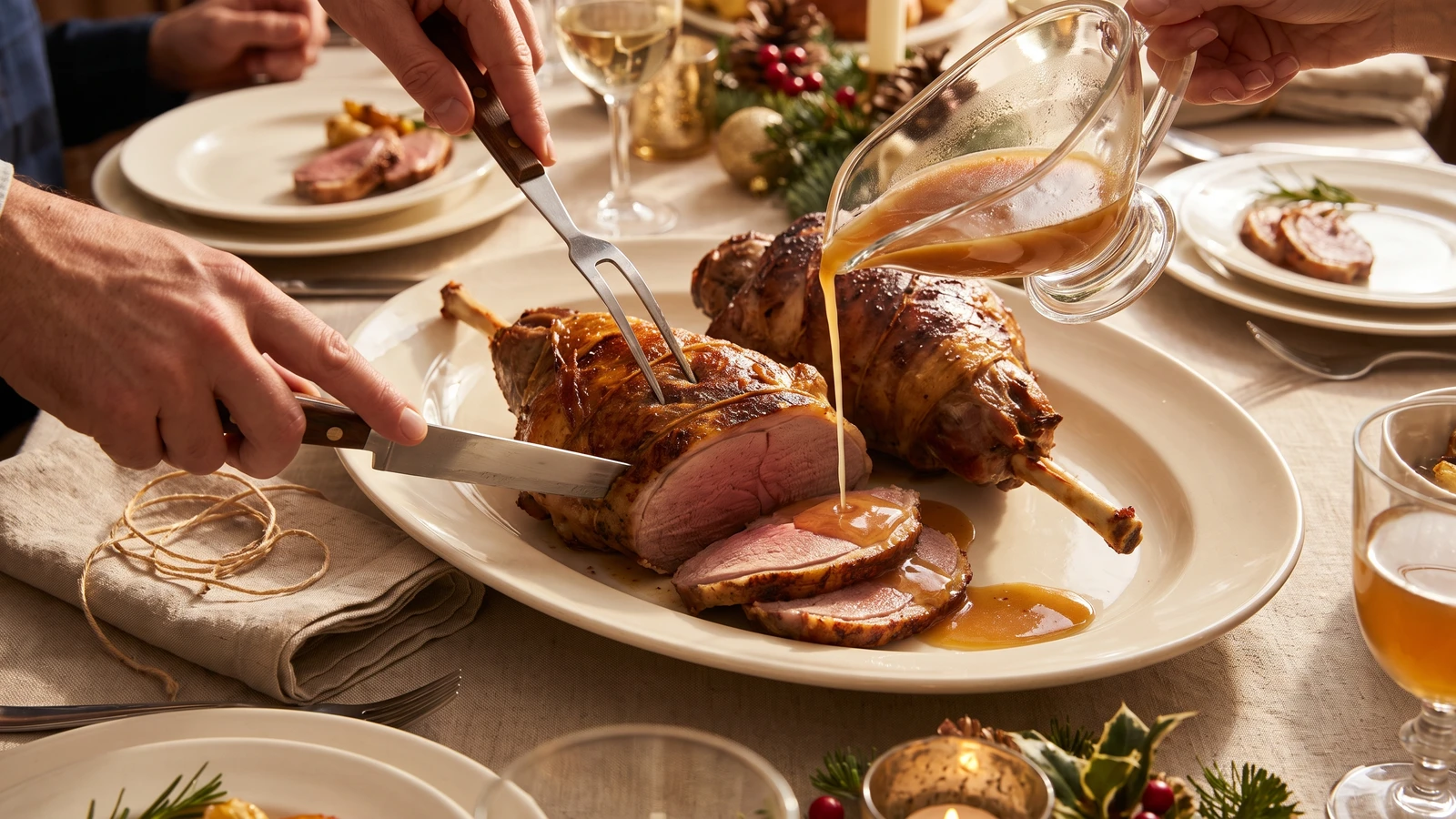
Two lamb legs become one burnished joint under a covered butter roast, then their own drippings become a clear, peppery gravy. Gentle heat and faithful basting teach the discipline of poêler.
La paire de gigots d’agneau poêlés teaches the quiet discipline of poêler: butter, close cover, gentle oven heat, and patient basting with the joint’s own juices. The meat should emerge deeply bronzed but evenly pink within, with a clear gravy that gleams around the slices rather than burying them. The one truth to know before touching the pan is simple: fierce heat cooks two exteriors while leaving the doubled heart behind.
The original double gigot was a Relevé, a grand presentation joint carried whole to a table of many diners. It assumed a butcher who could leave both legs attached, a deep poêle large enough to contain them, a commis free to baste, and a saucier ready beside a stockpot that never went cold. A salamander could correct pale colour at the finish. At home, two small boneless legs are tied cut-side together, thick end against thin, and cooked in a covered Dutch oven. The crowd-sized bones and separate sauce station are brigade scaffolding, so they can go. The covered butter roast, gentle heat, faithful basting, and highly seasoned clear gravy are the dish, so they stay.
The finished joint is generous without becoming absurd: one cook, one stove, one evening. Tie the legs into an even cylinder before they meet the heat, then keep the oven gentle and moisten the lamb only with the butter and seasoned juices gathering beneath it. That basting decides the dish.
The double gigot belongs to the formal Parisian table of the classical French canon, where a Relevé was a substantial joint presented whole and carved for a company. House lamb made it particularly suited to spring celebrations, surrounded by new vegetables and accompanied by either lamb stock or a clear, lightly thickened gravy. The double was a butcher’s and carver’s construction, not a regional breed or rustic specialty; its purpose was abundance made orderly.
Quantity
2, 3¼ lb total (1.5 kg)
fat caps intact and surfaces patted dry
Quantity
5 tablespoons (75 ml / 70 g)
divided
Quantity
2¼ teaspoons (11 ml / 14 g)
divided
Quantity
1 teaspoon (5 ml / 2 g)
divided
Quantity
1 small, about 1 cup (240 ml / 150 g)
cut into large pieces
Quantity
1 medium, about ¾ cup (180 ml / 100 g)
cut into large pieces
Quantity
1
Quantity
1¼ cups (300 ml / 300 g)
Quantity
1½ teaspoons (7.5 ml / 5 g)
Quantity
1 tablespoon (15 ml / 15 g)
| Ingredient | Quantity |
|---|---|
| small boneless lamb legsfat caps intact and surfaces patted dry | 2, 3¼ lb total (1.5 kg) |
| unsalted butterdivided | 5 tablespoons (75 ml / 70 g) |
| fine sea saltdivided | 2¼ teaspoons (11 ml / 14 g) |
| freshly ground black pepperdivided | 1 teaspoon (5 ml / 2 g) |
| yellow onioncut into large pieces | 1 small, about 1 cup (240 ml / 150 g) |
| carrotcut into large pieces | 1 medium, about ¾ cup (180 ml / 100 g) |
| bouquet garni containing parsley stems, thyme, and bay leaf | 1 |
| boiling water | 1¼ cups (300 ml / 300 g) |
| fécule (potato starch) | 1½ teaspoons (7.5 ml / 5 g) |
| cold water | 1 tablespoon (15 ml / 15 g) |
Lay the lamb legs cut-side together with their fat caps facing outward. Point the thick end of one toward the narrow end of the other so the assembled roast has an even thickness from end to end. Tie firmly with butcher’s twine at 1-inch (2.5 cm) intervals, then run one loop lengthwise to keep the ends tucked. Season with 2 teaspoons of the salt and ¾ teaspoon of the pepper, and leave at room temperature for 45 minutes. A loose or lopsided joint cooks unevenly, so retie it now if it sags; this is easier than negotiating with two different temperatures later.
Heat the oven to 325°F (165°C). Melt 2 tablespoons of the butter in a heavy covered Dutch oven over medium heat. When the foam subsides, add the lamb and brown it patiently on every accessible surface, turning with tongs, for 8 to 10 minutes. You want deep Maillard bronze, not blackened milk solids. If the butter scorches before the lamb colours, lift out the joint, discard the burnt fat, wipe the pot, and continue with 1 tablespoon of the reserved butter over lower heat. Ça se rattrape.
Lift the lamb briefly and spread the onion, carrot, and bouquet garni across the pot floor. Return the joint, dot it with the remaining butter, and close the lid tightly. Place the pot in the oven for 45 minutes, basting every 15 minutes with the butter and lamb juices collecting beneath it. Roll the joint once halfway through. Add no stock, wine, or water. If the pot looks dry, lower the oven by 25°F (15°C) and spoon the melted butter carefully over the meat; the joint must be moistened by its own seasoned gravy, not boiled in somebody else’s.
Remove the lid and raise the oven to 400°F (205°C). Continue roasting for 15 to 25 minutes, basting twice, until the surface is burnished and the centre reaches 140°F (60°C). If the colour arrives before the temperature, set the lid loosely over the pot and return the oven to 325°F (165°C). If the centre is ready while the surface remains pale, give the roast 1 to 2 watched minutes beneath the broiler, the home equivalent of the salamander. Transfer the joint to a warm platter, cover loosely with foil, and rest for 20 minutes; its centre should rise to about 145°F (63°C).
While the lamb rests, spoon excess fat from the pot without disturbing the brown fond. Add the boiling water, set the pot over medium heat, and scrape until every savoury brown deposit has dissolved. Simmer for 5 minutes, pressing the onion and carrot lightly, then strain into a small saucepan. Add every drop of resting juice from the platter and skim again. Mix the fécule with the cold water, bring the gravy to a gentle simmer, and whisk in enough slurry to give it the lightest nappe, coating a spoon while remaining clear. Season with the remaining salt and pepper. If it tightens too far, loosen it with boiling water; if it clumps, strain it and return it briefly to the heat. Ça se rattrape.
Remove every piece of twine and present the paired joint whole before carving. Follow the natural seam between the legs and cut each across its own grain into slices about ⅜ inch (1 cm) thick; sawing indiscriminately through both makes one half tender and the other stubborn. Arrange the slices on the warm platter, spoon over just enough clear gravy to make them gleam, and send the rest to the table in a warmed sauceboat. À table!
1 serving (about 340g)
Culinary guides, cultural storytelling, and the editorial depth that makes cooking meaningful.
Discover Culinary ExplorerChef Juliette
John Dory has the delicacy of sole and the firmness of turbot. A light flouring, a quick butter sauté, and nut-brown beurre noisette show exactly why looks never mattered.

Chef Juliette
Fresh haddock proves its delicacy in the meunière pan: a fine flour crust, moist pearly flakes, and beurre noisette sharpened with lemon and parsley, ready from one skillet in half an hour.

Chef Juliette
Éperlans à l’Anglaise turns small fish into a lesson in disciplined coating: boned smelts under a close, crisp crumb, pan-fried in clarified butter and finished with bright, half-melted maître d’hôtel butter.

Chef Juliette
Tiny smelts, shallot, mushrooms, white wine, gratin sauce, and fine bread raspings meet a fierce oven, where the fish must turn tender in the same breath the buttered crust bronzes.