
Chef Juliette
John Dory (St. Pierre)
John Dory has the delicacy of sole and the firmness of turbot. A light flouring, a quick butter sauté, and nut-brown beurre noisette show exactly why looks never mattered.
A cooking platform built around craft, culture, and the stories behind what we eat.
Created by Chef Juliette
Based on No. 1355, Baron (or Pair of Hind-quarters) of Lamb, from Le Guide Culinaire (1907) by Auguste Escoffier
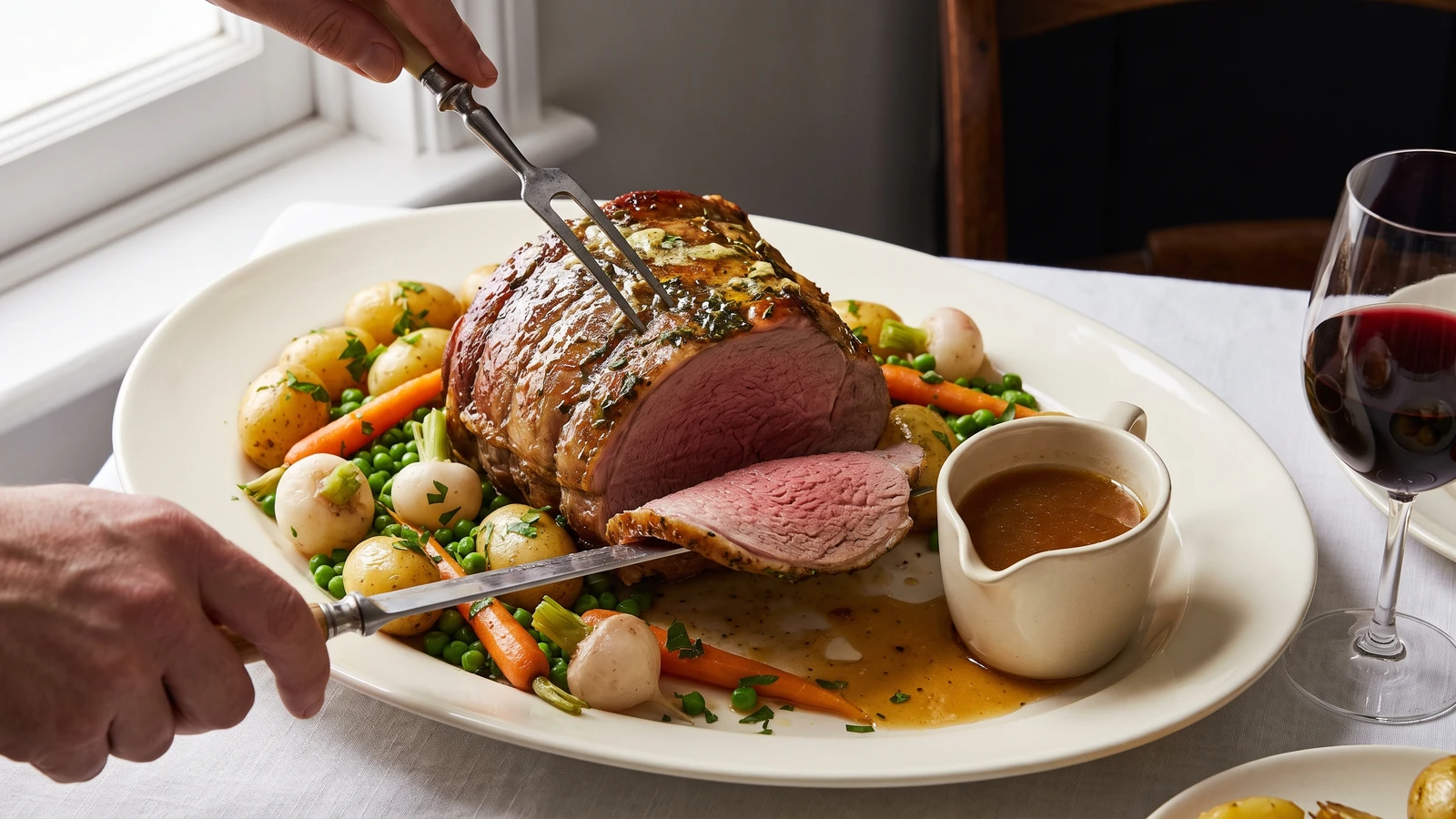
A whole saddle and its two hind legs, butter-poêlé under a close cover, carved rosy beside new vegetables and clear pan gravy: grand anatomy brought within reach of one home oven.
Baron d’Agneau Poêlé (butter-roasted baron of lamb) teaches the one truth of every grand joint: the clock is a rumor, temperature is fact. Because the saddle and both hind legs remain joined, you must read the meat in two places, protecting the lean loin while the thicker legs finish. Get that right and the carving board gives you bronzed fat, rosy loin, succulent leg, and a clear gravy carrying every savory trace from the pan.
The original relevé assumed a brigade table, a roasting vessel built for the joint, a stockpot that never went cold, and a saucier waiting to turn the drippings into gravy. The honest home equivalent is the smallest baron a butcher can prepare, a foil-sealed roasting pan, light unsalted stock, and two thermometers. The separate sauce station and parade of elaborate garnishes were brigade scaffolding; poêler in real butter, preserve the juices, and serve the joint with its own clear gravy. Those steps are the dish. One cook, one stove, one evening.
New potatoes, young carrots, turnips, and peas keep the source’s early-vegetable character without building a second production around the roast. The one step that decides everything comes before the heat: place one probe in the saddle and another in the thickest leg, because a baron must be cooked by its two readings, never by the clock alone.
At the French grand table, baron d’agneau belonged among the relevés, the substantial joints brought forward and carved for a company. Its name describes anatomy, not a sauce: the saddle remains joined to both hind legs, while the haunch named in the same canon is one leg with half the loin attached. House lamb was commonly accompanied by early or new vegetables, a seasonal practice that carried the grand joint naturally from formal service to Easter and holiday family tables.
Quantity
1, 6½ to 7½ pounds (3 to 3.4 kg)
chine removed, hip joints cracked, excess kidney fat trimmed, and joint tied by the butcher
Quantity
2 tablespoons (30 ml / 36 g)
divided
Quantity
2 teaspoons (10 ml / 4 g)
divided
Quantity
8 tablespoons (120 ml / 113 g)
softened and divided
Quantity
2 cups (475 ml / 300 g)
coarsely chopped
Quantity
1 cup (240 ml / 140 g)
coarsely chopped
Quantity
1 cup (240 ml / 110 g)
coarsely chopped
Quantity
6 cloves
lightly crushed
Quantity
8 sprigs
Quantity
2
Quantity
2½ cups (600 ml / 600 g)
Quantity
1½ pounds (680 g)
scrubbed
Quantity
12 ounces (340 g)
trimmed
Quantity
12 ounces (340 g)
trimmed and halved if larger than a walnut
Quantity
1½ cups (360 ml / 220 g)
Quantity
¼ cup (60 ml / 15 g)
chopped
| Ingredient | Quantity |
|---|---|
| small baron of lamb, saddle and both hind legs attachedchine removed, hip joints cracked, excess kidney fat trimmed, and joint tied by the butcher | 1, 6½ to 7½ pounds (3 to 3.4 kg) |
| fine sea saltdivided | 2 tablespoons (30 ml / 36 g) |
| freshly ground black pepperdivided | 2 teaspoons (10 ml / 4 g) |
| unsalted buttersoftened and divided | 8 tablespoons (120 ml / 113 g) |
| yellow onionscoarsely chopped | 2 cups (475 ml / 300 g) |
| carrotscoarsely chopped | 1 cup (240 ml / 140 g) |
| celerycoarsely chopped | 1 cup (240 ml / 110 g) |
| garliclightly crushed | 6 cloves |
| thyme | 8 sprigs |
| bay leaves | 2 |
| light unsalted lamb stock, or unsalted chicken stock | 2½ cups (600 ml / 600 g) |
| small new potatoesscrubbed | 1½ pounds (680 g) |
| baby carrotstrimmed | 12 ounces (340 g) |
| baby turnipstrimmed and halved if larger than a walnut | 12 ounces (340 g) |
| shelled peas, fresh or frozen | 1½ cups (360 ml / 220 g) |
| flat-leaf parsleychopped | ¼ cup (60 ml / 15 g) |
Set the lamb out for 45 minutes, then dry every surface thoroughly. Heat the oven to 450°F (230°C). Season the joint with 1 tablespoon plus 1 teaspoon (20 ml / 24 g) of the salt and 1½ teaspoons (7.5 ml / 3 g) of the pepper, working them around the legs and beneath any loose flap of fat. Insert one probe horizontally into the center of the saddle loin and a second into the thickest part of one leg without touching bone.
Spread the onions, chopped carrots, celery, garlic, thyme, and bay leaves in the roasting pan to make a mirepoix (aromatic vegetable bed). Dot it with 2 tablespoons (30 ml / 28 g) of the butter. Set the baron over it, fat side up, rub the meat with 4 tablespoons (60 ml / 57 g) of butter, and wrap a loose double layer of foil over the saddle like a broad belt, leaving both legs exposed. Roast uncovered for 20 minutes, until the legs begin to bronze and the butter smells nutty. If the mirepoix darkens faster than the meat, add ¼ cup (60 ml / 60 g) of the measured stock and scrape the vegetables inward. Ça se rattrape before they turn black, not after.
Lower the oven to 325°F (165°C). Pour ¾ cup (180 ml / 180 g) of the stock around the lamb, never over its browned surface, and close the roasting pan with its lid or a tight double layer of foil. Continue cooking for 60 to 75 minutes, basting the exposed legs with the butter and juices every 25 minutes. Keep the liquid at a quiet murmur. The close cover and butter protect the lean saddle while the joined legs cook; this is the poêlé, and it must stay.
While the lamb cooks, cover the new potatoes with cold water, season with a little of the remaining salt, and simmer until a knife enters with slight resistance, 15 to 18 minutes. Drain them. Put the baby carrots and turnips in the same saucepan with ½ cup (120 ml / 120 g) water, 1 tablespoon (15 ml / 14 g) of butter, and another pinch of salt. Cover and cook gently for 10 to 14 minutes, then add the peas for the final 2 minutes. The vegetables should be tender but hold their shapes. Set them aside with any buttery liquid remaining in the pan.
Uncover the lamb, remove the foil belt from the saddle, baste well, and raise the oven to 400°F (200°C). Roast for another 15 to 30 minutes, rotating the pan once, until the saddle reads 135 to 136°F (57 to 58°C) and the thickest part of each leg reads about 140°F (60°C). If the saddle reaches its temperature while the legs remain well behind, separate the saddle at the butcher-cracked hip joints, rest it loosely covered, and return the legs to the oven. Ça se rattrape, and dry loin does not. During the rest, every section should reach at least 145°F (63°C); if one stalls below that temperature, return only that section to a 350°F (180°C) oven for 5 to 10 minutes.
Transfer the baron to a large warm platter or carving board and cover it loosely with foil. Rest it for 30 to 40 minutes. Do not wrap it tightly, or the bronzed surface softens. This pause lets the temperature settle through the joined cuts and keeps the juices in the meat when the carving knife enters.
Spoon the mirepoix and pan juices into a fine sieve set over a heatproof jug, letting them drain without pressing, which would cloud the gravy. Skim the fat or pass the liquid through a fat separator. Set the emptied roasting pan over medium heat, add the remaining stock, and scrape up every brown trace of fond. Boil until reduced by roughly one third, add the defatted roasting juices, then strain once more and reduce until the gravy tastes deeply of lamb and lightly coats a spoon while remaining clear. Season with the remaining pepper and only as much salt as it needs. If it is weak, reduce it; if too strong or salty, add unsalted stock by the spoonful. If grease remains, skim again rather than whisking it into the gravy.
Return the potatoes, carrots, turnips, and peas to their saucepan with the final tablespoon (15 ml / 14 g) of butter. Toss over medium heat until glossy, then fold in the parsley and correct the seasoning. Remove the lamb’s strings, separate the legs at the hip joints, and lift each loin from the saddle by following the backbone with the knife. Slice the loin across the grain, carve the legs thinly, and arrange both on the warm platter with the vegetables. Spoon a little clear gravy beneath the meat and serve the rest alongside. À table!
1 serving (about 880g)
Culinary guides, cultural storytelling, and the editorial depth that makes cooking meaningful.
Discover Culinary ExplorerChef Juliette
John Dory has the delicacy of sole and the firmness of turbot. A light flouring, a quick butter sauté, and nut-brown beurre noisette show exactly why looks never mattered.

Chef Juliette
Fresh haddock proves its delicacy in the meunière pan: a fine flour crust, moist pearly flakes, and beurre noisette sharpened with lemon and parsley, ready from one skillet in half an hour.

Chef Juliette
Éperlans à l’Anglaise turns small fish into a lesson in disciplined coating: boned smelts under a close, crisp crumb, pan-fried in clarified butter and finished with bright, half-melted maître d’hôtel butter.

Chef Juliette
Tiny smelts, shallot, mushrooms, white wine, gratin sauce, and fine bread raspings meet a fierce oven, where the fish must turn tender in the same breath the buttered crust bronzes.