
Chef Juliette
John Dory (St. Pierre)
John Dory has the delicacy of sole and the firmness of turbot. A light flouring, a quick butter sauté, and nut-brown beurre noisette show exactly why looks never mattered.
A cooking platform built around craft, culture, and the stories behind what we eat.
Created by Chef Juliette
Based on No. 1354, Pilaw de Mouton à la Turque, from Le Guide Culinaire (1907) by Auguste Escoffier
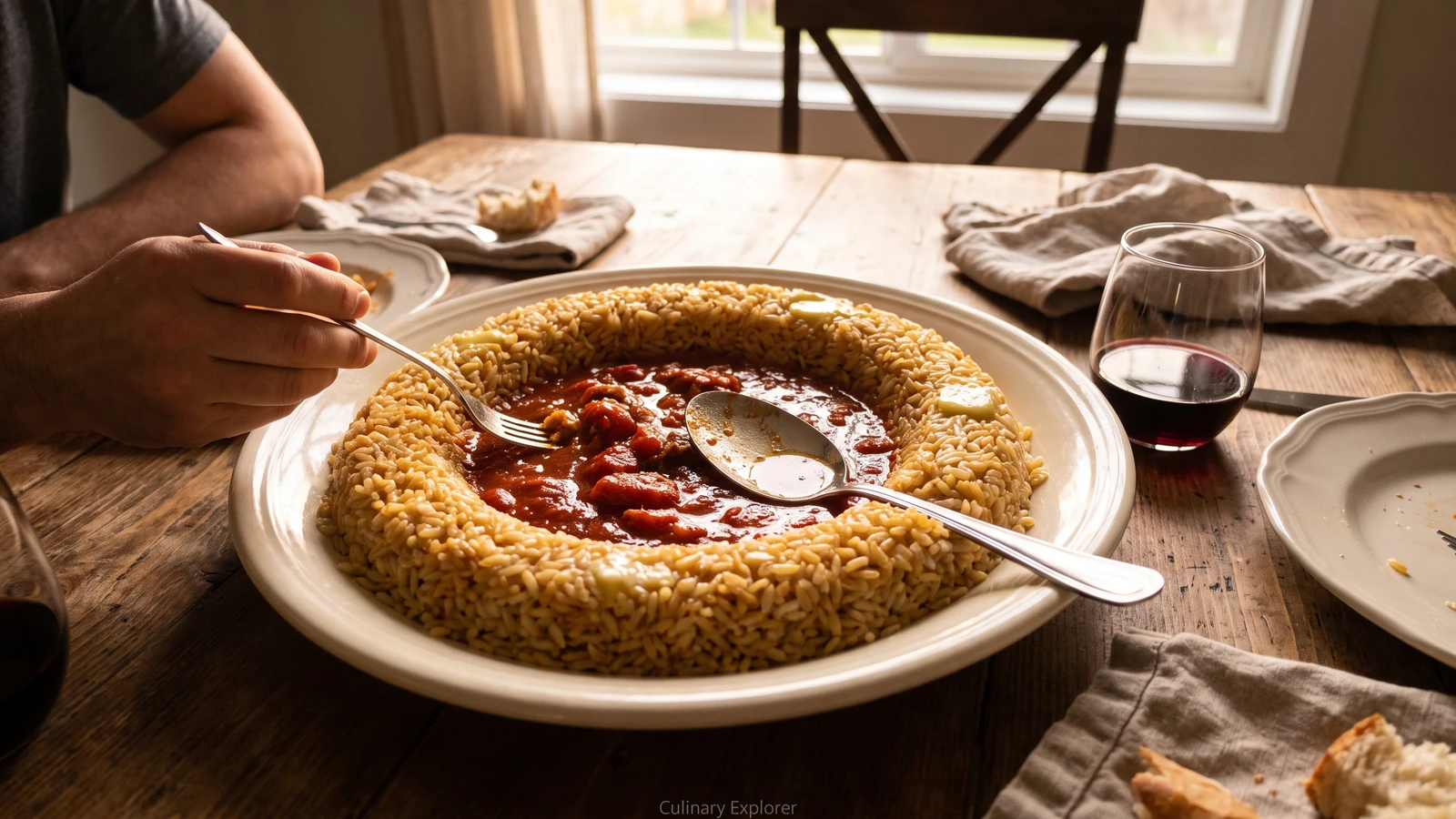
Tomato leads this mutton navarin, scented with ginger or saffron, while buttery pilaff rice keeps every grain distinct around the platter's edge. Brown the meat deeply, simmer gently, and one generous dish carries supper.
Pilaw de Mouton à la Turque (Turkish-style mutton with pilaff rice) teaches a clean division of labor: the meat needs the wet, patient heat of a tomato-led navarin, while the rice needs measured liquid and peace. Put them in one pot and the rice thickens the sauce before the mutton is tender. Cook them separately, bring them together on the platter, and each remains itself.
The professional entry assumed a saucier holding the mutton, finished stock never off the fire, and pilaff borders made to order for dining-room service. For four, one heavy pot and one lidded saucepan replace that brigade. The holding is scaffolding and can go; cooking the rice separately must stay because it protects both the grains and the sauce. A serving spoon forms the border without a special mould, while lamb shoulder may replace scarce mature mutton because it offers the same useful cut with a shorter braise for one cook, one stove, one evening.
Brown the meat until the pot floor wears a deep bronze fond. That is the one step to guard before the liquid goes in: tomato brings brightness and body, but it cannot invent browning afterward.
The dish's real home is the classical French dining-room kitchen, where pilaff rice represented a French reading of cookery associated with the Ottoman table. The title does not describe a direct Turkish household recipe: the meat follows navarin grammar, with tomato dominant and ginger or saffron supplying the distinguishing accent. Because rice cooked inside the braise held poorly through service, professional kitchens borrowed the arrangement used for curried mutton and placed the stew inside a separate pilaff border.
Quantity
2 pounds (900 g)
trimmed and cut into 1½-inch (4 cm) cubes
Quantity
2 teaspoons (10 ml / 12 g)
divided
Quantity
1 teaspoon (5 ml / 2 g)
Quantity
6 tablespoons (90 ml / 85 g)
divided
Quantity
1 large, about 1½ cups (360 ml / 200 g)
finely chopped and divided
Quantity
2 cloves
crushed
Quantity
2 tablespoons (30 ml / 33 g)
Quantity
2 tablespoons (30 ml / 16 g)
Quantity
1¾ cups (420 ml / 400 g)
crushed by hand
Quantity
1½ cups (360 ml / 360 g)
for the braise
Quantity
1
Quantity
¼ teaspoon (1.25 ml / 0.1 g) saffron or 1 teaspoon (5 ml / 2 g) ginger
Quantity
1½ cups (360 ml / 300 g)
rinsed and drained very well
Quantity
2¼ cups (540 ml / 540 g)
for the pilaff
| Ingredient | Quantity |
|---|---|
| boneless mutton shoulder, or lamb shoulder when mutton is unavailabletrimmed and cut into 1½-inch (4 cm) cubes | 2 pounds (900 g) |
| fine sea saltdivided | 2 teaspoons (10 ml / 12 g) |
| freshly ground black pepper | 1 teaspoon (5 ml / 2 g) |
| unsalted butterdivided | 6 tablespoons (90 ml / 85 g) |
| large yellow onionfinely chopped and divided | 1 large, about 1½ cups (360 ml / 200 g) |
| garliccrushed | 2 cloves |
| tomato paste | 2 tablespoons (30 ml / 33 g) |
| all-purpose flour | 2 tablespoons (30 ml / 16 g) |
| canned whole peeled tomatoes with their juicescrushed by hand | 1¾ cups (420 ml / 400 g) |
| unsalted chicken or lamb stockfor the braise | 1½ cups (360 ml / 360 g) |
| bouquet garni of bay leaf, parsley stems, and thyme | 1 |
| saffron threads or ground ginger | ¼ teaspoon (1.25 ml / 0.1 g) saffron or 1 teaspoon (5 ml / 2 g) ginger |
| long-grain white ricerinsed and drained very well | 1½ cups (360 ml / 300 g) |
| unsalted chicken or lamb stockfor the pilaff | 2¼ cups (540 ml / 540 g) |
If using saffron, crush the threads between your fingers and steep them in ¼ cup of the measured braising stock while you brown the meat. If using ginger, keep it dry for the sauce. Pat the mutton thoroughly dry, then season it with 1¼ teaspoons of the salt and all the pepper. A wet surface gives you grey meat and a weak fond; dryness comes first.
Heat 3 tablespoons of the butter in a heavy pot over medium-high heat until its foam subsides. Brown the mutton in three uncrowded batches, turning each piece only after its first side has formed a deep bronze crust, then transfer it to a bowl. If the fond begins turning black, pull the pot off the heat, wait twenty seconds, and carefully add 2 tablespoons of the measured braising stock. Scrape that brown liquid into the meat bowl, wipe away any black specks, add a little of the remaining butter, and continue. Ça se rattrape. Black fond is bitter; brown fond is the foundation.
Lower the heat to medium. Add 1 tablespoon of butter and three-quarters of the chopped onion, then cook for 6 to 8 minutes until soft and pale gold. Add the garlic and, if chosen, the ground ginger; stir for thirty seconds. Cook the tomato paste for 2 minutes until brick red, sprinkle in the flour, and stir for another minute. Whisk in the braising stock a little at a time, scraping up every trace of fond. If the flour clumps, stop before returning the meat and whisk firmly; stubborn lumps can be strained out and the sauce returned to the pot. Add the crushed tomatoes, any saffron infusion, the bouquet garni, the browned meat, and its collected juices.
Bring the sauce just to a simmer, then lower the heat and cover the pot with the lid slightly ajar. Hold it at a bare tremble until the meat is tender enough for a fork to enter with little resistance, about 75 to 90 minutes for lamb or 1½ to 2 hours for mutton. Stir from the bottom every twenty minutes. If the sauce is reducing before the meat softens, add hot stock a few tablespoons at a time; patience, not a hard boil, makes the shoulder tender.
Begin the rice when the meat is nearly tender and needs about thirty minutes more. Warm the pilaff stock in a separate pan or jug. Melt 2 tablespoons of butter in a lidded saucepan, add the remaining onion, and soften it without browning. Add the well-drained rice and nacrer it, stirring until every grain is butter-coated and looks faintly pearly. Pour in the hot stock, add ½ teaspoon salt, and stir once. Bring to a gentle boil, cover tightly, and cook over the lowest heat for 15 minutes. Remove from the heat without lifting the lid and rest for 10 minutes. If the rice is wet, uncover and set it over low heat for 2 minutes; if the centre of a grain is still hard, sprinkle over 2 tablespoons of hot stock, cover, and rest 5 minutes. Ça se rattrape.
Discard the bouquet garni and lift the tender meat into a warm bowl. Skim away only any clear excess fat, leaving the sauce's honest butter sheen, then boil the sauce for 5 to 10 minutes until it is nappant, thick enough to coat the back of a spoon while still flowing freely. If it becomes too tight, loosen it with a spoonful of stock; if it remains thin, keep reducing it without the meat. Return the mutton, warm it through gently, and taste for the remaining salt.
Fluff the pilaff gently with a fork. On a warm, wide serving platter, spoon the rice into a generous raised border, pressing it lightly against the platter's rim and leaving a broad well in the centre. Set the mutton inside and spoon over enough tomato sauce to pool around the meat without flooding the rice. Bring the platter straight to the table while the grains remain distinct and the sauce keeps its gloss. À table!
1 serving (about 580g)
Culinary guides, cultural storytelling, and the editorial depth that makes cooking meaningful.
Discover Culinary ExplorerChef Juliette
John Dory has the delicacy of sole and the firmness of turbot. A light flouring, a quick butter sauté, and nut-brown beurre noisette show exactly why looks never mattered.

Chef Juliette
Fresh haddock proves its delicacy in the meunière pan: a fine flour crust, moist pearly flakes, and beurre noisette sharpened with lemon and parsley, ready from one skillet in half an hour.

Chef Juliette
Éperlans à l’Anglaise turns small fish into a lesson in disciplined coating: boned smelts under a close, crisp crumb, pan-fried in clarified butter and finished with bright, half-melted maître d’hôtel butter.

Chef Juliette
Tiny smelts, shallot, mushrooms, white wine, gratin sauce, and fine bread raspings meet a fierce oven, where the fish must turn tender in the same breath the buttered crust bronzes.